
Index Research
Intraday Analysis for 13 Aug 2026
KRVFinMart12 August 202656 min
Educational/Derived AnalysisSource: KRVFinMart Research Desk (End-of-Day)As of 12 Aug 2026, 05:45 PM IST
Intraday Analysis for 13 Aug 2026
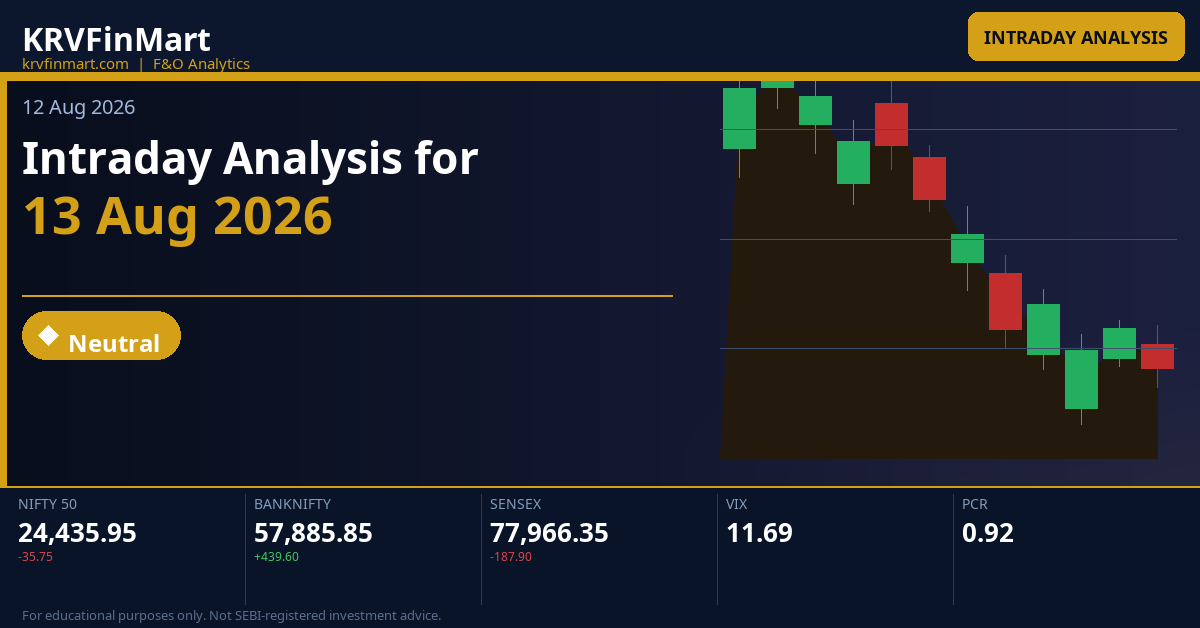
Markets closed on a mixed note on 12 Aug 2026, with NIFTY slipping 0.15% to 24,435.95, SENSEX declining 0.24% to 77,966.35, while BANKNIFTY outperformed with a 0.77% gain to close at 57,885.85 — a meaningful divergence that signals sector-specific buying in banking even as broader markets face mild distribution. India VIX data is unavailable for this session, making it imperative to use straddle pricing as the primary volatility proxy — NIFTY's weekly straddle at 245.5 points implies a ±1% expected move, suggesting the options market is pricing a contained session rather than a high-conviction directional breakout. With NIFTY max pain at 24,400 and BANKNIFTY max pain at 57,900 both aligning close to current prices, option sellers are likely to defend these gravitational zones aggressively, making CPR interaction at the open the key structural signal for tomorrow's intraday direction.
Key Market Signals — Intraday Setup
All three indices are trading below their respective weekly CPR pivots — NIFTY below weekly P at 24,590.97, SENSEX below weekly P at 78,618.06, and BANKNIFTY below weekly P at 57,782.35 — a consistent cross-index signal of underlying distribution despite today's BANKNIFTY bounce. The descending day CPR on NIFTY and SENSEX combined with BANKNIFTY's ascending but wide CPR suggests tomorrow opens in a structurally bifurcated environment where banking strength must either drag up the broader market or succumb to overhead supply.
Deep Technical Analysis & Levels
NIFTY
Descending — Medium (Width 0.18%)
▼ Bearish
Market Structure Balanced or transitional | Straddle Weekly ATM 24450 straddle priced at 245.5 pts (Call 121.10 + Put 124.40), implying a ±1.0% expected move (~24,204 to 24,695); monthly straddle at 384.45 pts suggests larger swing traders expect 24,065 to 24,834 range — the weekly straddle is the operative band for intraday traders on 13 Aug. | Max Pain NIFTY weekly max pain at 24,400 — sitting just 36 points below yesterday's close of 24,435.95, indicating option sellers will defend this gravitational zone and may pressure spot toward 24,400 through expiry; monthly max pain at 24,500 adds a mild upside pull but is secondary for the August 13 session. |
Tomorrow's Complete Level Map
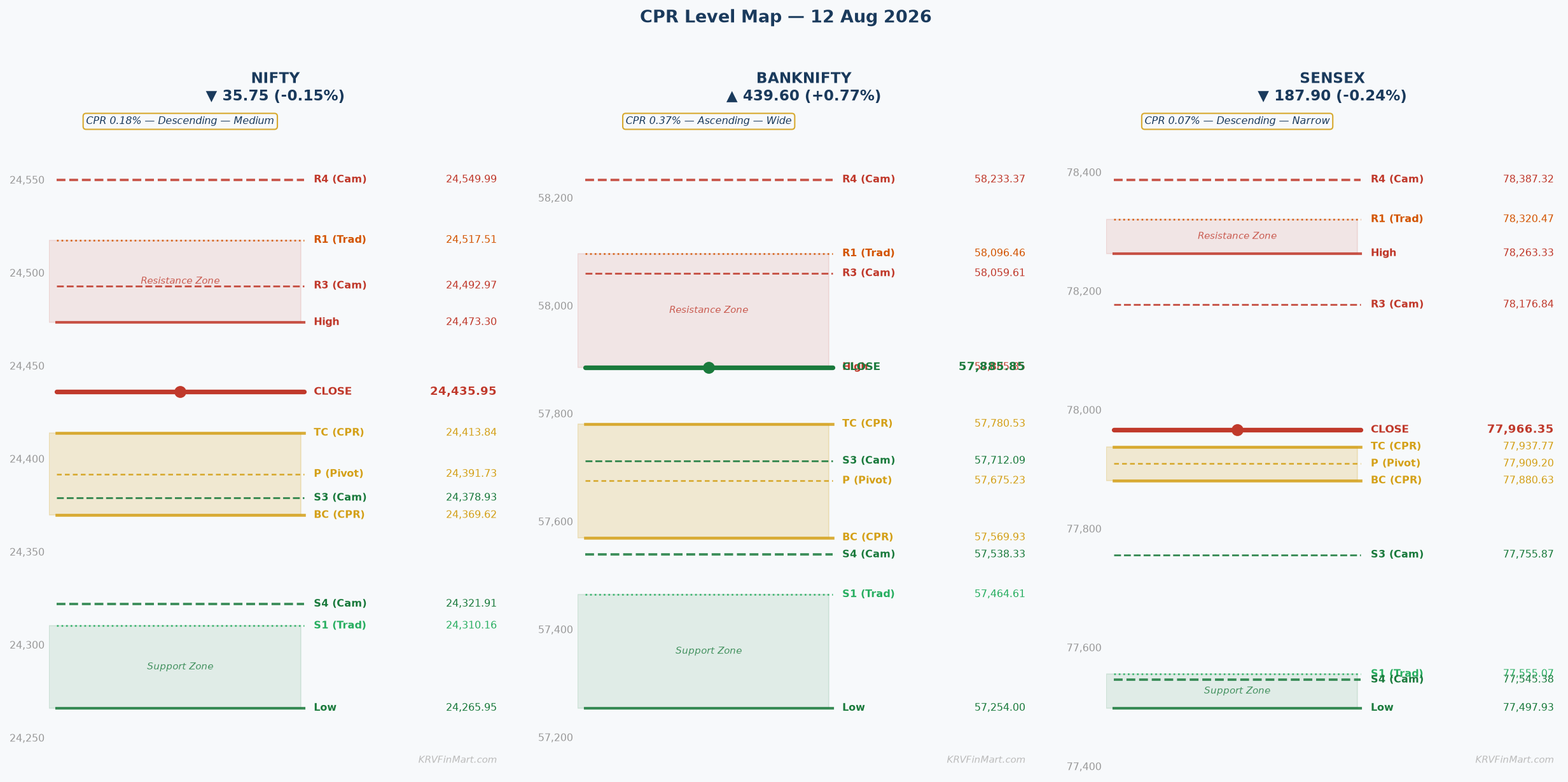
OI-R: 25,000 R3: 24,724.86 H6: 24,644.75 H5: 24,616.59 R2: 24,599.08 H4 ▶: 24,549.99 R1: 24,517.51 PDH: 24,473.30 H3 ↩: 24,492.97
TC: 24,413.84 P: 24,391.73 BC: 24,369.62
L3 ↩: 24,378.93 PDL: 24,265.95 S1: 24,310.16 L4 ▶: 24,321.91 S2: 24,184.38 L5: 24,255.31 L6: 24,227.15 S3: 24,102.81 OI-S: 24,000
↩ = Camarilla reversal point | ▶ = Camarilla breakout/breakdown trigger | OI-R/OI-S = Options wall (CE/PE max OI)
▲ Higher Open (Gap Up) — Open > Prev Close
▲ Bullish
Open lands: With a Descending CPR (TC=24,413.84 < prev BC), a gap-up open above 24,435.95 places price above the entire CPR band — above TC at 24,413.84 — meaning the gap has lifted price into what was expected to be resistance territory; the CPR band which should have acted as a cap now sits below, and the quality of the hold above TC becomes the defining structural test of the session.
CPR role: Launch pad / support floor — the CPR band (BC=24,369.62 to TC=24,413.84) transforms into a support zone on a gap-up open; the Descending CPR typically implies the band sits as overhead resistance below yesterday's price, but gap-up above it flips the band into an intraday demand zone where bulls must defend to maintain upside control.
Minor Gap (0.05–0.25%) — Structure Dominant
A minor gap-up of 0.05–0.25% opens NIFTY in the range of approximately 24,447 to 24,497 — this places price above TC at 24,413.84 but likely below or around the Camarilla H3 at 24,492.97, which is the first mean-reversion reference level. The Descending Medium CPR structure here adds meaningful confirmation to the gap: since the entire CPR is below yesterday's price, a minor gap-up above TC at 24,413.84 signals that sellers failed to reclaim the prior day's closing zone, and any dip back toward TC should attract buyers in the first 30 minutes. Per the Medium CPR width confirmation rule, wait for a first 30-minute candle close above TC at 24,413.84 before entering long; first target is Traditional R1 at 24,517.51, with PDH at 24,473.30 as an intermediate checkpoint, followed by a second partial at Camarilla H3 at 24,492.97 and exit near OI-R at 25,000 if momentum sustains.
Significant Gap (0.25–0.5%) — Balanced
A significant gap-up of 0.25–0.5% opens NIFTY in the zone of approximately 24,497 to 24,557 — this would open price directly around or above the Camarilla H3 at 24,492.97 and possibly near H4 at 24,549.99, immediately pressing into the first Camarilla breakout trigger level. At this opening zone, gap-fill risk is elevated because price is launching into the PDH zone at 24,473.30 and H3 at 24,492.97 simultaneously — these levels represent the prior session's high-water mark where sellers were active, and options delta-hedging flows from cewriters at 24,500 CE will create natural resistance that may cap the initial burst. The Medium CPR confirmation rule requires a 30-minute close above H4 at 24,549.99 to confirm genuine breakout momentum; if confirmed, target R1 at 24,517.51 is already behind price, making R2 at 24,599.08 and H5 at 24,616.59 the next partials, with the OI wall at 25,000 the ultimate ceiling for the session.
Large Gap (>0.5%) — Gap Direction Dominant
A large gap-up exceeding 0.5% opens NIFTY above approximately 24,557 — this thrusts price well above H3 at 24,492.97, H4 at 24,549.99, and potentially into the R2 at 24,599.08 to H5 at 24,616.59 zone on the open itself, which represents extreme dislocation from fair value. At this level, the probability of a gap-fill rotation back toward TC at 24,413.84 or at minimum P at 24,391.73 is high in the first 30–60 minutes, as participants who are short the 24,500 CE and 24,600 CE will aggressively sell the rip; the straddle pricing of 245.5 points implies a daily range contained within ~24,204–24,695, making a large gap-up into H5/H6 territory (24,616.59–24,644.75) a likely fade zone. The abort for any gap-fill short is a sustained two 30-minute closes above H6 at 24,644.75; if the gap holds and extends, the only remaining target is the OI-R wall at 25,000 CE, which is 500+ points away and unlikely to be tested in a single session without a major catalyst.
|
▲ Upside Path → OI-R From TC at 24,413.84, the confirmed upside path targets H3 at 24,492.97 as the first Camarilla mean-reversion stall zone, where partial profits should be booked; a sustained close above H3 opens H4 at 24,549.99 (the Camarilla breakout trigger) followed by R2 at 24,599.08 and H5 at 24,616.59, with the ultimate session ceiling being the OI-R wall at 25,000 where CE writers have built maximum open interest and will defend aggressively through gamma pressure. Each upside level requires volume confirmation — H3 to H4 transition specifically needs above-average volume and no rejection wicks; without that, H3 at 24,492.97 is likely the session high. |
▼ Downside Path → OI-S Failure to sustain above TC at 24,413.84 on any 30-minute close drags price back toward P at 24,391.73 and then BC at 24,369.62 — a breach of BC converts the CPR from support to a trap and accelerates selling toward L3 at 24,378.93 (note L3 at 24,378.93 sits inside the CPR band in this index, creating a compressed support cluster); further breakdown targets S1 at 24,310.16 and L4 at 24,321.91 as the next meaningful demand zone, with the OI-S wall at 24,000 PE representing the ultimate session floor where put writers will defend. Loss of L4 at 24,321.91 and PDL at 24,265.95 together would be a significant structural break requiring exit of all longs and reassessment of the gap-up thesis entirely. |
| 🔴 OI-R: OI-R at 25,000 CE represents the maximum open interest resistance level where call writers have positioned heavily, meaning every 50-point rally above 24,800 encounters accelerating negative delta from call sellers hedging their short gamma — this creates a self-reinforcing ceiling effect that makes 25,000 an extremely difficult level to breach intraday without sustained institutional buying. In a gap-up scenario, the 25,000 CE wall is largely irrelevant as a near-term target (it is 564 points above close) but serves as the hard cap for any aggressive long; it functions as the session's upside abort zone rather than a reachable target. | 🟢 OI-S: OI-S at 24,000 PE marks the maximum open interest support level where put writers have concentrated positions — in a gap-up scenario this level is deeply out of range (435 points below the close) and acts as a remote abort rather than an active intraday reference, functioning primarily as confirmation that the medium-term options market views 24,000 as strong structural support. If despite the gap-up price collapses all the way toward 24,000 (hypothetically), it would trigger massive put writer panic and gamma unwind, but this scenario is negligible in a gap-up context unless a macro shock occurs mid-session. |
⚡ Key Trigger: The key trigger for the gap-up scenario is a 30-minute candle close (per Medium CPR rule) above TC at 24,413.84 combined with a hold above PDH at 24,473.30 — together these two levels confirm that the gap is not a morning fake-out but a genuine shift in intraday control to bulls, as TC represents the ceiling of the Descending CPR band and PDH represents the prior session's supply zone. A failure to hold above TC at 24,413.84 on the first 30-minute close signals that the gap-up was absorbed by sellers and reversal toward P at 24,391.73, then BC at 24,369.62, and ultimately L3 at 24,378.93 becomes the operative bear case for the session.
▼ Lower Open (Gap Down) — Open < Prev Close
▼ Bearish
Open lands: A Descending CPR with TC=24,413.84 means the entire CPR band sits below yesterday's close of 24,435.95; a gap-down open therefore places price directly inside or below the CPR band — a gap of 0.05–0.25% opens price around TC at 24,413.84 or inside the band (BC=24,369.62 to TC=24,413.84), while a gap larger than 0.25% drives price below BC at 24,369.62 and into bearish territory below the entire Descending CPR.
CPR role: Overhead resistance / bearish battleground — in a gap-down, the Descending CPR band acts as overhead resistance; price opens below where yesterday's session hovered, and any intraday rally attempt back toward TC at 24,413.84 or P at 24,391.73 will encounter selling from participants positioned around the CPR; the band is a trap door rather than a support in this configuration.
Minor Gap (0.05–0.25%) — Structure Dominant
A minor gap-down of 0.05–0.25% opens NIFTY in the 24,375–24,424 range, which places price inside the CPR band (BC=24,369.62 to TC=24,413.84) or just below TC at 24,413.84 — this is a high-uncertainty open where the CPR band itself acts as the decision zone with neither bulls nor bears in clear control. Minor gaps inside the CPR in a Descending Medium structure are prone to filling within 30–60 minutes as the prior-day close at 24,435.95 acts as a magnet; however, the descending structure means any rally back to TC at 24,413.84 faces selling, and a 30-minute close below BC at 24,369.62 confirms resumption of the downside with L3 at 24,378.93 as immediate target. Beyond L3, the bear path opens toward S1 at 24,310.16 and L4 at 24,321.91 — note these two levels are in very close proximity (L4 at 24,321.91 and S1 at 24,310.16), forming a compressed support cluster that may provide a 15–20 point bounce before the next leg down.
Significant Gap (0.25–0.5%) — Balanced
A significant gap-down of 0.25–0.5% opens NIFTY in the range of approximately 24,314 to 24,375, placing price below BC at 24,369.62 and into the S1/L4 cluster zone (S1=24,310.16, L4=24,321.91) — this is a structurally bearish open where the entire CPR band sits overhead as resistance and immediate demand is tested at these compressed levels. The failure-and-resume scenario requires a 30-minute close below L4 at 24,321.91 to confirm continuation toward L5 at 24,255.31, PDL at 24,265.95, and S2 at 24,184.38; alternatively, if price recovers above BC at 24,369.62 within the first 30 minutes, a gap-fill attempt toward TC at 24,413.84 and the prior close at 24,435.95 becomes the bull case. Put writers at the 24,000 PE level will defend OI-S, limiting downside below S2 at 24,184.38 in the near term unless a macro catalyst accelerates the move through L5 at 24,255.31.
Large Gap (>0.5%) — Gap Direction Dominant
A large gap-down exceeding 0.5% opens NIFTY below approximately 24,314, breaching L4 at 24,321.91 and S1 at 24,310.16 on the open itself — this represents a panic-level dislocation that takes price toward L5 at 24,255.31 and PDL at 24,265.95 immediately, creating a zone where stop-loss triggers from prior-day longs compound the selling pressure. The panic-vs-recovery dynamic here depends critically on whether the opening candle shows a long lower wick (recovery buying) or a sustained close near the low of the candle (breakdown mode); with India VIX data unavailable, the straddle pricing of 245.5 points implies the market expected a maximum downside near 24,204 for the week, so a large gap-down threatens to immediately approach or breach the weekly straddle floor. Straddle monetisation (selling volatility) becomes attractive near L5 at 24,255.31 or L6 at 24,227.15 if a reversal candle forms, but the abort for this strategy is a sustained close below OI-S at 24,000, which would represent a breakdown of the entire options market structure built around the 24,000 PE wall.
|
▲ Upside Path → OI-R The recovery path in a gap-down begins with a 30-minute close back above BC at 24,369.62 — once reclaimed, P at 24,391.73 acts as the midpoint checkpoint, followed by TC at 24,413.84 as the final CPR ceiling; beyond TC, the bullish recovery targets PDH at 24,473.30 and H3 at 24,492.97, with the OI-R wall at 25,000 CE remaining a distant session ceiling. Genuine recovery is confirmed only when price sustains above TC at 24,413.84 for two consecutive 15-minute candles with volume above prior-bar average — anything less is a dead-cat bounce that shorts will use to reload positions near TC. |
▼ Downside Path → OI-S The primary bear path proceeds from below BC at 24,369.62 through L3 at 24,378.93 (note L3 sits inside the CPR band — a structural anomaly that creates a temporary speed bump), accelerating toward S1 at 24,310.16 and L4 at 24,321.91 where retail stop-losses from prior-day longs cluster and trigger automated selling that amplifies the move. Below this S1/L4 cluster, the next stations are PDL at 24,265.95, L5 at 24,255.31, and L6 at 24,227.15 in quick succession, with S2 at 24,184.38 marking the next major technical support; the OI-S at 24,000 PE is the ultimate floor where put writers will absorb selling, but reaching it intraday requires sustained institutional selling of size. |
| 🔴 OI-R: In the gap-down scenario, OI-R at 25,000 CE is entirely irrelevant as an intraday reference — it sits over 600 points above a possible depressed open and functions only as the macro ceiling for the weekly expiry cycle, with CE writers at 25,000 actually benefiting from the gap-down as their short calls decay faster. The real overhead resistance created by options positioning in a gap-down is closer to the CPR band (TC at 24,413.84) and the 24,500 CE strike, where residual call writing creates selling pressure that caps any intraday recovery bounce. | 🟢 OI-S: OI-S at 24,000 PE is the primary bear target and the zone where maximum put-writer pain begins — as spot approaches 24,000, put writers who are short gamma will aggressively buy futures to delta-hedge, creating a mechanical floor that typically slows and reverses the decline; this 24,000 level is the single most important downside reference for the August 13 session. Whether reaching 24,000 triggers covering (short-term floor) or further selling (put buyers profit-taking accelerates) depends on the speed of the decline — a fast, panic-driven move to 24,000 is more likely to see a sharp bounce, while a slow grind down allows delta-hedgers to absorb gradually with less mechanical pressure. |
⚡ Key Trigger: The key trigger in the gap-down scenario is failure to reclaim BC at 24,369.62 within the first 30 minutes — if price cannot recover above BC within two 15-minute candles, the Descending CPR has fully asserted its bearish mandate and the day's structure confirms a sell-on-rise regime where every rally to TC at 24,413.84 is a short opportunity. Conversely, a 30-minute candle close back above BC at 24,369.62 with expanding volume triggers a gap-fill attempt toward P at 24,391.73, TC at 24,413.84, and ultimately the prior close at 24,435.95, changing the day from a bear session to a range-recovery session.
◆ Near Flat Open — Open ≈ Prev Close (±0.05%)
◆ Neutral
Open lands: A flat open of ±0.05% on a close of 24,435.95 places NIFTY in the 24,423–24,448 range — this is above the entire Descending CPR band (BC=24,369.62 to TC=24,413.84), meaning price opens above TC at 24,413.84 in the flat scenario; the CPR band sits below as a potential support cluster but also represents a zone that, if breached, flips the day decisively bearish.
CPR role: Decision zone / support floor below — the flat open above TC at 24,413.84 makes the CPR band a crucial below-market support structure; a dip toward TC and a hold transforms the CPR into a launch pad for longs, while a breach of BC at 24,369.62 converts it into a bearish trap door that accelerates selling.
Near Flat (±0.05%)
A flat open in a Descending Medium CPR environment is a deceptively high-information setup — when price opens near 24,435.95 (above TC at 24,413.84), the first 15–30 minute candle resolves the directional ambiguity created by the CPR's descending structure versus the near-unchanged close. The CPR band boundaries are precise: TC at 24,413.84 is the bullish threshold below the open, and BC at 24,369.62 is the bearish threshold — a sustained hold above TC confirms that despite the Descending CPR's inherent bearish lean, bulls have retained control overnight and the session can trend upward. Since the CPR width is 0.18% (Medium category), a trend day probability is moderate but not high — Medium CPR sessions typically see multiple CPR tests and retests before direction is established, making the first 30-minute candle close the operative confirmation signal rather than the 15-minute rule applicable to Narrow CPRs. The bull trigger is a 30-minute close above TC at 24,413.84 followed by a sustained hold of PDH at 24,473.30 targeting H3 at 24,492.97 and R1 at 24,517.51; the bear trigger is a 30-minute close below BC at 24,369.62 which opens L3 at 24,378.93 (inside the band), then S1 at 24,310.16, L4 at 24,321.91, and the bear trend toward OI-S at 24,000.
|
▲ Upside Path → OI-R From a confirmed hold above TC at 24,413.84, the upside path targets H3 at 24,492.97 as the first Camarilla mean-reversion stall zone where partial profits should be taken (approximately 79 points above TC); above H3, the next leg targets R1 at 24,517.51 and H4 at 24,549.99 (Camarilla breakout trigger), with the final session target at R2 at 24,599.08 and H5 at 24,616.59 before approaching the OI-R wall at 25,000 CE which is the absolute ceiling. Each upside level should be approached with limit orders and volume confirmation — a close above H4 at 24,549.99 on above-average volume is required to justify holding through to H5/H6 territory. |
▼ Downside Path → OI-S A confirmed 30-minute close below BC at 24,369.62 initiates the bear path toward L3 at 24,378.93 (note: L3 at 24,378.93 is inside the BC value numerically — this tight clustering means the first real momentum support is actually S1 at 24,310.16 and L4 at 24,321.91, approximately 50 points below BC), followed by a test of PDL at 24,265.95 and L5 at 24,255.31 as the extended bear target. The OI-S wall at 24,000 PE remains the session floor — approaching it triggers mechanical put-writer hedging that creates a demand response, making the 24,000–24,100 zone the ultimate risk-reward reversal zone for aggressive counter-trend longs. |
| 🔴 OI-R: In the flat-open scenario, OI-R at 25,000 CE serves as the macro expiry ceiling that option writers are defending — for intraday traders, it functions as the absolute upper bound for long targets, with the practical session ceiling being R2 at 24,599.08 and H5 at 24,616.59 where Camarilla and traditional resistances converge well below the OI-R. CE writers at 25,000 are so far out of the money that their delta-hedging creates negligible intraday price impact on August 13, but their presence confirms that the options market views 24,500–24,600 as the realistic upper range of any bullish session. | 🟢 OI-S: OI-S at 24,000 PE is the primary downside anchor in the flat-open scenario — put writers at this level will begin delta-hedging (buying futures) as spot approaches 24,100–24,050, creating a mechanical demand floor that tends to hold the market above 24,000 unless genuine fundamental selling overwhelms the mechanical support. In a flat-open day, the 24,000 PE base provides psychological confidence to bulls that the downside is structurally limited, which itself prevents panic selling and keeps the CPR band interaction at 24,369.62–24,413.84 as the operative battleground rather than a trending collapse toward OI-S. |
⚡ Key Trigger: The structural fulcrum for a flat open is the first 30-minute candle close relative to TC at 24,413.84 and BC at 24,369.62 — a close above TC at 24,413.84 signals bull control and targets H3 at 24,492.97, while a close below BC at 24,369.62 signals bear control and targets L4 at 24,321.91 and S1 at 24,310.16. Market psychology around a flat open in a Descending CPR is driven by the tension between two narratives: sellers who see the descending band as confirmation to short any strength, and buyers who see the hold above TC as evidence that yesterday's sellers exhausted themselves — the first decisive 30-minute move resolves this tension and typically drives a 60–80 point directional run.
BANKNIFTY
Ascending — Wide (Width 0.37%)
↕ Conflicted
Market Structure Sideways or range-bound | Straddle Monthly ATM 57900 straddle priced at 1064.45 pts (Call 581.45 + Put 483.00), implying a ±1.84% expected monthly move (~56,835 to 58,964); for intraday purposes on 13 Aug, the operative range implied by the day CPR and straddle width is approximately 57,000–58,900, with the straddle pricing confirming the OI-S at 57,000 and OI-R at 58,000 as the key options walls for the near term. | Max Pain BANKNIFTY monthly max pain at 57,900 — virtually identical to yesterday's closing price of 57,885.85, creating an extremely powerful gravitational pull that will make it difficult for BANKNIFTY to stray far from the 57,900 zone intraday; option sellers on both sides are maximally incentivised to keep price near 57,900 through the expiry cycle. |
Tomorrow's Complete Level Map
OI-R: 58,000 R3: 58,728.31 H6: 58,524.67 H5: 58,436.32 R2: 58,307.08 H4 ▶: 58,233.37 R1: 58,096.46 PDH: 57,885.85 H3 ↩: 58,059.61
TC: 57,780.53 P: 57,675.23 BC: 57,569.93
L3 ↩: 57,712.09 PDL: 57,254.00 S1: 57,464.61 L4 ▶: 57,538.33 S2: 57,043.38 L5: 57,335.38 L6: 57,247.03 S3: 56,832.76 OI-S: 57,000
↩ = Camarilla reversal point | ▶ = Camarilla breakout/breakdown trigger | OI-R/OI-S = Options wall (CE/PE max OI)
▲ Higher Open (Gap Up) — Open > Prev Close
↕ Conflicted
Open lands: With an Ascending Wide CPR (BC=57,569.93 > prev_TC by structure), a gap-up above prev close of 57,885.85 places price above PDH at 57,885.85 and inside or above the TC at 57,780.53 zone — critically, it also immediately presses price into the OI-R wall at 58,000 CE, which is only 114 points above yesterday's close; the gap-up in BANKNIFTY immediately encounters maximum options resistance.
CPR role: Launch pad / support floor — the Wide Ascending CPR band (BC=57,569.93 to TC=57,780.53) sits well below a gap-up open, transforming it into a lower support zone; however, the 0.37% width of the CPR means a dip back into the band is a high-probability retest before any genuine breakout can be confirmed.
Minor Gap (0.05–0.25%) — Structure Dominant
A minor gap-up of 0.05–0.25% opens BANKNIFTY in the range of approximately 57,915 to 58,030 — this places price above PDH at 57,885.85 and directly into the OI-R resistance wall at 58,000 CE, where call writers have concentrated maximum open interest and will aggressively sell any strength to defend their short positions. The Ascending Wide CPR structure is conflicted here: while ascending CPR confirms multi-session bullish bias with BC above prior TC, the Wide 0.37% band means two 30-minute closes are required for confirmation, and the immediate OI-R at 58,000 makes upside conviction expensive in terms of risk-reward. Per the Wide CPR rule, the first target on any confirmed breakout above OI-R at 58,000 is Traditional R1 at 58,096.46 followed by H3 at 58,059.61 (note H3 sits between 58,000 and R1), with the instruction to exit near OI-R at 58,000 rather than trail — meaning the gap-up trade is primarily a scalp between PDH at 57,885.85 and 58,000.
Significant Gap (0.25–0.5%) — Balanced
A significant gap-up of 0.25–0.5% opens BANKNIFTY in the range of approximately 58,030 to 58,175, placing price above the OI-R wall at 58,000 CE and around H3 at 58,059.61 — this is a powerful opening that validates the ascending CPR's bullish implication but simultaneously enters the Camarilla mean-reversion zone where fading tends to dominate. The gap-fill risk is significant: opening above 58,000 CE means call writers who are short gamma begin delta-hedging by selling futures, creating a mechanical ceiling that often produces a 30–60 point fade before any genuine extension; the balanced approach requires two 30-minute closes above H3 at 58,059.61 to confirm that delta-hedging selling has been absorbed. If confirmed, the next targets are H4 at 58,233.37 (Camarilla breakout trigger) and R2 at 58,307.08 (Traditional second target), with the Wide CPR rule mandate to fade extremes and not trail beyond R1 at 58,096.46 unless the two-candle confirmation is clean.
Large Gap (>0.5%) — Gap Direction Dominant
A large gap-up exceeding 0.5% opens BANKNIFTY above approximately 58,175 and into the H4 at 58,233.37 to H5 at 58,436.32 zone — this represents an extreme dislocation that takes price deep into Camarilla upper territory and well above the OI-R at 58,000 CE, creating a situation where the gap-fill probability is very high as both technical and options-market forces align against further upside. The market psychology in this scenario is tricky: the ascending wide CPR provides structural bull backing, but the Wide CPR rule explicitly states to fade extremes and profit at R1 at 58,096.46 with exit near OI-R at 58,000 — a large gap-up above 58,233 means R1 is already behind price at the open, making the only valid long trade a gap-and-go momentum play above H5 at 58,436.32 toward H6 at 58,524.67. The abort level for any gap-fill short is a two 30-minute close above H5 at 58,436.32; if the gap holds above H5, the monthly straddle implies an upper bound near 58,964 is achievable, suggesting the session could target H6 at 58,524.67 and the R2 at 58,307.08 zone as the structural range.
|
▲ Upside Path → OI-R The confirmed upside path above OI-R at 58,000 proceeds through H3 at 58,059.61 (first partial profit per Camarilla mean-reversion rule), then H4 at 58,233.37 as the Camarilla breakout trigger where momentum accelerates if two closes confirm, followed by R2 at 58,307.08 and H5 at 58,436.32 as the extended targets; the Wide CPR mandate is to exit near OI-R at 58,000 on the first test and not trail aggressively unless the two-candle rule is clearly met. Volume confirmation is paramount at each Camarilla level — H3 at 58,059.61 must show declining selling volume (buyers winning) for the H4 move at 58,233.37 to be reliable. |
▼ Downside Path → OI-S Failure at OI-R at 58,000 or PDH at 57,885.85 initiates the fade path: TC at 57,780.53 is the first CPR band top support, followed by P at 57,675.23 as the midpoint and BC at 57,569.93 as the CPR base where the ascending structure should provide demand; below BC at 57,569.93, the Wide CPR's downside completion targets L4 at 57,538.33 (inside/near BC), S1 at 57,464.61, L5 at 57,335.38, and PDL at 57,254.00 with OI-S at 57,000 PE as the ultimate session floor. Retail stop-losses below L4 at 57,538.33 and S1 at 57,464.61 will accelerate the move toward PDL at 57,254.00 and L5 at 57,335.38 — these levels form the key bear acceleration zone. |
| 🔴 OI-R: OI-R at 58,000 CE is the single most important intraday level for BANKNIFTY on 13 Aug — this is the maximum CE open interest strike where call writers have built their primary line of defense, and in a gap-up scenario it becomes the immediate battleground where the session's directional bias is resolved within the first 30–60 minutes. CE writers at 58,000 will sell futures aggressively as spot approaches and exceeds 58,000, creating a natural ceiling that requires institutional buy-side force to overcome — the max pain at 57,900 further reinforces that sellers want price below 58,000 through expiry. | 🟢 OI-S: OI-S at 57,000 PE is a remote but important downside reference in the gap-up scenario — put writers at 57,000 are deeply out of money on a gap-up day and their delta-hedging (selling futures on decline) would only activate if price collapses 885+ points from the gap-up open, which is a tail risk rather than a base case. In the gap-up context, OI-S at 57,000 functions as the stop-loss abort level for any open long position — a breach of 57,000 would be catastrophic and signal a macro event overriding all CPR analysis. |
⚡ Key Trigger: The critical trigger for the gap-up scenario in BANKNIFTY is whether price can sustain two 30-minute closes above OI-R at 58,000 CE — this level is not merely a technical resistance but the most concentrated call-writing strike, meaning a genuine breakout above 58,000 with two confirmed candle closes triggers delta-hedging covering by CE writers (buying futures) that amplifies the move toward R1 at 58,096.46 and H4 at 58,233.37. Failure to hold above 58,000 on the first 30-minute close — with price slipping back below PDH at 57,885.85 — signals that the gap was a morning squeeze absorbed by professional sellers, and the day reverts to the Wide CPR fade structure targeting TC at 57,780.53 and P at 57,675.23.
▼ Lower Open (Gap Down) — Open < Prev Close
▼ Bearish
Open lands: An Ascending Wide CPR with BC=57,569.93 above a gap-down open means: a minor gap-down opens near BC at 57,569.93 or inside the band; a significant gap-down opens below BC at 57,569.93 but potentially above P at 57,675.23 or between BC and TC depending on exact gap size; a large gap-down breaches the entire CPR below BC and enters the L3/L4 zone (57,712.09–57,538.33) immediately — the Ascending CPR mandate says flat = near BC as support, gap-down = below BC (below entire ascending CPR).
CPR role: Overhead resistance / recovery battleground — in a gap-down through an Ascending Wide CPR, the entire band (BC=57,569.93 to TC=57,780.53) becomes overhead resistance; the 0.37% width means the CPR band spans 210 points, creating a wide recovery hurdle that requires sustained bull conviction and two 30-minute closes to reclaim meaningfully.
Minor Gap (0.05–0.25%) — Structure Dominant
A minor gap-down of 0.05–0.25% opens BANKNIFTY in the range of approximately 57,740 to 57,857 — this opens price inside the Wide CPR band (between BC at 57,569.93 and TC at 57,780.53 on the lower end), placing the session in a genuine decision zone where neither bulls nor bears have established structural control. Given the Ascending CPR's inherent bullish lean and yesterday's strong 0.77% close, a minor gap-down inside the CPR band has a higher-than-average gap-fill probability — the ascending structure suggests BC at 57,569.93 should provide demand on any dip, and a 30-minute recovery back above TC at 57,780.53 targets H3 at 58,059.61 and OI-R at 58,000. However, the Wide CPR rule requires two 30-minute closes for any directional trade; a single 30-minute close above TC at 57,780.53 is insufficient — the second close must also confirm before initiating long positions targeting R1 at 58,096.46.
Significant Gap (0.25–0.5%) — Balanced
A significant gap-down of 0.25–0.5% opens BANKNIFTY in the range of approximately 57,597 to 57,740, placing price at or just below BC at 57,569.93 — the entire CPR band is now overhead and the ascending CPR's bullish mandate is being seriously challenged by this opening. The failure-and-resume bear scenario requires a 30-minute close below BC at 57,569.93 and below L4 at 57,538.33 to confirm that the ascending CPR has been overridden by supply, targeting S1 at 57,464.61, L5 at 57,335.38, PDL at 57,254.00, and ultimately OI-S at 57,000 PE where put writers provide mechanical demand; PUT writing flow at 57,000 will increase sharply if price approaches this level intraday. The recovery bull scenario requires two consecutive 30-minute closes back above BC at 57,569.93 and then TC at 57,780.53 — achieving this reclaims the ascending CPR and restores bullish bias targeting H3 at 58,059.61 and OI-R at 58,000.
Large Gap (>0.5%) — Gap Direction Dominant
A large gap-down exceeding 0.5% opens BANKNIFTY below approximately 57,597 and potentially near L4 at 57,538.33 or S1 at 57,464.61 — this is a structurally devastating open for the ascending CPR thesis, as it places price below the entire CPR band and near the first major Camarilla support cluster, with PDL at 57,254.00 and OI-S at 57,000 as the primary bear targets. The panic-vs-recovery dynamic is acute: a large gap-down below the entire Ascending Wide CPR from a session that closed +0.77% the prior day creates maximum participant confusion — bulls who bought the close are immediately underwater and their stop-losses below L4 at 57,538.33 will trigger automated selling toward S1 at 57,464.61, L5 at 57,335.38, and L6 at 57,247.03. Straddle monetisation becomes attractive near PDL at 57,254.00 and L6 at 57,247.03 if a reversal candle forms (hammer, engulfing), as the monthly straddle floor of approximately 56,835 is near, but the abort is a close below OI-S at 57,000 which would breach the entire PE options wall and trigger accelerated put-buyer profit taking that pushes price toward S2 at 57,043.38.
|
▲ Upside Path → OI-R The recovery path begins with a two 30-minute close above BC at 57,569.93, then P at 57,675.23 as the CPR midpoint confirmation, TC at 57,780.53 as the CPR ceiling reclaim, and L3 at 57,712.09 as the Camarilla mean-reversion level within the recovery path; once TC is reclaimed with volume, the session targets H3 at 58,059.61 and OI-R at 58,000 (approximately the same level) as the primary resistance zone and profit target. The Wide CPR exit rule applies here — take profits at or near OI-R at 58,000 rather than trailing toward R1 at 58,096.46 unless two 30-minute closes above 58,000 confirm genuine breakout. |
▼ Downside Path → OI-S Below BC at 57,569.93, the confirmed bear path proceeds through L4 at 57,538.33 (note: L4 is very close to BC, creating a tight support cluster), then S1 at 57,464.61 where conventional stop-loss orders cluster, through L5 at 57,335.38 and PDL at 57,254.00 as momentum targets, with L6 at 57,247.03 and OI-S at 57,000 PE as the ultimate session floor. Retail stop-losses below L4 at 57,538.33 and S1 at 57,464.61 will mechanically accelerate the selloff — this 130-point zone between L4 (57,538.33) and S1 (57,464.61) is a stop-loss cascade zone that, once triggered, can deliver a fast 200–300 point move toward PDL at 57,254.00. |
| 🔴 OI-R: OI-R at 58,000 CE in the gap-down scenario functions as a distant but powerful overhead resistance — call writers at 58,000 are actually gaining from the gap-down as their short calls appreciate via positive theta and negative delta, meaning they have no incentive to cover and will sell futures on any recovery above 57,800, making the 57,800–58,000 zone a double ceiling of CPR TC and OI-R. For intraday recovery longs, OI-R at 58,000 is the maximum reward target — exceed it without two 30-minute confirms and you are fighting the entire CE writing community. | 🟢 OI-S: OI-S at 57,000 PE is the primary session floor in the gap-down scenario — put writers at 57,000 are sitting on in-the-money or near-money puts as spot falls toward their strike, and they will mechanically buy futures below 57,200–57,100 to delta-hedge, creating a demand buffer that typically arrests the decline near or above 57,000. If OI-S at 57,000 is breached intraday, it signals that put buyers have overwhelmed put writers and the next structural support is S2 at 57,043.38 and then S3 at 56,832.76, making the 57,000 level the single most important intraday stop-loss trigger for all bear positions. |
⚡ Key Trigger: The defining trigger in the gap-down scenario is whether BANKNIFTY can reclaim BC at 57,569.93 within the first 60 minutes (two 30-minute closes, per Wide CPR rule) — reclaiming BC confirms the ascending CPR's structural demand has reasserted itself and opens recovery toward TC at 57,780.53, P at 57,675.23, and ultimately the OI-R at 58,000 CE ceiling. Failure to reclaim BC at 57,569.93 after two attempts (two 30-minute candle closes below it) confirms the ascending CPR has been invalidated for the session, triggering the bear continuation toward L5 at 57,335.38, PDL at 57,254.00, and OI-S at 57,000 PE as the session's bear target.
◆ Near Flat Open — Open ≈ Prev Close (±0.05%)
◆ Neutral
Open lands: A flat open of ±0.05% on BANKNIFTY's close of 57,885.85 opens in the range of 57,857–57,914 — this places price above TC at 57,780.53 and above the entire Ascending Wide CPR band (BC=57,569.93 to TC=57,780.53); the open is near PDH at 57,885.85 and directly below OI-R at 58,000 CE, creating a 115-point compression zone between the open and the OI resistance wall.
CPR role: Decision zone / compressed compression band below — the Wide CPR band sits 100–315 points below a flat open, acting as a wide support shelf; the ascending CPR's bullish structural mandate is intact with a flat open, but the 0.37% width means the band functions as a range support rather than a precision trigger — price needs to fall back into the band (below TC at 57,780.53) before the CPR plays an active intraday role.
Near Flat (±0.05%)
A flat open in BANKNIFTY's Ascending Wide CPR scenario is a setup where the CPR band itself (BC=57,569.93 to TC=57,780.53) is 100–315 points away from price — meaning the opening volatility range is immediately defined by OI-R at 58,000 CE above (approximately 115 points up) and TC at 57,780.53 below (approximately 105 points down), creating a binary structure rather than a CPR-pivot decision. The Wide CPR confirmation rule demands two 30-minute closes for any directional commitment — a flat open that doesn't immediately resolve directionally in the first 30 minutes should be treated with caution, as the Wide CPR often produces range-bound behaviour where fading extremes (selling near 58,000, buying near 57,780) is the dominant intraday pattern. The Ascending CPR does provide a structural bullish lean even in the flat scenario — if price holds above TC at 57,780.53 on any pullback in the first hour, the ascending structure is intact and targets OI-R at 58,000 CE on recovery; however, the Wide CPR width of 0.37% means that a break below TC at 57,780.53 requires further confirmation (another 30-minute close below TC) before entering short. Both triggers are symmetrically important: bull trigger = two 30-minute closes above OI-R at 58,000 targeting H3 at 58,059.61, H4 at 58,233.37, and R1 at 58,096.46; bear trigger = two 30-minute closes below TC at 57,780.53 targeting P at 57,675.23, BC at 57,569.93, and L4 at 57,538.33 with OI-S at 57,000 PE as the ultimate bear destination.
|
▲ Upside Path → OI-R A confirmed two 30-minute close above OI-R at 58,000 CE opens the upside path through H3 at 58,059.61 (first Camarilla partial profit), H4 at 58,233.37 (breakout trigger requiring sustained buying volume to confirm), R1 at 58,096.46 (Traditional first target), and R2 at 58,307.08 with H5 at 58,436.32 as the extended session targets — the Wide CPR rule explicitly mandates not to trail beyond OI-R at 58,000 without the two-candle confirmation. Volume signature confirmation: H3 to H4 move at 58,059.61–58,233.37 must show increasing buying volume with no significant rejection wicks to validate continuation toward R2 at 58,307.08. |
▼ Downside Path → OI-S A confirmed break below TC at 57,780.53 (two 30-minute closes) initiates the wide CPR fade path through P at 57,675.23 (CPR midpoint) and BC at 57,569.93 (CPR base/ascending support), where the ascending CPR demand should absorb the first selling wave; if BC at 57,569.93 fails to hold on two candles, the next targets are L4 at 57,538.33, S1 at 57,464.61, L5 at 57,335.38, and PDL at 57,254.00 with the OI-S wall at 57,000 PE as the session floor. The Wide CPR's fade mandate means profits from shorts should be booked near BC at 57,569.93 on the first touch — only trail lower if the two-candle bear confirmation is clean below BC. |
| 🔴 OI-R: In the flat-open scenario, OI-R at 58,000 CE is the single most important near-term resistance — it is only 114 points above the flat open, making it the first decisive resistance test of the session and the level where the day's directional bias is established for most participants. CE writers at 58,000 will aggressively sell futures at this level (delta-hedging their short gamma), and the max pain at 57,900 reinforces their motivation to keep price below 58,000 through expiry — this creates a concentrated supply zone that requires exceptional buying volume to breach. | 🟢 OI-S: OI-S at 57,000 PE is the downside anchor in the flat-open scenario — 885 points below the flat open, it is not an immediately active intraday level but sets the lower boundary of the options market's expected range for the session. Put writers at 57,000 are comfortably out of money on a flat open and are not actively delta-hedging, meaning their mechanical demand is not a factor until price falls significantly (approximately below 57,200–57,300), making the OI-S at 57,000 a structural backstop rather than an active intraday reference for a flat opening day. |
⚡ Key Trigger: In the flat-open Wide Ascending CPR scenario, the dual triggers are: (1) bull — two consecutive 30-minute candle closes above OI-R at 58,000 CE, which signals that call writers are being overwhelmed and triggers their delta-hedging covering (buying futures) that amplifies the move toward H3 at 58,059.61 and R1 at 58,096.46; and (2) bear — two consecutive 30-minute closes below TC at 57,780.53, which signals that buyers have abandoned the ascending CPR's bullish mandate and triggers selling toward P at 57,675.23, BC at 57,569.93, and then S1 at 57,464.61. The psychological driver of this setup is the max pain gravity at 57,900 — market makers will actively work to keep BANKNIFTY near 57,900 through controlled two-way flow, making the flat session prone to oscillating between 57,800 and 58,000 until an external catalyst breaks the equilibrium.
SENSEX
Descending — Narrow (Width 0.07%)
▼ Bearish
Market Structure Trending (up or down trend) | Straddle Weekly ATM 78000 straddle priced at 426.25 pts (Call 226.90 + Put 199.35), implying a ±0.55% expected weekly move (~77,574 to 78,426); monthly straddle at 1398.6 pts implies a wider 78,000 ± 1,398 range (~76,601 to 79,399) — for August 13 intraday, the weekly straddle's 426.25 pt range is the operative band, and SENSEX's close at 77,966.35 is virtually at the weekly ATM strike of 78,000, reinforcing max pain gravity. | Max Pain SENSEX weekly max pain at 78,000 — almost exactly at yesterday's close of 77,966.35 (just 33.65 points away), creating extreme gravitational pull toward 78,000 for the August 13 expiry session; monthly max pain at 78,300 adds a moderate upside pull that may support any recovery attempt toward the 78,300 zone during the day. |
Tomorrow's Complete Level Map
OI-R: 80,000 R3: 79,085.87 H6: 78,736.38 H5: 78,633.16 R2: 78,674.60 H4 ▶: 78,387.32 R1: 78,320.47 PDH: 78,263.33 H3 ↩: 78,176.84
TC: 77,937.77 P: 77,909.20 BC: 77,880.63
L3 ↩: 77,755.87 PDL: 77,497.93 S1: 77,555.07 L4 ▶: 77,545.38 S2: 77,143.80 L5: 77,299.53 L6: 77,196.32 S3: 76,789.67 OI-S: 77,500
↩ = Camarilla reversal point | ▶ = Camarilla breakout/breakdown trigger | OI-R/OI-S = Options wall (CE/PE max OI)
▲ Higher Open (Gap Up) — Open > Prev Close
▲ Bullish
Open lands: With a Descending Narrow CPR (TC=77,937.77 < prev BC by definition), a gap-up above the prior close of 77,966.35 places price above TC at 77,937.77 — meaning the gap has elevated price above the entire Descending CPR band (BC=77,880.63 to TC=77,937.77); the CPR band now sits below as a potential support cluster, and the key question is whether the Descending CPR's natural downward pull overcomes the gap-up momentum to drag price back through TC at 77,937.77 and BC at 77,880.63.
CPR role: Launch pad / support floor — a gap-up above TC at 77,937.77 in a Descending Narrow CPR converts the tight 57-point band into an intraday support zone; the narrow width (0.07%) means this support is precise and binary — a breach of BC at 77,880.63 on a 15-minute close is immediately and definitively bearish per the Narrow CPR confirmation rule.
Minor Gap (0.05–0.25%) — Structure Dominant
A minor gap-up of 0.05–0.25% opens SENSEX in the range of approximately 78,005 to 78,160 — this opens price above TC at 77,937.77 and the entire Descending Narrow CPR band, with the lower end of this range near the weekly max pain at 78,000 and the upper end approaching PDH at 78,263.33. The Descending Narrow CPR creates a critical structural tension: the first 15-minute candle direction (per Narrow CPR rule) is decisive — a bullish first candle that holds above TC at 77,937.77 confirms that the descending CPR's resistance has been surpassed and targets H3 at 78,176.84 and then PDH at 78,263.33 as the first 15-minute intraday targets. Per the Narrow CPR width rule, take partial profits at the first Traditional target R1 at 78,320.47, trail to the Camarilla zone (H3 at 78,176.84 initially, then H4 at 78,387.32), and exit near OI-R at 80,000 if momentum is extraordinary — though the weekly straddle of 426 pts caps the realistic session range well below OI-R at 80,000.
Significant Gap (0.25–0.5%) — Balanced
A significant gap-up of 0.25–0.5% opens SENSEX in the range of approximately 78,160 to 78,355 — this places price between H3 at 78,176.84 and PDH at 78,263.33 at the lower end, and near R1 at 78,320.47 at the upper end, pressing immediately into the first Traditional resistance and the Camarilla mean-reversion zone simultaneously. Gap-fill risk is moderate: opening into H3 at 78,176.84 to R1 at 78,320.47 means the prior day's high at 78,263.33 is a natural supply zone where yesterday's longs book profits, creating a 30–60 minute consolidation or mild gap-fill before any genuine extension; delta-hedging from CE writers at 79,000 CE (monthly OI resistance) creates residual overhead pressure even from this distance. The Narrow CPR confirmation rule applies — first 15-minute candle close above PDH at 78,263.33 or H3 at 78,176.84 (whichever is the opening reference) confirms continuation with targets R1 at 78,320.47, H4 at 78,387.32, R2 at 78,674.60, and H5 at 78,633.16, with OI-R at 80,000 CE as the distant session ceiling.
Large Gap (>0.5%) — Gap Direction Dominant
A large gap-up exceeding 0.5% opens SENSEX above approximately 78,355 and into the H4 at 78,387.32 to R2 at 78,674.60 territory — this represents a significant dislocation from the prior close of 77,966.35 and immediately presses into the upper Camarilla breakout territory where the majority of intraday shorts are stopped out and momentum trades are triggered. The probability of a gap-fill toward TC at 77,937.77 is low but non-zero; the more likely scenario is a 15–30 minute consolidation near H4 at 78,387.32 or R1 at 78,320.47 before momentum players drive the next leg toward R2 at 78,674.60, H5 at 78,633.16, H6 at 78,736.38, and the monthly max pain at 78,300 (already below the open). The weekly straddle of 426.25 pts implies a maximum upside of approximately 78,392 from the weekly ATM at 78,000, meaning a large gap-up is already pressing or breaching the weekly straddle's upper boundary — options volatility will spike and intraday premium sellers will face stress.
|
▲ Upside Path → OI-R From TC at 77,937.77, the confirmed upside path proceeds through H3 at 78,176.84 (first Camarilla partial, approximately 239 points above TC), PDH at 78,263.33 (prior session high as momentum checkpoint), R1 at 78,320.47 (Traditional first target — partial profit per Narrow CPR rule), H4 at 78,387.32 (Camarilla breakout trigger — trail stops here), R2 at 78,674.60, and H5 at 78,633.16 in succession, with the Narrow CPR rule mandate to trail stops to the Camarilla zone and exit near OI-R at 80,000 CE (extremely distant, 2,033 points above close). Practical session targets on a gap-up day are R1 at 78,320.47 for scalpers and H4 at 78,387.32 to R2 at 78,674.60 for swing intraday players — the OI-R at 80,000 is a weekly/monthly reference, not a single-session target. |
▼ Downside Path → OI-S Failure of the gap-up manifests as a 15-minute close back below TC at 77,937.77, which reverses the bull narrative immediately and targets P at 77,909.20 (CPR midpoint), BC at 77,880.63 (CPR base), and then L3 at 77,755.87 as the first Camarilla mean-reversion bear target; below L3, the S1 at 77,555.07 and L4 at 77,545.38 cluster (approximately 77,545–77,555) forms the next significant support zone, followed by PDL at 77,497.93 and OI-S at 77,500 PE which are nearly identical and represent the session's primary bear completion zone. The OI-S at 77,500 and PDL at 77,497.93 form a powerful double-floor — reaching this zone on a gap-up failure day triggers maximum put-writer mechanical buying and typically produces a sharp 100–150 point bounce. |
| 🔴 OI-R: OI-R at 80,000 CE is an extremely distant ceiling (2,034 points above close) and plays no active intraday role for August 13 — it represents the monthly options market's upper structural boundary rather than a session target, and CE writers at 80,000 are so far out of money that their delta-hedging activities are negligible for this session's price action. The practical overhead resistance created by options positioning for August 13 is the 78,500–79,000 zone where monthly CE strikes have meaningful open interest (OI-R from monthly data shows 79,000 CE as the monthly resistance), making R2 at 78,674.60 and H5 at 78,633.16 the realistic session ceiling on a gap-up day. | 🟢 OI-S: OI-S at 77,500 PE is directly aligned with PDL at 77,497.93, creating a double-floor of Camarilla technical and options market support at the same price zone — in a gap-up scenario, this level is a remote downside reference but is critically important as the absolute abort level for any open long position. Put writers at 77,500 PE are near-money (SENSEX closed at 77,966.35) and actively delta-hedging by buying futures near 77,500–77,550, providing mechanical demand that makes this zone a strong intraday bounce point even in adverse conditions. |
⚡ Key Trigger: The Narrow CPR confirmation rule makes the first 15-minute candle close the definitive trigger — a 15-minute close above TC at 77,937.77 with above-average volume confirms bull control and targets H3 at 78,176.84 and PDH at 78,263.33 as the session's first major resistance sequence. In a gap-up scenario specifically, the trigger is more nuanced: the gap-up has already cleared TC at 77,937.77, so the 15-minute trigger upgrades to whether the opening candle holds above PDH at 78,263.33 (prior day resistance-turned-support) — a hold above PDH with the first 15-minute candle body confirms continuation, while a 15-minute close back below TC at 77,937.77 signals a gap failure and immediate reversal toward BC at 77,880.63.
▼ Lower Open (Gap Down) — Open < Prev Close
▼ Bearish
Open lands: A Descending Narrow CPR with TC=77,937.77 and BC=77,880.63 means a gap-down below 77,966.35 opens price inside the CPR band (minor gap) or below BC at 77,880.63 (significant/large gap); the Descending CPR mandate confirms that a gap-down into or below the CPR band is structurally consistent with the descending bias, making this the highest-conviction bearish opening scenario for SENSEX on August 13.
CPR role: Overhead resistance / bearish trap door — in a gap-down, the Descending Narrow CPR band (BC=77,880.63 to TC=77,937.77) sits overhead as a 57-point resistance band; any recovery back toward TC at 77,937.77 encounters sellers defending the descending CPR, and a 15-minute close below BC at 77,880.63 per the Narrow CPR rule immediately activates the bear path without waiting for additional confirmation.
Minor Gap (0.05–0.25%) — Structure Dominant
A minor gap-down of 0.05–0.25% opens SENSEX in the range of approximately 77,779 to 77,927 — this opens price inside the Descending Narrow CPR band (BC=77,880.63 to TC=77,937.77) or just below BC, placing the session in an immediate bearish decision zone where the CPR band acts as a trap door rather than support. The Narrow CPR rule applies: the first 15-minute candle close below BC at 77,880.63 confirms bearish resumption and targets L3 at 77,755.87 as the first bear station, followed by the S1/L4 cluster at 77,555.07/77,545.38, with gap-fill probability toward TC at 77,937.77 diminishing rapidly after the 15-minute bear confirmation. The Narrow CPR structure's Trending market classification means the descending bias has multi-session momentum behind it — minor gap-downs in a Trending Descending Narrow CPR are higher-conviction than they appear, as the CPR width's narrowness signals that a single 15-minute candle direction often sets the entire session bias.
Significant Gap (0.25–0.5%) — Balanced
A significant gap-down of 0.25–0.5% opens SENSEX in the range of approximately 77,579 to 77,779 — this opens price below BC at 77,880.63 and near the L3 at 77,755.87 to OI-S at 77,500 PE zone, pressing immediately into the Camarilla mean-reversion support and the near-term options put wall simultaneously. The failure-and-resume bear case is high probability here: a 15-minute close below L3 at 77,755.87 (per Narrow CPR rule) confirms momentum continuation toward the S1/L4 cluster at 77,555.07/77,545.38 and PDL at 77,497.93, with OI-S at 77,500 PE being both the options floor and the prior session's low — PUT writers at 77,500 who are now in-the-money will buy futures to delta-hedge, creating a natural bounce zone at 77,497.93–77,500. Recovery above BC at 77,880.63 within the first 15 minutes (rare but possible on a macro positive catalyst) would negate the gap-down thesis and signal a false breakdown above the Descending CPR.
Large Gap (>0.5%) — Gap Direction Dominant
A large gap-down exceeding 0.5% opens SENSEX below approximately 77,579 and near or below OI-S at 77,500 PE — this is the most bearish possible open, as it breaches both the PDL at 77,497.93 and the OI-S options wall at 77,500 simultaneously, potentially triggering put-buyer profit-taking cascades that amplify the move toward L4 at 77,545.38 (already above this open), L5 at 77,299.53, L6 at 77,196.32, and S2 at 77,143.80. The Narrow Trending Descending CPR in a large gap-down scenario is maximally bearish — the Trending market structure classification means the descending momentum has institutional backing, and a large gap-down below OI-S is a signal that real sell-side flow is overwhelming the put writer mechanical support. Straddle monetisation (volatility selling) becomes the only sensible counter-strategy near L5 at 77,299.53 to L6 at 77,196.32 if the gap-down is opening lower than these levels — the weekly straddle floor of approximately 77,574 (78,000 – 426) is already breached, signaling that options buyers are winning and premiums are elevated.
|
▲ Upside Path → OI-R The recovery path in a gap-down starts with a 15-minute close reclaiming BC at 77,880.63, then P at 77,909.20 as the CPR midpoint, TC at 77,937.77 as the full CPR reclaim, and H3 at 78,176.84 as the first genuine bull target — each of these levels requires a corresponding 15-minute candle body close to confirm genuine recovery rather than a temporary squeeze. Beyond TC at 77,937.77, the session can target H3 at 78,176.84 (first Camarilla partial per Narrow CPR rule), PDH at 78,263.33, and R1 at 78,320.47 as the recovery completion zone, with the Narrow CPR's Trending classification suggesting recovery moves are sharp and fast once confirmed. |
▼ Downside Path → OI-S The confirmed bear path below BC at 77,880.63 proceeds rapidly through L3 at 77,755.87 (first Camarilla mean-reversion support where a brief consolidation or bounce is expected), then the S1/L4 double-support at 77,555.07/77,545.38 where retail stop-losses from prior-day longs trigger automated selling cascades amplifying the move toward PDL at 77,497.93 and OI-S at 77,500 PE. Below OI-S at 77,500, the next stations are L5 at 77,299.53, L6 at 77,196.32, S2 at 77,143.80, and S3 at 76,789.67 — the Narrow CPR Trending structure means once BC at 77,880.63 is clearly lost, the session has a high probability of testing at least S1 at 77,555.07 and PDL at 77,497.93 before meaningful support establishes. |
| 🔴 OI-R: OI-R at 80,000 CE is irrelevant in the gap-down scenario — positioned 2,500+ points above a depressed open, it functions solely as the multi-week macro ceiling and provides no intraday resistance relevance for August 13. The practical overhead resistance in a gap-down context is the CPR band itself (BC=77,880.63 to TC=77,937.77) and the prior close at 77,966.35, where sellers who held overnight or added to shorts on the gap-down will defend aggressively against any recovery. | 🟢 OI-S: OI-S at 77,500 PE is the most critical level for the entire August 13 session in the gap-down scenario — it coincides almost exactly with PDL at 77,497.93 (a 3-point difference), meaning the double-floor of Camarilla downside technical support and maximum put open interest are at the same price zone, creating the strongest mechanical demand point available. If price reaches OI-S at 77,500 PE, it triggers put writer delta-hedging (buying futures) that creates a sharp bounce; however, if put buyers overwhelm put writers and OI-S at 77,500 is breached on a 15-minute close, the next floor is L5 at 77,299.53 — a potential 200-point extension that represents a significant breakdown in market structure for SENSEX. |
⚡ Key Trigger: Per the Narrow CPR rule, the 15-minute candle close is the primary trigger — a 15-minute close below BC at 77,880.63 in the gap-down scenario immediately confirms the Descending CPR's bearish mandate and activates the L3 at 77,755.87 target without needing additional candles. The dual trigger structure: bear confirmation = 15-minute close below BC at 77,880.63 targeting L3 at 77,755.87, S1 at 77,555.07/L4 at 77,545.38, and OI-S at 77,500; bull recovery = 15-minute close above TC at 77,937.77 (requires gap-fill of the entire CPR band) signaling a false breakdown and targeting H3 at 78,176.84 and PDH at 78,263.33.
◆ Near Flat Open — Open ≈ Prev Close (±0.05%)
◆ Neutral
Open lands: A flat open of ±0.05% on the close of 77,966.35 opens SENSEX in the range of 77,927 to 78,005 — the lower bound of this range (77,927) is exactly at or just below TC at 77,937.77, and the upper bound (78,005) is above TC at 77,937.77; this means a flat open places price right at the TC of the Descending Narrow CPR, making the first 15-minute candle's interaction with TC at 77,937.77 the single most important market structure event of the session.
CPR role: Decision zone / binary compression trigger — a flat open at TC at 77,937.77 in a Descending Narrow (0.07%) CPR with a Trending market structure is the textbook high-information setup; the 57-point CPR band (BC=77,880.63 to TC=77,937.77) acts as a compression band where the first directional break either triggers a trend day up or a trend day down, with the Narrow width making this one of the highest trend-day probability setups available.
Near Flat (±0.05%)
A flat open at TC at 77,937.77 in SENSEX's Descending Narrow (0.07%) CPR with a Trending market structure classification is a maximum-information, maximum-precision setup — the Narrow CPR rule mandates the first 15-minute candle as the primary directional signal, and the Trending classification means this candle has a high probability of setting the session's entire directional bias without significant reversal. The CPR band is just 57 points wide (BC=77,880.63 to TC=77,937.77), creating a precision trigger zone where a 15-minute close above TC at 77,937.77 is immediately bullish and a 15-minute close below BC at 77,880.63 is immediately bearish — the intermediate zone between BC and TC (57 points) is a no-trade zone in the first candle period. A Narrow Descending CPR in a Trending market structure has a statistically elevated probability of producing a trend day — the descending CPR alignment below yesterday's close confirms multi-session distribution, meaning a flat open at TC at 77,937.77 is the last opportunity for bears to reassert control; a failure to push below BC at 77,880.63 on the first candle would signal exhaustion of the descending trend and flip the bias toward the upside. The weekly max pain at 78,000 (just 33.65 points above close and 62.23 points above TC at 77,937.77) creates a gravitational pull that may resolve the flat-open compression upward initially, but the monthly max pain at 78,300 adds sustained upside potential if the bull trigger fires cleanly.
|
▲ Upside Path → OI-R A confirmed 15-minute close above TC at 77,937.77 opens the Narrow CPR upside path: TC at 77,937.77 → H3 at 78,176.84 (239 points, first partial profit per Narrow CPR rule) → PDH at 78,263.33 (prior session high, momentum checkpoint) → R1 at 78,320.47 (Traditional first target, take partial) → H4 at 78,387.32 (Camarilla breakout trigger, trail stops here) → R2 at 78,674.60 and H5 at 78,633.16 as extended targets. The Narrow CPR Trending rule specifies to trail stops to the Camarilla zone (H3 at 78,176.84 initially) and exit near OI-R at 80,000 — though the realistic session ceiling is R2 at 78,674.60 to H5 at 78,633.16 given the weekly straddle limit of approximately 78,426. |
▼ Downside Path → OI-S A confirmed 15-minute close below BC at 77,880.63 activates the bear trend path: BC at 77,880.63 → L3 at 77,755.87 (125-point bear move, first Camarilla partial — take short profits here) → S1 at 77,555.07/L4 at 77,545.38 double-support cluster (approximately 330 points below BC, where retail stop-losses cascade) → PDL at 77,497.93 and OI-S at 77,500 PE (the session floor, 380 points below BC) → L5 at 77,299.53 and L6 at 77,196.32 for extended bear completion. The Narrow CPR Trending mandate specifies first Traditional target (S1 at 77,555.07) as partial profit zone and exit near OI-S at 77,500 — do not trail below OI-S unless a 15-minute close confirms sustained momentum below 77,500. |
| 🔴 OI-R: In the flat-open Descending Narrow CPR scenario, OI-R at 80,000 CE is a macro reference rather than an active intraday ceiling — positioned 2,033 points above the flat open, it defines the ultimate upside boundary for the options market but has negligible mechanical impact on August 13 intraday price action. The practical CE resistance for August 13 is the 78,500–79,000 zone from monthly option positioning, making R2 at 78,674.60 and H5 at 78,633.16 the realistic bull completion targets aligned with both Camarilla and traditional resistance frameworks. | 🟢 OI-S: OI-S at 77,500 PE is the primary downside target and mechanical floor for the flat-open scenario — positioned only 466.35 points below the flat open (approximately 0.6%), it is within a realistic single-session range especially given the Narrow Trending CPR's elevated trend-day probability. Put writers at 77,500 PE have near-money positions (SENSEX at 77,966.35 is only 466 points above them) and are actively delta-hedging by buying futures near 77,500–77,550, meaning the OI-S at 77,500 zone creates a concentrated demand cushion that, if tested, generates a sharp bounce — the near-coincidence of OI-S at 77,500 with PDL at 77,497.93 makes this the session's most important downside level by a significant margin. |
⚡ Key Trigger: The first 15-minute candle close is the structural fulcrum — a 15-minute close above TC at 77,937.77 signals that despite the Descending CPR's bearish mandate, buyers are in control and the session targets H3 at 78,176.84, PDH at 78,263.33, and R1 at 78,320.47; conversely, a 15-minute close below BC at 77,880.63 confirms the Descending CPR's bearish trend is intact and the session targets L3 at 77,755.87, S1 at 77,555.07/L4 at 77,545.38, and OI-S at 77,500. The market psychology driving this flat-open setup is the tension between the weekly max pain at 78,000 (pulling price up 34 points) and the Descending Narrow CPR's structural sell mandate — whichever force is stronger in the first 15 minutes sets the day's narrative, and with the Trending classification, a decisive 15-minute candle with above-average volume carries exceptional confidence.
📊 VIX Insight: India VIX data was unavailable for the August 12 closing session, removing the primary volatility barometer from the analytical toolkit; in the absence of VIX data, traders must rely exclusively on straddle pricing as the volatility proxy — NIFTY's weekly straddle at 245.5 pts (~1.0% implied move), SENSEX's weekly straddle at 426.25 pts (~0.55%), and BANKNIFTY's monthly straddle at 1064.45 pts (~1.84%) collectively suggest a contained, moderately volatile environment rather than an extreme fear or complacency regime. For August 13, the operative volatility expectation is a ±1.0% band for NIFTY (24,190–24,681), with options pricing not flagging a high-conviction directional move — this means CPR structure and OI walls carry maximum weight in tomorrow's analysis, and any gap exceeding 0.5% should be treated with heightened caution as it would be pressing the edges of the straddle-implied range.
Overall View:
The August 13 session opens with a structurally bearish lean on NIFTY and SENSEX (both with Descending Day CPRs) offset by BANKNIFTY's Ascending Wide CPR that reflects the banking sector's outperformance on August 12 — this divergence creates a cross-index conflict where BANKNIFTY's gravitational pull toward max pain at 57,900 may provide enough systemic support to prevent a decisive NIFTY breakdown below CPR at 24,369.62–24,413.84. The most critical levels for August 13 are: NIFTY TC at 24,413.84 (30-minute close trigger), BANKNIFTY OI-R at 58,000 (options wall and session ceiling), and SENSEX TC at 77,937.77 (15-minute Narrow CPR trigger) — if all three indices fail their respective TC levels in the first 30 minutes, a coordinated bearish session targeting NIFTY OI-S at 24,000, BANKNIFTY OI-S at 57,000, and SENSEX OI-S at 77,500 becomes the dominant risk scenario. Conversely, BANKNIFTY holding above TC at 57,780.53 and NIFTY reclaiming PDH at 24,473.30 would signal sector-led recovery with SENSEX following toward weekly max pain at 78,000 — traders should use the first 30 minutes to identify which of these structural narratives is asserting itself before committing directional capital.
The August 13 session opens with a structurally bearish lean on NIFTY and SENSEX (both with Descending Day CPRs) offset by BANKNIFTY's Ascending Wide CPR that reflects the banking sector's outperformance on August 12 — this divergence creates a cross-index conflict where BANKNIFTY's gravitational pull toward max pain at 57,900 may provide enough systemic support to prevent a decisive NIFTY breakdown below CPR at 24,369.62–24,413.84. The most critical levels for August 13 are: NIFTY TC at 24,413.84 (30-minute close trigger), BANKNIFTY OI-R at 58,000 (options wall and session ceiling), and SENSEX TC at 77,937.77 (15-minute Narrow CPR trigger) — if all three indices fail their respective TC levels in the first 30 minutes, a coordinated bearish session targeting NIFTY OI-S at 24,000, BANKNIFTY OI-S at 57,000, and SENSEX OI-S at 77,500 becomes the dominant risk scenario. Conversely, BANKNIFTY holding above TC at 57,780.53 and NIFTY reclaiming PDH at 24,473.30 would signal sector-led recovery with SENSEX following toward weekly max pain at 78,000 — traders should use the first 30 minutes to identify which of these structural narratives is asserting itself before committing directional capital.
Disclaimer: KRVFinMart provides educational and informational content relating to financial markets. Articles, research, examples, charts, strategies and tools are provided for educational purposes and should not be interpreted as personalised investment advice or a guarantee of financial performance. Markets involve risk, including possible loss of capital. Past performance does not guarantee future results. KRVFinMart is not a SEBI Registered Investment Adviser or Research Analyst.