
Market Participants Analysis dated 31.07.2026

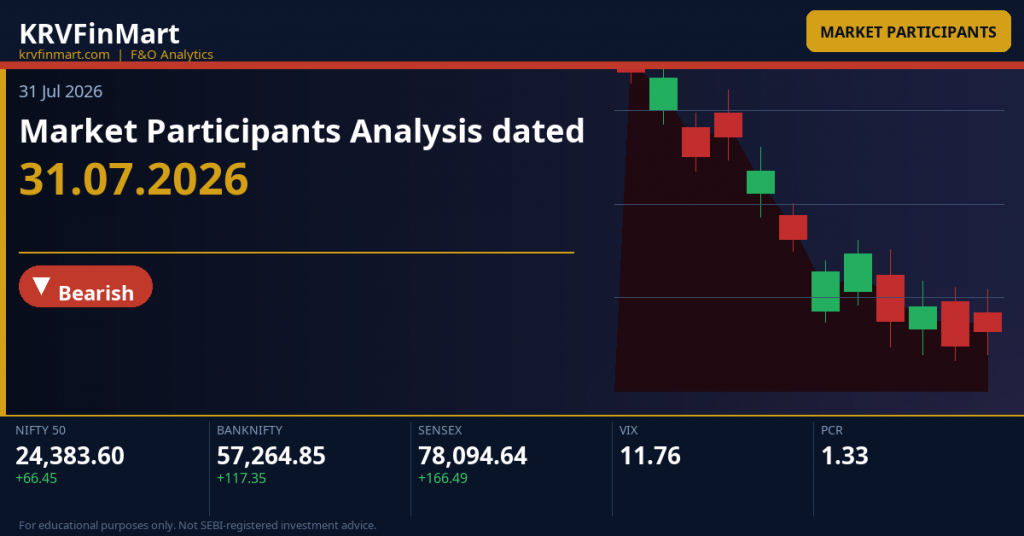
KRVFinMart — Daily Market Outlook
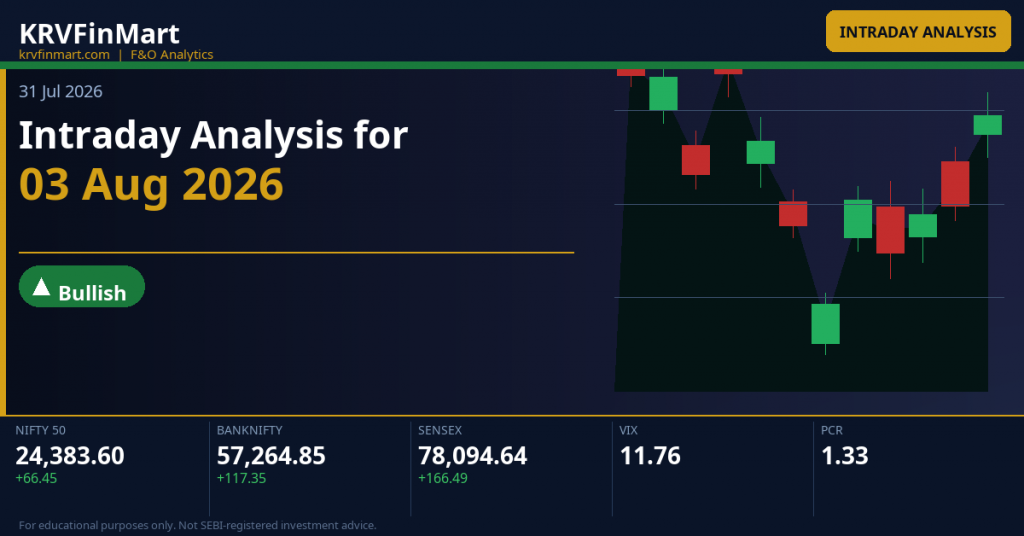
Key Market Signals — Data: 31 Jul 2026
|
NIFTY 50
24,383.60
▲ +66.45 (+0.27%)
|
BANK NIFTY
57,264.85
▲ +117.35 (+0.21%)
|
SENSEX
78,094.64
▲ +166.49 (+0.21%)
|
|
OVERALL PCR
1.33
▲ +0.11 (+9.40%)
PCR at 1.33 signals rising put-writing dominance — broadly supportive sentiment with underlying caution.
|
INDIA VIX
11.76
▼ -0.39 (-3.29%)
VIX at 11.76 and falling — deep complacency zone; options remain cheap, favouring sellers.
|
TOTAL OI CHANGE
42,495,078
▲ +3,529,194 (+9.06%)
Massive OI expansion of +9.06% confirms fresh money entering the market, not short covering.
|
|
FUTURES OI
611,068
▼ -15,832 (-2.53%)
Futures OI contraction alongside a rising market — mixed signal; could indicate short covering or long unwinding.
|
CALL OI CHANGE
7,814,418
▲ +851,639 (+12.23%)
Call OI surging +12.23% — resistance-supply building above current market levels.
|
PUT OI CHANGE
10,419,494
▲ +1,933,584 (+22.79%)
Put OI exploding +22.79% — dominant put build signals aggressive hedging and support flooring.
|
Participant-wise Key Points
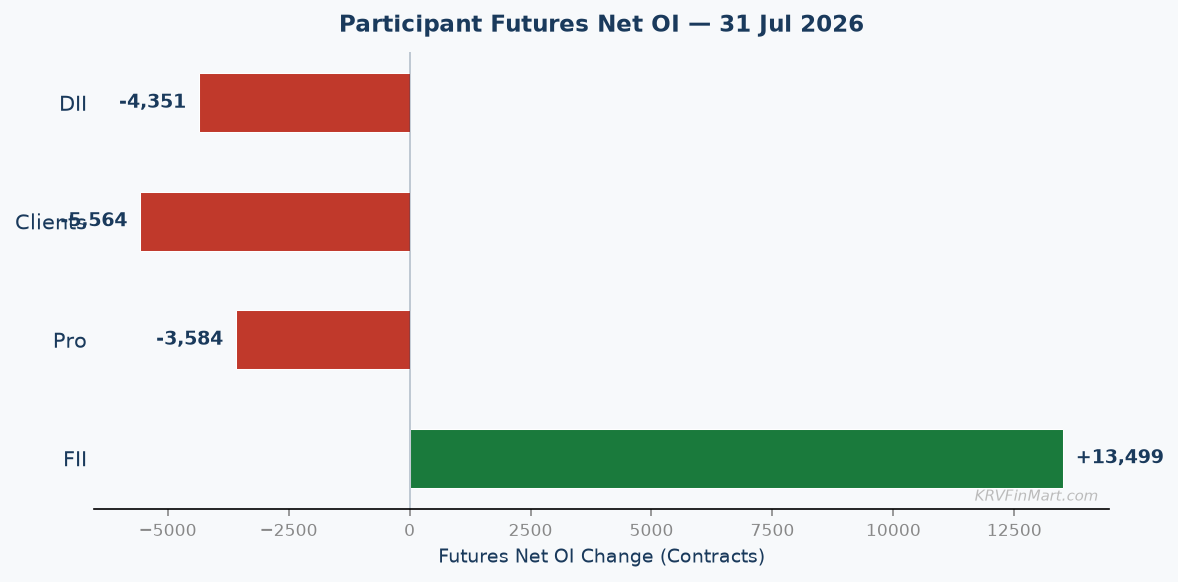
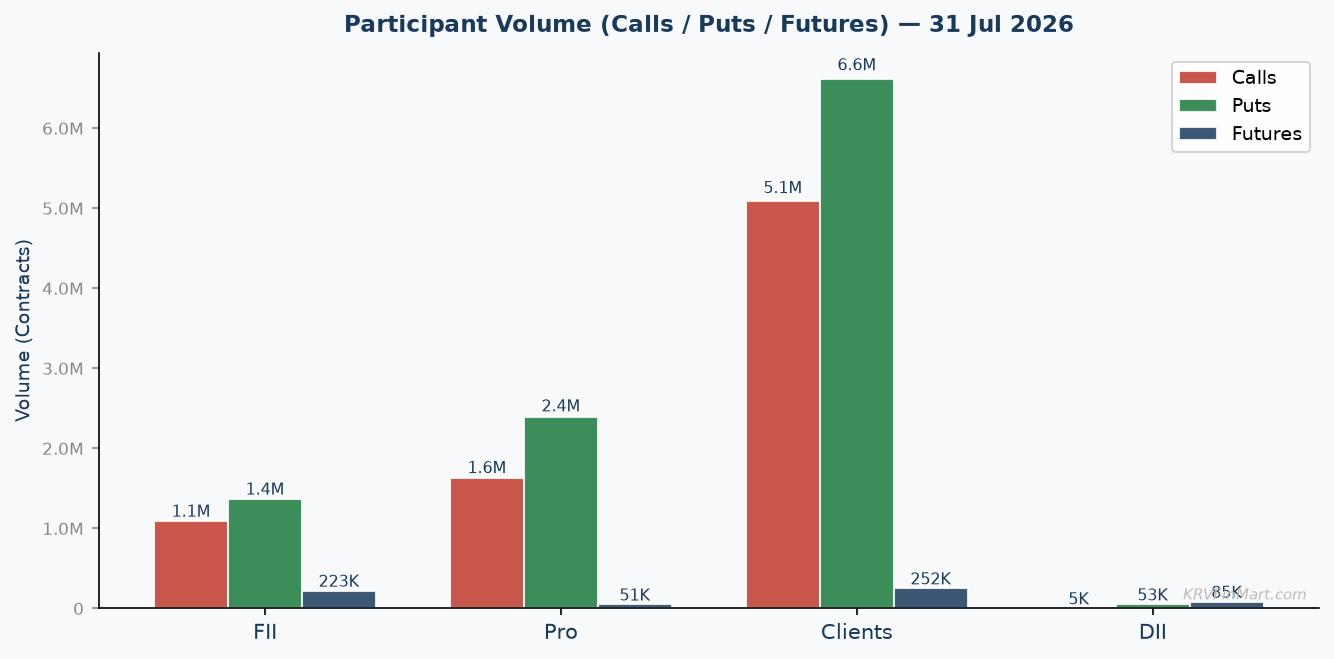
FII Cautiously Transitioning — Covering Futures Shorts, Building Put Hedge Architecture
- Futures net improved from -186,612 to -173,113 (net change +13,499 contracts). The Long side added 326 contracts (prev 24,435 → today 24,761, +1.33%) tagged [Long Buildup – Low Vol], while the Short side shed 13,173 contracts (prev 211,047 → today 197,874, -6.24%) tagged [Short Covering – Low Vol]. The Low Vol tag on both legs tells us this short-covering is hesitant and measured rather than a panicked capitulation — FIIs are trimming their futures short book under low volume conviction, not aggressively unwinding. The gross short-to-long ratio remains staggeringly lopsided at 197,874 vs 24,761 = 7.99:1, meaning even after covering 13,173 shorts, FIIs retain an overwhelming directional net short futures position; this is emphatically not a bullish pivot — it is a tactical adjustment within a dominant bear framework. The improvement in net from -186,612 to -173,113 is the first meaningful short-cover in several sessions and deserves close monitoring, but with a 7.99:1 short-to-long gross ratio, the thesis remains bearish until the net crosses -150,000 or tighter.
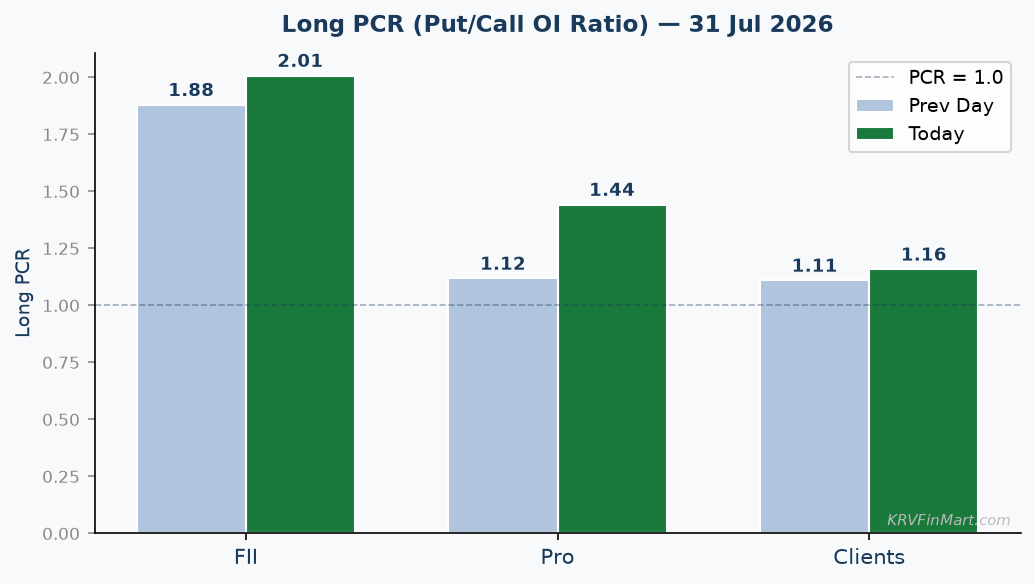
- Long PCR improved from 1.88 to 2.01 (+6.80%) and Short PCR improved from 0.59 to 0.71 (+19.94%). A Long PCR of 2.01 means FIIs now hold more than twice as many put longs as call longs on the options long side — this is a deeply defensive hedge posture, and today’s expansion from 1.88 to 2.01 shows they are ADDING to that defensive posture, not reducing it. The Short PCR rising from 0.59 to 0.71 (+19.94%) means FIIs are writing more puts relative to calls on the short side — put writing at current levels is either income generation or a signal that FIIs believe the immediate downside is bounded (supported), but with a Short PCR of only 0.71 (still below 1.0), they are still writing more calls than puts on the short side, maintaining a call-writing overlay that caps any upside. The dominant signal today is that the Long PCR expansion to 2.01 directly contradicts any interpretation of bullishness — while they trim futures shorts slightly, their options long book is becoming more defensively put-heavy, suggesting the futures short-cover is tactical (intraday noise) rather than a conviction reversal.
- Call OI net: -184,525 (Long 452,291 [Long Buildup – Low Vol], Short 636,816 [Short Buildup – Low Vol]; prev net -176,285, chg -8,240). Put OI net: +453,770 (Long 908,013 [Long Buildup – Low Vol], Short 454,243 [Short Buildup – Low Vol]; prev net +440,725, chg +13,045). The simultaneous expansion of net short calls (-184,525, deepening from -176,285) and net long puts (+453,770, expanding from +440,725) creates a classic synthetic bearish collar architecture — short calls cap any upside profit participation, while long puts provide directional downside exposure. The Low Vol tags on all four option legs indicate this positioning is being built incrementally and methodically under quiet market conditions, not in a rush, which is characteristic of institutional systematic hedging rather than panic. This options architecture perfectly corroborates the residual net short in futures (-173,113) — FIIs are running a unified multi-leg bearish structure across both futures and options simultaneously.
- Synthesis — FII Tactical Short-Cover Within a Persistent Bearish Architecture: FIIs present a nuanced but ultimately still-bearish picture on 31 Jul 2026. The futures net improved by +13,499 contracts to -173,113, which on the surface looks like a bullish shift, but the context destroys that interpretation — a 7.99:1 gross short-to-long ratio, a Long PCR that expanded to 2.01 (the highest defensive reading in recent sessions), a deepening net short call position (-184,525), and a growing net long put position (+453,770) collectively signal that FIIs are not reversing their bearish view. Instead, they appear to be partially covering futures shorts to rebalance their delta toward options-expressed bearishness — a classic institutional technique of shifting from high-margin-cost futures shorts to lower-cost options-based bearish exposure. The Low Vol tags across all five legs (futures + four options legs) confirm this is not a high-urgency reactive move; it is a deliberate, quiet, systematic repositioning. Compared to the previous session, the trend is one of structural continuity with tactical adjustment — the bear framework is intact, merely being expressed more efficiently through options.
- Forward: Watch whether the FII futures net crosses -160,000 in tomorrow’s data — a move to -160,000 or tighter (i.e., further meaningful short-covering) would be the first genuine signal that FIIs are beginning a directional thesis reversal and could unlock an accelerated upside move toward the 24,600 CE resistance wall. If instead the futures net stalls or drifts back below -180,000 (shorts re-added), combined with a Long PCR holding above 2.00, the bearish architecture is confirmed as entrenched and the 24,000 PE support becomes the key gravitational anchor for the weekly expiry cycle.
DII Mildly Defensive — Unwinding Long Futures, Maintaining Put Hedge Overlay
- Futures net declined from +49,558 to +45,207 (net change -4,351 contracts). The Long side shed 4,351 contracts (prev 69,579 → today 65,228, -6.25%) tagged [Long Unwinding – Low Vol], while the Short side was completely unchanged at 20,021 contracts (chg 0, +0.00%) tagged [Short Flat – Low Vol]. The Long Unwinding tag under Low Vol tells us DIIs are trimming their long futures book without urgency — this is a quiet, measured reduction rather than a distressed exit, consistent with institutional profit-taking or risk reduction ahead of month-end. The gross long-to-short ratio remains positive and meaningful at 65,228 vs 20,021 = 3.26:1 long-to-short, so DIIs remain structurally net long futures with a bullish directional bias in futures, but the direction of change today (long unwinding) is mildly cautionary. Contrasting DII futures behaviour with FII: while FIIs covered shorts today, DIIs reduced longs — both moves reduce net market exposure, suggesting a shared institutional preference for de-risking at current levels around 24,383.
- DII does not publish a distinct Long PCR or Short PCR breakdown in the standard participant data. However, we can infer directional PCR bias from their options OI changes: Call OI net: +4,495 (Long 4,575, Short 80) and Put OI net: +52,700 (Long 52,790, Short 90). The ratio of DII put longs to call longs is 52,790 : 4,575 = 11.54:1 — an extraordinary skew toward put longs relative to call longs, implying an implied Long PCR of approximately 11.5 for this participant. This extreme put-long skew tells us DII is running a heavily protective hedge overlay on top of their net long futures book — a classic institutional equity portfolio protection strategy where the long futures position represents equity beta exposure and the put longs represent downside insurance. The Short PCR equivalent (Short puts 90 vs Short calls 80) is nearly flat at 1.13, indicating DII is barely writing options on the short side, confirming their options book is almost entirely defensive hedging rather than income generation.
- Call OI net: +4,495 (Long 4,575 [Long Buildup – Low Vol], Short 80 [Short Flat – Low Vol]; prev net +4,345, chg +150). Put OI net: +52,700 (Long 52,790 [Long Buildup – Low Vol], Short 90 [Short Buildup – Low Vol]; prev net +52,405, chg +295). The Call OI net is tiny at +4,495, while the Put OI net is dominant at +52,700 — this 11.7:1 ratio of net put longs to net call longs creates a protective long architecture: DIIs are net long futures AND holding a massive put-long hedge, suggesting they are hedging a large equity book rather than expressing a pure directional bet. The Low Vol tags on both options sides confirm this positioning is routine and systematic, consistent with institutional portfolio management mandates. The marginal additions today (+150 call longs, +320 put longs, +25 put shorts) are all very small adjustments to a pre-existing large hedge structure — this is maintenance, not new positioning, and the micro-increase in put shorts (+25 contracts) at 38.46% percentage change is statistically irrelevant at 90 contracts total.
- Synthesis — DII Protective Long with Defensive Options Overlay: DIIs present the clearest and most internally consistent institutional equity protection story of 31 Jul 2026. They hold a net long futures position of +45,207 (down from +49,558 due to long unwinding) supported by an enormous put-long options book of 52,790 contracts that effectively insures their equity exposure against a significant market decline. The long unwinding in futures (-4,351) combined with no change in put shorts and only minor additions to put longs suggests DII is mildly reducing gross risk exposure at current levels — a typical month-end risk management action rather than a directional reversal call. Crucially, DII’s behaviour diverges from FII in an important way: FIIs are running an outright net short structure (futures net -173,113) while DIIs are net long futures (+45,207) with hedges — these two institutions are on opposite sides of the futures market, with FIIs as the dominant bearish force and DIIs as the structural long. The overall conclusion is that DIIs are cautiously holding their bullish structural futures position while ensuring downside protection is firmly in place, which is consistent with large mutual fund and insurance company mandates that must remain invested but hedged.
- Forward: The key watch level for DII tomorrow is whether their futures net holds above +40,000 contracts — a further decline below this threshold would signal accelerating institutional de-risking and could weigh on index support. Additionally, monitor whether DII put longs (currently 52,790) expand materially — any addition of more than 2,000 put contracts tomorrow would confirm DIIs are increasing their downside insurance, which would be a bearish forward signal for the 24,000 PE support zone becoming increasingly contested.
Pro Aggressively Hedged Both Ways — Dominant Put Long Explosion, Turning Net Long Options
- Futures net collapsed from +3,566 to -18 (net change -3,584 contracts). The Long side shed 1,488 contracts (prev 27,208 → today 25,720, -5.47%) tagged [Long Unwinding – Low Vol], while the Short side added 2,096 contracts (prev 23,642 → today 25,738, +8.87%) tagged [Short Buildup – Low Vol]. The combination of long unwinding AND short buildup under Low Vol conditions means Pros moved from a slightly net long futures position (+3,566) to essentially flat (-18) in a single session — this is a deliberate neutralisation of futures directional exposure, not a high-conviction directional bet. The gross ratio is now nearly equal at 25,720 long vs 25,738 short = 1.0007:1 — the most balanced futures book of all four participant groups, confirming Pros are running a market-neutral futures stance while placing their directional bets entirely through options. This futures neutralisation is the structural setup for a delta-neutral options strategy, where the enormous options activity (see bullets 2 and 3) is the primary expression of their market view.
- Long PCR expanded from 1.12 to 1.44 (+28.98%) and Short PCR expanded from 1.38 to 1.50 (+8.59%). The Long PCR jumping from 1.12 to 1.44 in a single session is one of the most significant PCR moves across all participants today — it means Pros shifted from holding 12% more put longs than call longs to holding 44% more put longs than call longs, a dramatic tilt toward defensive or directionally bearish options positioning in a single day. The Short PCR rising from 1.38 to 1.50 means Pros are also writing more puts than calls on the short side, which creates an interesting dual signal: they are BUYING puts aggressively (long PCR 1.44) while also WRITING puts (short PCR 1.50) — this is the classic long put / short put spread or ratio spread architecture where the long put provides directional downside exposure and the short put at a lower strike provides premium offset. The dominant signal from PCR is that Pros believe the market has meaningful downside potential — the Long PCR expansion of +28.98% to 1.44 is the single largest percentage PCR shift of any participant today and cannot be dismissed as routine.
- Call OI net: +155,914 (Long 892,107 [Long Buildup – Low Vol], Short 736,193 [Short Buildup – Low Vol]; prev net +132,067, chg +23,847). Put OI net: +181,150 (Long 1,286,439 [Long Buildup – Low Vol], Short 1,105,289 [Short Buildup – Low Vol]; prev net -22,921, chg +204,071). The Put OI net is the most dramatic data point for Pros today — it swung from -22,921 to +181,150, a change of +204,071 contracts, driven by an explosive increase in put longs of +418,219 contracts (prev 868,220 → today 1,286,439, +48.17%) against put short additions of only +214,148 contracts. This +48.17% single-day put long explosion is the largest absolute OI move of any participant-instrument combination in today’s data and signals high urgency institutional hedging or directional put positioning by Pros. The architecture is now net long both calls and puts (net call long +155,914, net put long +181,150) — this is a long straddle or strangle structure at a market-neutral futures level, implying Pros are positioned for a large volatility expansion move in either direction, with a slight bias toward downside given the larger put-long net.
- Synthesis — Pro Volatility Long / Downside Skewed Strangle Architecture: Pros present the most structurally complex and potentially significant positioning story of 31 Jul 2026. By neutralising their futures position to effectively flat (-18 contracts net), expanding their Long PCR to 1.44 (+28.98%), building a net long call position of +155,914, and most dramatically, flipping their put net from -22,921 to +181,150 via a +418,219 contract single-day put long explosion, Pros have constructed what appears to be a delta-neutral long strangle with a downside bias — they are long volatility via both calls and puts, but with significantly more put exposure than call exposure. The Low Vol tags on all options legs are slightly unusual for a position of this magnitude — they suggest the put buying was spread throughout the session rather than concentrated at a single moment of panic, which implies this is a planned institutional positioning exercise rather than a reactive hedge. The scale of the put long addition (+418,219 contracts, +48.17%) is exceptional and likely reflects either large client mandates for portfolio protection or Pros’ own directional view that a volatility event is imminent. Comparing to the previous session where Pro put net was -22,921, the complete reversal to +181,150 represents the most dramatic single-session positioning shift observed across all participants today and warrants elevated attention.
- Forward: The critical watch for Pro tomorrow is whether their put long book (currently 1,286,439 contracts) continues to expand or plateaus — any further addition of more than 100,000 put longs would confirm this is a multi-session directional positioning campaign rather than a one-day anomaly. If Pro puts continue to build while their Long PCR pushes above 1.60, the downside risk for the market toward the 24,000 PE support level becomes significantly elevated. Conversely, if tomorrow’s data shows Pro put longs contracting (monetising the puts after a down-move) and their Long PCR falls below 1.30, it would signal the downside scare has passed and bulls could reassert control toward 24,600 CE resistance.
Client Conflicted — Net Long Futures Eroding, Aggressive Put Sellers Dominating Options
- Futures net declined from +133,488 to +127,924 (net change -5,564 contracts). The Long side shed 2,403 contracts (prev 192,228 → today 189,825, -1.25%) tagged [Long Unwinding – Low Vol], while the Short side added 3,161 contracts (prev 58,740 → today 61,901, +5.38%) tagged [Short Buildup – Low Vol]. The combination of long unwinding (-2,403) and short buildup (+3,161) mirrors the Pro participant pattern — both groups are simultaneously reducing longs and adding shorts, suggesting a broad retail/client community that is becoming incrementally more cautious at current levels. The gross long-to-short ratio at 189,825 long vs 61,901 short = 3.07:1 confirms Clients remain structurally net long futures — they are the largest net-long futures participant by absolute contract count (+127,924), providing the primary retail bull counterweight to FII’s dominant net short (-173,113). However, the direction of change is clearly net long reduction, and if this trend continues over multiple sessions, the structural support from client long futures will progressively weaken.
- Long PCR expanded from 1.11 to 1.16 (+4.40%) and Short PCR expanded from 1.34 to 1.44 (+7.56%). The Client Long PCR of 1.16 is the lowest among all participants with available PCR data — meaning Clients hold only 16% more put longs than call longs on the long side, reflecting the least defensive options posture of the participant group. However, the Short PCR of 1.44 — meaning Clients are writing 44% more puts than calls on the short side — is a critical data point: this signals that retail clients are aggressively selling puts (collecting premium) in the belief that the market will NOT fall significantly, a classic income-generation strategy that profits in flat or rising markets but carries significant downside risk if support breaks. The rising Short PCR (+7.56% to 1.44) combined with a modestly rising Long PCR (+4.40% to 1.16) creates a mixed picture: Clients are mildly increasing put protection while simultaneously increasing put sales — the net effect is a market that Clients expect to stay range-bound with a mild upward tilt, but their put-selling book leaves them exposed to a sharp downside event.
- Call OI net: +24,116 (Long 2,558,236 [Long Buildup – Low Vol], Short 2,534,120 [Short Buildup – Low Vol]; prev net +39,874, chg -15,758). Put OI net: -687,620 (Long 2,962,505 [Long Buildup – Low Vol], Short 3,650,125 [Short Buildup – Low Vol]; prev net -470,209, chg -217,411). The Call OI net, while positive at +24,116, has actually SHRUNK from +39,874 — meaning Clients added more call shorts than call longs today, slightly reducing their net call long position. The Put OI net at -687,620 (deepening from -470,209) is the most structurally important data point for Clients — they are net short puts by 687,620 contracts, which is the largest absolute net put short position of any participant and represents enormous premium collected but equivalent downside risk if the market breaks lower. The [Short Buildup – Low Vol] tag on put shorts confirms this is fresh positioning under normal market conditions — Clients are systematically selling puts, likely at or near the 24,000 PE support strike, to collect premium in a low-VIX environment (VIX 11.76). This net put short of -687,620 paired with a net call long of +24,116 creates a net naked put writing architecture — bullish, premium-harvesting, but tail-risk exposed.
- Synthesis — Client Net Put-Writing Architecture with Eroding Long Futures Conviction: Clients present the most internally contradicted picture of 31 Jul 2026 — they are simultaneously reducing their long futures conviction (net -5,564 contracts, shrinking to +127,924) while aggressively EXPANDING their net put short book (deepening to -687,620 from -470,209, a further -217,411 contracts in a single day). This means Clients as a group are net bullish via put-writing (short puts = expecting market to stay above the put strike) while incrementally reducing their direct market exposure via futures — a classically confused retail positioning pattern that tends to emerge in low-volatility environments where complacency reigns and premium income is seen as ‘free money’. The VIX at 11.76 fully explains this behaviour: cheap options make put-writing attractive to retail traders who underestimate tail risk. The key risk is stark — with 3,650,125 short puts on the books and Pro simultaneously buying 1,286,439 put longs, Clients are effectively on the other side of the Pro put-buying trade; if the market declines toward 24,000, Clients’ put shorts will accelerate losses while Pro’s put longs profit. This adversarial positioning between Pro (long puts) and Client (short puts) is a critical structural tension in today’s market.
- Forward: The defining watch for Clients tomorrow is the 24,000 PE support level — if NIFTY closes below 24,000, Client put shorts (currently 3,650,125 contracts) will generate catastrophic mark-to-market losses and forced covering, which would accelerate the downside move in a gamma-squeeze dynamic. Monitor whether Client put short OI continues to expand (complacency deepening) or begins to contract (stop-losses and covering) — any reduction in Client short puts below 3,500,000 contracts combined with a PCR overall above 1.40 would signal the put-selling community is unwinding and downside pressure is building. Conversely, if Nifty holds above 24,383 (today’s close) with expanding PCR, the put premium collected continues to decay and Client’s strategy profits — their 127,924 net long futures provide additional upside participation.
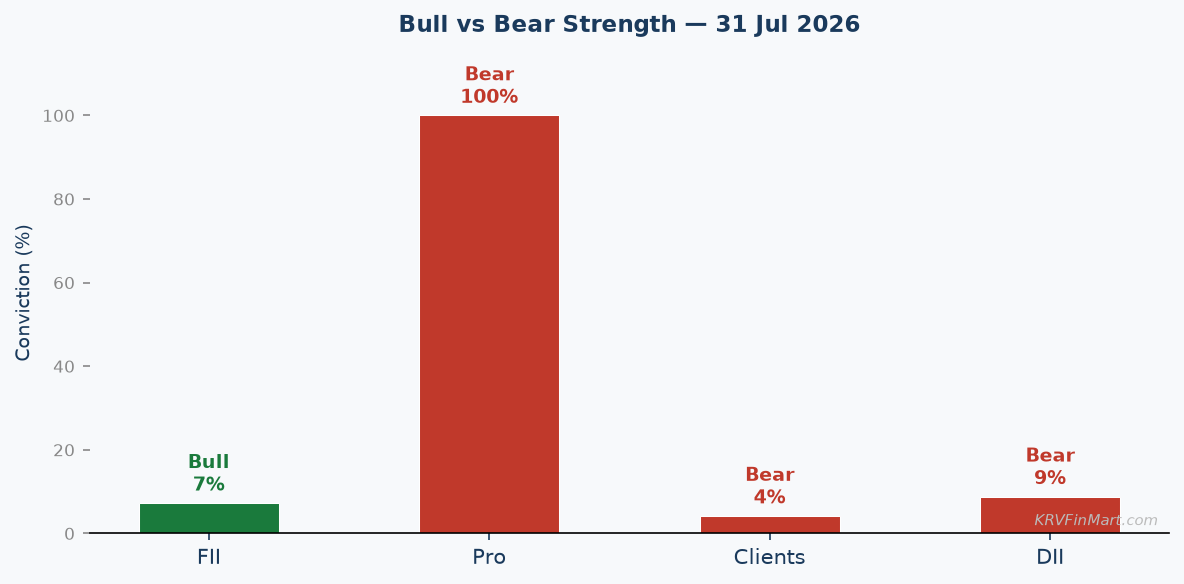
Bull vs Bear Strength by Participant
|
FII
Bearish / Tactical Cover 75%
▼▼
|
Clients
Complacent / Put Sellers 55%
▲
|
Pro
Volatility Long / Bearish Skew 60%
▼
|
DII
Mildly Defensive / Hedged Long 55%
▼
|
Conclusion — Market Outlook for 01 Aug 2026
The collective participant positioning on 31 Jul 2026 paints a picture of a market in structural tension between residual institutional bearishness and retail complacency. FII futures net remains deeply short at -173,113 despite a tactical 13,499-contract short cover — a 7.99:1 gross short-to-long ratio means FIIs retain overwhelming directional conviction that the market is vulnerable. DIIs hold a net long futures position of +45,207 but are unwinding longs at the margin (-4,351 today) and maintaining a massive 52,790-contract put long hedge, suggesting even the structurally bullish institutional player is incrementally de-risking. Pros have neutralised futures to flat (-18 contracts) and executed the largest single-day put long explosion of any participant — adding 418,219 put longs (+48.17%) to flip their put net from -22,921 to +181,150, a near-flat futures book combined with an enormous long strangle/downside-skewed options position signals Pros are positioning for a significant volatility event. Clients remain the lone structural bulls via a +127,924 net long futures position and a colossal 3,650,125 net put short book — their complacency-driven put-writing strategy is the primary source of market support but also the primary source of tail risk if support levels crack.
The Overall PCR rising sharply to 1.33 (+9.40% from 1.22) is broadly interpreted as a bullish signal, but the composition matters critically — the PCR expansion is driven primarily by Client put shorts (selling puts = put OI increases the denominator) rather than genuine long put buying for directional bearish bets. This distinction means the PCR is partly inflated by income strategies rather than pure hedging demand. India VIX at 11.76 (down -3.29%) confirms an environment of extreme complacency where options are cheap — this is precisely the environment in which tail risks are systematically underpriced and where Pro’s aggressive put buying (1,286,439 long puts) appears most prescient. The Total OI expansion of +9.06% (+3,529,194 contracts) is dominated by options OI rather than futures OI (which actually contracted -2.53%), confirming that participants are shifting their market exposure from futures to options — a structural shift toward defined-risk positioning that typically precedes a volatility expansion.
The bull case requires FII futures net to improve meaningfully toward -150,000 (significant short covering), the Overall PCR to hold above 1.30, and Nifty to sustain above the 24,000 PE support wall — if these three conditions are met simultaneously, the path toward 24,600 CE resistance becomes accessible. The bear case is triggered by any break below 24,000 (the dominant PE support strike for both weekly and monthly expiry), which would activate Pro’s 1,286,439 put long profits while simultaneously forcing Client’s 3,650,125 put short losses — a gamma-squeeze spiral that could accelerate a move toward 23,500 rapidly. The asymmetry of this setup — where the downside gamma is held by sophisticated Pros while the upside premium risk sits with retail Clients — suggests the risk-reward favours caution and the bear case is structurally better-armed going into August 2026.
Scenario 1 — Bull case:
If FII futures net improves from -173,113 toward -150,000 (net short covering of approximately 23,000 additional contracts) tomorrow, combined with the Overall PCR holding above 1.33 and India VIX declining further below 11.50, the bullish case accelerates. In this scenario, Client put shorts continue to decay profitably, DII long futures stabilise above 45,000 net, and the market is supported by the massive 24,000 PE support wall (dominant OI support strike). Price trajectory in this scenario targets 24,600 CE resistance (dominant weekly and monthly call writing strike), beyond which the next significant resistance is the 25,000 monthly CE wall.
Scenario 2 — Bear case:
If Nifty closes below the 24,000 PE support wall (max put OI strike for both weekly and monthly expiry) on a day when FII futures net deteriorates back below -180,000 (re-adding shorts) and the Overall PCR drops below 1.20 (put unwinding / call buying), the bear case activates fully. Pro’s 1,286,439 put longs begin generating significant profit, triggering mark-to-market losses on Client’s 3,650,125 short puts and forcing involuntary covering that cascades into a momentum sell-off. India VIX would likely spike above 13.50 in this scenario, amplifying options volatility and making the put-short exit even more costly for retail Clients. The bear case target in this scenario is the 23,500–23,800 zone where the next significant OI support structure would need to be evaluated.
|
Key Resistance
NIFTY 24,600 (Weekly CE max OI) and 25,000 (Monthly CE max OI) — FIIs are writing calls net at 636,816 short calls total, Clients hold 2,534,120 short calls, creating a massive combined call-writing wall that caps near-term upside; Pros are long calls at 892,107 but their net long position of +155,914 is insufficient to absorb the combined institutional call supply. BANKNIFTY 58,000 (Monthly CE max OI) and SENSEX 80,000 (Weekly and Monthly CE max OI) are the corresponding index resistance walls.
|
Key Support
NIFTY 24,000 (Weekly and Monthly PE max OI) — DII holds 52,790 put longs and Pros hold 1,286,439 put longs concentrated near this level, creating a structural demand floor. FII put longs at 908,013 add further institutional support at this strike. However, Client short puts of 3,650,125 mean any break below 24,000 would trigger massive forced covering, converting this support into a potential waterfall. BANKNIFTY 57,000 (Monthly PE max OI) and SENSEX 77,000–78,000 (Monthly and Weekly PE max OI) are corresponding support anchors.
|
Trigger to Watch
The single most important trigger for tomorrow is the Overall PCR crossing above 1.40 — if PCR expands to 1.40 or higher without a corresponding drop in Nifty, it signals genuine put-buying demand (not just put-writing) and confirms Pros’ +418,219 put long addition is attracting follow-through, which would pressure the market toward 24,000 PE support. Alternatively, if India VIX spikes above 13.00 (from current 11.76), it signals the complacency era is ending and would force Client put-short unwinding — the most systemic risk event in today’s positioning landscape.
|
This analysis is for educational purposes only and is not investment advice.
© KRVFinMart | krvfinmart.com
Responses