
Market Participants Analysis dated 05.08.2026

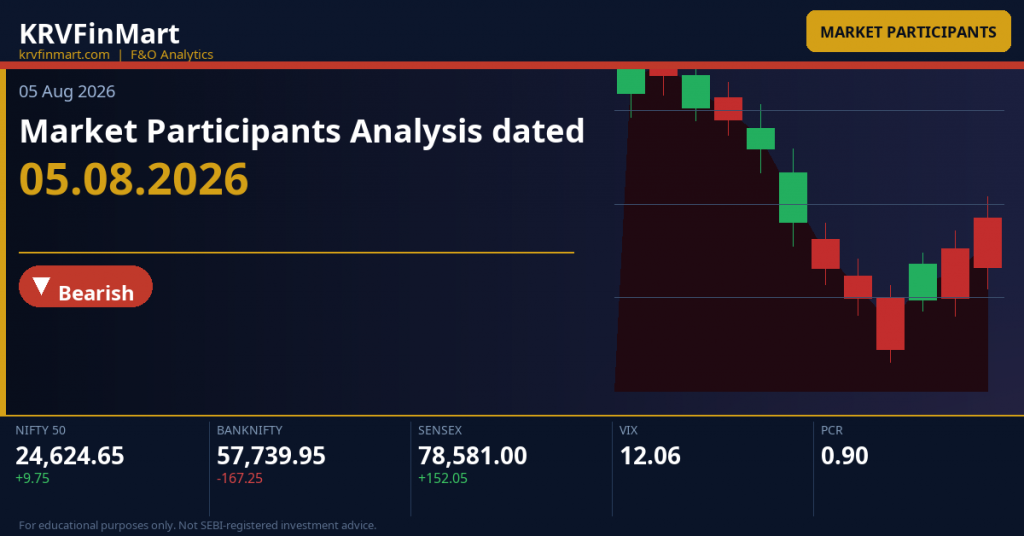
KRVFinMart — Daily Market Outlook
Key Market Signals — Data: 05 Aug 2026
|
NIFTY 50
24,624.65
▲ +9.75 (+0.04%)
|
BANK NIFTY
57,739.95
▼ -167.25 (-0.29%)
|
SENSEX
78,581.00
▲ +152.05 (+0.19%)
|
|
OVERALL PCR
0.90
▼ -0.08 (-7.60%)
PCR falling sharply to 0.90 — call OI build outpacing puts signals weakening near-term bullish sentiment.
|
INDIA VIX
12.06
▼ -0.13 (-1.07%)
VIX easing to 12.06 — complacency zone; markets pricing low near-term risk, supports range-bound trading.
|
TOTAL OI CHANGE
41,294,034
▲ +3,450,660 (+9.12%)
Large OI surge of +9.12% with flat price — classic bearish OI build confirming supply pressure.
|
|
FUTURES OI
616,118
▲ +21,302 (+3.58%)
Futures OI expanding with near-flat price — net short positioning being added, not covered.
|
CALL OI CHANGE
7,853,051
▲ +1,628,773 (+26.17%)
Aggressive call OI addition of +26.17% — heavy supply being written at upper strikes, capping upside.
|
PUT OI CHANGE
7,105,868
▲ +1,010,643 (+16.58%)
Put OI adding +16.58% — protective hedging demand growing but lagging call build, net bearish tilt.
|
Participant-wise Key Points
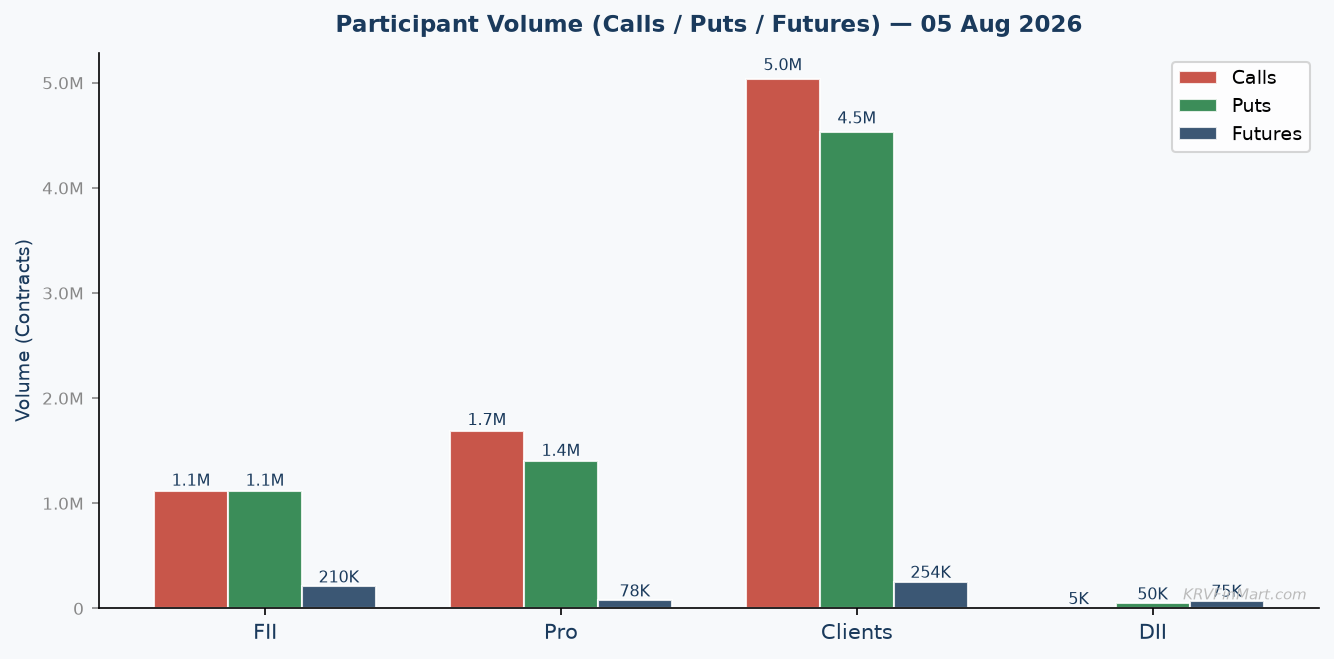
FII Strongly Bearish — Dual-Leg Conviction Short Architecture
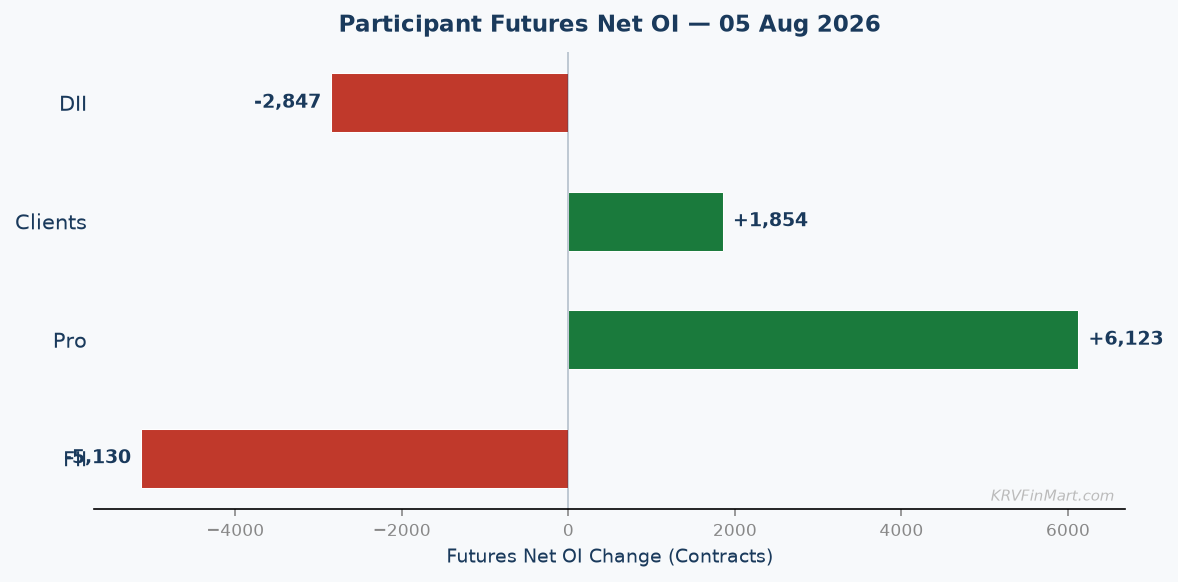
- Futures net deteriorated from -153,773 to -158,903 (net change -5,130 contracts, worsening by -3.33%). The Long side declined from 25,701 to 25,437 contracts tagged [Long Unwinding – Low Vol], while the Short side expanded from 179,474 to 184,340 contracts tagged [Short Buildup – High Vol]. The contrast between the volume tags is analytically decisive: the Short Buildup carries a High Vol confirmation, meaning these are deliberate, high-conviction additions — not routine roll activity — whereas the Long Unwinding is Low Vol, implying FIIs are gently trimming longs rather than aggressively exiting. The resulting gross short-to-long ratio now stands at a staggering 7.24:1 (184,340 shorts vs 25,437 longs), an extreme directional posture that signals FIIs are not hedging an equity book — they are running an outright structural bearish directional trade in index futures. Despite Nifty closing fractionally positive at +0.04%, FIIs added 4,866 short contracts today, confirming they view the flat close as a continuation of a bearish environment rather than a reversal trigger.
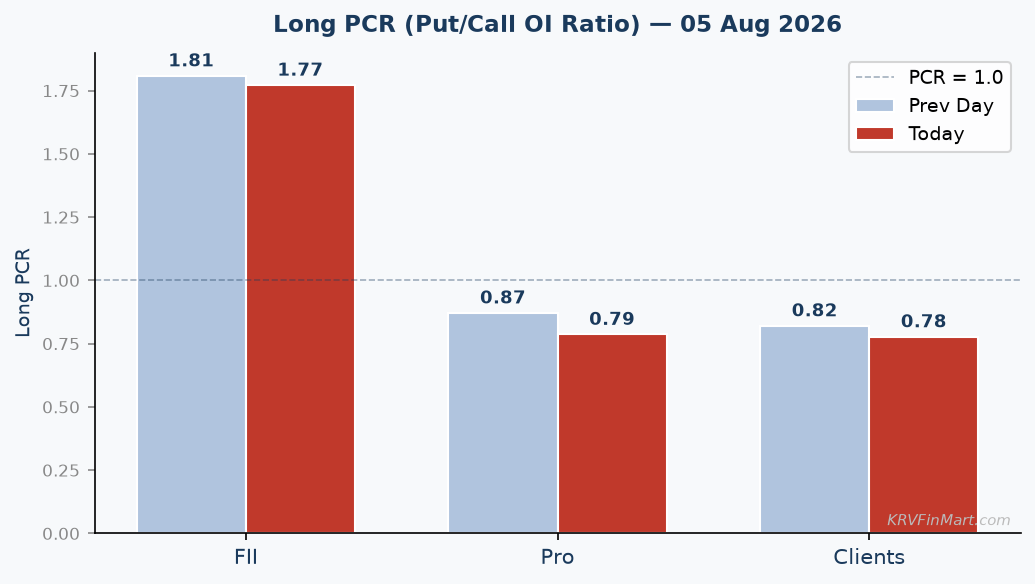
- Long PCR declined from 1.81 to 1.77 (-2.03%) and Short PCR rose from 0.47 to 0.49 (+4.69%). A Long PCR of 1.77 means FIIs hold 77% more put longs than call longs in absolute contract terms — this is a deeply defensive/bearish options stance on the buy side, though the slight decline from 1.81 signals marginally less put-long dominance as they also added call longs today. The Short PCR rising from 0.47 to 0.49 is the more revealing signal: at 0.49, FIIs are writing roughly twice as many calls as puts on the short side, which is a classic cap-the-upside strategy — they are not selling put spreads for income, they are selling calls to suppress any index rally. Together, the falling Long PCR and rising Short PCR create a subtle but important divergence: FIIs are rotating slightly from pure put protection toward a more aggressive call-writing posture, suggesting they believe upside is capped more than downside needs to be hedged aggressively. This reinforces the futures Short Buildup — both derivatives legs are aligned bearishly.
- Call OI net moved from -164,997 to -228,591 (net change -63,594 contracts; Long 446,265 [Long Buildup – Low Vol] vs Short 674,856 [Short Buildup – Low Vol]). Put OI net moved from +485,728 to +461,172 (net change -24,556 contracts; Long 791,017 [Long Buildup – Low Vol] vs Short 329,845 [Short Buildup – Low Vol]). On the call side, FIIs added 27,039 long contracts but added a far larger 90,633 short contracts, deepening their net call short by 63,594 — this is aggressive call writing that creates a ceiling on index upside. On the put side, they added 32,510 long contracts but also added 57,066 short contracts, which partially offsets the bearish put-long book — the net put long of 461,172 remains strongly positive but has narrowed slightly. The combined architecture is a net short calls + net long puts structure — this is a classic synthetic short collar or directional bearish spread, where FIIs profit most if the index either stays flat or declines. Both Low Vol confirmation tags are worth noting: while directionally clear, the absence of High Vol on options legs suggests these additions were executed with measured sizing rather than panic-driven urgency.
- Synthesis — FII Dual-Leg Conviction Bearish Architecture: FIIs present the most internally consistent and structurally reinforced bearish case among all participants today. Every data point aligns: a futures net of -158,903 with a 7.24:1 short-to-long ratio and a High Vol short buildup; a Long PCR of 1.77 (deeply defensive buy side); a rising Short PCR of 0.49 (aggressive call writing on short side); a net call OI of -228,591 (deepening); and a net put OI of +461,172 (strongly positive despite slight narrowing). The complete strategy is a synthetic short with a call-writing overlay — they are simultaneously short futures, short calls above the market, and long puts below, creating a multi-leg position that profits across a range of bearish or flat outcomes. The only internal nuance worth flagging is that put-net narrowed slightly today as FII also wrote additional puts (-57,066 on the short put side), suggesting they may be financing the call-writing book through put premium collection — a classic ratio spread or covered put architecture. Compared to the prior session, the short buildup in futures is accelerating (adding 4,866 contracts net) despite a flat-to-positive market close, confirming this is not a reactive hedge but a proactive structural view. FIIs are the dominant bearish anchor of this market.
- Forward trigger: Watch whether FII futures net short crosses -165,000 contracts in tomorrow’s data — if that threshold is breached with another High Vol tag on the short side, it confirms an accelerating bearish campaign and the index is vulnerable to a breakdown toward the PE support at 24,000 (NIFTY Week/Month OI support). Conversely, if the futures net improves meaningfully (toward -150,000 or better) with a Low Vol tag, it would signal short-covering has begun and the bearish thesis is being unwound — in that scenario watch the CE resistance at 25,000 as the next logical target for any relief rally. The key PCR threshold is Overall PCR recovering back above 0.95: failure to do so tomorrow would confirm the bearish options flow is dominating and the index directional risk remains skewed to the downside.
DII Cautiously Bearish — Reducing Net Long Futures While Adding Put Protection
- Futures net declined from +37,839 to +34,992 (net change -2,847 contracts, deteriorating by -7.52%). The Long side expanded modestly from 53,395 to 54,768 contracts tagged [Long Buildup – High Vol], while the Short side surged from 15,556 to 19,776 contracts tagged [Short Buildup – Avg Vol]. The divergence in confirmation tags is analytically significant: the Long Buildup carries a High Vol tag, meaning DIIs did add to longs with conviction, but the Short Buildup at Avg Vol means the 4,220 new short contracts were added at normal institutional sizing — likely a fresh hedge initiation rather than an aggressive directional short. The gross short-to-long ratio now stands at 0.36:1 (19,776 shorts vs 54,768 longs), which clearly shows DIIs remain net long in aggregate, but the rapid growth in shorts (from 15,556 to 19,776 = +27.13%) is the fastest rate of short accumulation among all participants on a percentage basis today, signalling that DIIs are beginning to hedge their long book more aggressively. This transition from a clean net long to a hedged net long is a subtle but important shift in DII posture.
- DII does not have a published Long PCR or Short PCR in today’s dataset, so direct PCR interpretation is unavailable. However, the options data provides a partial proxy for their directional view. On the call side, the minor Long Unwinding (-30 contracts, [Long Unwinding – Low Vol]) and Short Covering (-20 contracts, [Short Covering – Avg Vol]) are immaterial in size and suggest DIIs have virtually no meaningful call options exposure — their call book at 5,340 long vs 80 short is negligible relative to their futures and put books. On the put side, their Long Buildup of +1,254 contracts [Long Buildup – Low Vol] is the more meaningful signal — they are continuing to accumulate put longs even as the overall market adds call OI at a faster rate. The absence of any short put activity (Short Flat at 0 contracts on both days) is notable: DIIs are running a pure long put protection book with zero put writing, reflecting a straightforward hedge-the-downside approach without any premium collection.
- Call OI net moved from +5,270 to +5,260 (net change -10 contracts; Long 5,340 [Long Unwinding – Low Vol] vs Short 80 [Short Covering – Avg Vol]). Put OI net moved from +48,525 to +49,779 (net change +1,254 contracts; Long 49,779 [Long Buildup – Low Vol] vs Short 0 [Short Flat – Low Vol]). The call book is effectively flat and immaterial — the -10 net change and Low Vol tags confirm no strategic activity on the call side today. The put book tells the real story: with 49,779 net long puts and zero short puts, DIIs are running a fully unhedged put long position — every put they hold is directional or protective, with no short puts to offset the premium cost. The architecture is a net long puts + negligible calls = protective put book structure, which functions as insurance against their High Vol long futures position. This is not a directional bearish bet in isolation — it is a fiduciary hedge consistent with DII’s mandate of protecting equity portfolios from sharp drawdowns. The contrast with FII (who also hold net long puts but combine them with aggressive short futures and short calls) is instructive: DIIs are protecting, FIIs are attacking.
- Synthesis — DII Defensive Hedge Transition: DIIs present a picture of a large institutional holder transitioning from a relatively open long position to a more defensively hedged posture. Their futures net of +34,992 remains firmly positive (they are still net long the market by a wide margin), but the simultaneous addition of 4,220 new short futures contracts at Avg Vol alongside a growing 49,779 net put long book signals that DII risk managers are responding to the same macro or technical concerns that FIIs are acting on more aggressively. The complete strategy can be described as a covered long with put protection — they hold long futures, hedge with long puts, and maintain negligible call exposure. The fact that the short futures addition today was Avg Vol (not High Vol) suggests this is a routine hedge top-up rather than a dramatic conviction flip — DIIs have not abandoned their constructive long-term equity view. However, the put net growing from 48,525 to 49,779 while futures net shrinks from +37,839 to +34,992 creates a directional signal worth monitoring: if both trends continue over the next several sessions, DIIs would be materially reducing net equity beta while increasing downside protection, which would be a meaningful bearish structural signal.
- Forward trigger: Watch whether DII futures net long falls below +30,000 contracts in tomorrow’s data — this would signal an accelerating hedge program and would validate the bearish tilt being established today. If instead the short futures book is reduced (net improving back toward +37,000 or higher), it would confirm today’s short buildup was a one-day tactical hedge and DII remains a structural market support. Also watch whether DII put net crosses 55,000 contracts — aggressive put accumulation above that level in combination with declining futures net would constitute a two-leg bearish signal from one of the market’s most stable participants, raising the probability of a meaningful correction toward the PE support at 24,000 (NIFTY Week/Month).
Pro Cautiously Bullish — Massive Options Long Buildup with Residual Futures Short
- Futures net improved from -18,363 to -12,240 (net change +6,123 contracts, improving by +33.35%). The Long side surged from 24,532 to 32,893 contracts tagged [Long Buildup – High Vol], while the Short side expanded more modestly from 42,895 to 45,133 contracts tagged [Short Buildup – Avg Vol]. The High Vol tag on the Long Buildup is the critical signal here: Pro traders added 8,361 long futures contracts with high conviction, dwarfing the 2,238 new short contracts added at Avg Vol. The gross short-to-long ratio has improved meaningfully from 1.75:1 (42,895 / 24,532) to 1.37:1 (45,133 / 32,893), reflecting a significant compression of the directional short bias. Pro traders (proprietary desks) are showing the most active directional shift of any participant today — they appear to be positioning for at least a short-term bounce or range trade, reducing their net short exposure at a rate (+6,123 net improvement) that stands in sharp contrast to FII who are deepening their short by -5,130. This is a meaningful divergence between the two most sophisticated participant groups.
- Long PCR declined sharply from 0.87 to 0.79 (-9.71%) and Short PCR also declined from 0.90 to 0.88 (-2.52%). A Long PCR of 0.79 means Pro traders hold 79 put longs for every 100 call longs — they have slightly more call longs than put longs on the buy side, a modestly bullish options posture on the long book. The sharp decline in Long PCR from 0.87 to 0.79 (-9.71%) is the largest PCR move among all participants today and signals that call longs are being added at a much faster rate than put longs — Pro traders are positioning their long options book to benefit from an upward move. The Short PCR declining from 0.90 to 0.88 (-2.52%) means on the short side, they are still writing slightly more calls than puts, but this ratio is converging toward parity, suggesting they are not running an aggressive cap-the-upside call writing campaign. The combined picture — falling Long PCR with high call long additions, and declining but near-parity Short PCR — creates a mildly bullish or range-trade options posture rather than a directional long conviction, reinforcing the view that Pros are setting up for a potential bounce rather than a multi-day trending rally.
- Call OI net moved from -18,078 to +147,214 (net change +165,292 contracts; Long 919,712 [Long Buildup – Low Vol] vs Short 772,498 [Short Buildup – Low Vol]). Put OI net moved from -34,252 to +46,669 (net change +80,921 contracts; Long 724,252 [Long Buildup – Low Vol] vs Short 677,583 [Short Buildup – Low Vol]). Both call and put sides saw massive additions — 268,920 new call longs and 156,640 new put longs — making Pro the dominant options buyer in today’s session by a wide margin. However, both call and put long additions carry Low Vol confirmation tags, which tempers the conviction signal: these are large in absolute size but not executed with the kind of price urgency that High Vol tags imply. The architecture has shifted dramatically: Pro’s call net flipped from -18,078 (net short calls) to +147,214 (net long calls) — a complete reversal — while put net also flipped from -34,252 (net short puts) to +46,669 (net long puts). This net long calls + net long puts = long straddle/strangle architecture is the opposite of FII’s short straddle — Pros are positioned to profit from volatility expansion in either direction, but the higher magnitude of call net long (+147,214) vs put net long (+46,669) tilts the straddle slightly toward a bullish directional bias.
- Synthesis — Pro Volatility Long / Directional Bullish Tilt Architecture: Pro traders present the most complex and strategically interesting picture of today’s session. On the futures side, they have compressed their net short from -18,363 to -12,240 (+6,123 improvement) with a High Vol long buildup, signalling conviction in reducing directional bearish exposure. On the options side, they have simultaneously built massive long positions in both calls (+268,920 long contracts) and puts (+156,640 long contracts), flipping both nets to positive territory and constructing what is effectively a long volatility strangle with a net call bias. This architecture — long futures improvement + net long calls + net long puts — creates a position that benefits most if the market makes a decisive move upward (futures longs + call longs profit) but is also protected on the downside (put longs act as a hedge). The Low Vol tags on all options legs are a mild caveat — the sheer scale of the additions (total of 603,800 new long options contracts across calls and puts) is strategically enormous even if individual execution was measured. The divergence between Pro (improving futures net, long volatility) and FII (deepening futures short, short volatility via short calls) is the sharpest inter-participant conflict of today’s session and will determine which camp is correct as the market makes its next directional move. Pro appears to be positioning for a volatility event that breaks either above CE resistance at 25,000 or triggers a sharp move toward PE support at 24,000.
- Forward trigger: Watch whether Pro’s futures net short crosses zero and turns positive in tomorrow’s data — if that occurs, it would confirm Pro traders have fully abandoned their residual futures short bias and are running a net long futures book alongside their long straddle, which would be a strong short-term bullish signal for Nifty. The key level to watch in conjunction is Nifty 24,624 (today’s close): if Nifty opens and sustains above today’s close with expanding call OI being unwound (rather than added), it would validate the Pro long call strategy. Conversely, if the Overall PCR falls below 0.85 tomorrow while Pro’s put longs are being monetized, it would suggest the strangle is being harvested on the put side first — a bearish directional signal that aligns more with FII’s short thesis.
Client Bullish Futures / Bearish Options — Divergent Dual-Track Positioning
- Futures net improved from +134,297 to +136,151 (net change +1,854 contracts, improving by +1.38%). The Long side expanded from 193,780 to 194,961 contracts tagged [Long Buildup – High Vol], while the Short side contracted from 59,483 to 58,810 contracts tagged [Short Covering – Avg Vol]. The High Vol tag on the Long Buildup is significant: retail and HNI clients added 1,181 new long futures contracts with above-average conviction, while simultaneously covering 673 short contracts at Avg Vol — a dual-directional bullish signal in futures. The gross short-to-long ratio stands at a comfortable 0.30:1 (58,810 shorts vs 194,961 longs), confirming clients maintain an overwhelmingly net long futures posture. Clients are the only participant group showing both long accumulation AND short reduction simultaneously today, making them structurally the most bullish in the futures segment — the exact opposite of FII’s structural short. This retail/HNI bullishness in futures while FIIs build shorts is the classic ‘dumb money vs smart money’ positioning divergence that often precedes short squeezes or sharp corrections depending on which thesis resolves first.
- Long PCR declined from 0.82 to 0.78 (-5.28%) and Short PCR declined from 1.17 to 1.03 (-12.16%). A Long PCR of 0.78 means clients hold 78 put longs for every 100 call longs — they are modestly call-heavy on their long options book, consistent with a bullish directional view. However, the declining Long PCR (from 0.82) suggests they are adding call longs at a faster rate than put longs — net incrementally more bullish. The Short PCR decline from 1.17 to 1.03 is a larger and more important signal: at 1.03, clients were previously writing 17% more puts than calls on their short book (a bearish/range bet), but this ratio has collapsed toward parity (1.03), meaning the put writing advantage has nearly evaporated. The sharp -12.16% fall in Short PCR likely reflects clients adding significant new call shorts today, which is a bearish-options signal embedded within a bullish-futures framework — clients appear to be selling calls above the market to finance their futures longs, a classic covered call or collar approach. This internal contradiction — bullish futures but increasingly short calls — suggests clients are bullish but also acknowledging that upside may be limited near CE resistance at 25,000.
- Call OI net moved from +177,805 to +76,116 (net change -101,689 contracts; Long 2,555,208 [Long Buildup – Low Vol] vs Short 2,479,092 [Short Buildup – Low Vol]). Put OI net moved from -500,002 to -557,620 (net change -57,618 contracts; Long 1,987,886 [Long Buildup – Low Vol] vs Short 2,545,506 [Short Buildup – Low Vol]). Clients added a massive 518,457 new call long contracts and 620,146 new call short contracts, making them the dominant force in call OI expansion today (+1.38M gross call contracts across long and short) — the +26.17% surge in total Call OI is almost entirely driven by Client activity. Despite the massive call long additions, the call net has shrunk from +177,805 to +76,116 because short additions outpaced longs. Similarly on puts, both long (+314,918) and short (+372,536) additions are enormous, but the Short Buildup exceeds the Long Buildup, deepening the put net short from -500,002 to -557,620. The combined architecture is net long calls + net short puts = synthetic long / ratio call spread with put writing, which is a leveraged bullish bet — clients are collecting put premium while running a call long bias. Both Low Vol tags are a caveat given the enormous absolute volumes, but this architecture unmistakably signals clients are positioned for the market to remain stable or drift higher.
- Synthesis — Client Leveraged Bullish but Options-Capped Architecture: Clients present a fascinating dual-track structure today. In futures, they are unambiguously bullish: +136,151 net long futures, long buildup at High Vol, and short covering — the most bullish futures posture of any participant. In options, the picture is more nuanced: the massive Call OI additions (518,457 long, 620,146 short) create a net long call position of +76,116 while put activity creates a net short put position of -557,620, which together constitute a synthetic long / short put spread — a position that maximises profit in a stable-to-rising market but is exposed to sharp downside if the market breaks below the PE support at 24,000. The declining Short PCR from 1.17 to 1.03 confirms the put-writing component is being actively managed, with new call shorts being added as a partial offset. The critical internal contradiction is this: clients are net long futures AND net short puts — meaning they are doubly exposed on the downside if FII’s bearish thesis materializes and the market breaks below 24,000. This is the classic retail trap: max long at the top of a range with leveraged downside exposure through put writing, directly facing FII’s structural short. The Low Vol tags across all options legs suggest individual position sizing is measured, but the aggregate exposure at 2.55M+ gross call contracts and 2.55M+ gross put contracts is systemically significant.
- Forward trigger: Watch whether Client put net short deepens below -600,000 contracts in tomorrow’s data — this would confirm clients are continuing to sell puts aggressively to finance their long book, increasing their vulnerability to a downside gap. Conversely, if clients begin covering put shorts (put net short moving back toward -500,000 or better), it signals risk-off behavior and would be an early warning of retail capitulation. The most critical level to watch is NIFTY PE support at 24,000: if that OI support is breached on a closing basis, client put writing positions come under acute stress, which could trigger accelerated selling and a feedback loop. Also compare Client futures net vs FII futures net daily: today’s gap is +136,151 (Client) vs -158,903 (FII) — if FII adds more shorts while clients hold longs, the eventual squeeze or capitulation will be the defining market event of the near term.
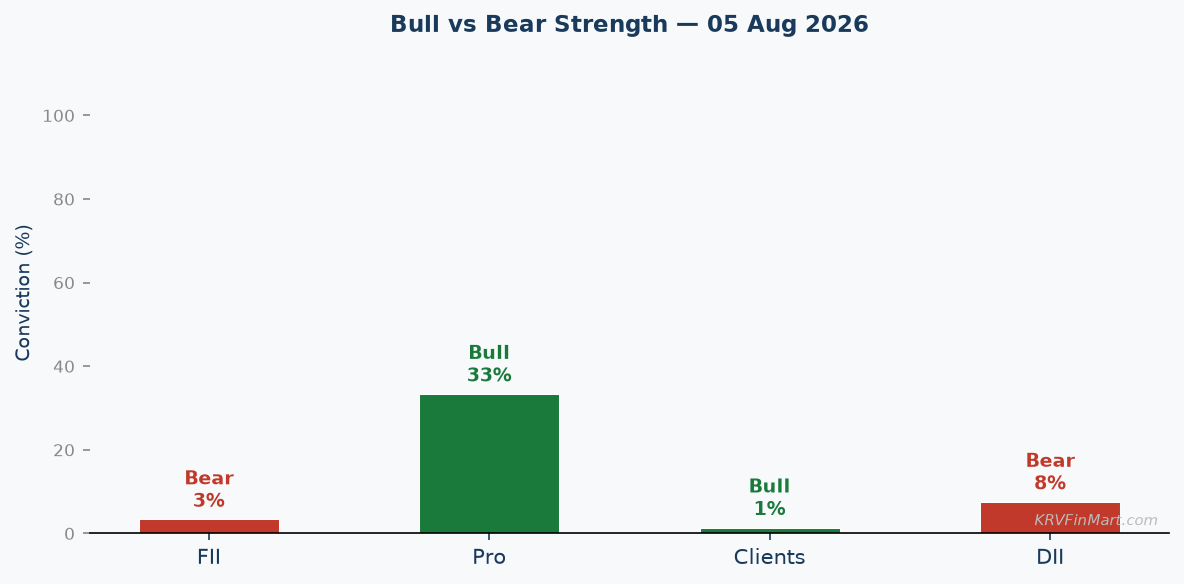
Bull vs Bear Strength by Participant
|
FII
Strongly Bearish 85%
▼▼
|
Clients
Bullish / Options Capped 60%
▲
|
Pro
Cautiously Bullish / Vol Long 55%
▲
|
DII
Mildly Bearish / Hedging 60%
▼
|
Conclusion — Market Outlook for Tomorrow (06 Aug 2026)
The collective participant positioning for 05 Aug 2026 presents a market at a critical structural inflection point. FIIs are the dominant directional anchor with a futures net of -158,903 (7.24:1 short-to-long ratio, High Vol confirmation on shorts), net call short of -228,591, and net put long of +461,172 — a fully assembled three-leg bearish architecture that has been deepening over multiple sessions. DIIs are transitioning from open long to hedged long, with futures net declining from +37,839 to +34,992 and put longs growing to +49,779 — providing marginal market support but no longer acting as a strong bullish counterweight. Pro traders are the key wildcard: they have flipped both call net (+147,214) and put net (+46,669) to positive territory in a single session, constructing a long volatility strangle while compressing their futures net short from -18,363 to -12,240 — suggesting sophisticated positioning for a breakout in either direction. Clients remain leveraged long in futures (+136,151 net) and are running a net short put book (-557,620), creating maximum downside vulnerability if FII’s bearish thesis resolves — the divergence between Client net long futures (+136,151) and FII net short futures (-158,903) is the single largest positioning risk in the market today.
The Overall PCR has fallen sharply from 0.98 to 0.90 (-7.60%), a decisive move away from the 1.0 neutral line and toward a bearish signal. Critically, this PCR decline occurred despite Total OI surging +9.12% — it was driven by call OI expanding at +26.17% versus put OI expanding at only +16.58%, confirming that supply (call writing + call buying) is being positioned heavily above the market. India VIX eased from 12.19 to 12.06 (-1.07%), remaining in a complacency zone — this low VIX in combination with the PCR decline and OI surge is a classic ‘calm before the storm’ setup where participants are loading positions at low cost. The NIFTY CE resistance at 25,000 (Week and Month) has heavy call OI supply being added by FIIs (net -228,591 short calls) and Clients (net +76,116 long calls vs massive short additions), creating a strong ceiling. The NIFTY PE support at 24,000 (Week and Month) has DII put longs (+49,779) and FII put longs (+461,172 net) anchoring demand — but Client’s net short put position (-557,620) means a break below 24,000 could trigger accelerated put-writing pain and forced selling.
The bearish thesis would be invalidated if FII futures net short improves meaningfully toward -145,000 or better in tomorrow’s session — any sign of short-covering from FIIs would signal the bearish campaign is pausing and could trigger a sharp short-squeeze toward CE resistance at 25,000. The bullish thesis requires Overall PCR to recover above 0.95 with put OI additions outpacing call OI additions, alongside a VIX spike above 13.50 that shakes out Client long positions and resets the leverage differential. Until one of these triggers fires, the market is in a high-OI, low-VIX, bearish-PCR range between 24,000 (PE support) and 25,000 (CE resistance) — with the weight of FII structural shorts and falling PCR tilting the near-term probability toward a test of the lower bound.
Scenario 1 — Bull case:
If FII futures net short improves toward -145,000 contracts (i.e., short-covering of ~14,000 contracts) with a Low Vol or Short Covering confirmation tag, combined with Overall PCR recovering above 0.95 driven by put OI additions outpacing calls, the bearish pressure dissipates rapidly. Pro’s long volatility strangle would be harvested on the call side, Client long futures positions would be vindicated, and Nifty could push toward CE resistance at 25,000 — the NIFTY Week/Month call OI wall. This scenario becomes more likely if India VIX drops below 11.50, signalling full market complacency that historically precedes short-covering rallies.
Scenario 2 — Bear case:
If FII futures net short deepens beyond -165,000 contracts (High Vol tag maintained on short buildup) while Overall PCR continues falling below 0.85, the structural bearish architecture intensifies. Client put writers (-557,620 net short puts) come under acute margin stress, forcing defensive covering that creates a negative feedback loop. DII’s transitioning hedge program would accelerate if futures net drops below +30,000. Pro’s put longs (+46,669) begin monetising. The combined pressure targets PE support at 24,000 (NIFTY Week/Month OI support) — a breach of which on a closing basis, with VIX spiking above 14.00, would confirm a trend breakdown and materially larger drawdown.
|
Key Resistance
25,000 (NIFTY CE OI Resistance — Week & Month): FIIs are net short -228,591 call contracts with the heaviest concentration at this strike; Clients have added 620,146 new call shorts today. This double-layer of call supply from both FIIs and Clients creates a formidable ceiling — sustained trade above 25,000 on a closing basis would trigger short-covering across both participant groups and could accelerate upside. For BANKNIFTY, CE resistance at 58,000 (Month) is backed by existing call OI supply.
|
Key Support
24,000 (NIFTY PE OI Support — Week & Month): FIIs hold net +461,172 long put contracts and DIIs hold +49,779 net long puts, creating a powerful demand zone at this strike. However, Client net short puts of -557,620 means a break below 24,000 would cause put-writing pain for Clients, creating a complex dynamic where institutional put longs (FII/DII) may be exercised against Client short puts — amplifying downside volatility on any breach. For BANKNIFTY, PE support at 57,000 (Month) is anchored by existing put OI demand.
|
Trigger to Watch
Overall PCR crossing below 0.85 or recovering above 0.95: A PCR break below 0.85 with Total OI continuing to expand would confirm bearish OI dominance and validate FII’s structural short — target PE support at 24,000. A PCR recovery above 0.95 driven by put OI additions outpacing call OI would signal FII short-covering has begun — target CE resistance at 25,000. Secondary trigger: India VIX spike above 13.50 (from current 12.06) would indicate institutional fear re-entering, likely accompanying a directional break.
|
This analysis is for educational purposes only and is not investment advice.
© KRVFinMart | krvfinmart.com
Responses