
Index Research
Intraday Analysis for 17 Aug 2026
KRVFinMart14 August 202650 min
Educational/Derived AnalysisSource: KRVFinMart Research Desk (End-of-Day)As of 14 Aug 2026, 05:48 PM IST
Intraday Analysis for 17 Aug 2026
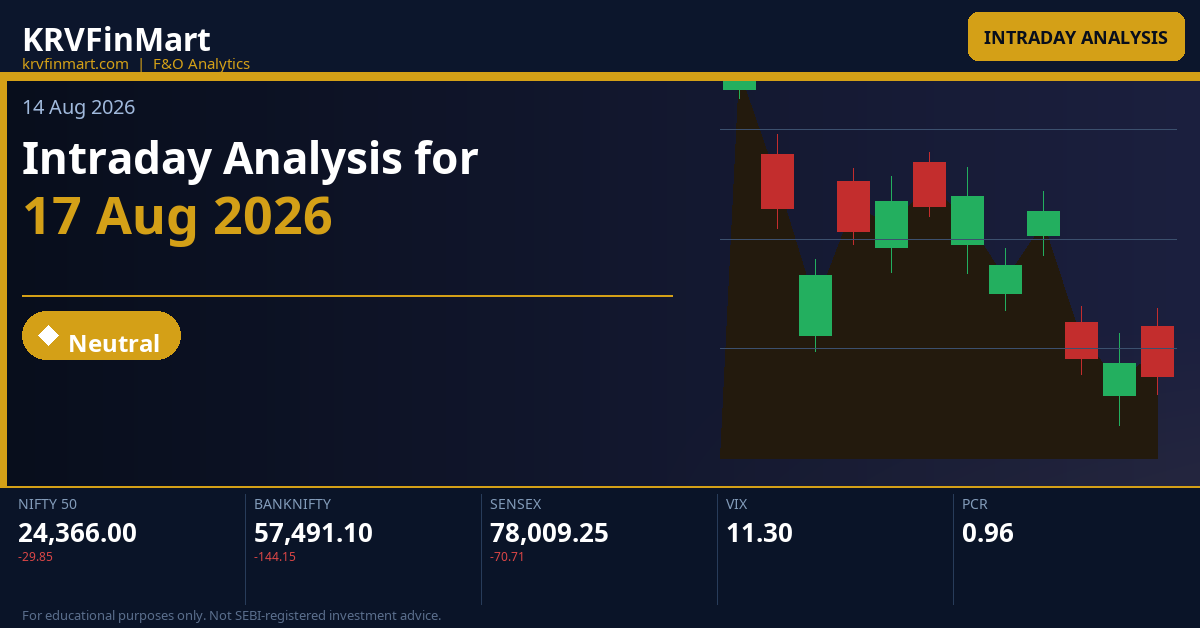
Markets closed marginally lower on 14 Aug 2026, with NIFTY shedding 0.12% to 24,366, BANKNIFTY declining 0.25% to 57,491.10, and SENSEX easing 0.09% to 78,009.25 — a broadly cautious Friday close that sets up Monday (17 Aug 2026) with modest bearish undertones. India VIX data was unavailable for Friday's close, which adds uncertainty to premium pricing; traders should treat options as potentially mispriced until the first 15-minute VIX print after open. Both NIFTY and BANKNIFTY carry Descending Narrow CPRs into Monday, a structural signal that favours trending sessions — the first directional break of the CPR band is likely to define the entire day's trade.
Key Market Signals — Intraday Setup
All three indices closed Friday below their respective weekly CPR midpoints (NIFTY weekly P=24,590.97, BANKNIFTY weekly P=57,782.35, SENSEX weekly P=78,618.06), confirming broad-market weakness heading into Monday. With NIFTY and BANKNIFTY both carrying Descending Narrow CPRs and SENSEX showing an Overlapping Medium CPR, Monday's open positioning relative to TC/BC on each index will be the critical determinant of whether sellers extend control or buyers stage a recovery.
Deep Technical Analysis & Levels
NIFTY
Descending — Narrow (Width 0.04%)
▼ Bearish
Market Structure Trending (up or down trend) | Straddle Weekly ATM 24350 straddle priced at 179.65 pts (Call 125.25 + Put 54.4), implying an expected intraday move of approximately ±179.65 pts from ATM — upside target zone 24,529 and downside target zone 24,170 on a one-standard-deviation basis. The asymmetric skew (Calls costlier than Puts at 125.25 vs 54.4) reflects net directional bullish positioning in near-term premiums even as the spot trend is fractionally bearish, suggesting option sellers are more aggressive on the put side. Monthly straddle at 335.15 pts implies a wider swing channel — traders should note that Monday being early in the expiry week means weekly gamma will dominate intraday moves. | Max Pain Weekly Max Pain at 24,400 (expiry 18-Aug-2026) sits above Friday's close of 24,366 by 34 pts, implying a gravitational pull toward 24,400 as option sellers defend their maximum profit zone — expect concentrated activity between 24,350–24,450 intraday. Monthly Max Pain at 24,450 (expiry 25-Aug-2026) adds a further upside magnet, suggesting the 24,400–24,450 band is a composite OI anchor zone for the week. Sellers will resist sharp moves in either direction away from these anchors, making breakouts above 24,450 or breakdowns below 24,300 more meaningful when they occur. |
Tomorrow's Complete Level Map
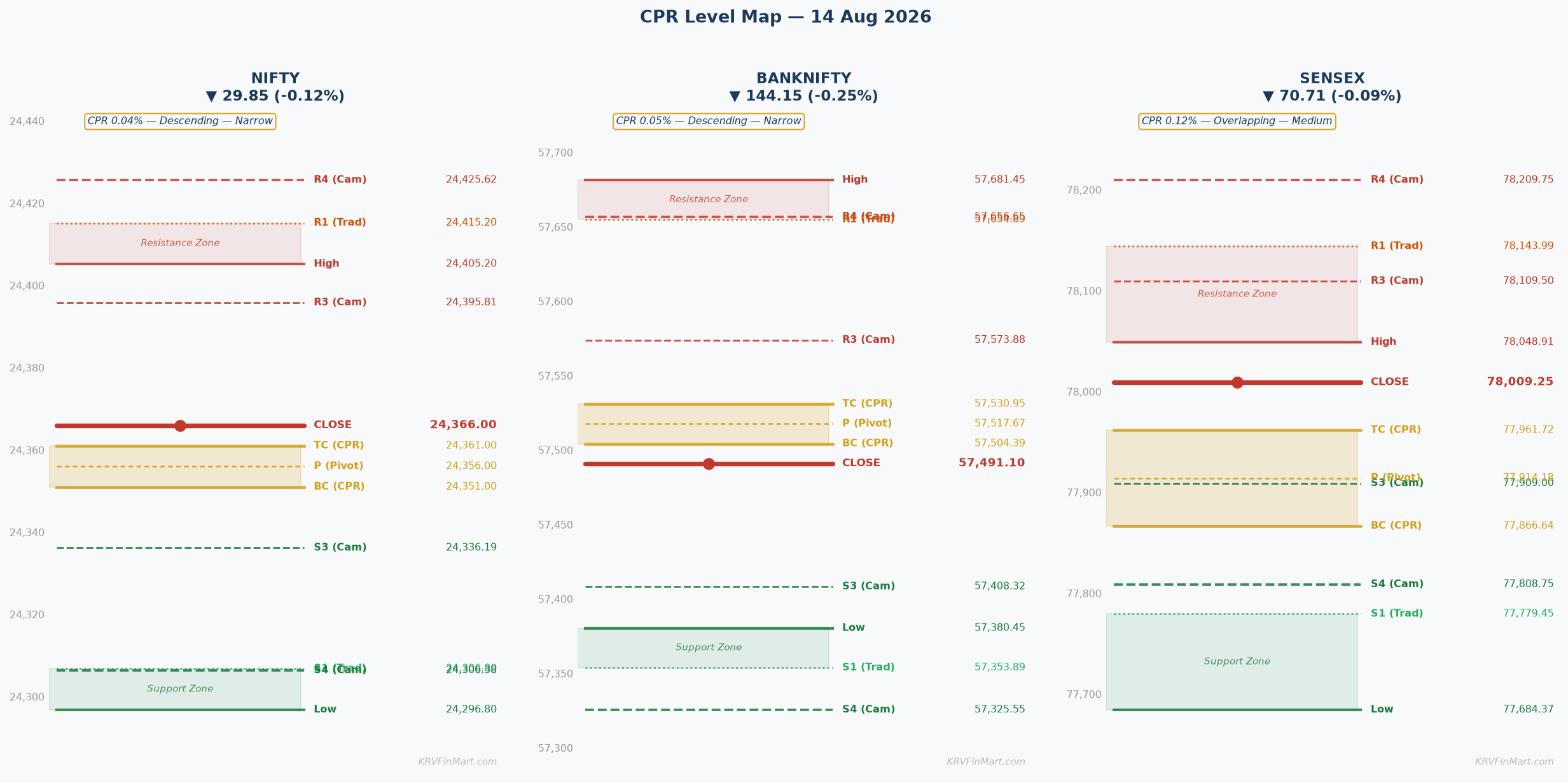
OI-R: 25,000 R3: 24,523.60 H6: 24,474.71 H5: 24,460.44 R2: 24,464.40 H4 ▶: 24,425.62 R1: 24,415.20 PDH: 24,405.20 H3 ↩: 24,395.81
TC: 24,361 P: 24,356 BC: 24,351
L3 ↩: 24,336.19 PDL: 24,296.80 S1: 24,306.80 L4 ▶: 24,306.38 S2: 24,247.60 L5: 24,271.56 L6: 24,257.29 S3: 24,198.40 OI-S: 24,000
↩ = Camarilla reversal point | ▶ = Camarilla breakout/breakdown trigger | OI-R/OI-S = Options wall (CE/PE max OI)
▲ Higher Open (Gap Up) — Open > Prev Close
▲ Bullish
Open lands: With a Descending CPR (TC=24,361 < prev_BC implied from structure), a gap-up open on Monday will place price ABOVE TC at 24,361, i.e., above the entire CPR band — a structurally positive position where the descending CPR band (BC=24,351 to TC=24,361) transforms into immediate support below the open.
CPR role: Launch pad / support band — the narrow CPR band (BC=24,351 to TC=24,361) will act as a firm base on any pullback; holding above TC=24,361 is the minimum bull condition.
Minor Gap (0.05–0.25%) — Structure Dominant
A minor gap up of 0.05–0.25% places NIFTY opening between approximately 24,378–24,427, landing just above TC at 24,361 and within the H3 zone at 24,395.81 — a structurally clean gap that respects the Descending CPR's presence while pressing into the first Camarilla resistance. The Descending Narrow CPR adds confirmation here: price opening above TC=24,361 in a descending CPR is a signal of hidden strength, as buyers have overcome the bearish CPR structure and the CPR band now flips to intraday support. The first target on this minor gap is H3 at 24,395.81, then PDH at 24,405.20, and confirmation of continuation comes with a first 15-minute candle close above H3=24,395.81 on above-average volume, after which R1=24,415.20 and H4=24,425.62 become the next sequential targets.
Significant Gap (0.25–0.5%) — Balanced
A significant gap up of 0.25–0.5% places NIFTY opening between 24,427–24,488, directly into the cluster zone of R1=24,415.20, H4=24,425.62, and R2=24,464.40 — a high-resistance confluence that demands caution on fresh longs at the open. At this gap size, structure and gap influence are balanced: the Descending Narrow CPR structure supports the bullish thesis (price well above TC=24,361) but the opening into Camarilla H4=24,425.62 and Traditional R1=24,415.20 creates an immediate supply zone where short-term profit booking is highly probable within the first 30 minutes. Delta-hedging flows from CE writers near 24,450 and the PDH=24,405.20 overhead will create headwinds — the actionable play is to wait for a 15-minute pullback-and-hold above H3=24,395.81 before initiating longs targeting H5=24,460.44 and R2=24,464.40.
Large Gap (>0.5%) — Gap Direction Dominant
A large gap up of more than 0.5% places NIFTY above 24,488, potentially testing H5=24,460.44, H6=24,474.71, or R3=24,523.60 at open — levels that represent significant Camarilla extension territory where mean-reversion selling tends to dominate. Gap dynamics dominate at this size, overriding the Descending CPR's structural nuance: with price launching into H5–H6 territory (24,460.44–24,474.71), the probability of an immediate gap-fill back toward TC=24,361 or CPR midpoint P=24,356 is elevated, especially in the absence of a VIX catalyst. The straddle premium of 179.65 pts implies a maximum expected range of roughly 24,170–24,530 for the week — a large gap up to R3=24,523.60 would nearly exhaust the weekly expected move in the first minutes of trade, making fade strategies (sell R3, target H4=24,425.62 or TC=24,361) more probable than extension plays targeting OI-R at 25,000.
|
▲ Upside Path → OI-R The sequential upside path from a confirmed gap-up is **TC=24,361 (support) → H3=24,395.81 (first scalp target, partial exit here) → PDH=24,405.20 (prior day high, second resistance, book partial) → H4=24,425.62 & R1=24,415.20 (breakout zone confluence, trail stops to H3) → H5=24,460.44 & R2=24,464.40 (second major target cluster, further partial exit) → H6=24,474.71 → R3=24,523.60 → OI-R=25,000 (ultimate ceiling where CE writing creates a near-impenetrable wall)**. Each successive level requires volume confirmation — a Narrow CPR day with trending structure has high probability of delivering 2–3 legs once H4=24,425.62 is cleared on strong volume, after which momentum can sustain to R2=24,464.40. |
▼ Downside Path → OI-S If the gap-up fails and TC=24,361 is lost on a 15-minute close basis, the first downside station is **P=24,356 (CPR midpoint pivot, minor support) → BC=24,351 (CPR base, critical support) → L3=24,336.19 (Camarilla mean-reversion zone, first bear target) → PDL=24,296.80 & S1=24,306.80 & L4=24,306.38 (triple-cluster bear acceleration zone, all within 10 pts of each other — this is the key breakdown level) → L5=24,271.56 & L6=24,257.29 → S2=24,247.60 → OI-S=24,000 (PE wall)**. Loss of TC=24,361 in a gap-up session is a high-conviction bearish signal because it transforms an expected trending-up day into a trend-reversal, with retail long stops cascading below BC=24,351 accelerating the move toward L3=24,336.19. |
| 🔴 OI-R: **OI-R at 25,000** (highest CE open interest strike for both week and month) represents the dominant ceiling in any gap-up scenario — CE writers have heavily positioned at 25,000, creating a gamma wall that absorbs upside momentum as NIFTY approaches that strike, with delta-hedging selling increasing proportionally as spot nears 25,000. In a minor or significant gap-up scenario, 25,000 is a theoretical target rather than an actionable intraday level (634 pts above Friday close), but it clearly defines that no CE squeeze is imminent — meaning gap-up moves will face natural supply at every Camarilla resistance level well before 25,000 becomes relevant. | 🟢 OI-S: **OI-S at 24,000** (highest PE open interest strike for both week and month) is not an immediate concern in a gap-up scenario — it sits 366 pts below Friday's close and well below PDL=24,296.80 — but it defines the absolute floor of PE-writing conviction, meaning any intraday dip that remains above 24,000 will face PUT buying support that prevents catastrophic intraday declines. PE holders will defend 24,000 aggressively, making it the ultimate abort level for intraday bears — as long as the session trades above 24,200 (S3=24,198.40), the OI-S floor is not under threat. |
⚡ Key Trigger: The primary trigger for a gap-up session is a **first 15-minute candle close above TC=24,361** (confirmed since open is already above TC in all gap-up scenarios, this effectively means holding TC=24,361 as support on the first 15-min low) — any 15-min candle that closes above H3=24,395.81 on above-average volume signals genuine institutional buying and unlocks R1=24,415.20 as the first partial profit target. If the first 15-minute candle fails to hold TC=24,361 as support and closes back inside the CPR band (below TC=24,361), the gap-up is classified as a bull trap and the session bias flips bearish toward L3=24,336.19 and then S1=24,306.80.
▼ Lower Open (Gap Down) — Open < Prev Close
▼ Bearish
Open lands: A gap-down in a Descending Narrow CPR setup places the open INSIDE the CPR band (between BC=24,351 and TC=24,361) on a minor gap, or BELOW BC=24,351 on a significant/large gap — in either case, the entire CPR band sits as overhead resistance, reinforcing the bearish Descending CPR structure.
CPR role: Overhead resistance — the narrow CPR band (BC=24,351 to TC=24,361) acts as a resistance ceiling on any bounce attempt; the bearish CPR structure means sellers are positioned in this zone and will defend every approach to TC=24,361.
Minor Gap (0.05–0.25%) — Structure Dominant
A minor gap down of 0.05–0.25% places NIFTY opening between 24,306–24,354, landing inside the CPR band or just below BC=24,351 — this is the most dangerous setup because price is in the CPR decision zone with the entire Descending band as overhead resistance. Minor gaps inside a Descending Narrow CPR have a high probability of filling back to TC=24,361 within 30–60 minutes, but the Descending structure means each rally attempt toward TC will face fresh supply from pre-positioned shorts, making the gap-fill a sell-on-strength opportunity rather than a buy signal. The actionable bear trigger is a 15-minute candle close below BC=24,351, which confirms the CPR band has rejected price and activates L3=24,336.19 as the first downside target, followed by the critical triple-cluster at PDL=24,296.80, S1=24,306.80, and L4=24,306.38.
Significant Gap (0.25–0.5%) — Balanced
A significant gap down of 0.25–0.5% places NIFTY opening between 24,245–24,305, breaching BC=24,351 convincingly and placing price near L4=24,306.38, S1=24,306.80, and PDL=24,296.80 — a loaded bear zone that will define whether sellers press further or cover. The failure-and-resume analysis here is critical: if price opens below BC=24,351 and is unable to reclaim BC=24,351 within the first 30 minutes, the CPR band (now firmly overhead) acts as a trap-door that has opened — sellers control and the path leads to L5=24,271.56 and L6=24,257.29. PUT writers who built positions at 24,000 will face assignment risk on further decline, but significant gap downs in a Trending structure with Narrow CPR typically see at least one recovery attempt to BC=24,351 — trade the recovery failure as the primary short setup.
Large Gap (>0.5%) — Gap Direction Dominant
A large gap down of more than 0.5% places NIFTY below 24,244, breaching L5=24,271.56, L6=24,257.29, and threatening S2=24,247.60 — levels that represent serious panic territory where institutional buyers typically step in with program buying near S2–S3 (24,247.60–24,198.40). Panic-versus-recovery dynamics dominate at this gap size: the absence of VIX data means premium pricing at open will be volatile, and early straddle monetisation (selling inflated premiums in first 5 minutes) is a consideration for experienced option traders. The recovery level to watch is BC=24,351 — if NIFTY stabilises and reclaims BC=24,351 within 60 minutes of a large gap down, the setup flips to a V-shaped recovery trade targeting P=24,356 and TC=24,361, with the straddle's 179.65 pt weekly implied move suggesting this gap would already be pricing in a 2-sigma event for the weekly expiry cycle.
|
▲ Upside Path → OI-R Recovery path from a gap-down session: **Open → BC=24,351 (first resistance on bounce, 15-min close required) → P=24,356 (CPR midpoint, second hurdle) → TC=24,361 (full CPR recovery, key bull confirmation level) → H3=24,395.81 (Camarilla recovery target, book partial) → PDH=24,405.20 (prior day high, strong resistance) → R1=24,415.20 & H4=24,425.62 (full recovery zone, session neutralised)**. Genuine recovery is confirmed by a 15-min close above TC=24,361 on strong volume — without this, all bounces within the CPR band are dead-cat territory and should be sold. |
▼ Downside Path → OI-S Bear continuation path: **BC=24,351 (overhead resistance confirmed) → L3=24,336.19 (Camarilla mean-reversion, first bear scalp target, book partial) → L4=24,306.38 & PDL=24,296.80 & S1=24,306.80 (critical triple-cluster, major support, partial cover here) → L5=24,271.56 (Camarilla extension, aggressive bear target) → L6=24,257.29 & S2=24,247.60 → S3=24,198.40 → OI-S=24,000 (PE wall, ultimate bear target)**. Retail stop-losses placed below PDL=24,296.80 will cascade into L4=24,306.38, likely creating a sharp leg lower to L5=24,271.56 — this is the highest-velocity segment of the downside path on a trending day. |
| 🔴 OI-R: **OI-R at 25,000** in a gap-down scenario becomes a distant irrelevance for intraday purposes — 634+ pts above a gap-down open — but it remains the reason why CE writers are comfortable adding shorts on any bounce, knowing that the 25,000 CE writing wall suppresses any directional recovery above 24,500. The CE writing pressure at 25,000 means that gap-down recovery rallies lose momentum well before approaching 24,500, let alone 25,000, reinforcing the sell-on-bounce strategy for the day. | 🟢 OI-S: **OI-S at 24,000** is the PRIMARY bear target and PUT monetisation zone in a gap-down scenario — 366 pts below Friday's close, representing a meaningful but reachable target on a large gap-down day with trending market structure. PE holders who built positions at 24,000 will begin partial profit-taking as NIFTY approaches 24,100–24,000 (S5=24,100 is the Traditional fifth support), and this covering creates a natural cushion near 24,000 — making it the zone to exit short positions and avoid overstaying the bear trade. |
⚡ Key Trigger: The dual-sided trigger for a gap-down session: **Bear confirmation — failure to reclaim BC=24,351 within the first 30 minutes (two 15-min candles closing below BC=24,351) confirms bearish control and activates L3=24,336.19 as the immediate target**; **Bull trigger — a 15-minute candle close back ABOVE TC=24,361 signals a bear trap and initiates recovery buying toward H3=24,395.81 and the PDH=24,405.20**. The asymmetry is important: with a Descending Narrow CPR and trending market structure, the bear confirmation path (CPR as resistance) is structurally the higher-probability outcome, making reclaim of TC=24,361 the required proof for bulls rather than the default expectation.
◆ Near Flat Open — Open ≈ Prev Close (±0.05%)
◆ Neutral
Open lands: A flat open of ±0.05% places NIFTY between 24,354–24,378, which in a Descending Narrow CPR means price opens AT or just above TC=24,361 — the CPR type prescribes that a flat open in a descending setup lands near TC, with the entire narrow CPR band (BC=24,351 to TC=24,361) acting as the immediate battleground.
CPR role: Decision zone / compression band — the 10-pt wide CPR (BC=24,351 to TC=24,361) is the highest-information zone of the day; the first directional break of this band, confirmed on a 15-minute candle close, is the primary trade signal for the entire session.
Near Flat (±0.05%)
Flat opens inside a Descending Narrow CPR (Width=0.04%, BC=24,351 to TC=24,361) are textbook trend-day setup sessions — the CPR is so narrow (just 10 pts wide) that the first 15-minute candle will almost certainly resolve the directional question, and whichever side claims the CPR band becomes the dominant force for the entire day. The Descending CPR structure means sellers carry the structural edge: the entire CPR band is technically below yesterday's implied open zone, and the market must prove buyer dominance by closing above TC=24,361 on the first 15-minute candle — failure to do so hands control to sellers. With a Width of 0.04% (narrowest possible category), this is a statistically high-probability trending day: price rarely oscillates within a 10-pt band in a trending market structure for more than the first 30 minutes, meaning by 9:30 AM the directional bias should be conclusively established. The dual trigger framework: **Bull trigger — first 15-min candle close above TC=24,361 with above-average volume** activates H3=24,395.81 as the first scalp target and confirms buyer control over the Descending CPR's bearish structure; **Bear trigger — first 15-min candle close below BC=24,351** confirms the Descending CPR is acting as a ceiling and sellers are pressing, activating L3=24,336.19 as the first downside target and PDL=24,296.80 as the next key level to breach.
|
▲ Upside Path → OI-R **TC=24,361 (bull trigger, must close above on 15-min basis) → H3=24,395.81 (Camarilla mean-reversion zone, first scalp partial exit — book 30–40% here as this is a common stall point) → PDH=24,405.20 (prior day high, significant resistance, trail stop to H3) → R1=24,415.20 & H4=24,425.62 (confluence zone, second partial exit, trail stop to PDH) → H5=24,460.44 & R2=24,464.40 (Camarilla and Traditional second target cluster) → H6=24,474.71 → R3=24,523.60 → OI-R=25,000 (ultimate ceiling)**. The narrow CPR trending-day dynamic means once H4=24,425.62 is cleared, momentum can sustain to R2=24,464.40 without a major retest. |
▼ Downside Path → OI-S **BC=24,351 (bear trigger, must close below on 15-min basis) → L3=24,336.19 (Camarilla mean-reversion, first bear scalp — partial cover here) → PDL=24,296.80 & S1=24,306.80 & L4=24,306.38 (critical triple-cluster, major support zone — book 40–50% of short position here as this dense cluster creates institutional buying) → L5=24,271.56 & L6=24,257.29 → S2=24,247.60 (second Traditional target) → S3=24,198.40 → OI-S=24,000 (PE wall, ultimate bear target)**. The retail stop cascade below PDL=24,296.80 makes the L4=24,306.38 zone a high-velocity segment — expect accelerated movement once PDL is breached. |
| 🔴 OI-R: **OI-R at 25,000** in a flat-open scenario acts as the distant but dominant CE writing ceiling — CE writers at 25,000 are not immediately threatened by a flat open near 24,366, but their presence suppresses any directional enthusiasm above 24,500, ensuring that even a strong bull day launched from a flat open will encounter increasing CE delta-hedging resistance as it approaches 24,500–24,600 (still well short of 25,000). This OI wall effectively caps the weekly bull thesis and means trend-day moves in a flat-open scenario are more likely to target R2=24,464.40 or R3=24,523.60 than to challenge the 25,000 CE wall. | 🟢 OI-S: **OI-S at 24,000** in a flat-open scenario provides a strong psychological and structural floor — PE writers at 24,000 represent significant premium collected on the downside, and these participants will defend aggressively as NIFTY approaches 24,100–24,000, creating incremental buying support that slows bear momentum in the S3=24,198.40 to OI-S=24,000 zone. For intraday bears launching from a flat open at 24,366, reaching OI-S=24,000 (366 pts below) in a single session requires a 1.5%+ decline — possible on a panic day but unlikely in a Narrow CPR trending session unless a fundamental catalyst emerges. |
⚡ Key Trigger: **Bull trigger: First 15-minute candle close above TC=24,361** (with volume above the session average) confirms that buyers have overcome the Descending CPR's bearish structure — this is the structural fulcrum because TC=24,361 is the upper boundary of a CPR that is technically positioned below yesterday's session, meaning any close above it is a counter-trend strength signal. **Bear trigger: First 15-minute candle close below BC=24,351** confirms the Descending CPR is acting as advertised — a resistance ceiling — and sellers are in control, making the entire 10-pt CPR band an overhead trap for any subsequent bounce; the market psychology driving this is that traders who bought the flat open expecting a gap-up will be stopped out below BC=24,351, adding momentum to the initial bearish leg.
BANKNIFTY
Descending — Narrow (Width 0.05%)
▼ Bearish
Market Structure Trending (up or down trend) | Straddle Monthly ATM 57500 straddle priced at 910.15 pts (Call 535.0 + Put 375.15), implying an expected move of approximately ±910 pts from ATM — upside range 58,410 and downside range 56,590 on a monthly basis. The call-heavy skew (535.0 vs 375.15) suggests option market makers are pricing more upside risk despite the bearish close, possibly reflecting hedging demand or residual directional flow from Friday's session. For Monday specifically, weekly straddle data isn't separately listed for BANKNIFTY but the monthly 910 pt range provides context — intraday moves exceeding 500 pts in either direction should be treated as significant and may signal straddle monetisation opportunities. | Max Pain Monthly Max Pain at 57,800 (expiry 25-Aug-2026) sits 308.9 pts above Friday's close of 57,491.10 — a meaningful gravitational pull that favours upside drift toward 57,800 during the week. This Max Pain level coincides closely with the weekly CPR BC=57,764.40 and weekly CPR TC=57,800.30, creating a powerful confluence zone at 57,800 that represents the primary weekly magnet for option sellers' maximum profit. Intraday dips that hold above OI-S=57,000 and rally toward 57,800 align with the Max Pain thesis and should be monitored for short-covering flow. |
Tomorrow's Complete Level Map
OI-R: 58,000 R3: 57,955.89 H6: 57,792.68 H5: 57,753.33 R2: 57,818.67 H4 ▶: 57,656.65 R1: 57,654.89 PDH: 57,681.45 H3 ↩: 57,573.88
TC: 57,530.95 P: 57,517.67 BC: 57,504.39
L3 ↩: 57,408.32 PDL: 57,380.45 S1: 57,353.89 L4 ▶: 57,325.55 S2: 57,216.67 L5: 57,228.87 L6: 57,189.52 S3: 57,052.89 OI-S: 57,000
↩ = Camarilla reversal point | ▶ = Camarilla breakout/breakdown trigger | OI-R/OI-S = Options wall (CE/PE max OI)
▲ Higher Open (Gap Up) — Open > Prev Close
▲ Bullish
Open lands: In a Descending Narrow CPR, a gap-up open places BANKNIFTY ABOVE TC=57,530.95 — above the entire CPR band (BC=57,504.39 to TC=57,530.95). This is structurally significant because the Descending CPR had positioned the entire band below the prior session's implied reference, so opening above TC=57,530.95 represents a direct counter to the bearish CPR structure and signals overnight buying conviction.
CPR role: Launch pad / support band — the CPR band (BC=57,504.39 to TC=57,530.95) immediately becomes intraday support on a gap-up; any pullback that holds above TC=57,530.95 confirms bull control and the CPR acts as a springboard for the next leg higher.
Minor Gap (0.05–0.25%) — Structure Dominant
A minor gap up of 0.05–0.25% places BANKNIFTY opening between approximately 57,520–57,635, landing just above TC=57,530.95 and pressing toward H3=57,573.88 — a tight, constructive open that aligns with the Descending CPR's hidden-strength signal when price holds above TC. The narrow CPR (width 0.05%, just 26.56 pts from BC=57,504.39 to TC=57,530.95) means the first 15-minute candle will quickly resolve whether TC=57,530.95 is genuine support or a failed breakout — the Descending structure adds weight to the bull thesis only if this level holds. The first target is H3=57,573.88 (first scalp partial), then PDH=57,681.45 and the H4=57,656.65 / R1=57,654.89 cluster — confirmation requires a first 15-minute candle close above H3=57,573.88 on above-average volume, after which H4=57,656.65 becomes the primary intraday target.
Significant Gap (0.25–0.5%) — Balanced
A significant gap up of 0.25–0.5% places BANKNIFTY opening between 57,635–57,779, directly into the H4=57,656.65, R1=57,654.89, PDH=57,681.45 cluster and approaching H5=57,753.33 — a complex resistance zone where multiple pivot levels converge within a 130-pt range. Opening into this dense cluster (R1=57,654.89, H4=57,656.65, PDH=57,681.45, H5=57,753.33) creates immediate supply pressure as CE writers near 58,000 begin delta-hedging — the risk of a sharp first-30-minute pullback to TC=57,530.95 is elevated. The actionable strategy is to wait for a 15-minute pullback and hold above TC=57,530.95, then enter longs targeting H5=57,753.33 and R2=57,818.67, while noting that OI-R=58,000 is just 221–365 pts above the gap-up open and represents a powerful intraday ceiling that limits upside extension.
Large Gap (>0.5%) — Gap Direction Dominant
A large gap up of more than 0.5% places BANKNIFTY above 57,779, potentially opening near H5=57,753.33, H6=57,792.68, R2=57,818.67, or even directly challenging OI-R=58,000 — a scenario where gap dynamics completely override the Descending CPR's structural bias. At these levels, BANKNIFTY would be opening essentially at or above the monthly Max Pain of 57,800 and the critical OI-R=58,000 CE wall, creating a near-certain mean-reversion setup — CE writers at 58,000 will defend aggressively, and the straddle's monthly 910 pt range would be partially consumed at the open. The fade strategy (sell H6=57,792.68 or OI-R=58,000 targeting H4=57,656.65 and TC=57,530.95) carries the highest probability in this scenario, with the abort level for the fade being a 15-min close above 58,000 (OI-R).
|
▲ Upside Path → OI-R **TC=57,530.95 (support, must hold) → H3=57,573.88 (first partial exit, 30% position) → PDH=57,681.45 & H4=57,656.65 & R1=57,654.89 (major confluence breakout zone, second partial, trail stop to H3) → H5=57,753.33 (Camarilla extension target) → H6=57,792.68 & R2=57,818.67 (second major target cluster, this is also near monthly Max Pain 57,800 — significant partial exit here) → R3=57,955.89 → OI-R=58,000 (CE wall, extreme target — do NOT trail above R2 per Narrow CPR width rule)**. The OI-R=58,000 CE writing concentration means momentum stalls sharply above 57,900 and positions should be substantially reduced before approaching 58,000. |
▼ Downside Path → OI-S **If TC=57,530.95 fails: → P=57,517.67 → BC=57,504.39 (CPR base, last support) → L3=57,408.32 (Camarilla mean-reversion, first bear target, partial cover) → PDL=57,380.45 (prior day low, key support) → S1=57,353.89 & L4=57,325.55 (bear acceleration cluster) → L5=57,228.87 & S2=57,216.67 (Camarilla and Traditional second target) → L6=57,189.52 → S3=57,052.89 → OI-S=57,000 (PE wall)**. A gap-up that fails and breaks below BC=57,504.39 creates a powerful bull trap that accelerates retail stop-losses toward L3=57,408.32 — this is the highest-velocity segment of the downside path in a failed gap-up scenario. |
| 🔴 OI-R: **OI-R at 58,000** is the dominant intraday ceiling in all gap-up scenarios for BANKNIFTY — CE writers at 58,000 have built the most concentrated call open interest at this strike for the monthly series, creating a gamma wall that generates increasing delta-hedging selling pressure as BANKNIFTY approaches 58,000. In a minor gap-up scenario, OI-R=58,000 is a distant but bounding target (509 pts above open); in a significant or large gap-up, it becomes the immediate fade level — traders should treat every approach to 58,000 as a short-entry opportunity with a stop above 58,100 and target of H4=57,656.65. | 🟢 OI-S: **OI-S at 57,000** in a gap-up scenario is the ultimate floor reference — 491 pts below Friday's close and 530+ pts below any gap-up open — making it irrelevant for intraday bull scenarios unless a dramatic reversal occurs. PE writers at 57,000 provide structural support that effectively eliminates the probability of a close below 57,000 in a gap-up session without a major fundamental shock, and this floor confidence is part of why option sellers can aggressively write calls at 58,000 — they know the downside is anchored. |
⚡ Key Trigger: **Primary bull trigger: First 15-minute candle close above H3=57,573.88** on above-average volume — this level is the structural fulcrum because H3 is the Camarilla mean-reversion zone where the first significant supply cluster resides, and a close above it signals that buyers have absorbed initial resistance and are targeting the H4=57,656.65 breakout zone. **Failure trigger: First 15-minute candle close back below TC=57,530.95** signals a failed gap-up / bull trap and the session flips to a sell-on-bounce structure, with L3=57,408.32 becoming the immediate downside target — this is critical in a Descending Narrow CPR because the bearish structure was only temporarily overridden by the gap, not eliminated.
▼ Lower Open (Gap Down) — Open < Prev Close
▼ Bearish
Open lands: A gap-down in a Descending Narrow CPR places the BANKNIFTY open INSIDE the CPR band (between BC=57,504.39 and TC=57,530.95) on a minor gap, or BELOW BC=57,504.39 on a significant/large gap — in all cases, the Descending CPR band becomes overhead resistance and the structure's bearish predisposition is confirmed by the gap direction.
CPR role: Overhead resistance / bearish trap door — the 26.56-pt wide CPR (BC=57,504.39 to TC=57,530.95) acts as a resistance ceiling on any bounce; sellers who were positioned in the Descending CPR zone will defend every approach to TC=57,530.95 and use it as a short re-entry.
Minor Gap (0.05–0.25%) — Structure Dominant
A minor gap down of 0.05–0.25% places BANKNIFTY opening between approximately 57,347–57,462, landing below BC=57,504.39 and testing the L3=57,408.32 zone immediately — a structurally weak position where the CPR band sits as overhead resistance 70–140 pts above the open. The minor gap in a Descending Narrow CPR has a meaningful gap-fill probability within the first 30–60 minutes (price often retests BC=57,504.39), but the Descending structure means this fill will be met with supply, making the fill itself a short-entry signal rather than a buy trigger. Bear confirmation comes with a 15-minute candle close below L3=57,408.32, activating PDL=57,380.45 and the S1=57,353.89 / L4=57,325.55 cluster as immediate targets — while the bull trigger is a 15-min close above BC=57,504.39, which would suggest the gap was a false breakdown.
Significant Gap (0.25–0.5%) — Balanced
A significant gap down of 0.25–0.5% places BANKNIFTY opening between approximately 57,347–57,347, closer to L3=57,408.32 and even approaching L4=57,325.55 — a zone where the distance to OI-S=57,000 becomes a real intraday consideration (325–408 pts below). The failure-and-resume framework applies: if BANKNIFTY opens near L3=57,408.32 and fails to reclaim BC=57,504.39 within two 15-minute candles, the breakdown is confirmed and the path extends to L4=57,325.55, S1=57,353.89, and then L5=57,228.87. PUT writers who sold 57,000 PEs are now facing delta pressure as the index approaches their strike — this will trigger mechanical delta-hedging (selling futures / buying puts) that ACCELERATES the downside move toward OI-S=57,000, making a quick test of 57,100–57,000 possible in a trending session.
Large Gap (>0.5%) — Gap Direction Dominant
A large gap down of more than 0.5% places BANKNIFTY below 57,204, potentially in the L5=57,228.87 / L6=57,189.52 zone or even threatening OI-S=57,000 — a near-panic scenario where PUT monetisation begins immediately at the open. Panic-versus-recovery dynamics in a large gap-down: BANKNIFTY's higher beta (vs NIFTY) means it can overshoot support levels sharply in the first 15 minutes, creating a V-recovery trade once OI-S=57,000 PE buying kicks in — the straddle's 910 pt monthly range means a large gap down to 57,000 would consume nearly 50% of the monthly expected move in the opening minutes, making premium sales attractive. The recovery trigger is a 15-min close above L3=57,408.32 (post-gap); the failure to achieve this confirms deep bear control and targets S2=57,216.67 and S3=57,052.89.
|
▲ Upside Path → OI-R Recovery path: **Open → L3=57,408.32 (first stabilisation zone) → BC=57,504.39 (first recovery resistance, 15-min close required to confirm) → P=57,517.67 (CPR midpoint) → TC=57,530.95 (full CPR recovery, bull control confirmed) → H3=57,573.88 (first bull target post-recovery) → PDH=57,681.45 & H4=57,656.65 & R1=57,654.89 (full recovery zone) → Max Pain=57,800 and R2=57,818.67 (ideal recovery target aligning with OI gravity)**. Volume must expand on any recovery attempt above BC=57,504.39 — low-volume bounces to BC should be treated as short-entry opportunities. |
▼ Downside Path → OI-S Bear continuation: **BC=57,504.39 (overhead, must not reclaim) → L3=57,408.32 (first bear target, partial cover 30%) → PDL=57,380.45 (prior day low, second support) → S1=57,353.89 & L4=57,325.55 (major bear acceleration cluster, second partial cover 30%) → L5=57,228.87 & S2=57,216.67 (Camarilla and Traditional second target, third partial) → L6=57,189.52 → S3=57,052.89 → OI-S=57,000 (PE wall, maximum bear target)**. Stop-losses from previous session longs placed below PDL=57,380.45 will cascade momentum into L4=57,325.55 — the 55-pt zone from PDL to L4 is the highest-velocity segment in a bear day. |
| 🔴 OI-R: **OI-R at 58,000** in a gap-down scenario becomes the ultimate overhead ceiling that keeps bears confident in their short positions — CE writers at 58,000 have no reason to cover, knowing that a gap-down session starting well below 57,500 makes 58,000 even more distant. The 58,000 CE wall effectively creates a one-way gamma pressure downward: as BANKNIFTY falls from 57,500 toward 57,000, CE delta decay accelerates (calls become further OTM), reducing any natural put-call balancing that might support prices. | 🟢 OI-S: **OI-S at 57,000** is the PRIMARY bear destination and PUT monetisation trigger in all gap-down scenarios — PE writers at 57,000 will begin defensive delta-hedging (selling futures to delta-hedge their short puts) as price approaches 57,100–57,000, paradoxically ADDING to downside pressure before the ultimate floor is hit. Traders should target 57,000 as the maximum bear intraday level and begin covering short positions in the 57,050–57,100 range, as PE buyers will defend the 57,000 strike aggressively and create sharp short-covering bounces precisely at this level. |
⚡ Key Trigger: **Bear confirmation: Failure to reclaim BC=57,504.39 within the first two 15-minute candles (30 minutes) after a gap-down open** — this confirms the Descending CPR is functioning as advertised (bearish ceiling) and the bear path toward L3=57,408.32, then L4=57,325.55 is active. **Bull reversal trigger: A 15-minute candle close above TC=57,530.95** is the minimum required to neutralise the bear thesis — this level is the structural apex of the Descending CPR and reclaiming it after a gap-down is a high-conviction signal that bulls have absorbed all the supply positioned in the bearish CPR band, creating a potential trend-reversal day toward H3=57,573.88 and PDH=57,681.45.
◆ Near Flat Open — Open ≈ Prev Close (±0.05%)
◆ Neutral
Open lands: A flat open of ±0.05% places BANKNIFTY between approximately 57,462–57,520, which in a Descending Narrow CPR (TC=57,530.95) means price opens just BELOW TC=57,530.95 or marginally inside the CPR band — the Descending CPR framework prescribes that a flat open lands near TC, and in this case, the open is at or barely below the CPR's top boundary.
CPR role: Decision zone — the 26.56-pt wide CPR (BC=57,504.39 to TC=57,530.95) is the intraday fulcrum; price is at the exact threshold where a 15-minute close above TC=57,530.95 is bullish and below BC=57,504.39 is bearish, with no ambiguity once the first candle resolves.
Near Flat (±0.05%)
A flat open in BANKNIFTY's Descending Narrow CPR is a setup where the first 15-minute candle IS the entire trading thesis — with the CPR band only 26.56 pts wide (BC=57,504.39 to TC=57,530.95) and a trending market structure, the compression energy will release decisively in one direction before 9:30 AM. The Descending CPR structure gives sellers the structural edge: BANKNIFTY must prove bullish conviction by closing above TC=57,530.95 on the first 15-minute candle, otherwise the default is for the Descending band to act as a ceiling and direct prices toward L3=57,408.32 and PDL=57,380.45. At Width=0.05% (Narrow), this is a statistically high-probability trending session — the 26.56-pt band will be resolved within minutes, and the subsequent directional move could span 200–400+ pts before any significant stall, making this a day to commit to a direction early rather than wait for multiple confirmations. The bull trigger is a first 15-min close above TC=57,530.95 targeting H3=57,573.88 and the critical H4=57,656.65 / R1=57,654.89 / PDH=57,681.45 confluence, while the bear trigger is a 15-min close below BC=57,504.39 targeting L3=57,408.32 and the L4=57,325.55 / S1=57,353.89 bear cluster — with monthly Max Pain at 57,800 and OI-R=58,000 above, the risk-reward for bulls is good if TC is reclaimed, but the Descending structure and Friday's bearish close give bears the initial advantage.
|
▲ Upside Path → OI-R **TC=57,530.95 (bull trigger level, must close above) → H3=57,573.88 (first scalp partial, 30% position exit) → PDH=57,681.45 & H4=57,656.65 & R1=57,654.89 (major confluence resistance cluster, second partial, trail stop to H3=57,573.88) → H5=57,753.33 (Camarilla extension) → H6=57,792.68 & R2=57,818.67 & Max Pain=57,800 (ideal target cluster for bull trend day — substantial partial exit here, this is the OI gravity zone for the week) → R3=57,955.89 → OI-R=58,000 (CE wall, do not trail above R2)**. The Max Pain=57,800 level acts as a gravitational magnet for the week, making R2=57,818.67 the highest-conviction intraday target on a trending bull day. |
▼ Downside Path → OI-S **BC=57,504.39 (bear trigger, 15-min close below) → L3=57,408.32 (Camarilla mean-reversion, first bear target, 30% partial cover) → PDL=57,380.45 (prior day low, second key support) → S1=57,353.89 & L4=57,325.55 (major bear cluster, second partial cover 30%) → L5=57,228.87 & S2=57,216.67 (third target cluster, additional cover) → L6=57,189.52 → S3=57,052.89 → OI-S=57,000 (PE wall, maximum bear target)**. In a flat-open trending day below BC=57,504.39, the move from PDL=57,380.45 to L4=57,325.55 happens with the fastest velocity as retail stop-losses cluster below the prior day's low. |
| 🔴 OI-R: **OI-R at 58,000** in a flat-open scenario provides a clear upside ceiling that actually SUPPORTS the bull case for trend-day moves: knowing CE writers are positioned at 58,000 (508.9 pts above current levels), option sellers will aggressively defend every approach to 58,000 — but this also means a trend day up from flat open has a well-defined maximum target, making position management straightforward. CE writers at 58,000 create increasing delta-hedging selling as price rises above 57,800, so the practical intraday ceiling is closer to R2=57,818.67 / Max Pain=57,800 than the full 58,000 level. | 🟢 OI-S: **OI-S at 57,000** in a flat-open scenario is the ultimate bear target and provides PE-based support — PE writers at 57,000 are approximately 491 pts below the flat open, meaning their defensive hedging only becomes active in the 57,100–57,000 zone. However, knowing this floor exists, intraday bears should pre-plan their exit strategy: begin covering shorts at S3=57,052.89 and exit the majority at OI-S=57,000, as PE buying pressure near 57,000 will create sharp short-covering bounces that can reverse 200–300 pts quickly. |
⚡ Key Trigger: **Bull trigger: First 15-minute candle close above TC=57,530.95 on above-average volume** — this level is the structural fulcrum because it is the upper boundary of a Descending CPR, meaning any close above it directly contradicts the CPR's bearish predisposition and signals institutional buying that has overcome pre-positioned sellers in the 57,504–57,530 band. **Bear trigger: First 15-minute candle close below BC=57,504.39** — this is the most efficient confirmation of a bearish trending day, as the market has validated the Descending CPR's ceiling role, and subsequent bounces to BC=57,504.39 or P=57,517.67 should be treated as short-entry opportunities rather than buying opportunities, with stops above TC=57,530.95.
SENSEX
Overlapping — Medium (Width 0.12%)
◆ Neutral
Market Structure Balanced or transitional | Straddle Weekly ATM 78000 straddle priced at 797.2 pts (Call 470.05 + Put 327.15), implying an expected intraday/weekly move of approximately ±797 pts from ATM — upside range 78,797 and downside range 77,203. The call-heavy skew (470.05 vs 327.15) reflects modest upside bias in premium, but with SENSEX closing at 78,009.25 (essentially at the ATM strike of 78,000), the market is pricing near-perfect ATM symmetry. Monthly straddle at 1219.95 pts provides the wider context — the 797 weekly range is the operative intraday framework. | Max Pain Weekly Max Pain at 78,000 (expiry 20-Aug-2026) exactly matches Friday's close of 78,009.25 and also coincides with OI-S=78,000 (PE max OI strike) — a powerful triple confirmation that 78,000 is the structural anchor for the week. Monthly Max Pain also at 78,000 (expiry 27-Aug-2026), creating a double-expiry Max Pain alignment at the same 78,000 strike that makes this level the most contested ground for Monday's session. Option sellers across both expiries are maximally incentivised to keep SENSEX pinned near 78,000, making excessive directional moves above 78,500 or below 77,500 the trades that require genuine catalyst support. |
Tomorrow's Complete Level Map
OI-R: 80,000 R3: 78,508.53 H6: 78,375.31 H5: 78,326.84 R2: 78,278.72 H4 ▶: 78,209.75 R1: 78,143.99 PDH: 78,048.91 H3 ↩: 78,109.50
TC: 77,961.72 P: 77,914.18 BC: 77,866.64
L3 ↩: 77,909 PDL: 77,684.37 S1: 77,779.45 L4 ▶: 77,808.75 S2: 77,549.64 L5: 77,691.66 L6: 77,643.19 S3: 77,414.91 OI-S: 78,000
↩ = Camarilla reversal point | ▶ = Camarilla breakout/breakdown trigger | OI-R/OI-S = Options wall (CE/PE max OI)
▲ Higher Open (Gap Up) — Open > Prev Close
▲ Bullish
Open lands: SENSEX has an Overlapping Medium CPR where BC=77,866.64 and TC=77,961.72 sit BELOW Friday's close of 78,009.25 — meaning the entire CPR band is below the previous close. A gap-up open on Monday pushes price further above TC=77,961.72, meaning the open lands well above the entire CPR band, which acts as significant underlying support. This is a Balanced/Transitional market structure, adding complexity: the CPR Overlapping type means price may oscillate above and within the CPR band before establishing directional conviction.
CPR role: Support band / launch pad — the CPR band (BC=77,866.64 to TC=77,961.72) is fully below the gap-up open and provides a wide 95-pt support buffer; any pullback that holds above TC=77,961.72 confirms bull control, while a breach of BC=77,866.64 would signal the gap-up is reversing.
Minor Gap (0.05–0.25%) — Structure Dominant
A minor gap up of 0.05–0.25% places SENSEX opening between 78,048–78,204, landing above Friday's close of 78,009.25 and pressing toward PDH=78,048.91 and H3=78,109.50 — levels that represent immediate resistance in this Balanced/Transitional structure. The Overlapping Medium CPR width of 0.12% means Medium confirmation rules apply: a first 30-minute close above H3=78,109.50 is required before pursuing the upside aggressively, with the first partial profit at R1=78,143.99 and the second at H4=78,209.75. The OI-S=78,000 strike coincides exactly with Weekly and Monthly Max Pain at 78,000, and since the gap-up open puts price above 78,000, this support has been activated — any pullback to 78,000 should be treated as a buy-on-dip opportunity with a stop below BC=77,866.64.
Significant Gap (0.25–0.5%) — Balanced
A significant gap up of 0.25–0.5% places SENSEX opening between 78,204–78,399, directly into the H4=78,209.75, R2=78,278.72, and H5=78,326.84 resistance cluster — a dense supply zone 200–400 pts above the previous close that demands caution on fresh longs. The gap-fill risk is elevated here: in a Balanced/Transitional market structure, significant gaps that open into Camarilla H4–H5 territory (78,209.75–78,326.84) face mean-reversion pressure within the first 30 minutes, with the gap-fill target being PDH=78,048.91 and then TC=77,961.72. If the gap holds and SENSEX establishes a 30-minute base above H4=78,209.75, the next targets are H5=78,326.84, H6=78,375.31, and R3=78,508.53 — all meaningful levels before OI-R=80,000 (1,990 pts above, effectively irrelevant intraday).
Large Gap (>0.5%) — Gap Direction Dominant
A large gap up of more than 0.5% places SENSEX above 78,399, potentially at H5=78,326.84, H6=78,375.31, or R3=78,508.53 — levels where the weekly straddle's 797 pt range is being consumed in the first minutes of trade, making straddle selling at the open the primary institutional play. In a Balanced/Transitional structure, large gaps up are particularly prone to rapid mean-reversion because the market is not in a strong trending phase — the first 30 minutes will likely see significant profit-taking as traders who held positions over the weekend exit, creating a sharp pullback to H3=78,109.50 or even PDH=78,048.91. The recovery criterion post-pullback is a 30-minute close above H3=78,109.50 with volume — without this, the large gap is a fade opportunity targeting TC=77,961.72 as the intraday anchor.
|
▲ Upside Path → OI-R **TC=77,961.72 (support floor, must hold) → H3=78,109.50 (Camarilla mean-reversion, 30-min close needed, first partial exit 25%) → PDH=78,048.91 (prior day high, secondary hurdle between TC and H3) → R1=78,143.99 (Traditional first target, second partial 25%) → H4=78,209.75 & R2=78,278.72 (Camarilla breakout zone and Traditional second target — third partial exit, trail stop to R1=78,143.99) → H5=78,326.84 (Camarilla extension) → H6=78,375.31 → R3=78,508.53 (maximum intraday bull target) → OI-R=80,000 (CE wall, multi-session target only)**. Do not trail above R2=78,278.72 per Medium CPR width guidelines — take profits and let the position run only to R3=78,508.53 at maximum. |
▼ Downside Path → OI-S **Failed gap-up: TC=77,961.72 → P=77,914.18 → L3=77,909 (L3 and P are very close at 77,909 and 77,914.18 — this 5-pt zone is the critical first downside stop) → BC=77,866.64 → PDL=77,684.37 & L4=77,808.75 & S1=77,779.45 (major support cluster) → L5=77,691.66 (Camarilla extension) → L6=77,643.19 → S2=77,549.64 → S3=77,414.91 → OI-S=78,000 (this is above current levels — once price falls back to 78,000, this becomes the floor; if price is already below 78,000 from a failed gap, OI-S=78,000 is ABOVE and becomes the ceiling)**. Note the unusual dynamic: OI-S=78,000 matches Friday's close — if price falls back through 78,000 in a gap-up reversal, the 78,000 PE wall transforms from a floor into an overhead magnet. |
| 🔴 OI-R: **OI-R at 80,000** (week and month CE max OI) is a distant but structurally important ceiling in any gap-up scenario — sitting 1,990+ pts above Friday's close, it is not an intraday target but defines the maximum CE writing conviction of the market. The 80,000 CE wall means option sellers are deeply comfortable writing calls throughout the 78,000–79,500 range, knowing 80,000 is a near-impenetrable ceiling — this suppresses intraday upside urgency and explains why gap-up moves in SENSEX tend to stall at H3–H4 (78,109.50–78,209.75) rather than extend to the OI wall. | 🟢 OI-S: **OI-S at 78,000** is the most critical level for Monday's session in a gap-up scenario — this PE max OI strike (for BOTH week and month) exactly matches both Max Pain levels and Friday's close, creating a triple-anchor at 78,000 that makes this the highest-conviction support zone in the market. On a gap-up, 78,000 acts as the buy-on-dip floor: any pullback that holds above 78,000 (i.e., above TC=77,961.72 and the CPR band) confirms the support structure, while a close below 78,000 would be a significant bearish signal given the combined Max Pain + OI-S anchor at this exact strike. |
⚡ Key Trigger: **Primary confirmation: First 30-minute candle close above H3=78,109.50 on above-average volume** — this is the trigger for Medium CPR width sessions, and H3=78,109.50 is the Camarilla mean-reversion resistance where early sellers will be concentrated on a gap-up day. The 30-minute timeframe is essential for the Medium CPR width (0.12%) because retests of TC=77,961.72 and even BC=77,866.64 are expected before the directional move is confirmed; **failure signal: a 30-min close back below TC=77,961.72** converts the gap-up to a failed breakout and activates the bear path toward L3=77,909 and S1=77,779.45.
▼ Lower Open (Gap Down) — Open < Prev Close
▼ Bearish
Open lands: A gap-down in SENSEX's Overlapping Medium CPR (where the CPR band BC=77,866.64 to TC=77,961.72 is already below Friday's close of 78,009.25) places the open either inside the CPR band (minor gap) or below BC=77,866.64 (significant/large gap). The critical additional factor: OI-S=78,000 and both Max Pain levels are at 78,000, meaning a gap-down open that breaches 78,000 is simultaneously breaching the primary PE support wall and both expiry anchor levels — a significant bear signal.
CPR role: Overhead resistance / critical battleground — a gap-down that opens inside the CPR band (between BC=77,866.64 and TC=77,961.72) places price in a no-man's land where the CPR band has not yet confirmed its direction; a gap-down below BC=77,866.64 makes the entire CPR band overhead resistance and activates the bearish path.
Minor Gap (0.05–0.25%) — Structure Dominant
A minor gap down of 0.05–0.25% places SENSEX opening between 77,815–77,970, landing inside the CPR band (between BC=77,866.64 and TC=77,961.72) or just below TC=77,961.72 — and critically, BELOW the OI-S=78,000 and Max Pain=78,000 anchor level for the first time. This is the most nuanced scenario: a minor gap that breaches 78,000 sends a meaningful signal despite its small size, as it breaks below the combined PE support wall (OI-S=78,000), both expiry Max Pain levels, and the CPR's TC=77,961.72 in one move. The 30-minute confirmation rule for Medium CPR applies: a 30-min close below BC=77,866.64 confirms bear control and activates L3=77,909 (note L3 at 77,909 is ABOVE BC=77,866.64 — this means L3 acts as the first intraday support even in a downside scenario), then PDL=77,684.37 and S1=77,779.45 as the primary bear targets.
Significant Gap (0.25–0.5%) — Balanced
A significant gap down of 0.25–0.5% places SENSEX opening between 77,620–77,814, breaching BC=77,866.64 convincingly and landing near L4=77,808.75, S1=77,779.45, or even approaching PDL=77,684.37 — levels that are 200–325 pts below the critical 78,000 OI-S floor. With 78,000 broken (both Max Pain levels AND OI-S at 78,000), this is a structurally bearish setup that will trigger PE delta-hedging (futures selling) from holders of the 78,000 strike, accelerating the downside. The failure-and-resume analysis: if SENSEX opens below BC=77,866.64 and cannot reclaim TC=77,961.72 within 30 minutes, the bearish path extends to L4=77,808.75, L5=77,691.66, PDL=77,684.37, S2=77,549.64, and potentially S3=77,414.91 — with the nearest OI floor now being the 77,000 PE base (not shown but implied by the S3 target zone).
Large Gap (>0.5%) — Gap Direction Dominant
A large gap down of more than 0.5% places SENSEX below 77,620, potentially at L5=77,691.66, L6=77,643.19, S2=77,549.64, or lower — a scenario where the combined Max Pain gravity at 78,000 is severely tested and where weekly straddle sellers face maximum mark-to-market losses. In a Balanced/Transitional structure, large gaps down create recovery opportunities (V-recoveries) when key support levels are reached: L5=77,691.66 and PDL=77,684.37 are the first recovery candidates, with a 30-minute base above PDL=77,684.37 required before reversing. The straddle's 797 pt weekly range implies maximum downside of approximately 77,203 from ATM=78,000 — a large gap near this boundary makes straddle monetisation (selling inflated puts at the open) a consideration for experienced practitioners.
|
▲ Upside Path → OI-R Recovery from gap-down: **Open → L3=77,909 (note: L3 is BETWEEN P=77,914.18 and TC=77,961.72 at 77,909 — this small zone 77,909–77,961 is the first recovery cluster) → TC=77,961.72 (first bull recovery signal, 30-min close required) → P=77,914.18 / OI-S=78,000 zone (recovery of critical 78,000 psychological level) → H3=78,109.50 (first upside target post-recovery) → PDH=78,048.91 → R1=78,143.99 (full recovery zone)**. Genuine recovery is confirmed only by a 30-minute close above TC=77,961.72 — any intraday bounce that fails at TC=77,961.72 or P=77,914.18 should be treated as a dead-cat and short-entry opportunity. |
▼ Downside Path → OI-S Bear continuation: **BC=77,866.64 (must not reclaim) → L3=77,909 (note: L3 at 77,909 is ABOVE BC — this means in the downside path, L3 was already breached before BC, confirming the L3→BC sequence) → PDL=77,684.37 & L4=77,808.75 & S1=77,779.45 (dense support cluster 77,684–77,808, first partial cover) → L5=77,691.66 (Camarilla extension) → L6=77,643.19 & S2=77,549.64 (second target cluster, major cover zone) → S3=77,414.91 → weekly straddle downside anchor ~77,203**. The 78,000 PE support once breached adds downside momentum — PE holders sell futures to delta-hedge, contributing to sell pressure throughout the 77,600–77,800 range. |
| 🔴 OI-R: **OI-R at 80,000** (week and month CE max OI) in a gap-down scenario is completely irrelevant for intraday trading — it sits 2,000+ pts above any gap-down open price, and CE writers at 80,000 are collecting pure premium decay. The distance of OI-R=80,000 from the trading range means there is no meaningful gamma pressure from call writers that would support prices in a gap-down scenario — the entire CE structure provides no intraday floor when SENSEX is trading near 77,500–77,900. | 🟢 OI-S: **OI-S at 78,000** is the MOST CRITICAL level for Monday's session in a gap-down scenario — when SENSEX opens BELOW 78,000 (the PE max OI strike, both Max Pain levels, and the approximate prior close all at this level), it signals that the primary option support floor has been breached. PE writers at 78,000 shift from a stable short-put position to a delta-hedging mode (selling futures proportional to their delta), which ACCELERATES the downside rather than slowing it — this counter-intuitive dynamic means a gap-down below 78,000 can see faster moves toward 77,800–77,700 than expected before the covering bounce eventually materialises near L5=77,691.66. |
⚡ Key Trigger: **Bear confirmation: Two consecutive 30-minute candles closing below BC=77,866.64** after a gap-down — this is the Medium CPR confirmation rule, and BC=77,866.64 is the structural fulcrum because it is the CPR base (the lowest level of the band that separates CPR-zone from below-CPR bearish territory). **Bull reversal trigger: A 30-minute candle close above TC=77,961.72 from a gap-down position** — this is the key level where the Overlapping CPR's Balanced/Transitional structure gives way to bullish control, and specifically reclaiming TC=77,961.72 also means reclaiming territory above the 78,000 OI-S zone (since TC=77,961.72 is only 38 pts below 78,000), effectively restoring the PE support floor.
◆ Near Flat Open — Open ≈ Prev Close (±0.05%)
◆ Neutral
Open lands: A flat open of ±0.05% places SENSEX between approximately 77,970–78,048, which in the context of the Overlapping Medium CPR (BC=77,866.64, TC=77,961.72) means the open lands ABOVE TC=77,961.72 — specifically, about 8–87 pts above TC. The Overlapping CPR structure with price above TC and near OI-S=78,000 / Max Pain=78,000 creates a perfectly balanced situation where neither bulls nor bears have a structural advantage at the open.
CPR role: Decision zone with support — the CPR band (BC=77,866.64 to TC=77,961.72) sits just below the flat open and acts as a support buffer; the 78,000 OI-S / Max Pain level immediately above BC creates a dual-layer support structure (TC=77,961.72 as first support, 78,000 as psychological anchor). The flat open above TC with a Balanced/Transitional structure means the first 30 minutes are informational — the session could go either way.
Near Flat (±0.05%)
A flat open in SENSEX's Overlapping Medium CPR is particularly meaningful because the open lands above TC=77,961.72 but within the 78,000–78,048 zone that coincides with BOTH weekly and monthly Max Pain at 78,000 and OI-S=78,000 — the market opens at maximum option seller equilibrium, which typically results in a pinned, rangebound early session before a directional break. Medium CPR width (0.12%) and Balanced/Transitional market structure together suggest the session will have at least one meaningful retest of TC=77,961.72 or BC=77,866.64 before establishing direction, making the 30-minute confirmation rule essential — do not initiate directional trades on the first 15-minute candle alone. The CPR band spans 95 pts (BC=77,866.64 to TC=77,961.72), and price hovering just above TC=77,961.72 at the flat open creates a natural compression setup: with PDH=78,048.91 as the first upside resistance and TC=77,961.72 as the first downside support, the initial range is only 87 pts wide — any breakout of PDH=78,048.91 with a 30-min close above H3=78,109.50 is bullish, while a 30-min close below TC=77,961.72 (which also means breaking below the 78,000 psychological level with L3=77,909 as the next stop) is bearish. The unique dynamics of the dual Max Pain / OI-S alignment at 78,000 mean that both option expiries are fighting to keep SENSEX pinned near 78,000 throughout the week, making the flat-open scenario the MOST LIKELY of the three for Monday given the combined institutional gravitational pull at exactly 78,000.
|
▲ Upside Path → OI-R **TC=77,961.72 (support just below flat open, must hold) → PDH=78,048.91 (first intraday resistance, minor stall zone) → H3=78,109.50 (30-min close required for bull confirmation, first partial exit 25%) → R1=78,143.99 (Traditional first target, second partial 25%) → H4=78,209.75 & R2=78,278.72 (Camarilla breakout and Traditional second target — third partial, trail stop to R1=78,143.99 per Medium CPR exit rules) → H5=78,326.84 → H6=78,375.31 → R3=78,508.53 (maximum intraday bull target) → OI-R=80,000 (multi-session target only)**. The Max Pain gravitational pull at 78,000 will create friction below 78,100 in the early session — patience with 30-min confirmations is mandatory. |
▼ Downside Path → OI-S **TC=77,961.72 (30-min close below triggers bear) → L3=77,909 (Camarilla mean-reversion, only 52.72 pts below TC — very close, first partial cover) → P=77,914.18 (CPR pivot, already above L3 — this means L3 and P are essentially the same zone; this 77,909–77,914 narrow band is the primary bear trigger cluster) → BC=77,866.64 (CPR base, second support, second partial cover) → PDL=77,684.37 & L4=77,808.75 & S1=77,779.45 (major triple support cluster, third partial) → L5=77,691.66 → L6=77,643.19 → S2=77,549.64 → S3=77,414.91 → OI-S=78,000 (NOTE: OI-S is above these levels — once SENSEX falls below 78,000, the 78,000 OI-S zone becomes OVERHEAD resistance rather than support; the next PE wall below 78,000 is at 77,000 by implication)**. |
| 🔴 OI-R: **OI-R at 80,000** in a flat-open scenario provides the most relevant context for medium-term positioning: CE writers have sold calls at 80,000 for both weekly (expiry 20-Aug-2026) and monthly (expiry 27-Aug-2026) expiries, creating a 1,990 pt ceiling above Monday's flat open that effectively eliminates any concern about upside blow-off for intraday traders. The distant OI-R=80,000 actually SUPPORTS bull positions up to R3=78,508.53 by creating a ceiling-free zone in the 78,000–79,500 range — CE writers are not meaningfully gamma-pressured until SENSEX approaches 79,000–79,500, giving intraday bulls a wide lane above the 78,000 anchor. | 🟢 OI-S: **OI-S at 78,000** in a flat-open scenario is the DEFINING level of the entire Monday session — with SENSEX opening approximately at 78,000 (flat open at 78,009.25 ±0.05% = 77,970–78,048), the OI-S=78,000 PE wall is essentially the OPENING PRICE. PE writers at 78,000 have maximum sensitivity at-the-money: any move below 78,000 triggers aggressive delta-hedging (selling futures), accelerating the downside; any hold above 78,000 means their puts decay rapidly, incentivising them to sell MORE puts (creating a self-reinforcing floor). This dual-directional dynamic from the at-the-money PE concentration at 78,000 is the single most important force for Monday's SENSEX session, and traders should treat 78,000 as the absolute fulcrum — the first 30 minutes above or below 78,000 will define the session's direction with high reliability. |
⚡ Key Trigger: **Bull trigger: First 30-minute candle close above H3=78,109.50 on above-average volume** — H3=78,109.50 is the Camarilla mean-reversion resistance and the first level that, if closed above on a 30-min basis, confirms buyers have overcome both the PDH=78,048.91 resistance and the initial CPR cap, signalling a trending-up session targeting R1=78,143.99 and H4=78,209.75. **Bear trigger: First 30-minute candle close below TC=77,961.72** — this is the structural fulcrum because TC=77,961.72 is the upper boundary of the Overlapping CPR, and falling below it in a flat-open session with Balanced/Transitional structure means the CPR band has absorbed the open's bulls and rejected them, activating L3=77,909 (only 52.72 pts below TC, very close) as the immediate target and signalling bear control for the session with BC=77,866.64 and PDL=77,684.37 as secondary targets.
📊 VIX Insight: India VIX data was unavailable for Friday 14 Aug 2026's close, which creates uncertainty for Monday's option premium pricing — without a VIX reference, traders cannot accurately assess whether implied volatility is elevated (inflated premiums, favour selling) or compressed (cheap premiums, favour buying). As a precaution, treat the first 15 minutes of Monday's session as a VIX discovery period: if OTM options (especially NIFTY 24,200 PE or 24,500 CE) are trading significantly above their theoretical values relative to the straddle benchmarks (NIFTY weekly straddle = 179.65 pts, BANKNIFTY monthly = 910.15 pts, SENSEX weekly = 797.2 pts), VIX has spiked overnight and premium-selling strategies should be deferred; if premiums are in line with or below these straddle levels, VIX is contained and directional strategies have better risk-reward. The absence of VIX data, combined with all three indices closing mildly lower on Friday, suggests a cautious-to-neutral overnight sentiment — until VIX is confirmed at open, default to the CPR structural bias (Bearish for NIFTY and BANKNIFTY, Neutral for SENSEX) as the primary filter.
Overall View:
Monday 17 Aug 2026 opens with a structurally bearish CPR setup for NIFTY (Descending Narrow 0.04%) and BANKNIFTY (Descending Narrow 0.05%), while SENSEX shows a more nuanced Overlapping Medium (0.12%) setup anchored at the critical 78,000 Max Pain / OI-S dual-expiry confluence — taken together, the primary bias for Monday is cautiously bearish with the CPR bands acting as initial resistance for all three indices. The most critical intraday levels to watch are NIFTY TC=24,361 (15-min close above = bull, below BC=24,351 = bear), BANKNIFTY TC=57,530.95 (same framework), and SENSEX 78,000 (30-min close above TC=77,961.72 = bull, below = bear toward L3=77,909 and PDL=77,684.37). Traders should size down in the absence of VIX confirmation, use the first 15–30 minutes purely for direction identification rather than position-building, and respect the OI walls (NIFTY 25,000 CE and 24,000 PE, BANKNIFTY 58,000 CE and 57,000 PE, SENSEX 80,000 CE and 78,000 PE) as the ultimate boundary conditions for any intraday directional thesis.
Monday 17 Aug 2026 opens with a structurally bearish CPR setup for NIFTY (Descending Narrow 0.04%) and BANKNIFTY (Descending Narrow 0.05%), while SENSEX shows a more nuanced Overlapping Medium (0.12%) setup anchored at the critical 78,000 Max Pain / OI-S dual-expiry confluence — taken together, the primary bias for Monday is cautiously bearish with the CPR bands acting as initial resistance for all three indices. The most critical intraday levels to watch are NIFTY TC=24,361 (15-min close above = bull, below BC=24,351 = bear), BANKNIFTY TC=57,530.95 (same framework), and SENSEX 78,000 (30-min close above TC=77,961.72 = bull, below = bear toward L3=77,909 and PDL=77,684.37). Traders should size down in the absence of VIX confirmation, use the first 15–30 minutes purely for direction identification rather than position-building, and respect the OI walls (NIFTY 25,000 CE and 24,000 PE, BANKNIFTY 58,000 CE and 57,000 PE, SENSEX 80,000 CE and 78,000 PE) as the ultimate boundary conditions for any intraday directional thesis.
Disclaimer: KRVFinMart provides educational and informational content relating to financial markets. Articles, research, examples, charts, strategies and tools are provided for educational purposes and should not be interpreted as personalised investment advice or a guarantee of financial performance. Markets involve risk, including possible loss of capital. Past performance does not guarantee future results. KRVFinMart is not a SEBI Registered Investment Adviser or Research Analyst.