
Market Participants Analysis dated 28.07.2026

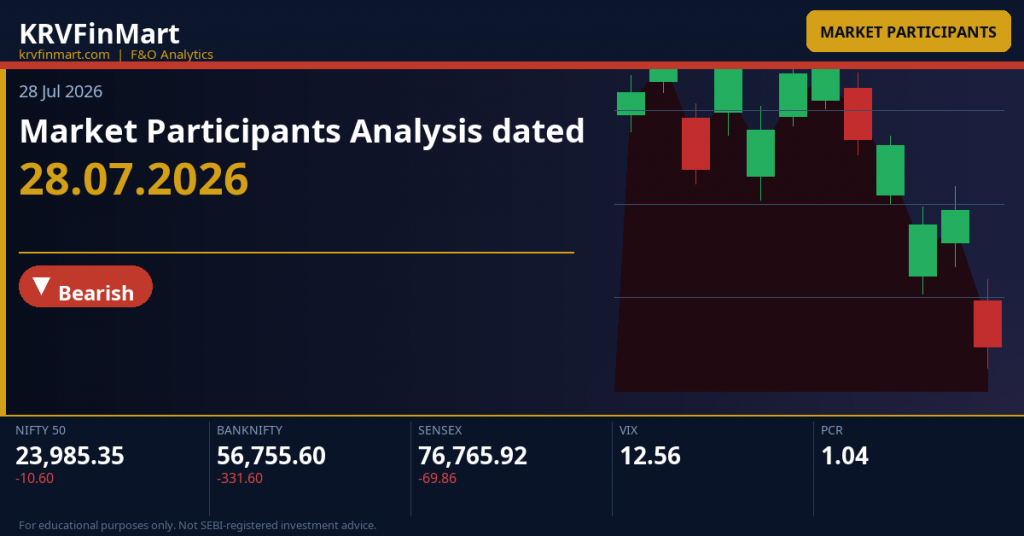
KRVFinMart — Daily Market Outlook
Key Market Signals — Data: 28 Jul 2026
|
NIFTY 50
23,985.35
▼ -10.60 (-0.04%)
|
BANK NIFTY
56,755.60
▼ -331.60 (-0.58%)
|
SENSEX
76,765.92
▼ -69.86 (-0.09%)
|
|
OVERALL PCR
1.04
▼ -0.01 (-0.81%)
PCR slipping below 1.05 — put-call parity eroding; mild bearish tilt as expiry-day OI washout reduces put cushion.
|
INDIA VIX
12.56
▼ -0.10 (-0.77%)
VIX easing from 12.66 to 12.56 — complacency zone; option sellers retain edge, low fear premium persists.
|
TOTAL OI CHANGE
32,076,620
▼ -19,803,700 (-38.17%)
Massive expiry-driven OI collapse of 38.17% — not directional signal; structural unwind post-series expiry.
|
|
FUTURES OI
636,184
▼ -175,370 (-21.61%)
Futures OI fell 21.61% — net unwinding dominates; directional conviction reset as new series begins thin.
|
CALL OI CHANGE
5,195,476
▼ -5,568,193 (-51.73%)
Call OI halved post-expiry — resistance levels to be re-established in fresh series; watch 24,000 CE build.
|
PUT OI CHANGE
5,395,906
▼ -5,874,826 (-52.12%)
Put OI also halved — support levels being freshly re-priced; 23,950 PE holds as key new-series floor.
|
Participant-wise Key Points
FII Moderately Bearish — Covering Shorts But Net Short Dominance Retained
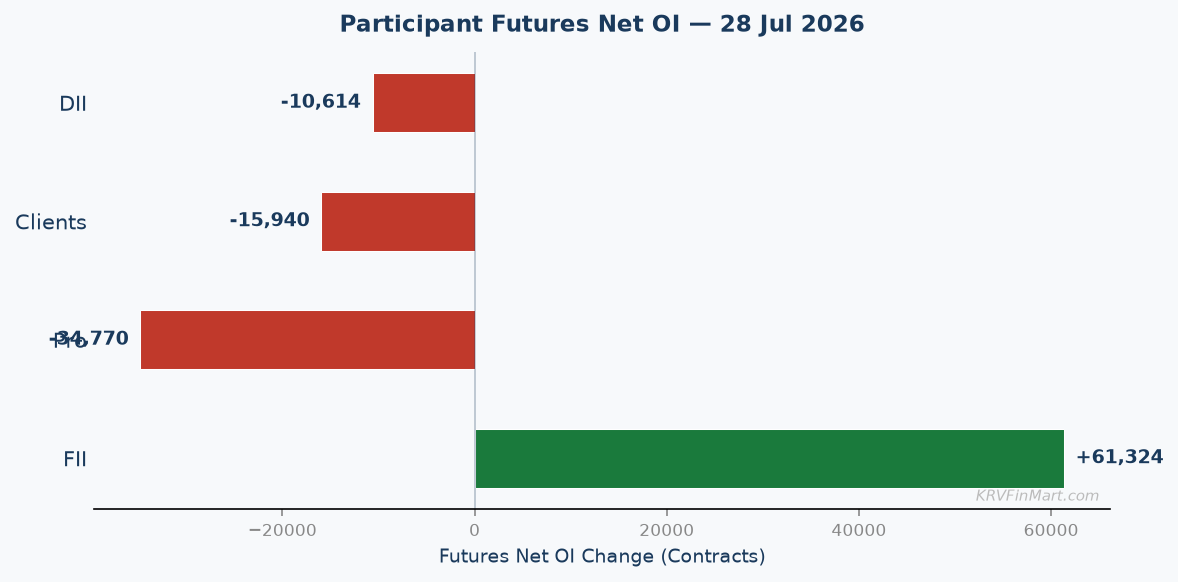
- Futures net improved from -266,925 to -205,601 (net change +61,324). The Long side fell from 28,429 to 21,862 contracts [Long Unwinding – High Vol] and the Short side fell sharply from 295,354 to 227,463 contracts [Short Covering – High Vol]. The High Vol tag on both legs is critical — this is not passive expiry roll-off; FIIs actively closed both long and short futures positions with above-average volume conviction. However, the short reduction of -67,891 contracts far outpaced the long reduction of -6,567 contracts, producing a net improvement of +61,324. Despite this covering, FIIs remain deeply net short at -205,601 contracts, maintaining a short-to-long ratio of approximately 10.4:1 (227,463 shorts vs 21,862 longs). This is not a thesis reversal — it is tactical short-covering on an expiry day, likely to re-establish shorts in the new series at higher strikes.
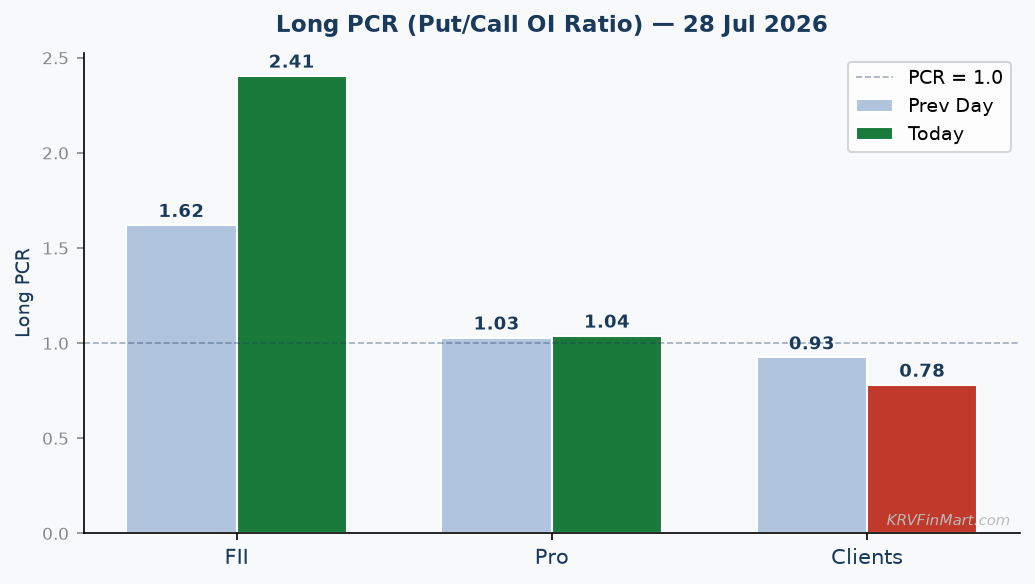
- Long PCR surged from 1.62 to 2.41 (+48.42%) and Short PCR collapsed from 0.70 to 0.38 (-45.19%). The Long PCR of 2.41 is the most extreme reading across all participants today — FIIs now hold 2.41 put longs for every call long, a heavily defensive hedge posture that signals either deep equity book protection or an outright directional bearish view through options. The Short PCR collapse from 0.70 to 0.38 is equally telling: FIIs are now writing more than 2.6x as many calls as puts on the short side, aggressively selling calls to cap upside — a classic range-ceiling strategy that profits if the market stays below the written call strikes. Together, an extreme Long PCR of 2.41 and a collapsed Short PCR of 0.38 form the most internally consistent bearish options posture in today’s dataset.
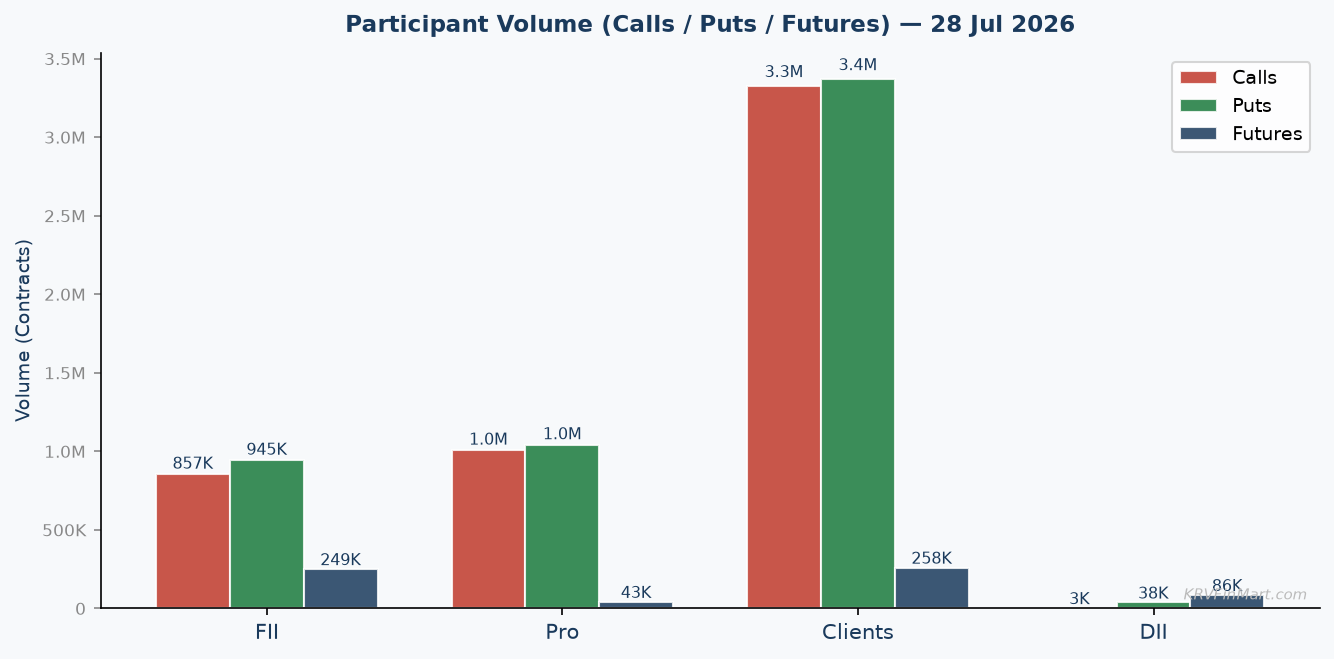
- Call OI net worsened to -247,547 (Long 304,843 [Long Unwinding – High Vol], Short 552,390 [Short Covering – High Vol], net change -22,009). Put OI net improved to +521,900 (Long 733,568 [Long Unwinding – High Vol], Short 211,668 [Short Covering – High Vol], net change +39,851). While both call longs and call shorts were reduced via High Vol unwinding, the net call position deepened by -22,009 — more call-short reduction than call-long reduction means the net short-call book is growing in concentration. On the put side, the long put reduction (-391,322) exceeded put short reduction (-431,173), causing the net long-put position to improve by +39,851. The architecture is clear: FIIs are net short calls at -247,547 and net long puts at +521,900 — a synthetic short overlay that hedges their massive futures short book from two directions simultaneously.
- Synthesis — FII Dual-Leg Synthetic Short Architecture: FIIs present the most coherent and conviction-heavy directional story in today’s dataset. Their futures net of -205,601 (after covering), combined with a Long PCR of 2.41, net short calls of -247,547, and net long puts of +521,900, forms a textbook synthetic short / protective bear spread across all three instruments. The expiry-day short covering of -67,891 futures should not be misread as a bullish flip — it is standard roll management, and the FII short-to-long ratio of 10.4:1 remains extreme. The Long PCR jump of +48.42% in a single session confirms FIIs aggressively added put longs relative to call longs in the new series, reinforcing the bearish forward view. The only mild contradiction is that gross put longs were reduced by -391,322 (Long Unwinding – High Vol), but the net put position still improved because put shorts were reduced even more (-431,173) — this tells us FIIs are selectively retaining their most favourable put longs while exiting expensive or near-expiry ones.
- Forward: The key falsifiable trigger is whether FII futures net crosses back below -220,000 in tomorrow’s data, which would signal fresh short re-establishment in the new series. Additionally, watch whether their Long PCR holds above 2.00 — any drop below 2.00 would indicate FIIs are monetising put longs and reducing hedge, which would be a genuine early signal of a bearish thesis softening. If both futures net deteriorates AND Long PCR stays above 2.00, the bearish case strengthens materially with 23,950 PE support at immediate risk of being tested.
DII Mildly Bearish — Reducing Long Futures, Maintaining Structural Put Longs
- Futures net declined from +65,085 to +54,471 (net change -10,614). The Long side fell from 80,730 to 70,112 contracts [Long Unwinding – High Vol] while the Short side was virtually unchanged at 15,641 contracts [Short Covering – High Vol] (reduction of just -4 contracts). The High Vol tag on Long Unwinding confirms this was a deliberate, above-average-volume reduction of the long futures book — not a thin expiry artefact. DIIs maintain a long-to-short ratio of approximately 4.5:1 (70,112 longs vs 15,641 shorts), confirming their structural long bias in futures is intact, but the net reduction of -10,614 contracts with near-zero short change signals that DIIs are cautiously trimming their bullish futures exposure rather than adding. This is consistent with institutional caution ahead of a new expiry series.
- DII options PCR data is not separately reported in today’s dataset. However, their options net positions provide directional context. DII Call net fell from +7,535 to +3,280 (change -4,255) and Put net fell from +50,521 to +38,077 (change -12,444). The put long book remains dominant at a net of +38,077, which is approximately 11.6x the call long net of +3,280 — this implies a Long PCR equivalent well above 1.0, consistent with structural hedging of a large equity AUM book. DIIs are reducing both call and put long exposure, but put longs are being retained far more proportionally than call longs, indicating they view downside protection as the priority for the new series.
- Call OI net reduced to +3,280 (Long 3,360 [Long Unwinding – High Vol], Short 80 [Short Covering – High Vol], net change -4,255 from prev +7,535). Put OI net reduced to +38,077 (Long 38,202 [Long Unwinding – Avg Vol], Short 125 [Short Covering – High Vol], net change -12,444 from prev +50,521). The Avg Vol tag on put long unwinding is notable — it contrasts with the High Vol tag on call long unwinding, suggesting DII put long reduction was more measured and passive relative to their call reduction. DII gross shorts in both calls (80) and puts (125) are negligible — virtually all DII options exposure is on the long side, confirming a pure protective hedge posture with no meaningful writing activity.
- Synthesis — DII Structural Long with Cautious Hedge Trim: DIIs are classic institutional long-equity participants — their futures net of +54,471 and net put long book of +38,077 both confirm a structurally bullish equity bias with a significant protective hedge. However, the reduction of -10,614 in futures net and -12,444 in put net today signals that DIIs are not adding exposure into the new series — they are trimming the edges of a large, existing long position. This is consistent with cautious portfolio management at the start of a new expiry cycle, not a directional call. The contrast with FII positioning is stark: while FIIs are aggressively net short at -205,601, DIIs are net long at +54,471 — these two institutions are on opposite sides of the futures market, with FIIs holding nearly 3.8x more directional short exposure than DIIs hold long. This imbalance favours FIIs as the dominant directional force.
- Forward: Watch whether DII futures net holds above +50,000 in the next session. A drop below this threshold would signal that DII long-side trimming is accelerating in the new series, removing a key structural support pillar. Conversely, if DII futures net stabilises or recovers toward +60,000 with put longs rebuilding above +40,000, it would signal institutional confidence returning and could partially offset FII bearish pressure around the 23,950 PE support level.
Pro Turning Neutral-to-Bearish — Flipped Net Short in Futures, Balanced Options
- Futures net deteriorated sharply from +32,647 to -2,123 (net change -34,770). The Long side collapsed from 65,692 to 20,281 contracts [Long Unwinding – High Vol] while the Short side fell more moderately from 33,045 to 22,404 contracts [Short Covering – High Vol]. The scale of the long unwinding — -45,411 contracts at High Vol — vastly exceeded short covering of -10,641 contracts, causing Pros to flip from net long to net short for the first time. This is a significant sentiment shift: Pros were the second-largest net long in futures at +32,647 yesterday and are now marginally net short at -2,123. While the -2,123 net is close to flat, the directional trajectory — a -34,770 swing in a single session with High Vol confirmation — is the most aggressive positioning shift among all four participant categories today.
- Long PCR moved from 1.03 to 1.04 (+0.98%) and Short PCR moved from 1.06 to 1.03 (-3.20%). Both PCR ratios are remarkably close to 1.00, confirming that Pros maintain a near-perfectly balanced options book. A Long PCR of 1.04 means Pro traders hold almost equal put and call longs — this is a delta-neutral or straddle-like long posture, capturing volatility rather than expressing direction. A Short PCR of 1.03 on the short side similarly means Pro traders are writing nearly equal calls and puts — consistent with a short strangle or range-writing strategy. The marginal decline in Short PCR from 1.06 to 1.03 suggests a slight shift toward writing marginally more calls than puts, which has a mild bearish tilt, but at these levels the signal is not yet directionally decisive.
- Call OI net reduced to +55,221 (Long 532,086 [Long Unwinding – High Vol], Short 476,865 [Short Covering – High Vol], net change -96,158 from prev +151,379). Put OI net reduced to +63,350 (Long 553,144 [Long Unwinding – High Vol], Short 489,794 [Short Covering – High Vol], net change -58,438 from prev +121,788). Both call and put nets declined, but call net fell by -96,158 versus put net falling by only -58,438 — meaning Pros shed call longs faster than put longs. The result is that the put net (+63,350) now exceeds the call net (+55,221) by +8,129 contracts, a mild tilt toward put longs in the new series. With gross longs and shorts both in the 500K+ range, Pro traders are the dominant options volume participant and their near-balanced book confirms a market-making or volatility-harvesting orientation rather than a pure directional bet.
- Synthesis — Pro Volatility Arbitrage Turning Directionally Bearish at the Margin: Pro traders occupy a unique structural role — their options book is the largest gross OI contributor on both the long and short side simultaneously, confirming their market-making and arbitrage function. However, today’s futures flip from +32,647 to -2,123 is analytically important because it signals that Pros — who typically hedge directional risk precisely — have reduced their long futures hedge significantly while barely touching shorts. This is consistent with reduced delta-hedging demand as their long call positions were unwound. The Long PCR nudging to 1.04 and Short PCR edging to 1.03 means their overall options architecture remains range-bound, but the futures flip to net short combined with faster call-long reduction than put-long reduction introduces a mild bearish skew at the margin. If Pros begin adding put longs or increasing short calls in the new series, it would represent a directional pivot signal worth tracking.
- Forward: The critical threshold to watch is whether Pro futures net crosses below -10,000 in the next session. A move to -10,000 or worse would confirm genuine directional short re-establishment (not just expiry artefact), which historically precedes broader market selling. Additionally, if Pro Short PCR drops below 1.00 (meaning they write more calls than puts), it would confirm a shift from neutral to bearish range-writing, supporting the case that 24,000 CE resistance holds as a ceiling in the new series.
Client Cautiously Bullish — Net Long Futures, Shifting to Net Long Calls
- Futures net declined from +169,193 to +153,253 (net change -15,940). The Long side fell from 230,926 to 205,837 contracts [Long Unwinding – High Vol] and the Short side fell from 61,733 to 52,584 contracts [Short Covering – High Vol]. Long reduction of -25,089 contracts exceeded short covering of -9,149 contracts, causing the net to weaken. Despite this, Clients retain the largest net long futures position of all participants at +153,253 contracts with a long-to-short ratio of approximately 3.9:1 (205,837 longs vs 52,584 shorts). The High Vol tag on both sides confirms these are active, deliberate adjustments — not passive expiry roll-offs. Clients are the structural counterweight to FII shorts: with FII net at -205,601 and Client net at +153,253, the two are the dominant opposing forces in the futures market, with FIIs holding a -52,348 contract net advantage on the short side.
- Long PCR fell from 0.93 to 0.78 (-15.58%) and Short PCR rose from 1.14 to 1.27 (+11.92%). These are the most directionally interesting PCR moves in the Client data. A Long PCR drop from 0.93 to 0.78 means Clients reduced put longs faster than call longs — they are reducing their downside hedge and rotating toward call longs, a bullish signal. The Short PCR rise from 1.14 to 1.27 means Clients are now writing 1.27 puts for every call on the short side — they are selling more puts than calls, which is a bullish bet that the market will stay above the put-writing strikes. Together: reducing put longs + increasing put writing = Clients are expressing confidence that the market will hold or go higher in the new series, the most bullish options posture among all four participants.
- Call OI net improved to +189,046 (Long 1,757,449 [Long Unwinding – High Vol], Short 1,568,403 [Short Covering – High Vol], net change +122,423 from prev +66,623). Put OI net improved to -623,327 (Long 1,373,039 [Long Unwinding – High Vol], Short 1,996,366 [Short Covering – High Vol], net change +31,031 from prev -654,358). The call net improvement of +122,423 — despite gross call longs falling by 1.69 million — occurred because call shorts fell even faster (-1.81 million), leaving Clients with a much stronger net long call position. The put net also improved by +31,031, driven by put shorts (-1,847,745) being reduced slightly faster than put longs (-1,816,714). Clients are the largest gross options participant and their net long calls at +189,046 combined with net short puts at -623,327 creates a bull risk reversal structure — long calls, short puts — which profits on a market move higher.
- Synthesis — Client Bull Risk Reversal with Put-Writing Conviction: The Client participant block is the clearest bullish signal in today’s dataset. A futures net of +153,253, a Long PCR of 0.78 (falling, meaning reducing put hedges), a Short PCR of 1.27 (rising, meaning writing more puts than calls), net long calls at +189,046, and net short puts at -623,327 collectively form a bull risk reversal architecture — the classic position of a participant who believes the market will move higher and is willing to sell put insurance to others. Clients are, in effect, the liquidity provider for FII put longs: FIIs are buying the puts that Clients are writing. This structural opposition means the market is balanced between two high-conviction opposing camps — FII bearish synthetic shorts versus Client bullish risk reversals — and the resolution of this tension will define the next directional move. The falling Long PCR (0.78) is the key differentiator: Clients are not merely bullish by default; they are actively reducing their own downside protection, which is a high-conviction directional bet.
- Forward: The critical trigger for the Client bull case is whether their Long PCR continues to fall toward 0.65 or below in the next session (confirming further put-hedge reduction) while Short PCR holds above 1.25. If Short PCR retreats back below 1.10, it would signal that Clients are closing put-writing positions — potentially because market risk is rising — and the bullish risk reversal would begin to unwind. Watch the 23,950 PE support: if this level is breached on a closing basis, Clients’ short put book becomes loss-making, which would force rapid put unwinding and accelerate a downside move.
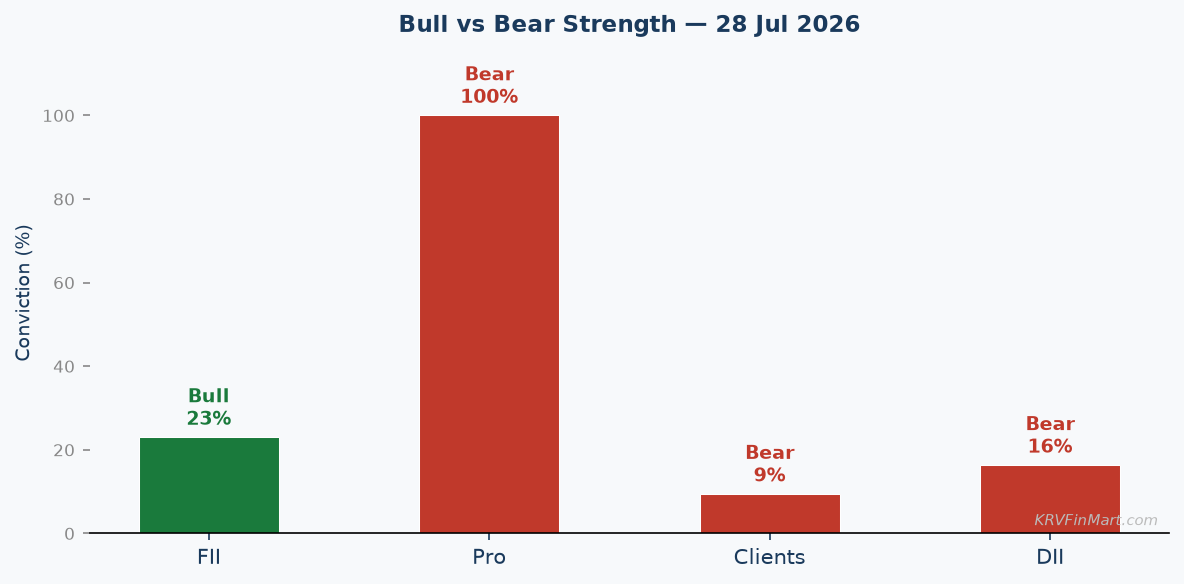
Bull vs Bear Strength by Participant
|
FII
Strongly Bearish — Synthetic Short 82%
▼▼
|
Clients
Cautiously Bullish — Bull Risk Reversal 65%
▲
|
Pro
Neutral to Mildly Bearish 52%
▶▼
|
DII
Mildly Bearish — Trimming Longs 58%
▼
|
Conclusion — Market Outlook for Tomorrow (29 Jul 2026)
The collective participant positioning as of 28 Jul 2026 presents a cautious bearish bias despite the expiry-driven OI collapse distorting the headline numbers. The dominant structural narrative is the FII vs Client opposition: FIIs hold a futures net of -205,601 contracts with a Long PCR of 2.41 and net short calls of -247,547, constructing a multi-leg synthetic short that spans futures, call shorts, and put longs. Against this, Clients hold a futures net of +153,253 with a falling Long PCR of 0.78 and net short puts of -623,327 — a bull risk reversal that profits if the market holds up. DIIs are net long futures at +54,471 but trimming, while Pros have flipped to marginally net short at -2,123 after a -34,770 contract futures net swing — the most aggressive intraday positioning shift of the session. The weight of smart money (FII + Pro) is now aligned on the short side in futures, outnumbering DII and Client longs on a net-adjusted basis.
The Overall PCR declined from 1.05 to 1.04 (-0.81%) on expiry day, which in isolation would suggest mild put-side weakness. However, the structural context matters more: the FII Long PCR of 2.41 (the highest in the dataset) signals aggressive put-long accumulation for the new series, which tends to build a floor of support at key strikes. India VIX fell from 12.66 to 12.56 (-0.77%), remaining in the complacency zone — this suppresses option premiums and benefits option writers. With VIX below 13.00, the market is not pricing meaningful fear, which paradoxically makes any sudden VIX spike toward 14.00+ a high-impact event. The OI support floor at 23,950 PE and resistance ceiling at 24,000 CE define an extremely narrow 50-point range for the new series open — a break in either direction with volume confirmation will be the decisive signal.
The bearish thesis would be invalidated if FII futures net improves meaningfully toward -180,000 or better in the next session (indicating new-series short re-establishment is being avoided), accompanied by a PCR recovery above 1.08 and VIX holding below 12.00. The bullish thesis would accelerate if Client put-writing positions at the 23,950 PE survive intact and Clients begin adding fresh call longs in the new series, pushing their Long PCR toward 0.65 — that combination would confirm the bull risk reversal is gaining conviction and could drive a break above the 24,000 CE resistance ceiling.
Scenario 1 — Bull case:
FII futures net improves toward -180,000 (short covering in new series), Overall PCR recovers above 1.08, and VIX dips below 12.30. Client Short PCR holds above 1.25 confirming continued put-writing confidence. Under this scenario, the 24,000 CE resistance is breached and Clients’ bull risk reversal accelerates, drawing momentum buyers and squeezing FII shorts progressively.
Scenario 2 — Bear case:
FII futures net deteriorates back below -220,000 as new-series shorts are re-established with High Vol confirmation. Overall PCR drops below 1.00, signalling put-side exhaustion. VIX spikes above 13.50, increasing option premiums and forcing Client put-writers to close short put positions. The 23,950 PE support is breached on a closing basis, triggering Client stop-losses and accelerating a move toward 23,800 as the next meaningful OI cluster.
|
Key Resistance
24,000 CE (NIFTY Week & Month) — FIIs are the primary call-writers at this level with a net short call position of -247,547 contracts; Pro traders add secondary call-writing supply. This is a double-layered supply zone where two of the four participant categories are positioned to cap upside.
|
Key Support
23,950 PE (NIFTY Week & Month) — FIIs hold net long puts of +521,900 contracts concentrated around this level; DIIs hold an additional +38,077 net put long position providing structural demand for puts. Clients’ short put book of -623,327 net makes this level existentially critical — a breach forces Client put unwinding, which would amplify the down move.
|
Trigger to Watch
Overall PCR crossing below 1.00 in tomorrow’s session would be the single most important confirmation of a bearish breakout — it would signal that put-side demand has collapsed, Client put-writing is being unwound under pressure, and FII put longs are being exercised or rolled lower. Simultaneously, FII futures net moving below -215,000 (fresh short addition in new series) would confirm the bearish re-establishment thesis.
|
This analysis is for educational purposes only and is not investment advice.
© KRVFinMart | krvfinmart.com
Responses