
Post Market Analysis dated 23.07.2026

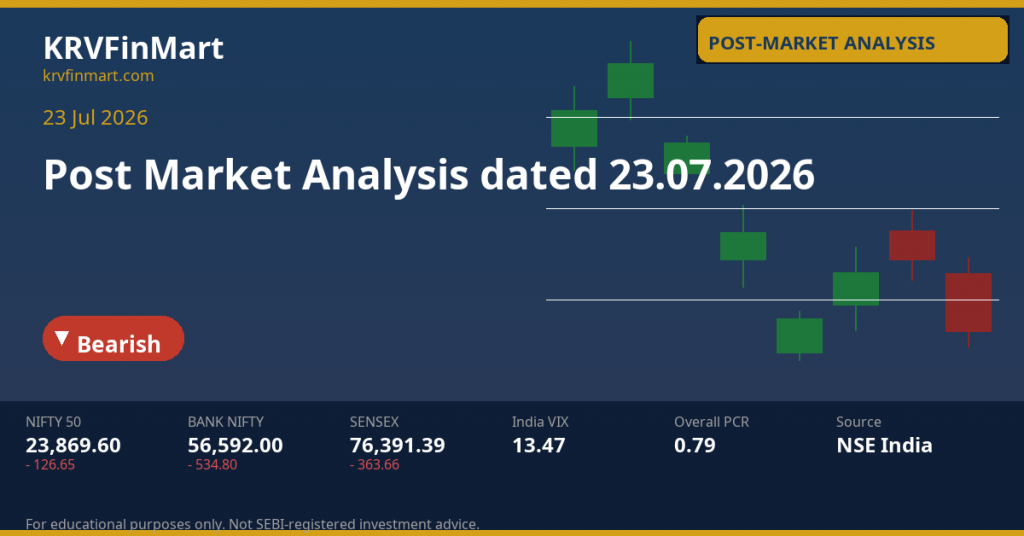
KRVFinMart — Daily Market Outlook
Key Market Signals — Data: 23 Jul 2026
|
NIFTY 50
23,869.60
▼ -126.65 (-0.53%)
|
BANK NIFTY
56,592.00
▼ -534.80 (-0.94%)
|
SENSEX
76,391.39
▼ -363.66 (-0.47%)
|
|
Overall PCR
0.79
▼ 0.05 (-6.33%)
PCR dropped sharply from 0.84 to 0.79 — call OI expanded 12.94% vs put OI’s 5.78%, signalling aggressive call writing or fresh call long addition outpacing put buildup; net bearish tilt gaining momentum.
|
India VIX
13.47
▲ 0.18 (+1.37%)
VIX nudged higher into 13.47 — still in the complacent low-fear zone, but the uptick on a gap-down day warns of latent anxiety; a sustained move above 14.50 would signal regime shift.
|
Total OI Change
50,158,998
▲ +1,247,980 (+2.55%)
Mild but broad OI build of +2.55% — market adding positions cautiously on both sides; not a panic unwind but not a conviction breakout either.
|
|
Futures OI
801,228
▲ +27,798 (+3.59%)
Futures OI up +3.59% with price gapping down and closing inside range — OI build on a down-gap confirms fresh short addition, not short covering; bearish lean in derivatives.
|
Call OI Change
10,610,886
▲ +1,215,424 (+12.94%)
Call OI surged +12.94% — the largest single-day OI expansion among all segments; suggests aggressive call writing (resistance building) or speculative call longs hedging against a bounce.
|
Put OI Change
8,346,344
▲ +456,120 (+5.78%)
Put OI grew +5.78% — meaningful support-side building, but the PCR’s fall shows calls are expanding faster; support is being built but not faster than resistance overhead.
|
Deep Technical Analysis & Levels
Participant-wise Key Points
FII Strongly Bearish — Dual-Leg Conviction
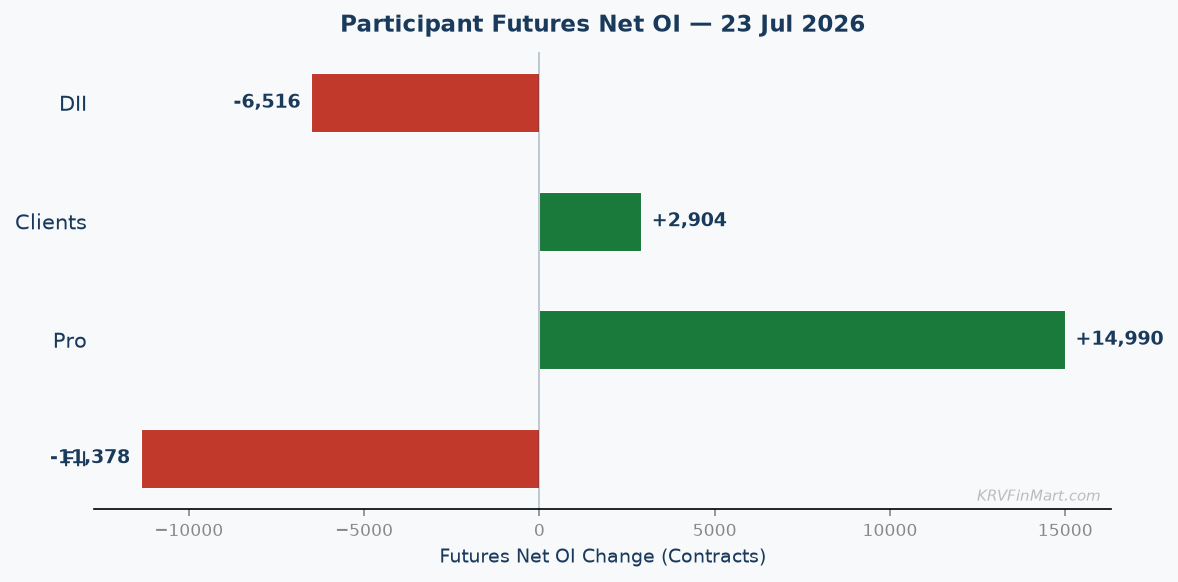
- Futures net deteriorated from -251,704 to -263,082 (net change -11,378; prev -251,704 → today -263,082). The Long side shed 162 contracts (prev 24,436 → today 24,274) tagged [Long Unwinding – High Vol], while the Short side added a massive 11,216 contracts (prev 276,140 → today 287,356) tagged [Short Buildup – High Vol]. The High Vol tag on both legs is critical — it means FIIs were not passively rolling; they were aggressively and deliberately unwinding longs and simultaneously adding fresh shorts with institutional-grade volume conviction. The resulting short-to-long ratio has worsened to 11.8:1 (287,356 shorts vs 24,274 longs), an extreme imbalance that signals not a hedge but a directional macro short of very high conviction.
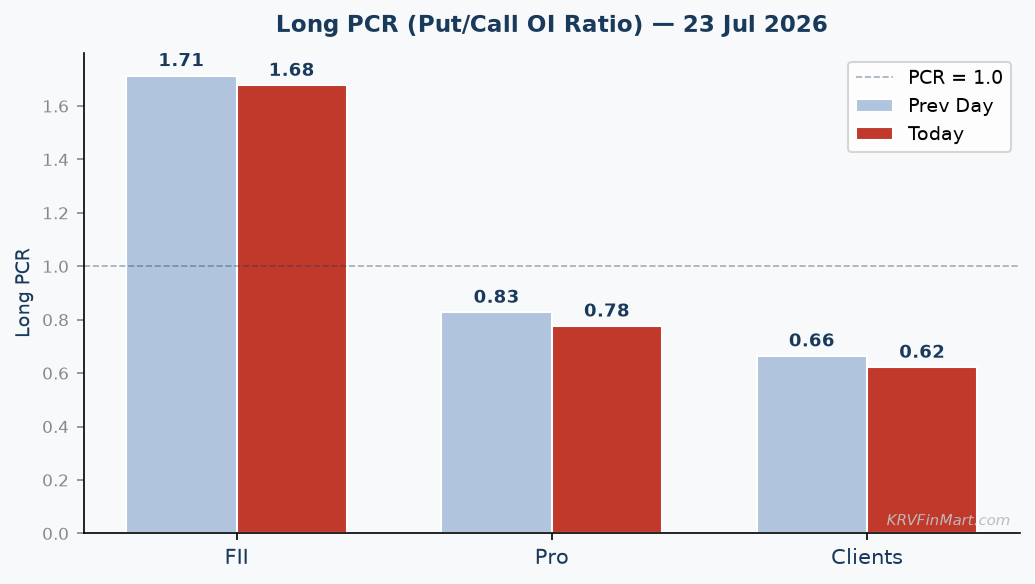
- Long PCR declined from 1.71 to 1.68 (change -2.14%) and Short PCR declined from 0.55 to 0.53 (change -5.15%). The Long PCR of 1.68 still means FIIs hold 68% more put longs than call longs — a deeply defensive/bearish options posture. The fall from 1.71 implies FIIs trimmed their relative put-long edge slightly, but the absolute level remains heavily skewed toward downside protection. The Short PCR of 0.53 — meaning FIIs are writing nearly twice as many calls as puts on the short side — is a call-capping strategy; they are suppressing upside by selling calls, fully consistent with their massive futures short book. The 5.15% decline in Short PCR suggests some call-write positions were closed or adjusted, but the directional read remains unchanged: FIIs are selling into any strength.
- Call OI net moved from -248,973 to -314,487 (change -65,514). Call Longs added 29,709 contracts (prev 588,956 → today 618,665) tagged [Long Buildup – Low Vol], while Call Shorts added a far larger 95,223 contracts (prev 837,929 → today 933,152) tagged [Short Buildup – Low Vol]. Put OI net moved from 544,408 to 546,528 (change +2,120). Put Longs added 28,260 contracts (prev 1,009,374 → today 1,037,634) tagged [Long Buildup – Low Vol], while Put Shorts added 26,140 contracts (prev 464,966 → today 491,106) tagged [Short Buildup – Low Vol]. The Low Vol tags on all four option legs suggest these additions were executed in thinner liquidity windows — possibly spread across strikes rather than concentrated — but the directional architecture is unmistakable: the dominant call-short expansion of 95,223 contracts versus a modest call-long addition of 29,709 creates a net call-short increase of 65,514 contracts, building a ceiling. The near-flat put net (+2,120) shows FIIs are maintaining, not aggressively expanding, their floor protection.
- Synthesis — FII Dual-Leg Bearish Architecture: FIIs are running one of the most internally consistent bearish setups across all four instrument types visible in today’s data. In futures, they added 11,216 fresh shorts at high volume while cutting longs — this is not hedging, this is directional positioning. In options, they are simultaneously writing calls aggressively (95,223 new short call contracts) to cap the upside AND maintaining a large net put-long book (546,528 net puts) to profit from or be protected against a downside move. Together, this constructs a classic synthetic short collar — short futures + short calls + long puts — which profits maximally when the market falls and loses slowly on a sustained rally only above the call strike. What makes this particularly significant is that today’s move was a gap-down that closed inside the prior range — yet FIIs did not cover a single futures short contract; in fact, they added 11,216 more. That refusal to cover on a technically non-confirming day (no PDL breakdown, no panic) is a strong signal that FIIs are positioned for a larger downside move rather than reacting to daily noise. The one internal nuance: the Low Vol tags on all option legs suggest the options positioning was built quietly and methodically, not in a single aggressive burst — this is deliberate accumulation of bearish exposure, not a knee-jerk hedge.
- Forward trigger: Watch whether FII futures net breaks decisively below -270,000 contracts in tomorrow’s data — that would confirm a fresh leg of short addition and would align with a potential test of Nifty’s Day S4 at 23,768.65 and the weekly S1 at 24,100.56. On the upside, if FII futures net improves (shorts reduce) toward -255,000 while Nifty reclaims its Day TC at 23,898.97, it would signal a short-covering episode that could trigger a sharp intraday squeeze — watch the 23,899 TC level as the line in the sand between FII-confirming-bearish and FII-forced-to-cover scenarios.
⟶ Tomorrow: FIIs hold a -263,082 futures net short with an 11.8:1 short-to-long ratio and a call-writing ceiling in place. Tomorrow, watch whether Nifty can reclaim the Day TC at 23,898.97 — a sustained hold above it puts pressure on FII shorts. Any further gap-down or PDL breakdown below 23,807.20 would confirm FII thesis and likely accelerate short addition, targeting 23,768 (Day S4).
Pro Aggressively Bullish Counterplay
- Futures net improved from +13,299 to +28,289 (net change +14,990; prev 13,299 → today 28,289). The Long side surged by 15,562 contracts (prev 44,801 → today 60,363) tagged [Long Buildup – High Vol], while the Short side added only a modest 572 contracts (prev 31,502 → today 32,074) tagged [Short Buildup – Avg Vol]. The High Vol tag on the long buildup versus only Average Vol on the short side is a stark contrast — Pros added long futures with institutional conviction while their short addition was tentative. This is not a hedged two-sided play; the net shift of +14,990 contracts represents Pros taking the other side of FII’s shorts, essentially acting as the market’s shock absorber and contrarian buyer.
- Long PCR declined from 0.83 to 0.78 (change -6.22%) and Short PCR declined from 0.77 to 0.70 (change -8.87%). Both PCRs falling simultaneously is a nuanced signal: the Long PCR falling means Pros are holding relatively more call longs than put longs — a bullish options lean. The Short PCR falling from 0.77 to 0.70 means they are now writing significantly more calls than puts on the short side, which at first glance looks bearish, but combined with their large long futures position, this is more likely covered call writing — a strategy to collect premium while long futures provide the underlying exposure. The 8.87% fall in Short PCR is the sharpest decline of any participant today and warrants monitoring.
- Call OI net moved from +69,005 to +139,845 (change +70,840). Call Longs added 149,624 contracts (prev 1,084,005 → today 1,233,629) tagged [Long Buildup – Low Vol], while Call Shorts added 78,784 contracts (prev 1,015,000 → today 1,093,784) tagged [Short Buildup – Low Vol]. Put OI net moved from +113,272 to +187,652 (change +74,380). Put Longs added 60,310 contracts (prev 897,069 → today 957,379) tagged [Long Buildup – Low Vol], while Put Shorts reduced by -14,070 contracts (prev 783,797 → today 769,727) tagged [Short Covering – Low Vol]. The combination of net call-long expansion (+70,840) and net put-long expansion (+74,380) while simultaneously covering put shorts creates a distinctly bullish options tilt — Pros are buying both calls for upside participation AND buying puts for downside insurance, while reducing their put-short book. This is a long strangle / protective long architecture, betting on volatility resolution to the upside.
- Synthesis — Pro Contrarian Long Against FII Shorts: Pros are running the mirror image of the FII playbook today, and doing so with conviction. They added 15,562 long futures contracts at high volume — directly absorbing FII’s short addition — while their options book shows expanding net call longs and expanding net put longs with put short covering. This combination — long futures + net long calls + net long puts with put-short reduction — is a leveraged long with VIX hedge structure: Pros want to be long the market’s recovery while protecting against the possibility that FII’s bearish thesis proves correct. The Low Vol tags across all option legs suggest this is being built gradually rather than in a single block, consistent with algorithmic or spread-based accumulation. Critically, Pros have nearly doubled their futures net long from 13,299 to 28,289 in a single session, a 112% expansion — this is not incremental positioning, it is a material thesis bet. The internal consistency is strong: long futures, long calls, long puts, short put reduction — all align toward a bullish-with-hedges conviction.
- Forward trigger: Watch whether Pro futures net pushes above +35,000 contracts tomorrow — that level would indicate continued accumulation and a potential squeeze setup against FII’s short book. The critical technical level is Nifty’s Day R3 at 23,920.08 — if Nifty opens and sustains above that level with Pro longs expanding, it signals Pros are getting confirmation and could trigger a gap-fill recovery toward 23,970.55 (Day R4). Conversely, if Pro futures net reverses below +20,000, it signals they are backing off the contrarian bet and FII shorts gain the upper hand.
⟶ Tomorrow: Pros nearly doubled their futures net long to +28,289 in a single day, directly countering FII shorts. Watch whether Nifty can hold above the Day BC at 23,879.39 at tomorrow’s open — a hold here with Pro longs expanding toward +35,000 sets up a squeeze toward 23,920 (R3) and 23,971 (R4). A failure at BC would validate FII’s bearish thesis.
Clients (Retail) Mildly Bullish Futures, Confused on Options
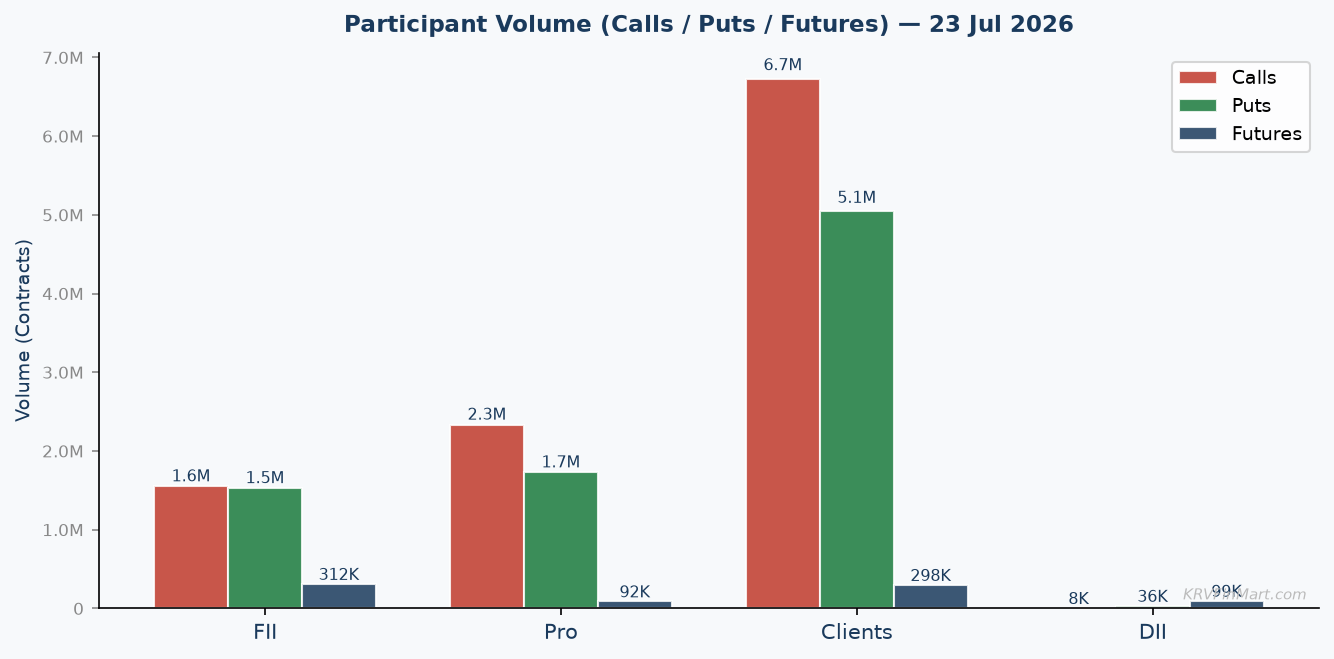
- Futures net improved marginally from +164,583 to +167,487 (net change +2,904; prev 164,583 → today 167,487). Long side added 4,962 contracts (prev 227,949 → today 232,911) tagged [Long Buildup – High Vol], while the Short side added 2,058 contracts (prev 63,366 → today 65,424) tagged [Short Buildup – High Vol]. Both sides tagged High Vol, meaning retail participants were actively adding on both sides — but the net was a mild long bias (+2,904). The 3.6:1 long-to-short ratio (232,911 longs vs 65,424 shorts) shows retail remains structurally net long futures, acting as the market’s typical contrarian absorber on down days. The high-volume tag on the short side also tells us some retail traders are beginning to short the market alongside FIIs — a distribution signal worth monitoring.
- Long PCR declined from 0.66 to 0.62 (change -6.40%) and Short PCR declined from 0.95 to 0.89 (change -6.28%). Retail’s Long PCR of 0.62 means they hold significantly more call longs than put longs — this is classically bullish/speculative retail behaviour, buying calls in anticipation of a bounce. The 6.40% drop in Long PCR suggests this call-heavy tilt was partially reduced today, possibly as calls lost value on the gap-down. The Short PCR at 0.89 (nearly 1:1 put-to-call short ratio) implies retail option writers are maintaining a roughly balanced writing book, with a very slight tilt toward writing puts — consistent with retail’s typical income-oriented covered write strategies.
- Call OI net moved from +172,273 to +167,052 (change -5,221). Call Longs added 428,379 contracts (prev 3,016,955 → today 3,445,334) tagged [Long Buildup – Low Vol], while Call Shorts added a larger 433,600 contracts (prev 2,844,682 → today 3,278,282) tagged [Short Buildup – Low Vol]. Put OI net moved from -691,782 to -769,347 (change -77,565). Put Longs added 138,421 contracts (prev 2,004,385 → today 2,142,806) tagged [Long Buildup – Low Vol], while Put Shorts added a much larger 215,986 contracts (prev 2,696,167 → today 2,912,153) tagged [Short Buildup – Low Vol]. Retail is the dominant player in absolute options volume and their positioning is notably self-contradictory: they are the largest call buyer AND the largest call writer simultaneously — a sign of different retail cohorts taking opposite sides. More concerning is the put net worsening to -769,347 — retail is net short puts massively, writing downside protection for others, which means if the market falls sharply, this put-short book creates a forced-buy-back dynamic (short squeeze on puts).
- Synthesis — Retail Caught Between Optimism and Mechanical Writing: Retail presents the most internally conflicted picture of all participants today. On one hand, they are net long futures (+167,487) with a call-heavy Long PCR (0.62) — bullish bets on a bounce. On the other hand, their options book shows them as the market’s largest net put seller (-769,347 net put OI), which is a income/premium capture strategy that works only in range-bound or rising markets. The danger is that this combination — long futures + long calls + massive net put short — creates a triple exposure to a downside move: futures lose, calls expire worthless, and put shorts get squeezed simultaneously. This is not a hedged structure; it is classic retail over-leverage in a low-VIX complacency environment. The Low Vol tags across all option legs suggest these were not panic trades but systematic, methodical additions — retail building into what they perceive as a dip-buying opportunity. The risk is that FII’s bearish conviction (11.8:1 short book) proves correct, triggering a retail unwind.
- Forward trigger: The key retail risk level is the Day S3 at 23,819.12 — a sustained break below this level would start testing retail’s long futures stop-losses and could trigger forced put-short covering (buy-to-close), amplifying any downside move. Watch whether retail futures net long drops below +160,000 contracts tomorrow — that would signal retail is beginning to unwind rather than add, a meaningful sentiment shift. Conversely, a Nifty recovery above 23,921 (Day R3) would validate retail’s bounce thesis and likely see them add more call longs.
⟶ Tomorrow: Retail holds a +167,487 net long futures position with a massive -769,347 net put-short book — a high-risk structure in a declining market. Tomorrow, watch Day S3 at 23,819.12: a break below with expanding volume puts retail’s entire structure under pressure. A recovery above Day TC 23,898.97 reduces risk and may see fresh call-buying enter.
DII Cautiously Reducing Longs
- Futures net declined from +73,822 to +67,306 (net change -6,516; prev 73,822 → today 67,306). The Long side shed a significant 6,463 contracts (prev 89,529 → today 83,066) tagged [Long Unwinding – High Vol], while the Short side added a negligible 53 contracts (prev 15,707 → today 15,760) tagged [Short Buildup – High Vol]. The High Vol tag on the long unwind is particularly telling — DIIs were not passively letting positions expire; they were actively reducing their long futures book at institutional volumes on a gap-down day. This behaviour is consistent with mutual fund/insurance hedging desks trimming exposure ahead of potential further downside, or rebalancing portfolios as prices fell. The 5.27:1 long-to-short ratio (83,066 vs 15,760) confirms DIIs remain structurally net long but the direction of change is clearly risk-reducing.
- DII PCR data is not applicable — DIIs operate negligible options volume as their mandate focuses on cash equities and futures hedging. Their sentiment must be read entirely from the futures book, which shows a net reduction of 6,516 contracts via high-conviction long unwinding, a cautiously defensive signal for a participant that typically acts as a market stabiliser.
- Call OI: Long flat at 7,815 contracts (prev 7,815 → today 7,815, change 0) tagged [Long Flat – Low Vol]; Short added 105 contracts (prev 120 → today 225) tagged [Short Buildup – High Vol]. Net call position moved from +7,695 to +7,590 (change -105). Put OI: Long added 1,070 contracts (prev 34,284 → today 35,354) tagged [Long Buildup – High Vol]; Short added negligible 3 contracts (prev 182 → today 185) tagged [Short Buildup – Low Vol]. Net put position improved from +34,102 to +35,169 (change +1,067). DII options activity is minimal in absolute terms — total options exposure is under 43,000 contracts across all legs. However, the High Vol tag on the call-short addition (despite only 105 contracts) and the High Vol tag on the put-long buildup (+1,070 contracts) indicate deliberate, purposeful hedging activity rather than noise. DIIs added put longs to protect their equity book — a textbook portfolio insurance move.
- Synthesis — DII Defensive Rebalancing Under Pressure: DIIs today tell a story of quiet, methodical risk reduction. They unwound 6,463 long futures contracts at high volume — the largest single-participant high-vol long unwind of the session — while simultaneously adding modest put protection (+1,070 put longs at high vol). This is classic institutional portfolio management: reduce leveraged futures exposure while buying put longs to maintain downside protection on the underlying equity book. The call-short addition (105 contracts, high vol) is immaterial in size but signals a covered-call mentality — DIIs are not expecting a sharp bounce. Taken together, DIIs are not panicking, but they are clearly not adding risk at current levels. The net futures position remains a positive +67,306 — they are still the second-largest net long participant — but the direction of travel (from +73,822 to +67,306 in one session) deserves attention as a signal of institutional caution.
- Forward trigger: Watch whether DII futures net falls below +60,000 contracts tomorrow — that level would represent an acceleration of long unwinding that could weigh on market breadth even if FII short-covering provides a technical bounce. The specific level to monitor is Nifty’s Monthly BC at 23,665.88 — if DII continues reducing and price approaches that level, it would suggest institutional hedgers are protecting against a deeper monthly correction. A stabilisation of DII longs at or above +65,000 would signal that today’s reduction was tactical rather than trend-following.
⟶ Tomorrow: DIIs reduced futures longs by 6,463 contracts at high volume — a clear risk-management signal. Watch whether the net holds above +65,000 tomorrow; a further drop below that level alongside Nifty testing Day S3 at 23,819.12 would indicate institutional hedgers are not yet comfortable adding back exposure. Stability at current levels would be a quiet positive.
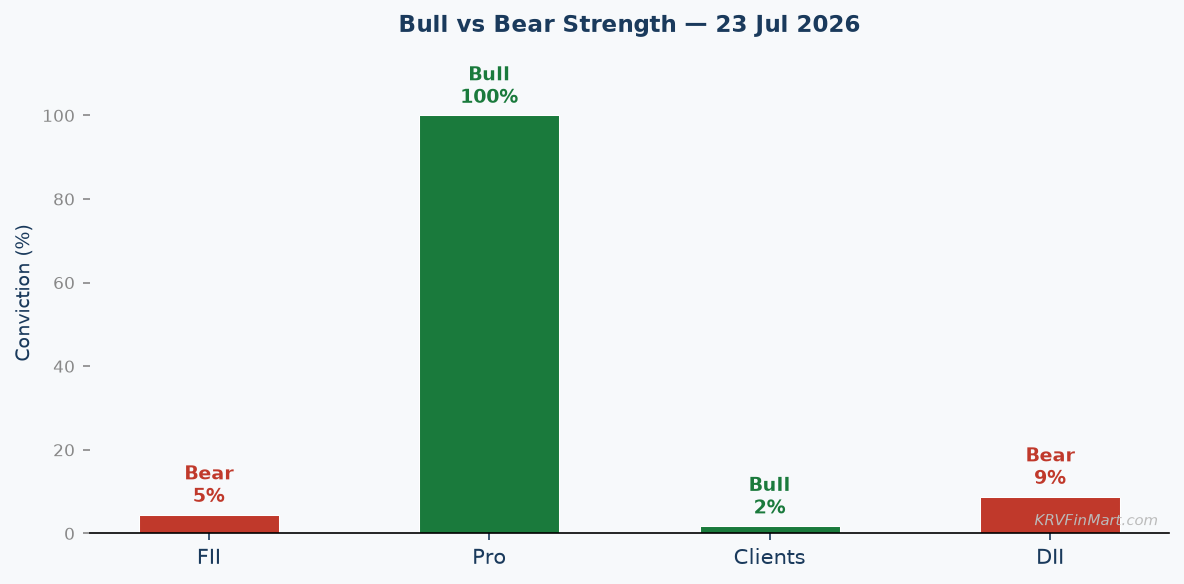
Bull vs Bear Strength by Participant
|
FII
Strongly Bearish 88%
▼▼
|
Clients
Mildly Bullish 52%
▲
|
Pro
Aggressively Bullish 74%
▲▲
|
DII
Cautiously Neutral 45%
▼
|
Conclusion — Market Outlook for Tomorrow (24 Jul 2026)
Today’s session delivered a clear and consistent message across all three indices: gap-down opens of -0.31% to -0.58% that failed to recover, with price closing inside the prior day’s range on Nifty, BankNifty, and Sensex simultaneously. This broad-based range-contain pattern is not a sign of strength — it is a sign of sellers holding supply overhead while buyers lacked the conviction to push higher. The driving force behind the bearish undertow is unambiguous: FIIs added 11,216 fresh short futures contracts at high volume (taking their net to -263,082, a 11.8:1 short-to-long ratio) while simultaneously writing 95,223 new short call contracts to cap any bounce. This dual-leg bearish architecture — short futures + short calls + long puts — is a synthetic short collar of high conviction, and the refusal to cover on a day that closed inside range (not a breakdown) tells us FIIs are positioned for a larger downside move than today’s action delivered. The Overall PCR’s sharp fall from 0.84 to 0.79 (-6.33%) in a single session — driven by call OI expanding +12.94% versus put OI’s +5.78% — confirms that the market’s options market is shifting bearish in character, with supply being actively built overhead.
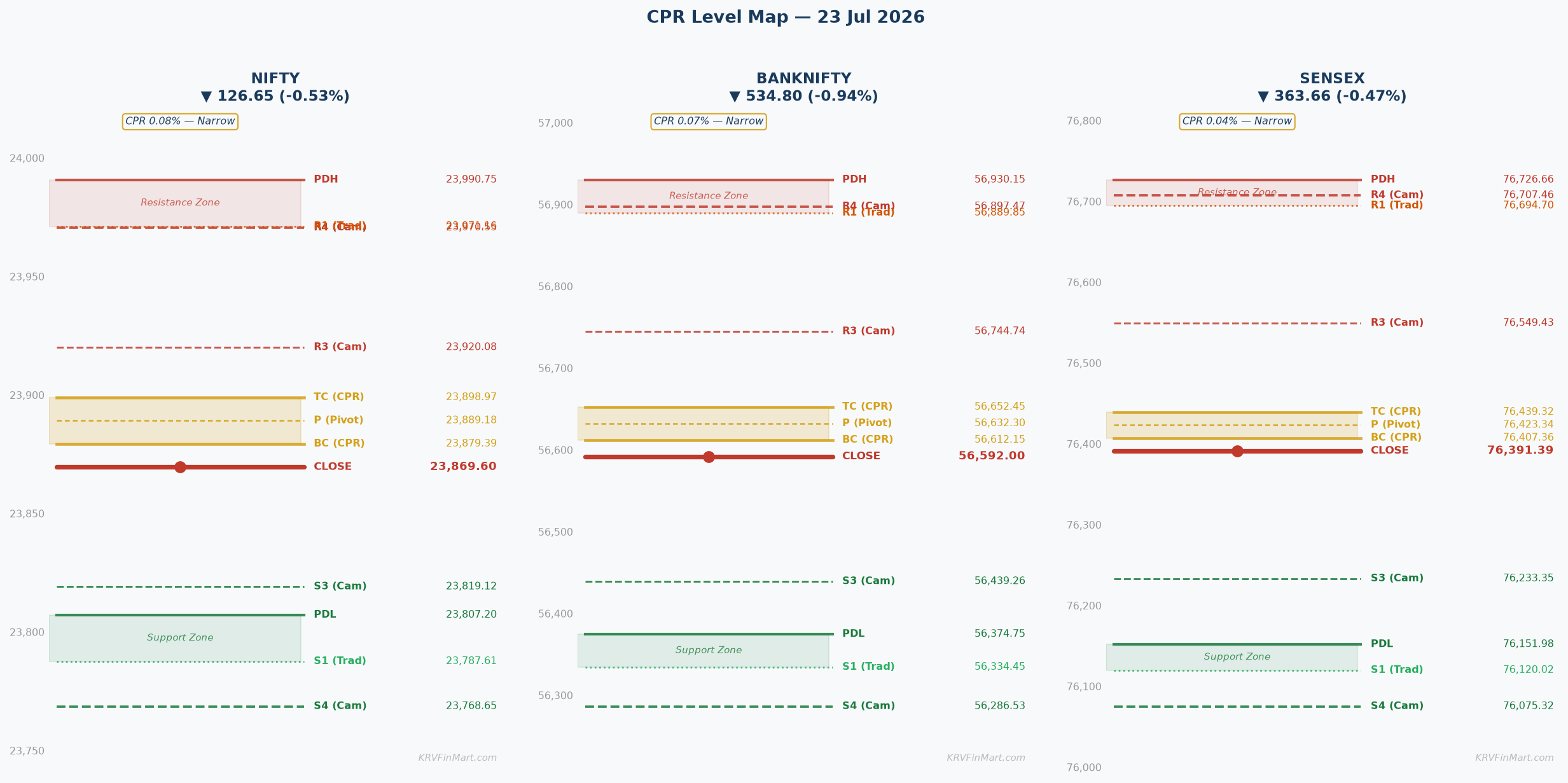
Tomorrow’s day-type signals are sending a rare, high-conviction message: all three indices carry ultra-narrow Day CPRs — Nifty at 0.08%, BankNifty at 0.07%, and Sensex at an extraordinary 0.04% — which together point to a high-probability trend day across the board. When all major indices simultaneously compress into ultra-narrow CPR bands, the market is in energy-compression mode and history strongly favours a large directional move in the first hour of trade. The direction of that trend day is the key question, and the participant data gives a clear initial lean: FIIs are short, DIIs are reducing longs, and India VIX ticked up +1.37% to 13.47 — the complacent low-fear environment is showing its first signs of nervousness. On the bull side, Pros nearly doubled their net long futures to +28,289 and retail remains net long at +167,487 — a meaningful counterbalance that could trigger a short-squeeze bounce if Nifty opens above the Day TC at 23,898.97. The OI context (market intelligence notes ‘expanding both sides — range day or volatile open likely’) adds a complicating factor: tomorrow could open with high volatility before committing to a direction, creating whipsaw risk for early trend-followers.
The scenario that changes everything: if Nifty opens above Day TC at 23,898.97 and holds for 30 minutes, the ultra-narrow CPR trend-day dynamic could trigger a violent short squeeze on FII’s -263,082 contract short book, with Pros already positioned long to amplify the move. The bull target in that scenario is Day R4 at 23,970.55 and then the PDH at 23,990.75. Conversely, if Nifty opens below Day BC at 23,879.39 with FII data showing further short addition, the trend-day energy resolves to the downside toward 23,819 (S3) and potentially 23,768 (S4). The single most important level to watch is the 23,879–23,899 CPR band — this 20-point zone will define tomorrow’s entire day-trading landscape. India VIX crossing above 14.50 would confirm a fear-regime shift and accelerate any downside move; a VIX decline back toward 13.00 would signal complacency returning and favour the bounce scenario.
Scenario 1 — Bull case:
Nifty opens above Day TC at 23,898.97 and sustains for 30 minutes on expanding volume — this triggers ultra-narrow CPR trend-day dynamics to the upside, forces short-covering on FII’s -263,082 futures short book, and targets Day R4 at 23,970.55 and the PDH at 23,990.75. Watch for FII futures net to improve toward -255,000 as the confirmation trigger; Pro longs expanding above +35,000 would reinforce the squeeze thesis.
Scenario 2 — Bear case:
Nifty opens below Day BC at 23,879.39 and fails to recover within the first 15 minutes — the ultra-narrow CPR trend-day energy resolves bearishly toward Day S3 at 23,819.12 and then Day S4 at 23,768.65. This scenario is confirmed if FII futures net worsens beyond -270,000 contracts in tomorrow’s data and India VIX breaks above 14.50, signalling a fear-regime transition. Retail’s massive -769,347 net put-short book would accelerate the move as forced put-covering adds to selling pressure.
|
Key Resistance
23,898.97 (Day TC) and 23,970.55 (Day R4 / Camarilla) — FII’s 95,223 new short call contracts and -263,082 futures net short build a supply wall at and above the CPR TC; the PDH at 23,990.75 is the ultimate intraday ceiling.
|
Key Support
23,879.39 (Day BC) as immediate floor; 23,819.12 (Day S3 / Camarilla) as the first meaningful demand zone where Pros’ +28,289 net long futures provides structural support; 23,799.12 (Monthly TC) as the critical positional floor where a close below would flip monthly bias bearish.
|
Trigger to Watch
Nifty’s 23,879–23,899 ultra-narrow CPR band at tomorrow’s open — a directional 30-minute breakout above 23,899 (TC) or below 23,879 (BC) with volume will determine whether the ultra-narrow trend-day energy resolves as a short squeeze rally or a FII-thesis-confirming bearish breakdown. Secondary trigger: India VIX crossing 14.50 would signal a fear-regime shift and strongly favour the bear case.
|
The content provided on KRVFinMart is intended for educational and informational purposes only. We are not licensed financial advisors. ( Contact us @ https://krvfinmart.com/contact-us/ )
© KRVFinMart | krvfinmart.com
Responses