
Index Research
Intraday Analysis for 21 Aug 2026
KRVFinMart20 August 202656 min
Educational/Derived AnalysisSource: KRVFinMart Research Desk (End-of-Day)As of 20 Aug 2026, 04:19 PM IST
Intraday Analysis for 21 Aug 2026
Markets closed in positive territory on 20 Aug 2026, with NIFTY gaining +0.64% to 24,231.85, BANKNIFTY adding +0.45% to 57,495.90, and SENSEX rising +0.82% to 77,537.72, reflecting broad-based buying across large-caps. India VIX data is unavailable for this session, making it critical to rely on options straddle premiums and OI structures to gauge implied volatility — the NIFTY weekly straddle at 195.05 points implies a ±0.80% expected move, while the BANKNIFTY monthly straddle at 578 points implies approximately ±1.00% movement from current levels. All three indices carry Ascending Narrow CPR formations for 21 Aug 2026, historically the single strongest signal for a high-probability trending day where the first 15-minute candle sets the tone for the entire session.
Key Market Signals — Intraday Setup
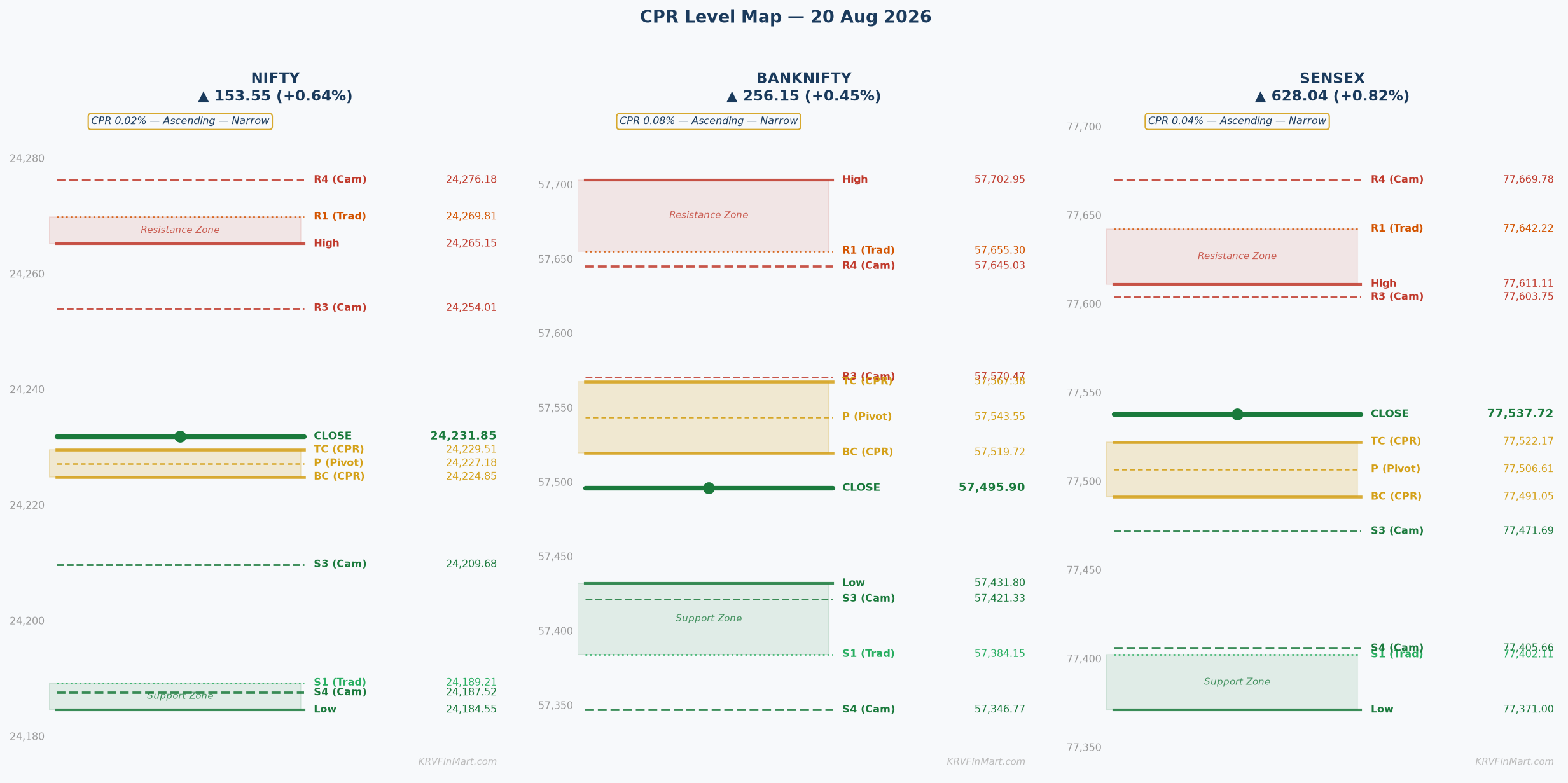
All three indices — NIFTY, BANKNIFTY, and SENSEX — are printing Ascending Narrow CPR structures for 21 Aug 2026, with widths of just 0.02%, 0.08%, and 0.04% respectively, creating a rare tri-index alignment that historically precedes a strong directional trending day. With current spot prices sitting marginally below all three CPR bands (NIFTY close at 24,231.85 vs BC 24,224.85, BANKNIFTY close at 57,495.90 vs BC 57,519.72, SENSEX close at 77,537.72 vs BC 77,491.05), the opening gap direction will be the definitive session trigger — above CPR bands signals a bullish trending day, below confirms bearish pressure.
Deep Technical Analysis & Levels
NIFTY
Ascending — Narrow (Width: 0.02%)
▲ Bullish
Market Structure Trending (up or down trend) | Straddle ATM 24,250 weekly straddle = 119.00 (Call) + 76.05 (Put) = **195.05 points** implied move, suggesting NIFTY is expected to move ±195 points from ATM (range approximately 24,055 to 24,445) for the 25 Aug 2026 expiry; the put premium being lower than the call premium indicates a mild upward skew in options pricing. | Max Pain Max Pain at **24,250** for both Week and Month (25-Aug-2026 expiry) — price gravitating toward 24,250 into expiry benefits option sellers the most; intraday, expect institutional activity to defend this level, making 24,250 a magnetic zone where pin risk is highest as expiry approaches. |
Tomorrow's Complete Level Map
OI-R: 24,500 R3: 24,350.41 H6: 24,312.61 H5: 24,302.07 R2: 24,307.78 H4 ▶: 24,276.18 R1: 24,269.81 PDH: 24,265.15 H3 ↩: 24,254.01
TC: 24,229.51 P: 24,227.18 BC: 24,224.85
L3 ↩: 24,209.68 PDL: 24,184.55 S1: 24,189.21 L4 ▶: 24,187.52 S2: 24,146.58 L5: 24,161.64 L6: 24,151.09 S3: 24,108.61 OI-S: 24,000
↩ = Camarilla reversal point | ▶ = Camarilla breakout/breakdown trigger | OI-R/OI-S = Options wall (CE/PE max OI)
▲ Higher Open (Gap Up) — Open > Prev Close
▲ Bullish
Open lands: For an Ascending CPR where BC (24,224.85) > prev_TC, a gap-up open places NIFTY inside or above the CPR band (BC 24,224.85 to TC 24,229.51) — a minor gap opens inside this ultra-narrow 4.66-point band, while a significant or large gap opens above TC 24,229.51, immediately above the entire CPR structure.
CPR role: Launch pad — the ascending CPR band acts as an immediate support floor on a gap-up; once price opens above TC 24,229.51, the entire CPR band transitions from overhead resistance to a dynamic support base that bulls will defend on any early dip.
Minor Gap (0.05–0.25%) — Structure Dominant
A minor gap-up of 0.05%–0.25% on NIFTY translates to an opening roughly between 24,244 and 24,292, placing price inside the CPR band (above TC 24,229.51) or marginally above it near Camarilla H3 at 24,254.01. The Ascending Narrow CPR structure (width 0.02%) strongly confirms this gap, as the entire CPR band is positioned above yesterday's close, meaning bulls have maintained structural control across two consecutive sessions — there is no CPR conflict here, only confirmation. The first target on a minor gap-up is a 15-minute candle close above H3 24,254.01, which opens the path to PDH 24,265.15 and then R1 24,269.81, with partial profits recommended at R1 given its proximity to PDH — a confluence of resistance that may cause the first meaningful pause.
Significant Gap (0.25–0.5%) — Balanced
A significant gap-up of 0.25%–0.50% opens NIFTY between approximately 24,292 and 24,353, placing price near or above H4 24,276.18 and toward R2 24,307.78 — this is a zone where gap-fill risk becomes non-trivial as opening momentum may already be exhausted by the time price reaches these levels. The Ascending Narrow CPR (0.02% width) adds structural bullishness, but opening directly at H4 24,276.18 or above means Camarilla mean-reversion dynamics kick in — H4 is the classical Camarilla breakout/breakdown trigger, and opening here without a confirmed first 15-min close above it creates a fade-the-open risk. Aggressive traders should wait for a 15-min candle close above H4 24,276.18 before entering long, targeting H5 24,302.07 and H6 24,312.61, while noting that delta-hedging flows from market makers selling calls at the OI resistance wall of 24,500 may cap further upside and increase volatility in the 24,300–24,350 range.
Large Gap (>0.5%) — Gap Direction Dominant
A large gap-up of more than 0.50% opens NIFTY above 24,353, potentially approaching or exceeding R3 24,350.41 and bringing price within striking distance of the OI resistance wall at 24,500 — this is a zone dominated by heavy CE (call) writing, creating a powerful gamma ceiling that institutions will aggressively defend. The probability of an immediate extension above R3 24,350.41 without a gap-fill is low historically; with the straddle implying only 195.05 points of total expected movement, a large gap itself consumes a significant portion of the day's expected range, making a gap-fill back toward TC 24,229.51 or at least P 24,227.18 the high-probability first move. Abort longs if the first 15-min candle closes back below H4 24,276.18 — if that happens, the gap-up has become an exhaustion trap, and a gap-fill toward TC 24,229.51 and even L3 24,209.68 becomes the base case; hold longs only if the large gap is confirmed with sustained volume and price holding above R3 24,350.41 on two consecutive 15-min candles.
|
▲ Upside Path → OI-R On confirmation, the upside path follows: **TC 24,229.51 → H3 24,254.01 → PDH 24,265.15 → R1 24,269.81 → H4 24,276.18 → R2 24,307.78 → H5 24,302.07 → H6 24,312.61 → R3 24,350.41 → OI-R 24,500** — take first partial profits at R1 24,269.81 (Traditional first target, Narrow CPR rule), trail stop to H3 24,254.01, and target OI-R 24,500 as the ultimate ceiling, where CE writers will aggressively defend and intraday longs should be fully closed. Each Camarilla level from H3 through H6 represents a zone where short-sellers will attempt mean reversion, so volume must remain elevated to confirm genuine trend momentum at each step. |
▼ Downside Path → OI-S Failure to sustain above TC 24,229.51 triggers a reversal path: **TC 24,229.51 → P 24,227.18 → BC 24,224.85 → L3 24,209.68 → PDL 24,184.55 → L4 24,187.52 → S1 24,189.21 → L5 24,161.64 → OI-S 24,000** — loss of TC 24,229.51 on a gap-up day is a critical structural failure because it signals that the ascending CPR band has become overhead resistance rather than support, completely inverting the bullish thesis. The presence of retail stop-losses clustered below PDL 24,184.55 and L4 24,187.52 means any sustained break below these levels could trigger a rapid move toward L5 24,161.64 and L6 24,151.09, accelerating the downside momentum toward OI-S 24,000. |
| 🔴 OI-R: OI resistance at **24,500** represents the single largest CE (call) writing concentration for both week and month expiries — this strike acts as a powerful gamma ceiling where option sellers (typically institutions) will aggressively add short calls on any rally toward this level, creating a self-reinforcing supply wall that caps intraday upside. In a gap-up scenario, if NIFTY approaches 24,500, the velocity of delta-hedging by market makers selling the underlying will intensify, making 24,500 a fade-the-rally zone for intraday traders rather than a breakout target — close all long positions before reaching 24,500 and consider short scalps at this strike. | 🟢 OI-S: OI support at **24,000** is the largest PE (put) writing concentration for both week and month expiries — on a gap-up day, this level is largely irrelevant as an intraday target given the 231-point gap from today's close, but it defines the absolute floor below which institutional put writers would face maximum pain and begin unwinding, potentially triggering a gamma cascade lower. In the context of a gap-up scenario, 24,000 serves as the abort level for intraday shorts — if somehow price reaches this level, massive PE covering would create a sharp bounce, making it a buy-the-panic zone rather than a breakdown level. |
⚡ Key Trigger: The primary trigger on a gap-up open is a **first 15-min candle close above TC 24,229.51** (for minor gaps) or **above H4 24,276.18** (for significant/large gaps) with above-average volume — this confirms that the ascending CPR band has transitioned into active support and that directional momentum is genuine rather than a pre-market overshoot. Failure to hold TC 24,229.51 within the first 15 minutes flips the structure to a bull trap, with the CPR band becoming overhead resistance and the bias shifting to a gap-fill scenario targeting P 24,227.18, BC 24,224.85, and ultimately L3 24,209.68.
▼ Lower Open (Gap Down) — Open < Prev Close
▼ Bearish
Open lands: For an Ascending CPR where BC (24,224.85) > prev_TC, a gap-down open places NIFTY below the entire CPR band — below BC 24,224.85 — which is the most bearish structural signal for this CPR type, as price opens beneath an ascending CPR that is already positioned above yesterday's close.
CPR role: Overhead resistance — the entire CPR band (BC 24,224.85 to TC 24,229.51) becomes an overhead resistance ceiling on a gap-down, and the 4.66-point wide band must be fully reclaimed before any bullish reversal case can be established; until BC 24,224.85 is recovered, the CPR band acts as a distribution zone that will suppress rally attempts.
Minor Gap (0.05–0.25%) — Structure Dominant
A minor gap-down of 0.05%–0.25% opens NIFTY between approximately 24,171 and 24,220, placing price below BC 24,224.85 but above L3 24,209.68 and close to the Camarilla mean-reversion zone — historically, minor gaps inside the prior day's range (PDL 24,184.55 to PDH 24,265.15) fill within the first 30–60 minutes as early buying pressure tests the CPR band as resistance. The ascending CPR structure creates a critical observation zone: if price reclaims BC 24,224.85 within the first 30 minutes on strong volume, the gap-down was a false breakdown and the bullish trending structure reasserts; however, if BC 24,224.85 caps the first rally attempt, the CPR band acts as classic overhead resistance and the bearish path becomes the primary scenario. Specific bear target on failure: L3 24,209.68 as the first stall level, then PDL 24,184.55 and L4 24,187.52 as the next support cluster, with S1 24,189.21 completing the bear confluence zone at the same level.
Significant Gap (0.25–0.5%) — Balanced
A significant gap-down of 0.25%–0.50% opens NIFTY between approximately 24,111 and 24,171, placing price near or below L3 24,209.68 and approaching S3 24,108.61 — at this depth, the ascending CPR band (BC 24,224.85 to TC 24,229.51) is now more than 50 points overhead, making an early gap-fill recovery extremely difficult and putting the bearish case firmly in control. The 30-minute reclaim rule applies: if NIFTY recovers BC 24,224.85 within 30 minutes of open on above-average volume, treat as a recovery trade targeting P 24,227.18 and TC 24,229.51; however, any failure to reclaim BC 24,224.85 confirms distribution at the CPR band and initiates the L3 24,209.68 → L4 24,187.52 → L5 24,161.64 bear sequence. PUT writers are actively defending 24,000 OI-S, creating a support cushion, but a significant gap-down accelerates the move toward S2 24,146.58 and L5 24,161.64, where PE premium expansion will attract fresh put buyers, confirming the bearish momentum and making a recovery trade less viable.
Large Gap (>0.5%) — Gap Direction Dominant
A large gap-down of more than 0.50% opens NIFTY below approximately 24,111, potentially breaching S3 24,108.61 and bringing price dangerously close to the OI-S floor at 24,000 — this is a panic-driven open that immediately triggers stop-losses below PDL 24,184.55 and L4 24,187.52, with retail participants exiting long positions en masse. VIX-implied expansion (even without exact data, the straddle of 195.05 points suggests that a 200+ point gap-down would be a multi-sigma event) makes straddle monetisation the primary strategy — those holding long straddles from below would be taking profits on the put leg, while fresh shorts should wait for a dead-cat bounce into L3 24,209.68 or BC 24,224.85 before entering. The recovery target on a large gap-down is BC 24,224.85, and a 15-min close back above L4 24,187.52 after the initial panic flush signals potential stabilisation; full abort if price cannot hold L6 24,151.09, in which case OI-S 24,000 becomes the day's directional target for bear traders.
|
▲ Upside Path → OI-R Recovery path on gap-down: **L3 24,209.68 → BC 24,224.85 → P 24,227.18 → TC 24,229.51 → H3 24,254.01 → PDH 24,265.15 → R1 24,269.81 → OI-R 24,500** — the recovery is only confirmed genuine when price closes above TC 24,229.51 on a 15-min candle with volume exceeding the opening bar, signalling that the ascending CPR band has been reclaimed and the bullish structure is back in control. A dead-cat bounce that stalls at BC 24,224.85 without closing above TC 24,229.51 is a sell-the-rally setup, with a stop above TC 24,229.51 and a target back toward L3 24,209.68. |
▼ Downside Path → OI-S Bear continuation path: **BC 24,224.85 cap → L3 24,209.68 → PDL 24,184.55 → L4 24,187.52 → S1 24,189.21 → S2 24,146.58 → L5 24,161.64 → L6 24,151.09 → S3 24,108.61 → OI-S 24,000** — retail stop-losses clustered just below PDL 24,184.55 and L4 24,187.52 (a 3-point confluence) will accelerate the move once breached, creating a cascade toward L5 24,161.64 and L6 24,151.09. The OI-S at 24,000 is the ultimate bear target and the primary PE monetisation zone — traders should consider partial profit-taking at S2 24,146.58 and full exit at OI-S 24,000 rather than holding through the put-writing support at this strike. |
| 🔴 OI-R: OI resistance at **24,500** on a gap-down day is remote as an intraday target but serves as the macro ceiling that short-sellers will reference — CE writers at 24,500 have zero motivation to unwind on a bearish day, effectively anchoring the overhead supply structure and preventing any institutional short-covering rally from extending beyond the CPR band. This creates a psychological anchor that limits the recovery upside even in a bull-recovery scenario, as institutional participants know that 24,500 CE writers will aggressively sell any rally, keeping bullish conviction capped. | 🟢 OI-S: OI support at **24,000** is the primary bear target and the most critical level for PUT monetisation on a gap-down day — this strike represents the largest PE writing concentration, meaning institutional put sellers have maximum financial incentive to defend this level through index futures buying and call unwinding. If NIFTY reaches 24,000 intraday, expect a sharp and violent snap-back bounce driven by put-writer defence, making it a high-risk zone to hold fresh shorts; instead, take full profits on put longs at 24,000 and watch for a potential reversal setup. |
⚡ Key Trigger: **Failure to reclaim BC 24,224.85 within 30 minutes of open** is the primary bear confirmation trigger — any rally that tests BC 24,224.85 and fails (with a 15-min close back below it) confirms the CPR band as active overhead resistance and initiates the full bearish path from L3 24,209.68 to OI-S 24,000. The bull trigger is the reverse: a 30-min candle close above BC 24,224.85 followed by a hold above P 24,227.18 signals gap-fill recovery, targeting TC 24,229.51 and potentially R1 24,269.81 on strong volume — traders must choose their side at BC 24,224.85, as this is the structural fulcrum for the entire session.
◆ Near Flat Open — Open ≈ Prev Close (±0.05%)
◆ Neutral
Open lands: A flat open of ±0.05% places NIFTY between 24,219.72 and 24,243.98 — this means price opens near or marginally above BC 24,224.85 and close to the ultra-narrow CPR band (BC 24,224.85 to TC 24,229.51, width just 4.66 points), creating a textbook decision-zone setup where the CPR band acts as a compression spring.
CPR role: Decision zone and compression band — the 0.02% width CPR is one of the tightest possible formations, meaning the band itself provides almost no buffer between bull and bear structural control; the first 15-minute candle is the highest-information signal of the day, and its direction will set the trend for the entire session with high probability.
Near Flat (±0.05%)
A flat open on NIFTY with an Ascending Narrow CPR (width 0.02%, BC 24,224.85 to TC 24,229.51) is a classic high-information compression setup — when price opens inside a 4.66-point band after a +0.64% trending day, the market is in a perfect equilibrium, and the first 15-minute candle IS the trade with no ambiguity. A 15-min close above TC 24,229.51 on above-average volume confirms bullish control of the ascending CPR structure, with the day structure immediately shifting to trending-up mode targeting H3 24,254.01, PDH 24,265.15, and R1 24,269.81 in sequence, with the ultimate session target being OI-R 24,500 for aggressive bulls. Conversely, a 15-min close below BC 24,224.85 signals that despite the ascending CPR, selling pressure is overwhelming the bullish structure — this is a rare but high-conviction bearish signal, initiating L3 24,209.68 as the first target and L4 24,187.52 as the next, with OI-S 24,000 as the session floor. With CPR width at just 0.02%, the probability of a trending day (versus a range-bound session) is statistically very high — narrow CPR bands concentrate the decision into a single binary event, and once the 4.66-point band is decisively broken in either direction, the trend day characteristics dominate with price typically extending at least to the first Traditional target (R1 24,269.81 on the upside or S1 24,189.21 on the downside) without significant pullback.
|
▲ Upside Path → OI-R Bull path from flat open: **TC 24,229.51 → H3 24,254.01 → PDH 24,265.15 → R1 24,269.81 (first partial profit, Narrow CPR rule) → H4 24,276.18 → R2 24,307.78 → H5 24,302.07 → H6 24,312.61 → R3 24,350.41 → OI-R 24,500** — the Narrow CPR confirmation rule requires taking partial profits at R1 24,269.81 (first Traditional target) and trailing stops to H3 24,254.01, then targeting the Camarilla H4 24,276.18 as the breakout trigger that opens the door to H5 24,302.07 and H6 24,312.61. Volume confirmation is essential at PDH 24,265.15 — if price stalls at the prior day's high without expansion volume, consider reducing position size before the R1 24,269.81 target rather than holding the full position into resistance. |
▼ Downside Path → OI-S Bear path from flat open: **BC 24,224.85 → L3 24,209.68 (first stall/reversal reference) → PDL 24,184.55 → L4 24,187.52 (breakdown trigger) → S1 24,189.21 → S2 24,146.58 → L5 24,161.64 → L6 24,151.09 → S3 24,108.61 → OI-S 24,000** — a break below BC 24,224.85 on the first 15-min candle with strong red volume is a high-conviction bearish entry; the Narrow CPR rule applies to the downside as well, meaning partial profits should be taken at S1 24,189.21 (near PDL 24,184.55 and L4 24,187.52 confluence) with a trail stop to L3 24,209.68. The L4 24,187.52 breakdown trigger is particularly significant — a 15-min close below L4 confirms that the Camarilla mean-reversion zone has been decisively broken and that the move is likely to extend toward L5 24,161.64 and L6 24,151.09 with momentum. |
| 🔴 OI-R: On a flat-open day, OI resistance at **24,500** functions as the ultimate session ceiling that CE writers will defend — with NIFTY opening more than 270 points below this level, institutional CE writers at 24,500 create a persistent supply overhang that caps the bullish scenario's maximum extension for the intraday session. Aggressive long traders who ride the bull path from TC 24,229.51 through R3 24,350.41 should treat 24,500 as a mandatory full exit zone, not a level to hold through — the gamma exposure of short call sellers at this strike creates violent mean-reversion dynamics. | 🟢 OI-S: On a flat-open day, OI support at **24,000** represents the deepest PE writing concentration and the absolute floor of institutional put-selling — this level is 232 points below the flat-open zone, making it a distant but structurally critical anchor that prevents institutional sentiment from turning fully bearish on NIFTY. PE writers at 24,000 will provide a natural demand floor that limits downside extensions beyond this level intraday, making it the ultimate bear target and profit-taking zone for any put-long strategy initiated on a bearish first 15-min candle breakdown below BC 24,224.85. |
⚡ Key Trigger: **First 15-min candle close above TC 24,229.51 = confirmed bull trigger; first 15-min candle close below BC 24,224.85 = confirmed bear trigger** — with only 4.66 points separating the bull and bear structural thresholds, this is the most binary CPR decision point possible, making it the highest-conviction trigger of all three open scenarios. The structural fulcrum is the Pivot (P) at 24,227.18 — price hovering at P for more than 15 minutes without resolution signals indecision and warrants waiting for a full 30-min candle close before committing directionally, as choppy action within the CPR band is a false-signal zone that should be avoided with naked directional positions.
BANKNIFTY
Ascending — Narrow (Width: 0.08%)
▲ Bullish
Market Structure Trending (up or down trend) | Straddle ATM 57,500 monthly straddle = 346.00 (Call) + 232.00 (Put) = **578 points** implied move, suggesting BANKNIFTY is expected to move ±578 points from ATM (range approximately 56,922 to 58,078) for the 25 Aug 2026 expiry; the significant call-put premium differential (346 vs 232) indicates a meaningful upward skew with the market pricing in asymmetric risk to the upside. | Max Pain Max Pain at **57,600** for the Month (25-Aug-2026 expiry) — this 104-point gap above current close of 57,495.90 creates an upward gravitational pull toward 57,600 as expiry approaches, as option sellers benefit from price converging toward this strike; intraday, 57,600 acts as a secondary magnetic level above the primary CPR band resistance. |
Tomorrow's Complete Level Map
OI-R: 58,000 R3: 57,926.45 H6: 57,767.35 H5: 57,732.12 R2: 57,814.70 H4 ▶: 57,645.03 R1: 57,655.30 PDH: 57,702.95 H3 ↩: 57,570.47
TC: 57,567.38 P: 57,543.55 BC: 57,519.72
L3 ↩: 57,421.33 PDL: 57,431.80 S1: 57,384.15 L4 ▶: 57,346.77 S2: 57,272.40 L5: 57,259.68 L6: 57,224.45 S3: 57,113.00 OI-S: 57,000
↩ = Camarilla reversal point | ▶ = Camarilla breakout/breakdown trigger | OI-R/OI-S = Options wall (CE/PE max OI)
▲ Higher Open (Gap Up) — Open > Prev Close
▲ Bullish
Open lands: For an Ascending CPR where BC (57,519.72) > prev_TC, a gap-up open places BANKNIFTY at or inside the CPR band (BC 57,519.72 to TC 57,567.38) on a minor gap, or above TC 57,567.38 and toward H3 57,570.47 on a significant or large gap — the CPR band is 47.66 points wide (0.08%), providing a meaningful buffer zone above yesterday's close.
CPR role: Launch pad — on a gap-up, the ascending CPR band transitions immediately into active support; BC 57,519.72 anchors the lower boundary of bullish control while TC 57,567.38 (just 3 points below H3 57,570.47) creates a powerful dual-confirmation bull trigger when both the CPR top and the first Camarilla resistance are breached simultaneously.
Minor Gap (0.05–0.25%) — Structure Dominant
A minor gap-up of 0.05%–0.25% on BANKNIFTY opens price between approximately 57,524 and 57,639, placing it inside the CPR band (between BC 57,519.72 and TC 57,567.38) or marginally above TC 57,567.38 — at this opening level, the ascending CPR structure fully confirms the bullish bias, as price is opening within the pre-defined support zone of the day's CPR band. The critical observation at this opening range is the near-coincidence of TC 57,567.38 and H3 57,570.47 — a 15-min candle close above H3 57,570.47 (which simultaneously confirms TC as support) is an unusually high-confluence bull trigger that combines CPR breakout confirmation with Camarilla mean-reversion zone clearance in a single signal. First targets on minor gap-up confirmation: R1 57,655.30 for first partial profit (Narrow CPR rule), then H4 57,645.03 as the Camarilla breakout trigger that opens the path to PDH 57,702.95 — note that H4 57,645.03 comes before R1 57,655.30, so price will need to clear the Camarilla breakout trigger before reaching the Traditional first target, making a sustained move above 57,645.03 on volume the highest-conviction bull signal.
Significant Gap (0.25–0.5%) — Balanced
A significant gap-up of 0.25%–0.50% opens BANKNIFTY between approximately 57,639 and 57,783, placing price above TC 57,567.38 and potentially above R1 57,655.30 — at this opening level, BANKNIFTY is already trading within the H4 57,645.03 to H5 57,732.12 Camarilla zone, which is technically the Camarilla breakout/momentum zone rather than the mean-reversion zone. Gap-fill risk is elevated when opening in the H4–H5 zone, as institutional participants may use the elevated open to distribute positions before the real directional move initiates — the 30-min window is critical here. Wait for a 15-min candle close and hold above H4 57,645.03 before treating this as a genuine continuation; if the first 15-min candle fails to hold H4 57,645.03, the gap-fill path targets TC 57,567.38 and P 57,543.55, with delta-hedging flows from CE writers at OI-R 58,000 adding selling pressure at the upper Camarilla levels.
Large Gap (>0.5%) — Gap Direction Dominant
A large gap-up of more than 0.50% opens BANKNIFTY above approximately 57,783, placing price near H5 57,732.12, H6 57,767.35, or potentially approaching the critical OI resistance wall at 58,000 — this is a zone of extreme CE writing concentration where institutions are synthetically short calls, and any open near 58,000 will trigger aggressive delta-hedging selling of the underlying. The straddle of 578 points suggests that a large gap of 300+ points (>0.52%) already consumes more than half the day's expected range, making it statistically improbable that price extends significantly beyond the opening level without a gap-fill first — straddle sellers would aggressively close positions at these elevated levels. Abort all gap-up longs if price falls back below H5 57,732.12 on a 15-min close after a large gap — this signals exhaustion, and the gap-fill target becomes TC 57,567.38, with the risk of a full CPR band retest at BC 57,519.72 on aggressive selling; hold longs only with two consecutive 15-min closes above H6 57,767.35 and approaching OI-R 58,000.
|
▲ Upside Path → OI-R Confirmed bull path: **TC 57,567.38 → H3 57,570.47 → H4 57,645.03 (breakout trigger) → R1 57,655.30 (first partial, Narrow rule) → PDH 57,702.95 → H5 57,732.12 → H6 57,767.35 → R2 57,814.70 → R3 57,926.45 → OI-R 58,000** — partial profits at R1 57,655.30 are mandatory per the Narrow CPR confirmation rule, with stops trailed to H3 57,570.47 after R1 is reached; the path from PDH 57,702.95 to OI-R 58,000 represents a 297-point move that aligns with the call premium of 346 points, suggesting market makers have this extension scenario priced in. Volume confirmation is especially critical at PDH 57,702.95 — previous day's high acts as a natural distribution zone where prior shorts will exit and new short-sellers may initiate. |
▼ Downside Path → OI-S Failure path on gap-up: **TC 57,567.38 loss → P 57,543.55 → BC 57,519.72 → L3 57,421.33 → PDL 57,431.80 → L4 57,346.77 → S1 57,384.15 → L5 57,259.68 → OI-S 57,000** — loss of TC 57,567.38 on a gap-up day is a critical bull-trap signal, inverting the ascending CPR from a launch pad to overhead resistance; the proximity of PDL 57,431.80 and L3 57,421.33 creates an important support cluster where the first attempted recovery may occur. Sustained selling below L3 57,421.33 confirms the full bearish scenario with retail stop-losses accelerating the move toward L4 57,346.77 and the OI-S floor at 57,000. |
| 🔴 OI-R: OI resistance at **58,000** is the dominant CE writing strike for BANKNIFTY's monthly expiry — in a gap-up scenario, this level represents the maximum gamma ceiling where short call writers have the most concentrated exposure, creating a supply wall that institutions will defend with futures selling and call additions as price approaches. The 504-point gap from close to OI-R 58,000 means a gap-up scenario must be sustained with strong trending momentum to reach this ceiling, but if it does, the CE gamma force will create significant selling pressure and likely cap the intraday high at or just below 58,000. | 🟢 OI-S: OI support at **57,000** is the largest PE writing concentration for BANKNIFTY monthly and is entirely irrelevant as a gap-up scenario downside target — at 496 points below the close and 519+ points below any gap-up open, this level would only come into play if an extraordinarily bearish reversal occurred after a gap-up, which would require a complete breakdown of all intermediate support levels. In the context of a gap-up session, 57,000 functions as the macro floor defining the put-writer defence zone that eliminates any catastrophic downside risk for the day. |
⚡ Key Trigger: **First 15-min candle close above H3 57,570.47** is the primary bull trigger on a minor gap-up — this simultaneously confirms CPR top (TC 57,567.38) as support and clears the first Camarilla resistance, creating an unusually high-quality dual confirmation that is the strongest bull signal available for BANKNIFTY on this day. For significant/large gaps, the trigger upgrades to **H4 57,645.03** — a 15-min close above this Camarilla breakout level with above-average volume confirms that the gap is not a fade opportunity but a genuine trending-day extension, targeting PDH 57,702.95, R1 57,655.30, H5 57,732.12, and ultimately OI-R 58,000.
▼ Lower Open (Gap Down) — Open < Prev Close
▼ Bearish
Open lands: For an Ascending CPR where BC (57,519.72) > prev_TC, a gap-down open places BANKNIFTY below the entire CPR band — below BC 57,519.72 — creating the most bearish structural signal for this CPR configuration, as price opens beneath an ascending CPR that had already positioned the band above yesterday's close.
CPR role: Overhead resistance — the CPR band (BC 57,519.72 to TC 57,567.38) acts as a 47.66-point overhead resistance zone on a gap-down; any rally toward BC 57,519.72 will face distribution pressure as the ascending CPR structure is completely invalidated below BC, and the band becomes a supply ceiling that will cap recovery attempts.
Minor Gap (0.05–0.25%) — Structure Dominant
A minor gap-down of 0.05%–0.25% on BANKNIFTY opens price between approximately 57,352 and 57,467, placing it below BC 57,519.72 and inside the prior day's range (PDL 57,431.80 to PDH 57,702.95) — this is a marginal but structurally important breach of the ascending CPR floor, with price near L4 57,346.77 on the lower end or between L3 57,421.33 and PDL 57,431.80 at the upper end. Minor gaps in BANKNIFTY (which is a highly liquid index with 578-point straddle implying large moves) tend to fill within the first 30–45 minutes when opening inside the prior day's range, making the 30-min reclaim test of BC 57,519.72 the defining moment of the session. If BC 57,519.72 is reclaimed within 30 minutes on above-average volume, treat as a gap-fill trade targeting P 57,543.55 and TC 57,567.38; if BC 57,519.72 caps the first rally (first 30-min close below it), initiate shorts targeting L3 57,421.33, PDL 57,431.80, and then L4 57,346.77 — the S1 57,384.15 confluence near the PDL zone will be the key interim support.
Significant Gap (0.25–0.5%) — Balanced
A significant gap-down of 0.25%–0.50% on BANKNIFTY opens between approximately 57,208 and 57,352, placing price at or below L4 57,346.77 and near L5 57,259.68 — at this level, the ascending CPR band is more than 170 points overhead, making a same-session recovery to BC 57,519.72 statistically unlikely without a significant catalyst. The failure-and-resume vs recovery analysis: if BANKNIFTY opens near L4 57,346.77 and holds above L5 57,259.68 on the first 30-min candle close, a recovery attempt targeting S1 57,384.15 and L3 57,421.33 is viable but should be treated as a short-covering bounce, not a trend reversal; if L5 57,259.68 is breached on the opening candle, the PUT writing defence at OI-S 57,000 becomes the primary target with L6 57,224.45 as an intermediate milestone. PE option writers at 57,000 will begin actively buying BANKNIFTY futures to protect their short put positions as price approaches 57,000, creating an artificial support cushion that makes 57,000–57,050 a high-risk zone for fresh shorts.
Large Gap (>0.5%) — Gap Direction Dominant
A large gap-down of more than 0.50% opens BANKNIFTY below approximately 57,208, potentially breaching L5 57,259.68 and L6 57,224.45, bringing price dangerously close to the OI-S wall at 57,000 — this is a panic-driven opening that triggers massive stop-loss selling from overnight long positions and accelerates through the L5–L6 zone where thin support exists. The 578-point monthly straddle, if already priced in for the expiry cycle, means a 290+ point gap-down on a single day represents an extraordinary implied volatility event that will cause straddle buyers to begin closing their profitable put legs, creating a natural buying pressure floor near the open. Recovery zones to watch: L6 57,224.45 and L5 57,259.68 as the first stabilisation areas; a 15-min close above L4 57,346.77 after the initial panic flush is the minimum requirement for considering any long position, while the full bear target remains OI-S 57,000 for those riding put momentum.
|
▲ Upside Path → OI-R Recovery path on gap-down: **L3 57,421.33 → PDL 57,431.80 → S1 57,384.15 stabilisation → BC 57,519.72 (critical reclaim) → P 57,543.55 → TC 57,567.38 → H3 57,570.47 → R1 57,655.30 → OI-R 58,000** — genuine recovery is only confirmed when price closes above TC 57,567.38 on a 15-min candle with strong upside volume, as this simultaneously reclaims the entire CPR band and flips the structure back to bullish control. A dead-cat bounce that reaches BC 57,519.72 but fails to close above TC 57,567.38 within two 15-min candles is a sell-the-rally signal with a tight stop above TC 57,567.38. |
▼ Downside Path → OI-S Bear continuation: **CPR cap at BC 57,519.72 → L3 57,421.33 → PDL 57,431.80 → L4 57,346.77 → S1 57,384.15 → S2 57,272.40 → L5 57,259.68 → L6 57,224.45 → S3 57,113.00 → OI-S 57,000** — retail stop-losses clustered below PDL 57,431.80 and L4 57,346.77 will trigger a sharp acceleration once these levels are breached, with the L4 Camarilla breakdown trigger being the most critical intraday level to watch for momentum entry. The OI-S at 57,000 is the PUT monetisation target where option buyers will systematically close profitable long put positions, creating a sharp bounce — take all short profits before or at 57,000, not through it. |
| 🔴 OI-R: OI resistance at **58,000** on a gap-down day is a distant macro ceiling — CE writers at 58,000 are in maximum profit with BANKNIFTY below 57,500, and their short call positions require no hedging, meaning there is zero institutional buying pressure from this source on a bearish day. This creates a 'free-fall' dynamic in the 57,000–57,500 zone where there are no natural buyers from the options market above, amplifying the downside momentum of a gap-down session. | 🟢 OI-S: OI support at **57,000** is the most critical level on a gap-down day — this is where the monthly PE writing concentration is highest, meaning institutional put sellers have the largest financial incentive to defend this level aggressively through futures buying and call unwinding. Approaching 57,000 intraday will trigger a reflexive rally attempt from put-writer defence; short-sellers must take profits at or before 57,000 and watch for a violent reversal, while long options (put buyers) should convert their positions to partial profits here rather than attempting to hold through the institutional support. |
⚡ Key Trigger: **Failure to reclaim BC 57,519.72 within 30 minutes of open** is the primary bear confirmation on a gap-down day — BC 57,519.72 is the structural fulcrum where the ascending CPR floor (now inverted to overhead resistance) will be defended by short-sellers; any rally that reaches BC 57,519.72 and closes below it on a 30-min candle confirms the bear path from L3 57,421.33 to OI-S 57,000. The bull trigger is a 30-min candle close above BC 57,519.72 on strong volume — this signals that the gap-down was a false breakdown and that institutions are buying the dip, initiating a recovery trade toward P 57,543.55, TC 57,567.38, and potentially H3 57,570.47 on continued momentum.
◆ Near Flat Open — Open ≈ Prev Close (±0.05%)
◆ Neutral
Open lands: A flat open of ±0.05% places BANKNIFTY between 57,467 and 57,524 — the close of 57,495.90 is already below BC 57,519.72, meaning a flat open also opens below the entire ascending CPR band, creating a structurally bearish default position that requires an active reclaim of BC 57,519.72 to establish bullish control.
CPR role: Decision zone with bearish default — unlike NIFTY where the close is above BC, BANKNIFTY's close at 57,495.90 is already 23.82 points below BC 57,519.72; a flat open therefore begins the session below the ascending CPR band, making the CPR band an active overhead resistance until explicitly reclaimed, with the first 15-min candle being the definitive directional signal.
Near Flat (±0.05%)
A flat open on BANKNIFTY with an Ascending Narrow CPR (width 0.08%, BC 57,519.72 to TC 57,567.38) creates a nuanced but clear setup — because BANKNIFTY closed at 57,495.90 (below BC 57,519.72), a flat open places price below the entire CPR band, creating an important asymmetry where the default opening bias is actually slightly bearish despite the ascending CPR structure. The critical structural test is whether the first 15-min candle closes above BC 57,519.72: if yes, bulls have reclaimed the ascending CPR floor and the bullish trending structure is restored, with TC 57,567.38 and H3 57,570.47 as immediate targets; if no, the ascending CPR band acts as a distribution ceiling and the bearish path from L3 57,421.33 to OI-S 57,000 becomes the primary scenario. With CPR width at 0.08% (narrow), the probability of a trending day is very high — the 47.66-point band will be resolved decisively by the first 15-minute candle, and given the max pain at 57,600 (above TC 57,567.38), there is a structural gravitational pull toward 57,600 that adds a slight bullish lean to the flat-open neutral setup. Both triggers must be precisely defined: a 15-min close above BC 57,519.72 = initiate longs targeting TC 57,567.38 → H3 57,570.47 → R1 57,655.30 → Max Pain 57,600 → OI-R 58,000; a 15-min close that fails to reach BC 57,519.72 or closes below the open = initiate shorts targeting L3 57,421.33 → L4 57,346.77 → OI-S 57,000.
|
▲ Upside Path → OI-R Bull path from flat open: **BC 57,519.72 (reclaim) → P 57,543.55 → TC 57,567.38 → H3 57,570.47 (dual CPR+Camarilla confirmation) → H4 57,645.03 (breakout trigger) → R1 57,655.30 (first partial, Narrow rule) → Max Pain 57,600 → PDH 57,702.95 → H5 57,732.12 → OI-R 58,000** — the convergence of TC 57,567.38 and H3 57,570.47 within 3 points creates the strongest bull signal cluster on the chart; a sustained hold above H3 57,570.47 on two 15-min candles confirms the trending day is underway with OI-R 58,000 as the session target. Volume above the 10-day average at the BC reclaim moment is the key quality filter — thin volume reclaims often reverse at P or TC, while high-volume reclaims typically reach at least R1 57,655.30. |
▼ Downside Path → OI-S Bear path from flat open: **Open below BC 57,519.72 → L3 57,421.33 (first Camarilla mean-reversion stall) → PDL 57,431.80 → S1 57,384.15 → L4 57,346.77 (breakdown trigger) → S2 57,272.40 → L5 57,259.68 → L6 57,224.45 → S3 57,113.00 → OI-S 57,000** — the bear path from a flat open is particularly high-conviction given that price is already below BC 57,519.72, meaning the ascending CPR is already acting as overhead resistance at the session start. A 15-min close below L3 57,421.33 with strong volume is the momentum acceleration signal that targets L4 57,346.77 and eventually OI-S 57,000 as the primary session target for bearish option strategies. |
| 🔴 OI-R: On a flat-open day where BANKNIFTY is already below BC 57,519.72, OI resistance at **58,000** is the macro ceiling that CE writers will aggressively defend — the 504-point gap from the flat open to OI-R 58,000 means this level is unlikely to be reached intraday unless a massive gap-up occurs, but it anchors the upside expectation and keeps CE premium writers comfortable in their short call positions without delta-hedging pressure at current levels. This CE writing comfort at 58,000 also means there is no natural institutional buying support from delta-hedging above 57,600, giving bears a structurally clear path from the CPR area down to OI-S 57,000. | 🟢 OI-S: On a flat-open day, OI support at **57,000** is the primary PUT writing concentration that creates a natural demand floor — PE writers at 57,000 will begin actively defending this level as price approaches, making 57,000 the most important downside target for bearish trades and the mandatory full exit zone for any put-long strategies. The 495.90-point distance from flat open to OI-S 57,000 means the bear case would need to cover approximately 86% of the monthly straddle's implied range in a single session — achievable only on extraordinarily bearish news, making a measured bear target of L4 57,346.77 and S2 57,272.40 more realistic for most intraday scenarios. |
⚡ Key Trigger: **First 15-min candle close above BC 57,519.72 = confirmed bull trigger (CPR reclaim); first 15-min candle that fails to reach BC 57,519.72 and closes below the opening price = confirmed bear trigger (CPR rejection)** — the 23.82-point gap between the current close (57,495.90) and BC (57,519.72) means there is a clear observable test zone where market participants can watch whether buyers or sellers control the opening hour. BC 57,519.72 is the most important single level for BANKNIFTY on 21 Aug 2026 in a flat-open scenario — it determines whether the ascending CPR is a support floor or an overhead resistance ceiling for the entire session.
SENSEX
Ascending — Narrow (Width: 0.04%)
▲ Bullish
Market Structure Trending (up or down trend) | Straddle ATM 77,500 monthly straddle = 570.00 (Call) + 298.00 (Put) = **868 points** implied move for the month (27-Aug-2026 expiry), while the weekly straddle at same ATM = 37.65 (Call) + 0.05 (Put) = **37.70 points** — the near-zero weekly put premium (0.05) is extraordinary and signals that the weekly expiry (20 Aug 2026) was effectively expiring at the close, making the monthly straddle of 868 points the relevant implied range for 21 Aug 2026 trading; the massive call-put differential in the monthly straddle (570 vs 298) implies strong upward skew. | Max Pain Max Pain at **77,500** for both Week (20-Aug-2026) and Month (27-Aug-2026) expiries — SENSEX closed at 77,537.72, which is just 37.72 points above the max pain level, creating an extremely tight pin scenario where the market is essentially at max pain; this proximity means that option sellers face minimum pain at current levels, reducing the gravitational pull further and suggesting price may remain relatively rangebound around 77,500 unless a clear directional trigger emerges. |
Tomorrow's Complete Level Map
OI-R: 77,600 R3: 77,882.33 H6: 77,778.35 H5: 77,746.90 R2: 77,746.72 H4 ▶: 77,669.78 R1: 77,642.22 PDH: 77,611.11 H3 ↩: 77,603.75
TC: 77,522.17 P: 77,506.61 BC: 77,491.05
L3 ↩: 77,471.69 PDL: 77,371.00 S1: 77,402.11 L4 ▶: 77,405.66 S2: 77,266.50 L5: 77,328.54 L6: 77,297.09 S3: 77,162.00 OI-S: 77,500
↩ = Camarilla reversal point | ▶ = Camarilla breakout/breakdown trigger | OI-R/OI-S = Options wall (CE/PE max OI)
▲ Higher Open (Gap Up) — Open > Prev Close
▲ Bullish
Open lands: For an Ascending CPR where BC (77,491.05) > prev_TC, a gap-up open on SENSEX places price inside or above the CPR band (BC 77,491.05 to TC 77,522.17, width 31.12 points) — critically, SENSEX also closes near OI-S 77,500, meaning a gap-up open immediately puts price above the massive PE writing concentration at 77,500 AND inside the CPR band, creating a unique dual-support floor scenario.
CPR role: Launch pad with dual OI support — on a gap-up, the ascending CPR band (BC 77,491.05 to TC 77,522.17) becomes support, AND the underlying PE writing wall at OI-S 77,500 provides additional institutional buying support from below; this creates an unusually strong launch pad where both CPR structure and options OI forces are aligned bullishly.
Minor Gap (0.05–0.25%) — Structure Dominant
A minor gap-up of 0.05%–0.25% on SENSEX opens price between approximately 77,576 and 77,731, placing it above TC 77,522.17 and approaching or exceeding H3 77,603.75 — this is the most critical level to watch as H3 is only 81.58 points above TC and is situated just 3.36 points above OI-R 77,600, creating an extraordinary triple-resistance confluence of H3 77,603.75, OI-R 77,600, and PDH 77,611.11 all within a 11-point zone. The ascending CPR structure fully confirms the gap-up bullishness, with the OI-S 77,500 now acting as a floor below BC 77,491.05 — this means if price pulls back to test the CPR band on a minor gap-up, it has the backing of both CPR support and PE writer defence at 77,500. The first 15-min candle close above H3 77,603.75 simultaneously clears OI-R 77,600 and PDH 77,611.11 (within a 11-point range) — this triple-level clearance on a single candle is the highest-conviction bull signal for SENSEX, opening the path to R1 77,642.22 and H4 77,669.78 for partial profit targets per the Narrow CPR confirmation rule.
Significant Gap (0.25–0.5%) — Balanced
A significant gap-up of 0.25%–0.50% opens SENSEX between approximately 77,731 and 77,926, placing price near H4 77,669.78 to H5 77,746.90 or even approaching R3 77,882.33 — at this level, SENSEX is opening above the OI-R 77,600 CE writing wall, meaning the dominant options supply has been breached by the gap itself, potentially triggering forced delta-hedging buying from short call writers who must now buy the underlying to hedge their exposure. Gap-fill risk at these levels is significant: opening 200–400 points above TC 77,522.17 means the entire CPR band plus OI-R 77,600 are now downside support levels; if the gap-fill occurs back to OI-R 77,600, it becomes a buy-the-dip opportunity rather than a breakdown. Wait for a 15-min confirmation close above H5 77,746.90 before entering additional longs; if the first 15-min candle closes below H4 77,669.78, the gap-fill path toward TC 77,522.17 and OI-S 77,500 is the higher-probability trade.
Large Gap (>0.5%) — Gap Direction Dominant
A large gap-up of more than 0.50% opens SENSEX above approximately 77,926, potentially above R3 77,882.33 and approaching H6 77,778.35 — at this opening level, SENSEX is in uncharted territory above all meaningful intraday resistance levels, and the monthly straddle of 868 points (put side: 298 points) suggests the market had priced in a maximum downside of 77,202 and maximum upside of 78,368, making a 400+ point gap-up a significant event that consumes more than 45% of the upside implied range in a single open. The market psychology on a large gap-up at these levels shifts immediately to 'who is selling' — institutions that sold calls at 77,600 OI-R are in maximum pain and will sell underlying aggressively to hedge, creating a violent resistance zone between H6 77,778.35 and R3 77,882.33. Critical abort level: if the first 15-min candle closes below H5 77,746.90 after a large gap-up, exit all longs immediately — the probability of a gap-fill back toward OI-R 77,600 and TC 77,522.17 becomes the primary scenario, representing a 200–300 point reversal.
|
▲ Upside Path → OI-R Bull path on gap-up: **TC 77,522.17 → H3 77,603.75 (triple confluence: H3 + OI-R 77,600 + near PDH 77,611.11) → R1 77,642.22 (first partial, Narrow rule) → H4 77,669.78 → H5 77,746.90 → R2 77,746.72 → H6 77,778.35 → R3 77,882.33 → (monthly OI-R 80,000 as extended target)** — take first partial profits at R1 77,642.22 per the Narrow CPR rule, trail stop to H3 77,603.75; the convergence of H5 77,746.90 and R2 77,746.72 (within 0.18 points) creates the next major resistance cluster after H4. The monthly OI-R at 80,000 is the extreme upside target for multi-day swing traders, but intraday traders should exit at R2 77,746.72 / H5 77,746.90. |
▼ Downside Path → OI-S Failure path on gap-up: **H3 77,603.75 loss → TC 77,522.17 → P 77,506.61 → OI-S 77,500 (PE writing support) → BC 77,491.05 → L3 77,471.69 → PDL 77,371.00 → L4 77,405.66 → S1 77,402.11 → L5 77,328.54 → OI-S monthly 77,500 (already passed, next stop L6 77,297.09) → S2 77,266.50 → S3 77,162.00** — the OI-S at 77,500 (weekly and monthly PE writing) creates a significant cushion just below BC 77,491.05, meaning the first real test after a gap-up failure will be a hard bounce at the 77,491–77,500 zone before any further downside materialises. Only a decisive close below OI-S 77,500 / BC 77,491.05 confirms the full bearish scenario. |
| 🔴 OI-R: OI resistance at **77,600** (weekly CE max OI) is the single most critical level for SENSEX on 21 Aug 2026 — it sits just 3.36 points below H3 77,603.75 and just 11.11 points below PDH 77,611.11, creating the tightest OI-resistance confluence with Camarilla levels of any index in this analysis. CE writers at 77,600 will defend this strike with maximum aggression on any gap-up attempt, creating a zone of intense selling pressure between 77,600 and 77,611; the key question for gap-up traders is whether intraday buying momentum can overcome this concentrated supply, and the answer depends entirely on whether the first 15-min candle closes ABOVE 77,611.11 with strong volume. | 🟢 OI-S: OI support at **77,500** (weekly and monthly PE max OI) is extraordinarily positioned — it sits between BC 77,491.05 and TC 77,522.17, placing it inside the CPR band itself, a level of structural support that is highly unusual. This means that on a gap-up day, the ascending CPR band is simultaneously reinforced by the PE writing wall at 77,500, making the zone from 77,491 to 77,522 a triple-support area (CPR lower boundary + PE OI + P 77,506.61) that would require exceptional selling pressure to breach — this is the buy-the-dip zone of choice if a gap-up reversal brings price back to this area. |
⚡ Key Trigger: **First 15-min candle close above H3 77,603.75** (which simultaneously clears OI-R 77,600 and approaches PDH 77,611.11) is the primary bull trigger on any gap-up scenario — this triple-confluence clearance within an 11-point zone is unique to SENSEX on 21 Aug 2026 and represents the most important level on the chart for gap-up scenarios. Failure to hold H3 77,603.75 (first 15-min close back below it after an initial breach) triggers a mean-reversion trade targeting TC 77,522.17, P 77,506.61, and the OI-S defence zone at 77,500 — the speed of this reversal will be amplified by CE writers at 77,600 who will aggressively sell into any failed breakout above their short strike.
▼ Lower Open (Gap Down) — Open < Prev Close
▼ Bearish
Open lands: For an Ascending CPR where BC (77,491.05) > prev_TC, a gap-down open places SENSEX below the entire CPR band — and critically, also below OI-S 77,500 which sits inside the CPR band. This creates a uniquely dangerous scenario: a gap-down not only breaches the ascending CPR floor at BC 77,491.05 but simultaneously breaches the PE writing support at OI-S 77,500, which normally would cushion downside moves.
CPR role: Overhead resistance with OI-S breach — on a gap-down, the CPR band (BC 77,491.05 to TC 77,522.17) becomes overhead resistance, and the breach of OI-S 77,500 creates a critical test of PUT writer resolve — if PE writers at 77,500 begin to unwind their short puts (by selling underlying futures), it amplifies the downside momentum rather than cushioning it, creating a potential panic cascade.
Minor Gap (0.05–0.25%) — Structure Dominant
A minor gap-down of 0.05%–0.25% on SENSEX opens between approximately 77,344 and 77,499, placing price below OI-S 77,500 and BC 77,491.05 — the breach of the PE writing wall at 77,500 on the opening tick is the most important structural signal, as this level has maximum institutional PE concentration and its breach suggests that selling pressure has overwhelmed even the strongest put-writer defence. At the lower end of a minor gap (near 77,344), price is approaching PDL 77,371.00 and L4 77,405.66 — a confluence of prior day's low and Camarilla breakdown trigger that will be the first meaningful test. The 30-min reclaim rule applies: if SENSEX recovers OI-S 77,500 and BC 77,491.05 on a 30-min candle close, the PE writer defence has held and a recovery trade to P 77,506.61 and TC 77,522.17 is viable; if the 30-min candle closes below BC 77,491.05, the CPR band and OI-S 77,500 have both become confirmed overhead resistance, initiating the L3 77,471.69 → PDL 77,371.00 → L4 77,405.66 → S1 77,402.11 bear sequence.
Significant Gap (0.25–0.5%) — Balanced
A significant gap-down of 0.25%–0.50% opens SENSEX between approximately 77,151 and 77,344, placing price below L4 77,405.66 and approaching S3 77,162.00 — at this depth, SENSEX has already breached multiple support levels including OI-S 77,500, BC 77,491.05, L3 77,471.69, PDL 77,371.00, L4 77,405.66, and S1 77,402.11 in the opening gap, representing an extraordinary structural breakdown. The failure-and-resume analysis: if SENSEX opens near S3 77,162.00 and attempts a recovery, the first resistance cluster of S1 77,402.11 / L4 77,405.66 / PDL 77,371.00 (all within 35 points) will be a formidable overhead zone; any 30-min close above PDL 77,371.00 signals dead-cat bounce potential toward L3 77,471.69 and BC 77,491.05. PUT writer defence at the monthly OI-S 77,500 has been completely overwhelmed at this gap level, and the next institutional support is at S3 77,162.00 and the monthly traditional S1 76,157.74, making the intraday downside path relatively open.
Large Gap (>0.5%) — Gap Direction Dominant
A large gap-down of more than 0.50% opens SENSEX below approximately 77,151, potentially at S3 77,162.00 or below — this is a catastrophic gap that would signal a systemic event, breaching all Camarilla levels from L3 through L6 and approaching the monthly support structure at S1 76,157.74. The straddle monetisation opportunity is maximum here — weekly straddle (37.70 points) is essentially worthless post-expiry, but monthly straddle put side (298 points above the 77,500 strike) would be generating enormous profits for put buyers; the key action for straddle holders is to begin closing put legs in tranches as price approaches S3 77,162.00. A 15-min recovery close above L6 77,297.09 after the initial panic is the first stabilisation signal, with a full recovery case only emerging above L4 77,405.66 — until then, the SENSEX bear trade with targets at S3 77,162.00 remains the primary scenario.
|
▲ Upside Path → OI-R Recovery path on gap-down: **L3 77,471.69 stabilisation → BC 77,491.05 (CPR reclaim) → OI-S 77,500 (PE wall reclaim) → P 77,506.61 → TC 77,522.17 → H3 77,603.75 → OI-R 77,600 (now overhead) → R1 77,642.22 → PDH 77,611.11 → H4 77,669.78** — the recovery sequence is fundamentally constrained by the OI-R 77,600 ceiling, which becomes the maximum recovery target for most gap-down scenarios as CE writers at 77,600 will aggressively sell any approach to this level. A genuine multi-target recovery above 77,600 requires sustained volume well above the 20-day average and a decisive close above PDH 77,611.11. |
▼ Downside Path → OI-S Bear continuation: **BC 77,491.05 and OI-S 77,500 cap → L3 77,471.69 → PDL 77,371.00 → L4 77,405.66 → S1 77,402.11 (triple confluence within 35 points) → L5 77,328.54 → L6 77,297.09 → S2 77,266.50 → S3 77,162.00 → monthly S1 76,157.74** — the triple confluence of PDL 77,371.00, L4 77,405.66, and S1 77,402.11 creates the most important intraday support cluster after BC 77,491.05 on a gap-down day; a 15-min close below L4 77,405.66 triggers the full Camarilla breakdown sequence toward L5 77,328.54 and L6 77,297.09 with accelerating momentum. Take bear profits in tranches at L4 77,405.66, L5 77,328.54, and S3 77,162.00 rather than holding for a single large target. |
| 🔴 OI-R: OI resistance at **77,600** on a gap-down day is the maximum recovery ceiling — CE writers at 77,600 are in maximum profit with SENSEX below this level, and any intraday recovery that approaches 77,600 will be met with aggressive short call additions and underlying sales from these participants. This makes 77,600 an impenetrable overhead resistance in a gap-down scenario, effectively capping the recovery potential and defining the bear case's upper boundary for the entire session. | 🟢 OI-S: OI support at **77,500** on a gap-down day is breached by definition — the fact that price has gapped below 77,500 means the PE writing protection has failed to prevent the initial move, creating uncertainty about whether PE writers will defend by buying futures (creating a bounce) or will begin closing their short put positions by buying back puts (accelerating the downside as their futures hedges unwind). The resolution of this PUT writer behaviour in the first 30 minutes — whether 77,500 is defended or abandoned — is the single most important market signal for SENSEX on a gap-down day. |
⚡ Key Trigger: **Failure to reclaim BC 77,491.05 AND OI-S 77,500 within 30 minutes** is the dual bear confirmation trigger for SENSEX on a gap-down day — these two levels are only 8.95 points apart (BC 77,491.05 and OI-S 77,500) but together represent the CPR structural floor and the PE writing wall, making their combined recovery or failure the highest-information event of the session. The bull trigger is a 30-min candle close above OI-S 77,500 (which simultaneously means price is above BC 77,491.05 and approaching P 77,506.61) — this signals that PE writers have successfully defended their position and that institutional buying from put-writer hedging is supporting the recovery.
◆ Near Flat Open — Open ≈ Prev Close (±0.05%)
◆ Neutral
Open lands: A flat open of ±0.05% places SENSEX between 77,499 and 77,576 — this is a uniquely complex scenario for SENSEX because: (1) the close at 77,537.72 is above OI-S 77,500 but inside the CPR band (BC 77,491.05 to TC 77,522.17); a flat open places price inside the CPR band or marginally above TC 77,522.17; and (2) OI-S 77,500 sits inside the CPR band itself, meaning price opens with OI-S 77,500 as an immediate support floor and OI-R 77,600 as an immediate resistance ceiling only 62.28–100 points above.
CPR role: Compression band between dual OI walls — the 31.12-point wide ascending CPR band for SENSEX is uniquely sandwiched between OI-S 77,500 (inside/below BC 77,491.05) and OI-R 77,600 (just above H3 77,603.75), creating a 100-point tunnel between two major options walls; this is the tightest OI-to-OI gap of any index in this analysis, making SENSEX the most compressed and range-sensitive instrument for 21 Aug 2026.
Near Flat (±0.05%)
A flat open on SENSEX with an Ascending Narrow CPR (width 0.04%, BC 77,491.05 to TC 77,522.17) creates the most constrained intraday setup of all three indices — the CPR band is sandwiched between OI-S 77,500 and OI-R 77,600, creating a 100-point tunnel where both OI walls will limit directional conviction until one of them is decisively breached with sustained volume. The first 15-min candle close above TC 77,522.17 signals bullish CPR control, with the immediate path toward H3 77,603.75 and OI-R 77,600 — but the OI-R at 77,600 is only 77.83 points above TC 77,522.17, meaning the bull path has an extremely short runway before hitting the CE writing wall; traders must be prepared to take partial profits at R1 77,642.22 per the Narrow CPR rule but recognise that OI-R 77,600 will likely cap the first thrust. The bear scenario initiates with a 15-min close below BC 77,491.05, simultaneously breaching the CPR floor and approaching OI-S 77,500 — but because OI-S 77,500 is only 8.95 points below BC 77,491.05, any breach of BC 77,491.05 immediately tests the PE writing wall at 77,500, creating a reflexive bounce probability that makes fresh shorts at BC 77,491.05 high-risk unless accompanied by a confirmed close below OI-S 77,500. With max pain at 77,500 (just 37.72 points below the 77,537.72 close) and SENSEX already effectively at max pain, the flat-open scenario on SENSEX has the highest probability of a range-bound session (between OI-S 77,500 and OI-R 77,600) among all three indices — directional traders should wait for a decisive breakout above 77,600 or breakdown below 77,500 before committing to trend trades.
|
▲ Upside Path → OI-R Bull path from flat open: **TC 77,522.17 → H3 77,603.75 / OI-R 77,600 (triple confluence: H3 + OI-R + near PDH 77,611.11) → R1 77,642.22 (first partial, Narrow CPR rule) → H4 77,669.78 → H5 77,746.90 / R2 77,746.72 (near-perfect convergence within 0.18 points) → H6 77,778.35 → R3 77,882.33 → monthly OI-R 80,000** — the convergence of H5 77,746.90 and R2 77,746.72 (within 0.18 points) is the second major resistance cluster after the OI-R 77,600 zone, and represents the maximum intraday extension target for most flat-open bull scenarios; trail stops to H3 77,603.75 after R1 77,642.22 is taken, and to H4 77,669.78 after H5 is reached. |
▼ Downside Path → OI-S Bear path from flat open: **BC 77,491.05 (CPR floor breach) → OI-S 77,500 test (watch for PUT writer bounce) → L3 77,471.69 → PDL 77,371.00 → L4 77,405.66 / S1 77,402.11 (triple confluence with PDL within 35 points) → L5 77,328.54 → L6 77,297.09 → S2 77,266.50 → S3 77,162.00** — the bear path requires decisively closing below OI-S 77,500, as the PE writing wall will create at least one sharp bounce attempt before the bear move extends toward L3 77,471.69 and PDL 77,371.00. Only a sustained 15-min close below L3 77,471.69 confirms that PUT writer defence has failed and that the full bear sequence toward L4 77,405.66 and S1 77,402.11 is underway. |
| 🔴 OI-R: On a flat-open day, OI resistance at **77,600** (weekly CE max OI) is the most critical intraday level for SENSEX — sitting just 62.28 points above TC 77,522.17 and 3.36 points below H3 77,603.75, this CE writing wall will absorb the initial bullish thrust from any ascending CPR breakout and create a powerful selling force that may reverse the move before R1 77,642.22 is reached. Intraday traders must treat 77,600 as a 'close above or abort' level — a clear 15-min candle body close above 77,600 (not just a wick) is required to confirm that CE writer short-covering is driving a genuine breakout toward R1 77,642.22 and H4 77,669.78. | 🟢 OI-S: On a flat-open day, OI support at **77,500** (weekly AND monthly PE max OI, the rarest double-expiry OI confluence in this dataset) is the most powerful support level in SENSEX's entire chart structure for 21 Aug 2026 — with both weekly and monthly max pain at 77,500, institutional put writers from two different expiry cycles are simultaneously defending this level, creating a compounded demand force that makes 77,500 an extraordinarily resilient support zone. Any dip to 77,500 intraday is a high-probability buy-the-dip opportunity with a tight stop below BC 77,491.05, targeting the recovery to TC 77,522.17 and OI-R 77,600 — the double-expiry PE writing defence makes this the highest-conviction support trade available across all three indices on 21 Aug 2026. |
⚡ Key Trigger: **First 15-min candle close above OI-R 77,600** (which encompasses H3 77,603.75 and PDH 77,611.11 within 11 points) = confirmed bull breakout with free path to R1 77,642.22; **first 15-min candle close below OI-S 77,500** (which also means BC 77,491.05 has been breached) = confirmed bear breakdown targeting L3 77,471.69 and PDL 77,371.00. The structural fulcrum is OI-R 77,600 on the upside and OI-S 77,500 on the downside — these two OI walls, not the CPR band itself, are the primary decision levels for SENSEX in a flat-open scenario, because the CPR band sits entirely within the OI tunnel and therefore the options market forces dominate the CPR structure on this specific day.
📊 VIX Insight: India VIX data is unavailable for 20 Aug 2026 closing, making direct volatility assessment impossible; however, the options market provides a surrogate signal — NIFTY's weekly straddle premium of 195.05 points (0.80% of spot) implies moderate volatility expectation, while SENSEX's monthly straddle of 868 points (1.12% of spot) and BANKNIFTY's monthly straddle of 578 points (1.00% of spot) suggest the market is pricing in a controlled but meaningfully volatile environment for the next week. For 21 Aug 2026, traders should treat the straddle values as the implied daily volatility boundary — any move exceeding 50% of the weekly straddle (approximately 97.5 points on NIFTY, 289 points on BANKNIFTY, and 18.85 points on weekly SENSEX) within a single session would signal an above-average volatility day, and position sizing should be adjusted accordingly given the absence of confirmed VIX data.
Overall View:
All three indices — NIFTY, BANKNIFTY, and SENSEX — are presenting identical CPR configurations for 21 Aug 2026: Ascending Narrow CPR structures that historically deliver the highest-probability trending days, where the first 15-minute candle sets the session direction with minimal ambiguity. The critical nuance for 21 Aug 2026 is that SENSEX is operating in an extraordinarily tight OI tunnel (OI-S 77,500 to OI-R 77,600, just 100 points wide), while NIFTY operates in a wider OI corridor (24,000 to 24,500, 500 points) and BANKNIFTY in a mid-range OI tunnel (57,000 to 58,000, 1,000 points) — this differential suggests SENSEX will be the most range-constrained of the three, NIFTY will have the cleanest trending-day setup if the gap-up scenario materialises above TC 24,229.51, and BANKNIFTY's key test is whether the open can reclaim BC 57,519.72 given that the close at 57,495.90 is already below the ascending CPR band. The unified trading conclusion for 21 Aug 2026: **watch the opening gap direction across all three indices simultaneously** — a coordinated gap-up above all three CPR bands (NIFTY TC 24,229.51, BANKNIFTY BC 57,519.72, SENSEX TC 77,522.17) would confirm a powerful tri-index trending day to the upside, while a gap-down below all three CPR bands would initiate a synchronized bearish session targeting respective OI-S levels at 24,000, 57,000, and 77,500.
All three indices — NIFTY, BANKNIFTY, and SENSEX — are presenting identical CPR configurations for 21 Aug 2026: Ascending Narrow CPR structures that historically deliver the highest-probability trending days, where the first 15-minute candle sets the session direction with minimal ambiguity. The critical nuance for 21 Aug 2026 is that SENSEX is operating in an extraordinarily tight OI tunnel (OI-S 77,500 to OI-R 77,600, just 100 points wide), while NIFTY operates in a wider OI corridor (24,000 to 24,500, 500 points) and BANKNIFTY in a mid-range OI tunnel (57,000 to 58,000, 1,000 points) — this differential suggests SENSEX will be the most range-constrained of the three, NIFTY will have the cleanest trending-day setup if the gap-up scenario materialises above TC 24,229.51, and BANKNIFTY's key test is whether the open can reclaim BC 57,519.72 given that the close at 57,495.90 is already below the ascending CPR band. The unified trading conclusion for 21 Aug 2026: **watch the opening gap direction across all three indices simultaneously** — a coordinated gap-up above all three CPR bands (NIFTY TC 24,229.51, BANKNIFTY BC 57,519.72, SENSEX TC 77,522.17) would confirm a powerful tri-index trending day to the upside, while a gap-down below all three CPR bands would initiate a synchronized bearish session targeting respective OI-S levels at 24,000, 57,000, and 77,500.
Disclaimer: KRVFinMart provides educational and informational content relating to financial markets. Articles, research, examples, charts, strategies and tools are provided for educational purposes and should not be interpreted as personalised investment advice or a guarantee of financial performance. Markets involve risk, including possible loss of capital. Past performance does not guarantee future results. KRVFinMart is not a SEBI Registered Investment Adviser or Research Analyst.