
Market Participants Analysis dated 21.08.2026
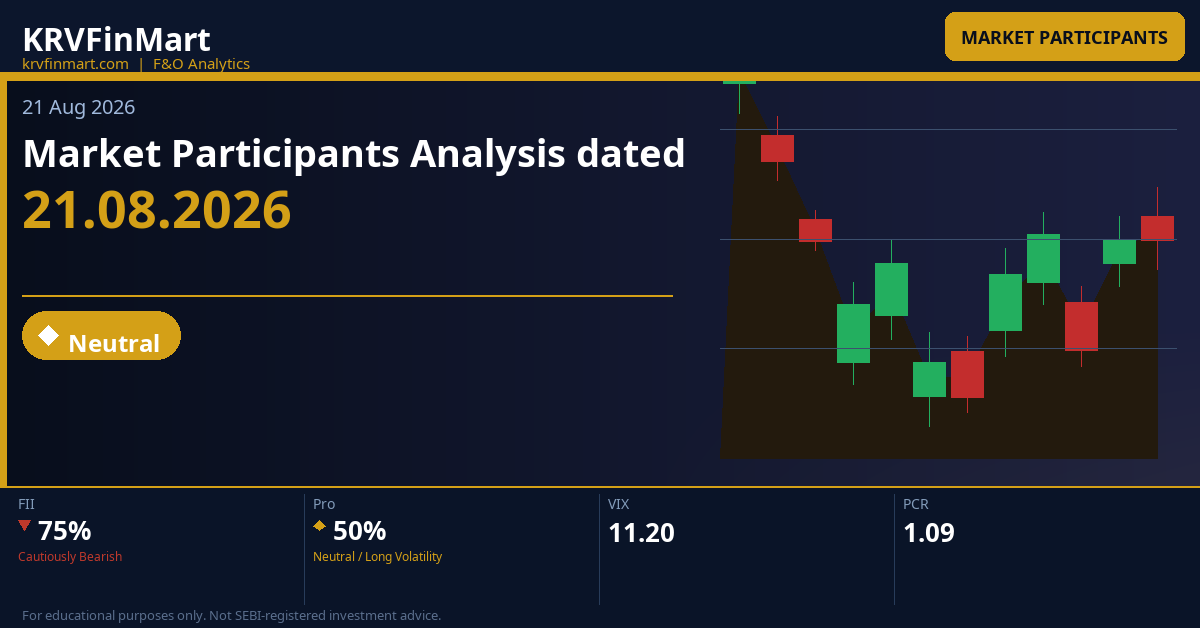
KRVFinMart — Daily Market Outlook
Key Market Signals — Data: 21 Aug 2026
NIFTY 50 24,252.00 ▲ +20.15 (+0.08%) | BANK NIFTY 57,761.95 ▲ +266.05 (+0.46%) | SENSEX 77,540.83 ▲ +3.11 (+0.00%) |
OVERALL PCR 1.09 ▲ +0.00 (+0.15%) PCR at 1.09 indicates mildly bullish sentiment; put writers slightly dominate, but no strong directional tilt. | INDIA VIX 11.20 ▲ +0.44 (+4.09%) VIX rising +4.09% to 11.20 signals hedging demand picking up despite low absolute level — complacency fading. | TOTAL OI CHANGE 50,282,950 ▲ +1,407,542 (+2.88%) Significant OI build of +2.88% signals fresh positioning entering the market on both sides. |
FUTURES OI 705,944 ▲ +2,510 (+0.36%) Marginal futures OI addition of +0.36% shows subdued directional conviction in outright futures. | CALL OI CHANGE 9,835,118 ▲ +801,130 (+8.87%) Sharp call OI surge of +8.87% indicates aggressive call writing and/or buying — resistance building overhead. | PUT OI CHANGE 10,699,278 ▲ +885,964 (+9.03%) Put OI expansion of +9.03% shows strong hedging demand and support building — put longs and writers both active. |
Participant-wise Key Points
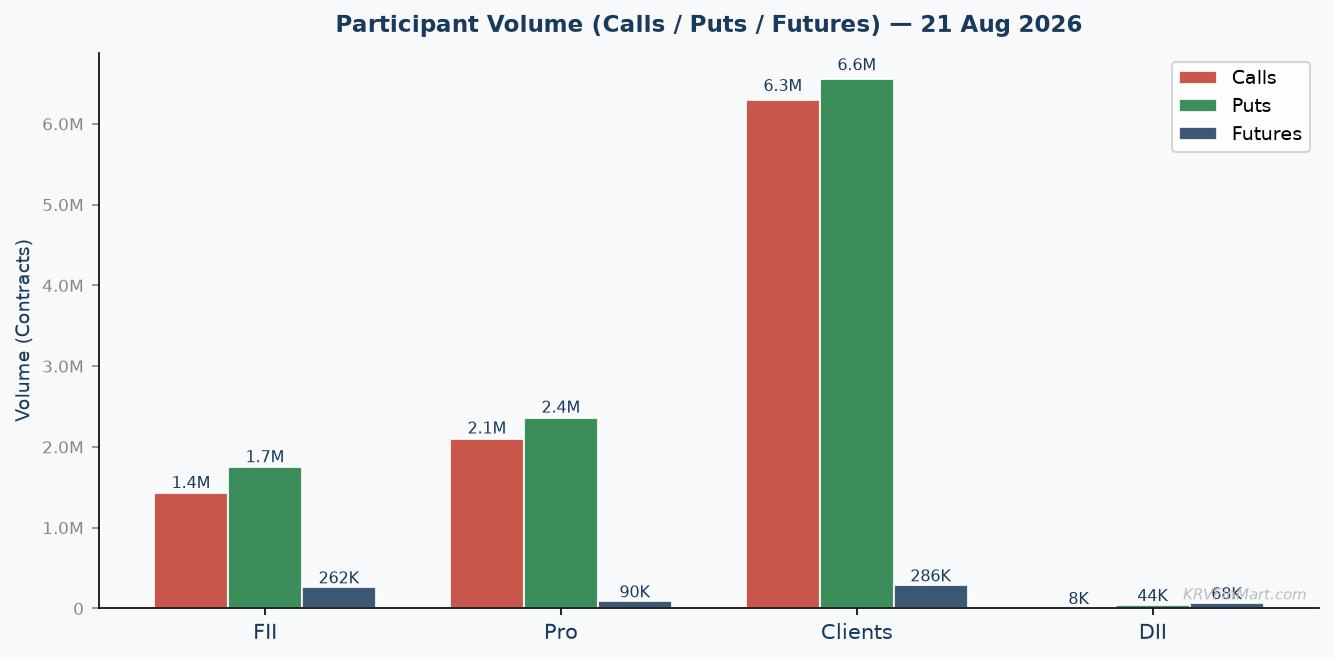
FII Cautiously Bearish — Hedged Short with Selective Long Buildup
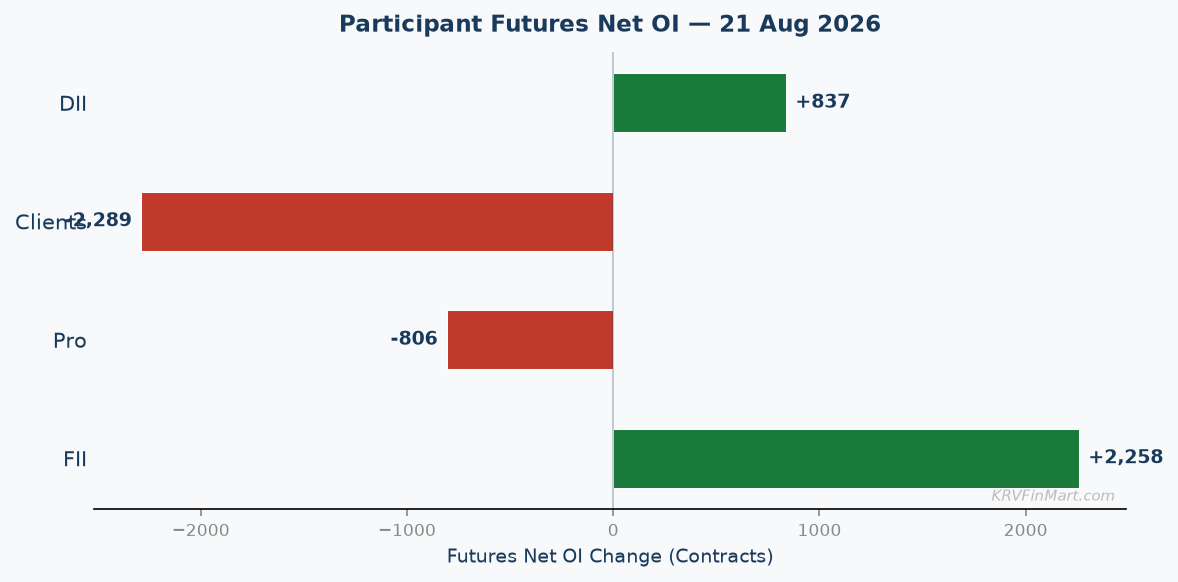
- Futures net improved marginally from -212,113 to -209,855 (net change +2,258 contracts). On the long side, FIIs added +1,725 contracts to reach 26,060 longs [Long Buildup - High Vol], while on the short side they covered a modest -533 contracts to bring gross shorts to 235,915 [Short Covering - High Vol]. The High Vol tag on both the long buildup and short covering is critical — it signals these are deliberate, conviction-driven actions rather than passive or mechanical adjustments. The gross short-to-long ratio remains a commanding 9.05:1 (235,915 shorts vs. 26,060 longs), which unequivocally confirms this is not a hedged book — FIIs are running an outright directional short of institutional scale. Despite NIFTY closing in the green at 24,252.00 (+0.08%), FIIs did not meaningfully reduce their short exposure, which is a stark contrarian signal that their bearish thesis remains intact.
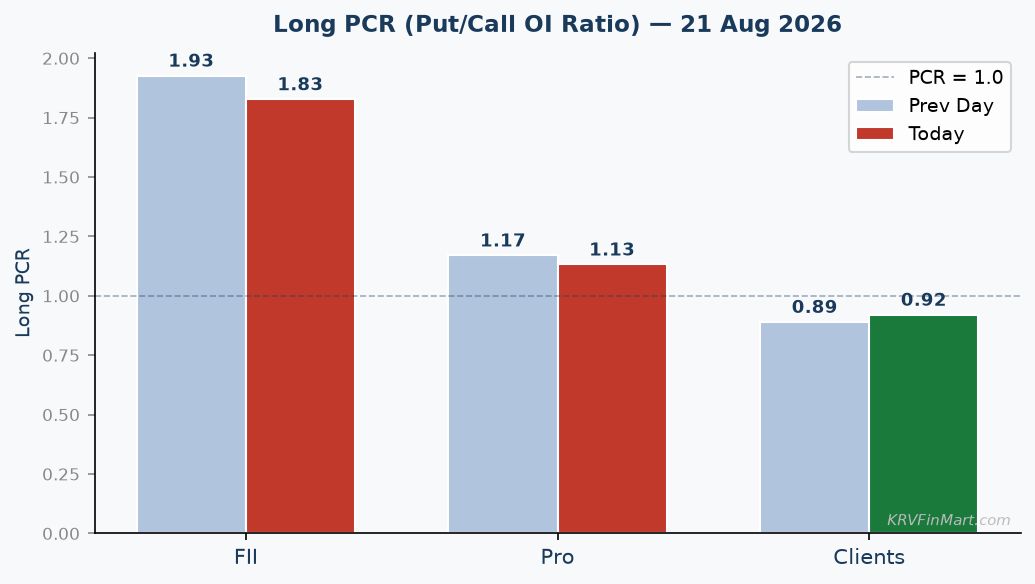
- Long PCR declined from 1.93 to 1.83 (chg -5.15%) and Short PCR rose from 0.75 to 0.78 (chg +3.66%). A Long PCR of 1.83 means FIIs hold 83% more put longs than call longs — an emphatically defensive options posture that either protects a large equity portfolio or expresses an outright directional bearish view through options. The decline in Long PCR from 1.93 to 1.83 is notable: it tells us that while FIIs added put longs today, they added call longs at a faster pace (+9.18% vs. +3.55%), suggesting they are marginally reducing their pure bearish skew but not abandoning it. The Short PCR rising from 0.75 to 0.78 means FIIs are writing incrementally more puts relative to calls on the short side — a shift that introduces a mild range-income or downside-cap element into their short options book. The dominant signal remains firmly bearish: a Long PCR of 1.83 combined with a 9.05:1 futures short ratio leaves no ambiguity about FII directional intent.
- Call OI net moved from -233,793 to -218,113 (net improvement of +15,680; Long 605,959 [Long Buildup - Low Vol], Short 824,072 [Short Buildup - Low Vol]). Put OI net moved from +478,916 to +467,947 (net decline of -10,969; Long 1,107,435 [Long Buildup - Low Vol], Short 639,488 [Short Buildup - Low Vol]). The Low Vol tags on all four options legs are meaningful — they indicate that while FIIs are adding to both call and put positions, the volume conviction behind these additions is thin, suggesting these are incremental adjustments rather than high-conviction new strikes being aggressively initiated. The architecture remains a net short calls + net long puts combination, which is the classic structure of a synthetic short or protective collar — FIIs are capping upside through call writing (net -218,113 calls) while maintaining significant downside protection through put longs (net +467,947 puts). This options architecture directly reinforces and is entirely consistent with their dominant futures short book of -209,855.
- Synthesis — FII Cautious Bearish with Defensive Repositioning: FIIs present the most internally consistent bearish narrative in today's data across all four participant groups. Their futures net of -209,855 (down from -212,113 by a mere +2,258 contracts) represents a negligible reduction relative to their total short exposure — this is not short covering, it is noise around a massive entrenched position. The 9.05:1 gross short-to-long ratio in futures, combined with a Long PCR of 1.83 (net long 1,107,435 puts vs. 605,959 call longs) and a net short call book of -218,113, creates a three-pronged bearish architecture: short futures, long puts, short calls. The Low Vol confirmation tags on options additions suggest FIIs are making incremental calibrations rather than executing a directional ramp, implying the core thesis is being maintained rather than accelerated. The marginal decline in Long PCR from 1.93 to 1.83 and the minor futures net improvement suggest FIIs may be selectively trimming extreme bearishness at the margins — but with a 9.05:1 short ratio, any talk of a thesis flip is premature. Compared to yesterday, FIIs are holding steady in their core bearish posture while making minor adjustments at the edges, confirming this is a conviction carry rather than a reactive repositioning session.
- Forward: The critical threshold to watch is whether FII futures net improves beyond -200,000 contracts — a move from today's -209,855 toward -200,000 or better would signal the beginning of genuine short covering and could accelerate a NIFTY move toward the 24,300 CE resistance and potentially beyond. If instead FII futures net deteriorates back toward -215,000 or worse tomorrow, the bearish thesis intensifies and the 24,000 PE support becomes the gravitational anchor for the market. Watch also whether FII Long PCR recovers above 1.90 — a rebound there would confirm renewed hedging demand and a re-escalation of the bearish options architecture.
DII Mildly Bullish — Steady Long Futures with Negligible Options Activity
- Futures net improved from +27,278 to +28,115 (net change +837 contracts). On the long side, DIIs added +793 contracts to reach 47,906 longs [Long Buildup - High Vol], while on the short side they covered a minimal -44 contracts to bring gross shorts down to 19,791 [Short Covering - High Vol]. The High Vol tags on both the long buildup and short covering are significant — they confirm that DII futures activity today, though modest in absolute scale, was deliberate and conviction-driven rather than mechanical or passive. The gross long-to-short ratio stands at a healthy 2.42:1 (47,906 longs vs. 19,791 shorts), which is a structurally net long book consistent with DIIs' well-established role as domestic institutional buyers and market stabilisers. This incremental long buildup on a near-flat NIFTY day (+0.08%) suggests DIIs are accumulating on dips or maintaining their index exposure ahead of expected domestic flows rather than reacting to short-term price action.
- DII options PCR data is not provided in today's dataset, so no Long PCR or Short PCR values can be stated for this participant. However, the options activity data itself gives us directional colour: on the call side, DII call longs held unchanged at 8,221 contracts while call shorts rose modestly by +50 contracts to 130 — an entirely negligible quantum. On the put side, both put longs and put shorts held unchanged at 44,254 and 0 respectively, with a High Vol tag on the put long flat, confirming this is a deliberate hold rather than a stale position. In the absence of PCR data, the put-to-call positioning ratio implied by raw numbers (44,254 put longs vs. 8,221 call longs) suggests a strong defensive or hedging bias layered on top of an otherwise bullish futures book — a classic DII structure where equity AUM hedging coexists with net long futures.
- Call OI net stands at +8,091 (Long 8,221 [Long Flat - Low Vol], Short 130 [Short Buildup - Low Vol]). Put OI net stands at +44,254 (Long 44,254 [Long Flat - High Vol], Short 0 [Short Flat - High Vol]). The Long Flat - High Vol tag on DII put longs is the most important signal in this block — it means DIIs are deliberately holding their 44,254 put longs without adding or reducing, signifying high-conviction retention of a hedging or protective position. The call side is effectively immaterial at a net of +8,091 with near-zero short writing, telling us DIIs are not using call writing as a yield-enhancement tool today. The overall options architecture is a long put, minimal call activity structure — not a synthetic short (because futures are net long), but rather a covered hedge where DII's net long futures book of +28,115 is partially protected by a significant put long position of 44,254 contracts. This is textbook equity AUM protection — bullish directionally but risk-managed against tail downside.
- Synthesis — DII Steady Bullish with Tail-Risk Hedge: DIIs are presenting the most straightforward and internally consistent positioning among today's participants — a net long futures book of +28,115 (up +837 from yesterday's +27,278) supported by deliberate High Vol confirmation tags, layered with a substantial put long position of 44,254 contracts that has been held flat with High Vol conviction. This is the quintessential domestic institutional structure: buy the dip in futures, hedge the tail with puts, and let the equity AUM generate long-term returns. The fact that DII longs are tagged as High Vol while the quantum of change (+793 contracts) is modest suggests DIIs were active participants in today's session on the long side without needing to make large structural changes — their book was already positioned correctly. Compared to yesterday, DII net has improved by +837 contracts, which is directionally consistent and shows no sign of distribution or unwinding. The contrast with FII is stark: where FIIs maintain a 9.05:1 short-to-long ratio and a synthetic short options architecture, DIIs maintain a 2.42:1 long-to-short ratio with a protective put hedge — these two participant groups are positioned on opposite sides of the directional spectrum, creating the structural tension that defines the current market.
- Forward: The key watch for DIIs tomorrow is whether their futures net crosses and sustains above +30,000 contracts — a move from today's +28,115 toward that threshold would signal an acceleration of the bullish accumulation thesis, particularly meaningful if it occurs alongside NIFTY testing the 24,300 CE resistance. If instead DII futures net slips below +27,000, it would indicate the long buildup is stalling and we may see range-bound or mildly corrective price action. Also watch whether DII put longs of 44,254 start to reduce — any unwinding of that hedge would signal DIIs are growing more confident about the upside and reducing tail-risk protection.
Pro Cautiously Neutral — Balanced Two-Way Options Book with Marginal Futures Short Bias
- Futures net declined from +11,530 to +10,724 (net change -806 contracts). On the long side, Pros added +716 contracts to reach 50,287 longs [Long Buildup - Low Vol], while on the short side they added +1,522 contracts to reach 39,563 shorts [Short Buildup - Avg Vol]. The Low Vol tag on long buildup versus the Avg Vol tag on short buildup is a key divergence — the short additions carry more volume-weight conviction than the long additions, indicating Pros are more deliberate about adding short exposure than long. The gross long-to-short ratio is 1.27:1 (50,287 longs vs. 39,563 shorts), a relatively balanced book but one that has marginally shifted more bearish today as shorts grew faster (+4.00%) than longs (+1.44%). This mild deterioration in net from +11,530 to +10,724 suggests Pros are selectively hedging or fading the market at current levels rather than expressing a strong directional conviction — consistent with their typical role as market makers and sophisticated spread traders.
- Long PCR declined from 1.17 to 1.13 (chg -3.26%) and Short PCR declined from 1.13 to 1.11 (chg -1.80%). A Long PCR of 1.13 means Pros hold 13% more put longs than call longs — a mildly defensive tilt but nowhere near the extreme defensive posture seen in FIIs at 1.83. The decline in Long PCR from 1.17 to 1.13 tells us Pros added call longs at a faster pace (+14.93%) than put longs (+11.19%), indicating a modest reduction in bearish skew on the long options side — they are warming slightly to upside exposure. Similarly, the Short PCR declining from 1.13 to 1.11 means Pros are writing slightly fewer puts relative to calls on the short side — a marginal shift toward call writing dominance which has a mildly bearish tone for the market's upside. The dominant signal from Pro PCR is neutrality with a slight reduction in bearish hedging — neither strongly directional nor definitively committed to any particular scenario, which is consistent with their market-maker function.
- Call OI net improved from +114,315 to +145,158 (net change +30,843; Long 1,122,093 [Long Buildup - Low Vol], Short 976,935 [Short Buildup - Low Vol]). Put OI net improved from +167,492 to +185,335 (net change +17,843; Long 1,270,133 [Long Buildup - Low Vol], Short 1,084,798 [Short Buildup - Low Vol]). The Low Vol tags on all four legs indicate these substantial position additions — +145,739 call longs, +114,896 call shorts, +127,834 put longs, +109,991 put shorts — are being executed at below-average volume conviction, suggesting these are systematic or algorithmic additions rather than high-conviction directional bets. The architecture of net long calls (+145,158) and net long puts (+185,335) creates a classic long strangle or long volatility structure — Pros are positioned to profit from a large move in either direction, consistent with the rising VIX environment (+4.09% today). This long volatility architecture is perfectly consistent with Pros' market-maker role, where they benefit from gamma and vega exposure when volatility expands.
- Synthesis — Pro Balanced Long Volatility with Mild Short Futures Bias: Pro traders are presenting a sophisticated two-layer strategy today: a mild short bias in futures (net +10,724, declining from +11,530) combined with a long volatility options architecture (net long calls +145,158 AND net long puts +185,335). The futures short bias in net terms is modest and consistent with Pros fading the market at 24,252 resistance zone, while the simultaneous build of long calls and long puts in options suggests they are hedging their futures book against a breakout in either direction — a straddle-like protection that profits if VIX continues to expand from today's 11.20 (+4.09%). The Low Vol tags on all four options legs indicate this is a systematic, spread-oriented build rather than a high-conviction directional bet, reinforcing the interpretation that Pros are primarily positioning for volatility expansion rather than a specific market direction. The decline in both Long PCR (1.17→1.13) and Short PCR (1.13→1.11) tells us the overall balanced nature of the book is being slightly rebalanced toward call exposure, which would benefit from an upside move — creating a marginal bull lean within an otherwise neutral volatility structure. Compared to FII's dominant bearish architecture and DII's bullish accumulation, Pros are acting as the market's shock absorber and volatility monetiser today.
- Forward: The key trigger to watch for Pros is whether India VIX sustains above 11.20 or accelerates toward 12.00 tomorrow — if VIX expands, Pros' long strangle book (+145,158 net call longs + +185,335 net put longs) becomes increasingly profitable and we would expect them to maintain or increase their long volatility positions. Conversely, if VIX reverts below 11.00, Pros may begin unwinding their long options legs and rotating toward net short options (volatility selling), which would compress premiums and constrain NIFTY's movement. Also watch whether Pro futures net deteriorates below +10,000 — a break of that threshold alongside increasing short additions would confirm Pros are tilting more definitively bearish in their directional book.
Client Cautiously Bearish on Futures, Two-Way Hedged on Options — Marginally Bearish Net
- Futures net declined from +173,305 to +171,016 (net change -2,289 contracts). On the long side, Clients reduced by -1,979 contracts to 228,719 longs [Long Unwinding - Avg Vol], while on the short side they added +310 contracts to 57,703 shorts [Short Buildup - Avg Vol]. The Avg Vol tags on both the long unwinding and short buildup indicate these are routine rather than high-conviction directional moves — Clients are trimming longs and incrementally adding shorts at average market activity levels, not aggressively repositioning. The gross long-to-short ratio stands at 3.96:1 (228,719 longs vs. 57,703 shorts), which remains a robustly net long book in absolute terms, but the trend is notable: Clients are the only participant group showing simultaneous long unwinding and short buildup in futures today, signalling increasing caution about the upside at current NIFTY levels near 24,252. This marginal deterioration in net futures from +173,305 to +171,016 is consistent with retail and HNI participants beginning to hedge or de-risk as NIFTY approaches the 24,300 CE resistance overhead.
- Long PCR improved from 0.89 to 0.92 (chg +3.37%) and Short PCR declined marginally from 1.17 to 1.16 (chg -0.21%). A Long PCR of 0.92 means Clients hold 8% more call longs than put longs — a mildly bullish skew on the long options side, with retail participants still holding more calls than puts on their buying book. The improvement in Long PCR from 0.89 to 0.92 signals Clients are incrementally increasing their put long exposure relative to calls, moving toward a more hedged stance — this is directionally consistent with their futures long unwinding. The Short PCR of 1.16 (marginally down from 1.17) means Clients are writing 16% more puts than calls on the short side — a significant observation, as put writing dominance on the short side implies Clients are still confident about downside support at the 24,000 PE support level, selling puts they believe will expire worthless. The combined PCR picture is nuanced: long options are mildly bullish (92 call longs per 100 put longs approaching parity) while short options are moderately bullish-on-downside (put writing dominance), creating a mixed but defensively-tilting signal.
- Call OI net declined from +111,337 to +64,864 (net change -46,473; Long 3,181,286 [Long Buildup - Low Vol], Short 3,116,422 [Short Buildup - Low Vol]). Put OI net declined from -690,662 to -697,536 (net change -6,874; Long 2,927,817 [Long Buildup - Low Vol], Short 3,625,353 [Short Buildup - Low Vol]). The massive gross position sizes here reflect Clients' dominant role as the largest options participant by volume — their 3,181,286 call longs and 3,625,353 put shorts are the single largest position blocks in the entire market today. The Low Vol tags on all four legs indicate these enormous additions (call longs +203,886, call shorts +250,359, put longs +277,151, put shorts +284,025) are being added at below-average volume conviction — consistent with broad retail and HNI participation spread across many small lots rather than institutional concentration. The architecture of net long calls (+64,864) but net short puts (-697,536) is a synthetic long or risk reversal structure — Clients own upside via call longs while selling downside protection via put shorts, effectively agreeing to buy the market lower if NIFTY falls to 24,000 while participating in any upside above current levels. This architecture contradicts the cautious signal from futures unwinding, revealing a bifurcated Client behaviour: futures traders are de-risking while options participants are maintaining or increasing a bullish risk-reversal stance.
- Synthesis — Client Bifurcated: Futures Caution vs. Options Bullish Risk Reversal: The most interesting analytical story in today's Client data is the sharp internal contradiction between their futures book and their options architecture. In futures, Clients are de-risking — unwinding -1,979 longs and adding +310 shorts to produce a declining net of +171,016 — a clear signal of growing caution near the 24,300 resistance. Yet in options, the dominant architecture is a synthetic long / risk reversal: net long calls (+64,864) and net short puts (-697,536), meaning Clients as a group have effectively agreed to own the market at lower levels (through put writing) while holding upside optionality (through call buying). This split reflects the heterogeneous nature of the Client category — sophisticated HNI option writers are selling puts to collect premium at the 24,000 PE support while more directional retail futures traders are pulling back from long exposure. The declining call net from +111,337 to +64,864 is a bearish options signal — call longs are growing slower than call shorts, meaning upside demand from retail is being overwhelmed by call supply. Compared to FIIs who are bearish with conviction (9.05:1 short ratio) and DIIs who are bullish with conviction (2.42:1 long ratio), Clients are the ambiguous middle — expressing both caution (futures) and bullishness (options risk reversal) simultaneously, which typically signals a range-bound rather than strongly trending environment.
- Forward: The critical Client watch for tomorrow is whether the call OI net continues to compress from today's +64,864 toward zero or negative territory — if call net turns negative (call shorts exceed call longs), it would signal that retail participants have fully flipped to a cap-upside view and the 24,300 CE resistance becomes an extremely strong ceiling. Conversely, if Client put longs (currently 2,927,817) accelerate meaningfully toward 3,200,000+, it would signal a shift from put writing to put buying — hedging demand replacing income generation — which would be a genuine bearish signal from the largest participant group. Also watch whether Client futures net breaches +170,000 to the downside, as a clean break of that level would confirm accelerating long unwinding and increase downside risk toward the 24,000 PE support.
Bull vs Bear Strength by Participant
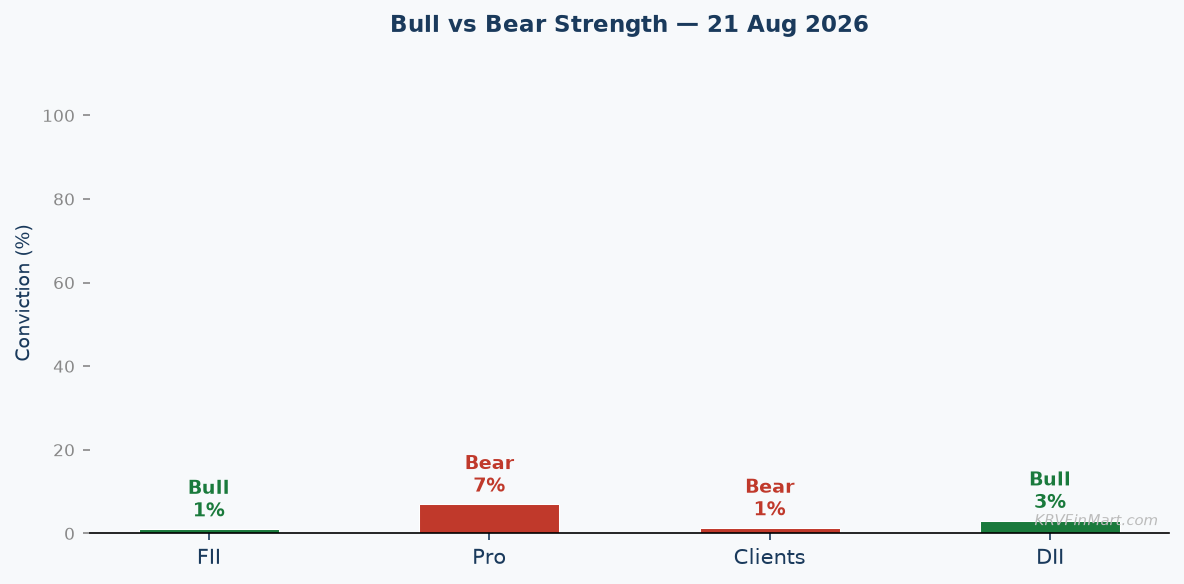
FII Cautiously Bearish 75% ▼▼ | DII Mildly Bullish 65% ▲ | Pro Neutral / Long Volatility 50% ▶ | Client Cautious / Bifurcated 45% ▼ |
Conclusion — Market Outlook for Tomorrow (22 Aug 2026)
The collective participant positioning on 21 Aug 2026 paints a picture of a market in structural tension rather than directional resolution. FIIs maintain an overwhelming 9.05:1 short-to-long ratio in futures (gross shorts 235,915 vs. longs 26,060), a net of -209,855, and a dual-leg bearish options architecture (net short calls -218,113, net long puts +467,947) that together constitute the most bearish institutional posture of any participant group. Directly opposing this, DIIs hold a net long futures book of +28,115 contracts with a 2.42:1 long-to-short ratio and have deliberately retained their 44,254 put long hedge with High Vol conviction. Pro traders are positioned for volatility expansion via a long strangle architecture, adding no directional clarity, while Clients display internal bifurcation — futures unwinding contrasted against an options synthetic-long risk reversal. The net result of these competing forces is a market where bulls (DII, Client options) and bears (FII futures and options) are roughly counterbalancing each other, creating conditions more consistent with sideways chop than a clean trend day.
The Overall PCR of 1.09 (effectively unchanged from 1.09 prev, +0.15% change) confirms this neutral-to-mildly-bullish equilibrium — put OI still exceeds call OI, providing a structural underpinning. However, the +9.03% surge in put OI and +8.87% surge in call OI in a single session, against a NIFTY that moved only +0.08%, is a pronounced warning sign: the market is being aggressively positioned in both directions simultaneously, a hallmark of approaching volatility expansion. India VIX rising +4.09% to 11.20 from 10.76 reinforces this — the fear gauge is waking up from historically suppressed levels, and with FII put longs at 1,107,435 and Client put additions of +277,151 in a single session, hedging demand is clearly picking up. The 24,000 PE support is being defended by Client put writers (income from premium) and FII put longs (directional protection), while the 24,300 CE resistance is being reinforced by FII call writing (net short 824,072 calls) — the market is effectively pinned between these two OI pillars.
The bullish thesis would require FII futures net to improve meaningfully toward -200,000 or better (a reduction of approximately 10,000 short contracts) alongside VIX retreating below 11.00 and the Overall PCR expanding above 1.15 — only then would the structural bearish overhang from FIIs begin to release and allow NIFTY to challenge the 24,300 CE resistance with conviction. The bearish thesis gains traction if FII futures net deteriorates below -215,000, VIX accelerates above 12.50, and Client futures net breaks below +170,000 — that convergence would signal institutional bear pressure overcoming domestic support, exposing the 24,000 PE support as the next gravitational level.
Scenario 1 — Bull case:
If FII futures net improves from -209,855 toward -200,000 or better (net short covering of ~10,000 contracts), driven by short covering tagged with High Vol confirmation, and the Overall PCR expands above 1.15 (put OI building faster than call OI, signalling put writer confidence), and India VIX retreats back below 11.00, then NIFTY has the structural fuel to challenge and potentially breach the 24,300 CE resistance where FII and Client call writers are concentrated. A sustained breakout above 24,300 with expanding DII long additions (net crossing +30,000) would confirm a bullish trend day and open the path toward the next OI zone.
Scenario 2 — Bear case:
If FII futures net deteriorates from -209,855 toward -215,000 or worse (new short additions tagged High Vol), and India VIX accelerates above 12.50 (signalling institutional hedging demand surging), and the Overall PCR drops below 1.00 (call OI overtaking put OI, indicating bearish sentiment shift), then FII's put longs of 1,107,435 begin monetising in-the-money, Client futures long unwinding accelerates below +170,000, and NIFTY faces gravitational pull toward the 24,000 PE support. A breach and close below 24,000 with expanding put long positions would confirm a structural bearish resolution of the current range.
Key Resistance 24,300 (NIFTY CE max OI strike) — FIIs are the dominant call writers here with gross short calls of 824,072 contracts (net short -218,113), and Client call shorts of 3,116,422 reinforce this as the market's primary supply ceiling. A high-volume close above 24,300 would pressure both FII and Client call writers to cover, potentially triggering a short-covering rally. | Key Support 24,000 (NIFTY PE max OI strike) — FII put longs of 1,107,435 contracts and Client put shorts of 3,625,353 (premium income writers expecting the level to hold) together create a powerful dual-layer demand zone. DII's deliberate retention of 44,254 put longs with High Vol conviction at this level further reinforces it as the structural floor. | Trigger to Watch India VIX crossing and sustaining above 12.00 — currently at 11.20 (+4.09%), a further acceleration in VIX toward 12.00 would signal that FII put longs are being aggressively bid (hedging demand surging), making downside monetisation increasingly likely and increasing the probability of a test of the 24,000 PE support. Conversely, VIX reverting below 11.00 would signal market calm, allowing call writers at 24,300 to relax and the range to compress further before the next directional catalyst. |