
Index Research
Intraday Analysis for 24 Aug 2026
KRVFinMart21 August 202649 min
Educational/Derived AnalysisSource: KRVFinMart Research Desk (End-of-Day)As of 21 Aug 2026, 04:07 PM IST
Intraday Analysis for 24 Aug 2026
Markets closed on 21 Aug 2026 with a near-flat to mildly positive tone — NIFTY added just +0.08% to close at **24,252**, BankNifty gained +0.46% to end at **57,761.95**, and SENSEX was virtually unchanged at **77,540.83**. India VIX data is unavailable for this session, which limits our ability to gauge implied volatility premium precisely; traders should assume a moderate-volatility environment and size positions conservatively until VIX confirms direction. The options market structure — with NIFTY's ATM straddle priced at **159.75 points** and max pain sitting right at **24,250** — signals that option writers expect the index to remain in a narrow band, making the first directional breakout of the session the defining trade of the day.
Key Market Signals — Intraday Setup
All three indices are approaching their respective Day-CPR bands with narrow-to-medium CPR widths, signalling elevated trend-day probability on 24 Aug 2026 — the direction of the first 15-to-30-minute candle will set the session's directional bias. BankNifty's ascending medium CPR sitting well above its previous close, combined with a balanced market structure, makes it the index most likely to exhibit the day's clearest trending behaviour.
Deep Technical Analysis & Levels
NIFTY
Ascending — Narrow (Width 0.02%)
▲ Bullish
Market Structure Trending (up or down trend) | Straddle ATM 24250 straddle = **159.75 points** (Call 96.25 + Put 63.5), implying a one-sigma expected move of approximately ±159.75 pts from 24250, giving a range of roughly **24,090 to 24,410** for the weekly expiry. | Max Pain Max Pain = **24,250** for both the week (25-Aug-2026) and month expiry — this is essentially at the current close and the ATM strike, implying that option writers are most comfortable with NIFTY pinning near this level; any sustained move away from 24,250 benefits buyers and hurts the short-options camp. |
Tomorrow's Complete Level Map
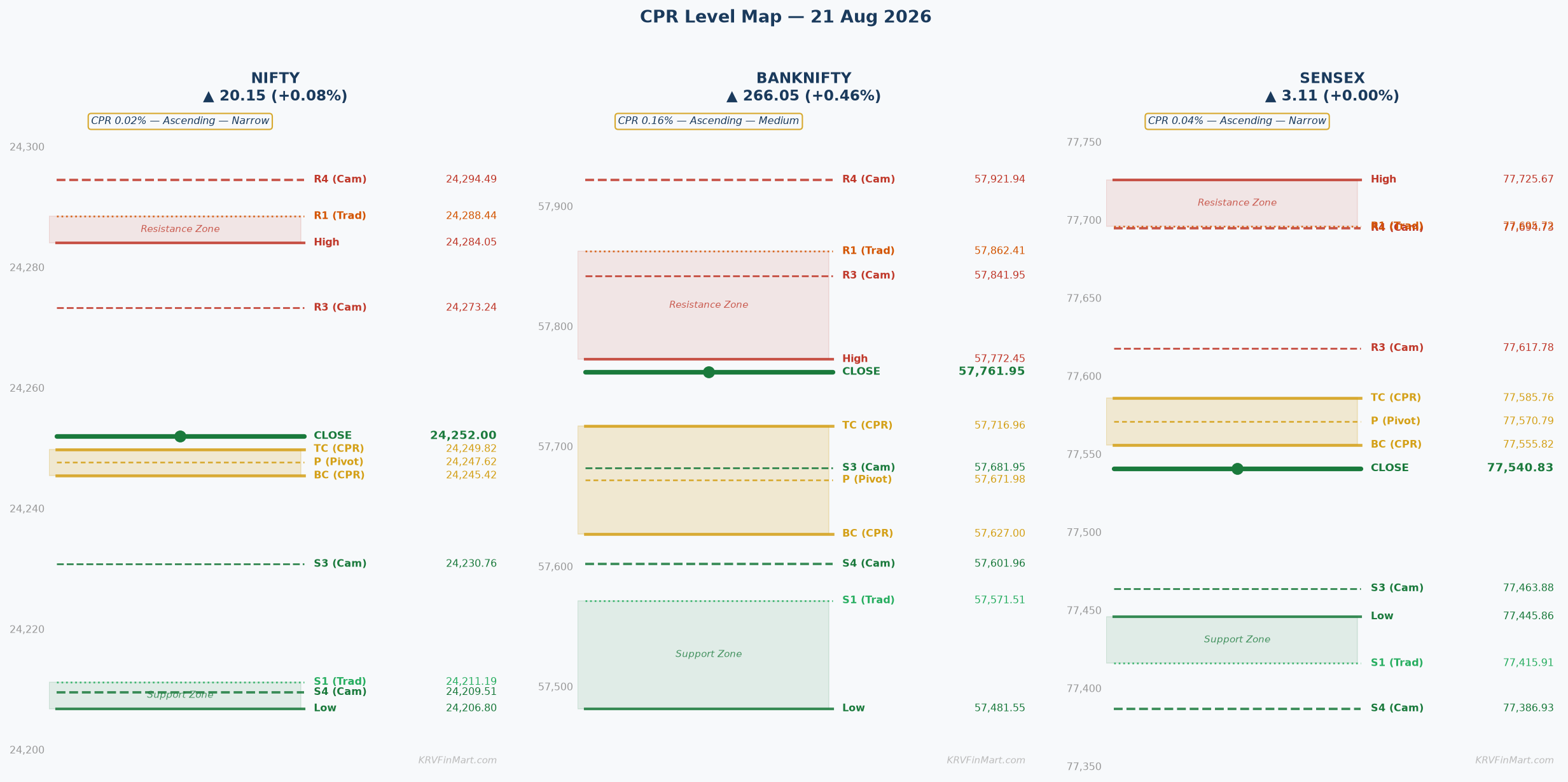
OI-R: 24,300 R3: 24,365.69 H6: 24,329.39 H5: 24,319.31 R2: 24,324.87 H4 ▶: 24,294.49 R1: 24,288.44 PDH: 24,284.05 H3 ↩: 24,273.24
TC: 24,249.82 P: 24,247.62 BC: 24,245.42
L3 ↩: 24,230.76 PDL: 24,206.80 S1: 24,211.19 L4 ▶: 24,209.51 S2: 24,170.37 L5: 24,184.69 L6: 24,174.61 S3: 24,133.94 OI-S: 24,000
↩ = Camarilla reversal point | ▶ = Camarilla breakout/breakdown trigger | OI-R/OI-S = Options wall (CE/PE max OI)
▲ Higher Open (Gap Up) — Open > Prev Close
▲ Bullish
Open lands: With an Ascending CPR where BC=24,245.42 and TC=24,249.82 both sit above yesterday's effective action zone, a gap-up open places price inside the CPR band or above TC=24,249.82 — since the entire CPR is above the prior session's close, even a minor gap up of 0.05-0.25% lands price squarely inside this extremely narrow 4.4-point CPR band or just above TC, making the CPR an immediate launch pad if buyers defend it.
CPR role: Launch pad — the ascending narrow CPR acts as a bullish launchpad; if price opens above TC=24,249.82 and holds, the band becomes a dynamic support zone from which the trending structure accelerates upward.
Minor Gap (0.05–0.25%) — Structure Dominant
A minor gap up of 0.05–0.25% from 24,252 would place NIFTY opening between approximately **24,264 and 24,312**, landing just above TC=24,249.82 and immediately entering the zone between TC and H3=24,273.24. The ascending narrow CPR (width just 0.02% = 4.4 points) strongly confirms a trend-day setup, and with price opening above the entire CPR band, the structure adds powerful bullish confirmation to the gap — there is virtually no conflict between gap direction and CPR structure, both pointing up. The first target is **H3=24,273.24** (Camarilla mean-reversion zone), which must be cleared on the first 15-minute candle close to confirm continuation toward **R1=24,288.44** and then the critical OI-R wall at **24,300**.
Significant Gap (0.25–0.5%) — Balanced
A significant gap up of 0.25–0.5% would place NIFTY's open between approximately **24,313 and 24,373**, directly above PDH=24,284.05 and into the cluster of **R1=24,288.44, H4=24,294.49**, and the OI-R CE wall at **24,300** — this means price opens into immediate layered resistance. Gap-fill risk is moderate-to-high in this scenario because price would be opening above every meaningful Camarilla and Traditional resistance level up to R2=24,324.87, triggering delta-hedging sell flows from CE writers who have their maximum pain at 24,250. The recommended approach is to watch for a first 15-minute candle hold above **R1=24,288.44** as the scalp trigger, targeting **R2=24,324.87**, while a failure to hold above OI-R=24,300 calls for a fade trade back toward PDH=24,284.05 and TC=24,249.82.
Large Gap (>0.5%) — Gap Direction Dominant
A large gap up exceeding 0.5% would thrust NIFTY above **24,373**, well above OI-R=24,300 and into the zone of **H5=24,319.31, H6=24,329.39**, and R3=24,365.69, entering territory where CE writers face losses and gamma hedging flows could theoretically extend the move. However, with max pain anchored at **24,250** and the straddle premium at only **159.75 points**, a large gap up exhausts much of the implied move at the open itself, making extension probability low and gap-fill probability high; the abort level for any long-side trade is a 15-minute close below **OI-R=24,300**, which would signal CE writer confidence returning. If price does sustain above **R3=24,365.69** on two consecutive 15-minute closes, the next meaningful target is the weekly Camarilla H3=24,463.62, though this remains a low-probability scenario given the narrow daily CPR and max-pain gravitational pull.
|
▲ Upside Path → OI-R The upside path follows H3=24,273.24 → PDH=24,284.05 → R1=24,288.44 → H4=24,294.49 → OI-R=24,300, with each level representing a distinct supply zone — H3 is the Camarilla mean-reversion stall, PDH is yesterday's high (structural resistance), R1 is the first Traditional profit-booking level, and OI-R=24,300 is the primary CE writing wall where call sellers defend aggressively. Volume confirmation is essential at each step: a candle closing above PDH=24,284.05 on above-average volume signals institutional participation and raises the probability of reaching the OI-R wall; a volume fade as price approaches 24,300 is the classic signal to book partial profits. |
▼ Downside Path → OI-S If price opens gap-up but fails to sustain above TC=24,249.82 within the first 15 minutes, the failure path is TC→P=24,247.62→BC=24,245.42→L3=24,230.76, and a decisive 15-minute close below BC=24,245.42 structurally converts the ascending CPR from support to resistance. Loss of BC=24,245.42 in a gap-up scenario is a powerful bearish signal — it means all gap-up buyers are underwater and stop-losses cascade, accelerating the move toward L3=24,230.76 and then S1=24,211.19, with the ultimate bear target in this scenario being the L4=24,209.51 cluster near PDL=24,206.80 before OI-S=24,000 becomes relevant on a multi-day breakdown. |
| 🔴 OI-R: OI-R at **24,300** is the primary upside ceiling for 24 Aug 2026, representing the strike with the highest Call OI concentration — CE writers have sold calls here in large volumes precisely because they believe NIFTY will not sustain above this level into the weekly expiry on 25 Aug 2026. In a gap-up scenario, this level acts as a momentum-fade zone: price reaching 24,300 triggers delta-hedging sell flows from CE writers trying to keep their short calls out-of-the-money, creating a visible rejection candle that confirms the ceiling role; only a decisive 15-minute close above 24,300 with expanding volume overrides this CE writing wall and turns it into support for a continuation trade. | 🟢 OI-S: OI-S at **24,000** is the primary PE writing support base and is far below the current price in a gap-up scenario — it is effectively irrelevant as an intraday target unless a catastrophic reversal occurs. The large OI at 24,000 PUT strike tells us that PE writers are comfortable the market will not breach this level before the 25-Aug expiry, providing a distant floor that gives bulls positional confidence; in a gap-up day, OI-S=24,000 serves as the abort-all-longs level rather than an active trading target. |
⚡ Key Trigger: The key trigger for the gap-up scenario is a **first 15-minute candle close above TC=24,249.82** (confirmed by the Narrow CPR rule) — given the CPR width of just 0.02%, this confirmation is almost instantaneous post-open, and what truly matters is whether the first candle can close and hold above **H3=24,273.24** to signal genuine momentum beyond mean-reversion. A failure to hold H3=24,273.24 within the first 15-minute candle and a pullback into the CPR band (BC=24,245.42 to TC=24,249.82) is actually a textbook bullish retest setup — the CPR band becomes support for a second-entry long trade targeting R1=24,288.44 and OI-R=24,300.
▼ Lower Open (Gap Down) — Open < Prev Close
▼ Bearish
Open lands: In an Ascending CPR scenario, a gap-down open places price below BC=24,245.42 — the entire CPR band (BC=24,245.42 to TC=24,249.82) becomes overhead resistance, and price is trading below the ascending structure that was set up for the bulls. This is the most bearish opening configuration for this CPR type, as it means buyers failed to defend the ascending setup at the open and the trend structure is immediately under question.
CPR role: Overhead resistance — the CPR band (BC=24,245.42 to TC=24,249.82) flips from launch pad to a 4.4-point resistance zone that bears will defend and bulls must reclaim to neutralise the gap-down pressure.
Minor Gap (0.05–0.25%) — Structure Dominant
A minor gap down of 0.05–0.25% from 24,252 places NIFTY opening between approximately **24,240 and 24,191**, just below BC=24,245.42, which means the entire ascending CPR band sits above price as overhead resistance. Minor gaps in an ascending narrow CPR configuration often fill within the first 30–60 minutes, as the structural uptrend attracts dip buyers who push price back toward BC=24,245.42; however, the key test is whether BC=24,245.42 is reclaimed as support or merely acts as a ceiling for a failed recovery. If the open is between **24,240 and 24,245**, the bear scenario is limited — L3=24,230.76 is the first meaningful downside target — but a failure to reclaim BC=24,245.42 within the first two 15-minute candles opens the door to S1=24,211.19 and the L4=24,209.51 cluster.
Significant Gap (0.25–0.5%) — Balanced
A significant gap down of 0.25–0.5% places NIFTY opening between approximately **24,131 and 24,191**, below the CPR band and approaching S1=24,211.19 — this is a structurally important breakdown because price is now below both the ascending CPR and the previous day's pivot area. The 30-minute reclaim rule applies: a 30-minute candle close back above BC=24,245.42 is required to negate the bearish signal, and failure to achieve this within the first 30 minutes confirms a failure-and-resume bear pattern with L3=24,230.76 as the first target, then L4=24,209.51 and S1=24,211.19 as a cluster zone near PDL=24,206.80. PUT writing at OI-S=24,000 provides a distant floor, and the straddle range of 159.75 points from 24,250 implies a downside target of approximately **24,090**, which aligns well with the S2=24,170.37 and L5=24,184.69 zone as the realistic intraday bear target.
Large Gap (>0.5%) — Gap Direction Dominant
A large gap down exceeding 0.5% below 24,252 places NIFTY below **24,131**, breaching S1=24,211.19, L3=24,230.76, and approaching S2=24,170.37 and L5=24,184.69 at the open itself — this is a panic-open scenario where option sellers face immediate losses and VIX (though unavailable today) would typically spike. The panic dynamic creates two distinct trading opportunities: an aggressive mean-reversion fade for experienced scalpers targeting recovery back toward L3=24,230.76 and then BC=24,245.42 (the two-30-min-close rule applies for any recovery trade), and a trend-continuation short for those who wait for a dead-cat bounce rejection at BC=24,245.42 targeting L6=24,174.61 and S3=24,133.94. The straddle's 159.75-point implied move is exceeded in this scenario, making straddle monetisation (selling the spike in IV) a sophisticated play for options traders.
|
▲ Upside Path → OI-R The bull recovery path in a gap-down scenario follows BC=24,245.42 → P=24,247.62 → TC=24,249.82 → H3=24,273.24, with each level representing a milestone of buyer strength — reclaiming TC=24,249.82 neutralises the gap-down completely and puts bulls back in control targeting H3=24,273.24 and ultimately OI-R=24,300. Confirmation of genuine recovery (not a dead-cat bounce) requires the 15-minute candle that reclaims TC=24,249.82 to close on above-average volume AND the subsequent candle to hold above BC=24,245.42 on a pullback, rather than collapsing back below. |
▼ Downside Path → OI-S The bear continuation path follows L3=24,230.76 → L4=24,209.51 (cluster with PDL=24,206.80 and S1=24,211.19) → L5=24,184.69 → L6=24,174.61 → S2=24,170.37, with retail stop-losses below L3=24,230.76 providing the fuel for acceleration toward the L4/PDL cluster. The L4=24,209.51 zone near PDL=24,206.80 is the strongest intraday support cluster (Camarilla breakout trigger + previous day low + Traditional S1 within ~4 points of each other), and a breach of this cluster with a 15-minute candle close below 24,205 opens a fast path to L5=24,184.69 and L6=24,174.61 before OI-S=24,000 becomes a multi-session consideration. |
| 🔴 OI-R: OI-R=24,300 serves as the distant overhead ceiling for shorts in a gap-down scenario — CE writers at 24,300 are profitable and will defend their positions aggressively, meaning any recovery rally is expected to stall well before reaching 24,300, making it the maximum upside target for any recovery trade rather than a realistic intraday objective. The gamma pressure from CE writers at 24,300 being in-the-money-comfortable means they will not cover, and institutional desks running delta-hedged books will be net sellers on any rally back toward 24,285–24,300. | 🟢 OI-S: OI-S=24,000 is the primary PE writing base and represents the options market's current floor — in a significant or large gap-down scenario, this level becomes the ultimate bear target and the zone where PE monetisation (booking profits on long puts) begins. Reaching 24,000 intraday would be an extreme outcome (250+ points from the close), but the PE writing concentration here means that arriving at this level triggers aggressive put-writer covering that creates a sharp technical bounce — making 24,000 both a bear target and a high-probability mean-reversion zone for nimble scalpers. |
⚡ Key Trigger: The key bear trigger is **failure to reclaim BC=24,245.42 within the first 15-minute candle close** — in a narrow CPR setup, the inability to reclaim even the bottom of the CPR band within the first 15 minutes is a high-conviction bear signal that the ascending structure has failed for the session. Conversely, the bull trigger is a 15-minute candle close back above BC=24,245.42, which would convert the gap-down into a false breakdown setup targeting TC=24,249.82, P=24,247.62, and then H3=24,273.24 in a strong recovery; the structural fulcrum is BC=24,245.42 — every subsequent level decision flows from whether this point is held or lost.
◆ Near Flat Open — Open ≈ Prev Close (±0.05%)
◆ Neutral
Open lands: A ±0.05% open from 24,252 places NIFTY between **24,240 and 24,264**, which means price opens either inside the CPR band (BC=24,245.42 to TC=24,249.82) or within just 2–14 points of it — given the ascending CPR structure, a flat open near the previous close (24,252) lands price almost exactly at or just above TC=24,249.82, putting price right at the top of the ascending CPR band.
CPR role: Decision zone — the ascending narrow CPR (BC=24,245.42 to TC=24,249.82, width just 4.4 points) acts as an ultra-compressed decision zone where the entire day's directional trade is decided within the first 15-minute candle; the CPR is too narrow to trade within, making it purely a trigger mechanism.
Near Flat (±0.05%)
A flat open in NIFTY with an **Ascending Narrow CPR (width 0.02% = 4.4 points)** is one of the highest-probability trend-day setups in technical analysis — the CPR is so narrow that it provides almost no range buffer, and the market must choose a side immediately, making the first 15-minute candle the entire trade with extremely limited whipsaw room. Price opening near TC=24,249.82 means bulls have a hair-trigger advantage — they are already at the top of the CPR band, and a single 15-minute candle that closes above **TC=24,249.82** and holds gives them full structural control of the day with no overhead CPR resistance. Conversely, a first 15-minute candle that closes below BC=24,245.42 converts the entire ascending CPR into overhead resistance, and given that max pain is at **24,250** (essentially at the current CPR midpoint), a downside break means the gravitational pull of max pain is temporarily suspended and bears are in control targeting L3=24,230.76 and S1=24,211.19. The dual triggers to watch: **Bull = first 15-min close above TC=24,249.82** targeting H3=24,273.24 and then OI-R=24,300; **Bear = first 15-min close below BC=24,245.42** targeting L3=24,230.76 and then L4=24,209.51 — with the CPR width at just 0.02%, there is no middle ground and no room for an indecisive outcome.
|
▲ Upside Path → OI-R The upside path from a flat open follows TC=24,249.82 → H3=24,273.24 → PDH=24,284.05 → R1=24,288.44 → H4=24,294.49 → OI-R=24,300, with H3=24,273.24 as the first partial-profit level (Narrow CPR rule: take first partial at first Traditional target, which is R1=24,288.44, and trail to Camarilla zone). The Narrow CPR confirmation rule requires only the first 15-minute candle to validate direction, meaning longs initiated above TC=24,249.82 can be trailed aggressively with a stop below BC=24,245.42, targeting OI-R=24,300 as the primary exit zone where CE writers create the natural ceiling. |
▼ Downside Path → OI-S The downside path follows BC=24,245.42 → L3=24,230.76 → PDL=24,206.80 → L4=24,209.51 → S1=24,211.19 → L5=24,184.69 → OI-S=24,000, with L3=24,230.76 as the first Camarilla mean-reversion stall and L4=24,209.51 as the breakdown trigger. The cluster of L4=24,209.51, S1=24,211.19, and PDL=24,206.80 within a 5-point range creates the strongest intraday support cluster on the downside — a close below PDL=24,206.80 on a 15-minute candle activates the L5=24,184.69 and L6=24,174.61 targets before OI-S=24,000 becomes relevant. |
| 🔴 OI-R: OI-R=24,300 is the CE writing ceiling established by option sellers who wrote calls at this strike anticipating that NIFTY will not sustain above 24,300 into the 25-Aug weekly expiry — in a flat-open trending scenario, this level is the natural exit for all long-side intraday trades and the zone where institutional desks begin building short delta exposure. With max pain at 24,250 (just 50 points below OI-R=24,300), the gravitational pull between max pain and the CE wall creates a natural trading range ceiling, making 24,300 a high-confidence profit-booking zone for longs initiated from the CPR band. | 🟢 OI-S: OI-S=24,000 is the PE writing base that represents the options market's downside anchor — in a flat-open scenario, this level is 252 points below the current price and is relevant only if the day develops into a severe trending day down. The massive PUT OI at 24,000 tells us PE writers are highly confident NIFTY will not breach this level by expiry, which provides a psychological safety net for bulls and makes any dip toward 24,000 a PE writing opportunity for sophisticated participants — in practice, this level anchors the lower boundary of the macro option structure within which today's intraday moves occur. |
⚡ Key Trigger: **Bull trigger: First 15-minute candle close above TC=24,249.82** on above-average volume — in a flat-open ascending narrow CPR, this is the single most important level because it confirms that the ascending bullish structure has been accepted by the market and the trend-day up thesis is activated, immediately targeting H3=24,273.24. **Bear trigger: First 15-minute candle close below BC=24,245.42** — this 4.4-point inversion of the CPR from launch pad to resistance is the structural fulcrum that determines the entire session, as bears must hold price below BC=24,245.42 for the entire session to maintain downside control, while any reclaim above BC=24,245.42 immediately neutralises the bear case.
BANKNIFTY
Ascending — Medium (Width 0.16%)
▲ Bullish
Market Structure Balanced or transitional | Straddle ATM 57800 straddle = **493.45 points** (Call 198.45 + Put 295.0), implying an expected intraday move of approximately ±493.45 pts from 57800, giving a practical range of roughly **57,307 to 58,293** for the monthly expiry — notably, the put premium (295.0) exceeds the call premium (198.45), reflecting modest downside skew despite the ascending CPR structure. | Max Pain Max Pain = **57,700** for the BankNifty monthly expiry (25-Aug-2026), which is approximately 62 points below the 21-Aug close of 57,761.95 and sits between BC=57,627 and TC=57,716.96 of the Day CPR — this max pain level is essentially inside the ascending CPR band, creating a gravitational pull that makes the 57,627–57,716 zone the most contested area of the session. |
Tomorrow's Complete Level Map
OI-R: 58,000 R3: 58,153.31 H6: 58,054.27 H5: 58,015.37 R2: 57,962.88 H4 ▶: 57,921.94 R1: 57,862.41 PDH: 57,772.45 H3 ↩: 57,841.95
TC: 57,716.96 P: 57,671.98 BC: 57,627.00
L3 ↩: 57,681.95 PDL: 57,481.55 S1: 57,571.51 L4 ▶: 57,601.96 S2: 57,381.08 L5: 57,508.53 L6: 57,469.63 S3: 57,280.61 OI-S: 57,000
↩ = Camarilla reversal point | ▶ = Camarilla breakout/breakdown trigger | OI-R/OI-S = Options wall (CE/PE max OI)
▲ Higher Open (Gap Up) — Open > Prev Close
▲ Bullish
Open lands: With BC=57,627 significantly above the previous close of 57,761.95 — wait, BankNifty closed at 57,761.95 which is ABOVE TC=57,716.96, meaning price already closed above the entire ascending CPR on 21 Aug. Therefore, a gap-up open on 24 Aug places price further above TC=57,716.96, opening above the ascending CPR band and into or above H3=57,841.95 territory, which is a very bullish positioning.
CPR role: Confirmed support zone — since BankNifty closed above TC=57,716.96 on 21 Aug, the entire ascending CPR band (BC=57,627 to TC=57,716.96) now acts as a confirmed support zone on the gap-up open, and the 90-point CPR width provides meaningful support depth.
Minor Gap (0.05–0.25%) — Structure Dominant
A minor gap up of 0.05–0.25% from the close of 57,761.95 places BankNifty opening between approximately **57,791 and 57,906**, which is above TC=57,716.96 and into the zone bracketed by PDH=57,772.45 and H3=57,841.95 — with the close already above the entire ascending CPR, a minor gap up confirms the bullish trend structure is intact. The Medium CPR width (0.16% = ~90 points) means the first 30-minute close must be watched, and a 30-minute candle that closes above **H3=57,841.95** is the primary confirmation signal for a trending-up day targeting R1=57,862.41 and then H4=57,921.94. Gap-fill probability is moderate — the CPR band from BC=57,627 to TC=57,716.96 sits 45–135 points below the open, making a full gap-fill unlikely in a minor gap scenario unless broad market sentiment turns negative; the more likely outcome is a brief consolidation between PDH=57,772.45 and H3=57,841.95 before a directional breakout.
Significant Gap (0.25–0.5%) — Balanced
A significant gap up of 0.25–0.5% from 57,761.95 places BankNifty opening between approximately **57,906 and 58,050**, directly into the zone of **H3=57,841.95, R1=57,862.41, H4=57,921.94, R2=57,962.88** and approaching the critical OI-R CE wall at **58,000**. Opening into this cluster of four significant resistance levels creates an immediate mean-reversion risk — CE writers at 58,000 will defend aggressively, and the delta-hedging flows from option market makers at H4=57,921.94 and R2=57,962.88 will be selling into the gap. The recommended approach is the 30-minute confirmation rule: if the first 30-minute candle closes and holds above **H4=57,921.94** on above-average volume, it signals genuine momentum toward OI-R=58,000; a 30-minute close below H4=57,921.94 confirms mean-reversion toward TC=57,716.96 and the max pain zone at 57,700.
Large Gap (>0.5%) — Gap Direction Dominant
A large gap up exceeding 0.5% from 57,761.95 places BankNifty above **58,050**, which means opening above OI-R=58,000, H5=58,015.37, and H6=58,054.27 — this is an extreme opening where CE writers at 58,000 are immediately underwater and must cover, creating a short-covering squeeze dynamic. However, with the monthly max pain at **57,700** (350+ points below the open), the gravitational pull back toward max pain is powerful, and the straddle's 493.45-point implied move is nearly exhausted in the opening gap itself, making extension probability very low. The specific abort level for any long-side position in this scenario is a 15-minute close below OI-R=58,000, which signals that CE writers have regained control; the realistic targets in this case are mean-reversion back toward H4=57,921.94, then H3=57,841.95, and ultimately the CPR band at TC=57,716.96.
|
▲ Upside Path → OI-R The upside path follows H3=57,841.95 → PDH=57,772.45 (already below in gap-up, so previous resistance) → R1=57,862.41 → H4=57,921.94 → R2=57,962.88 → OI-R=58,000, with the Medium CPR rule requiring partial profits at the first Traditional target (R1=57,862.41) and second partial at the Camarilla zone (H4=57,921.94) before exiting near OI-R=58,000. Each of these levels is a distinct supply zone — H3=57,841.95 is the Camarilla mean-reversion stall where first-wave sellers appear, H4=57,921.94 is the Camarilla breakout trigger where momentum traders confirm the trend, and OI-R=58,000 is the CE writing wall that is the primary exit for all intraday longs. |
▼ Downside Path → OI-S If the gap-up fails and price reverses below TC=57,716.96, the downside path follows TC=57,716.96 → P=57,671.98 → BC=57,627 → max pain 57,700 (magnet zone) → L3=57,681.95 → L4=57,601.96 → S1=57,571.51 → OI-S=57,000, with max pain at 57,700 acting as the first magnetic pull point. The loss of BC=57,627 in a gap-up scenario is a severe failure — it means the ascending CPR has been completely negated and the balanced market structure is shifting bearish, accelerating toward L4=57,601.96 and S1=57,571.51 as the bear campaign targets. |
| 🔴 OI-R: OI-R=58,000 is the primary CE writing ceiling for the BankNifty monthly expiry — the concentration of call writing at this strike reflects institutional conviction that BankNifty will not sustain above 58,000 into the 25-Aug expiry, and in a gap-up scenario this level acts as the primary profit-exit zone for longs and the initiation point for counter-trend shorts. CE writers at 58,000 with deep out-of-the-money protection will be highly motivated to defend this level with aggressive selling, creating visible rejection candles on any approach — traders should watch for a 15-minute doji or bearish engulfing candle at 58,000 as the confirmation of CE writer dominance. | 🟢 OI-S: OI-S=57,000 is the distant PE writing base in a gap-up scenario — it is 761 points below the close and approximately 800+ points below a gap-up open, making it essentially irrelevant as an intraday bear target unless a catastrophic reversal unfolds. The large PUT OI at 57,000 confirms that PE writers view this as a safe floor and that institutional options books are not positioned for a move to 57,000 in the near term, providing macro-level confidence to bulls that the downside is structurally protected. |
⚡ Key Trigger: The key trigger for a gap-up in BankNifty with a Medium CPR is the **first 30-minute candle close above H3=57,841.95** (Camarilla mean-reversion first stall zone) — this is because the Medium width requires a 30-minute confirmation, and H3=57,841.95 is the first Camarilla resistance above where any gap-up open would initially find selling pressure from mean-reversion traders. A 30-minute close above **H3=57,841.95** on volume above the 30-minute average activates the trending-up thesis with targets at R1=57,862.41 (first partial profit), H4=57,921.94 (second partial per Medium CPR rule), and OI-R=58,000 as the primary exit zone; failure to close above H3=57,841.95 in the first 30 minutes triggers a mean-reversion short targeting TC=57,716.96 and max pain at 57,700.
▼ Lower Open (Gap Down) — Open < Prev Close
▼ Bearish
Open lands: A gap-down open from 57,761.95 places BankNifty below TC=57,716.96, and depending on the gap size, potentially below P=57,671.98, BC=57,627, or even L3=57,681.95 — given that the previous close was already above the entire ascending CPR (57,762 vs TC=57,717), a gap-down pulls price back into or below the CPR band, converting what was a supportive post-close position into immediate overhead resistance.
CPR role: Overhead resistance — the entire ascending CPR band (BC=57,627 to TC=57,716.96) becomes overhead resistance in a gap-down scenario, with BC=57,627 as the critical recovery trigger and TC=57,716.96 as the full recovery confirmation.
Minor Gap (0.05–0.25%) — Structure Dominant
A minor gap down of 0.05–0.25% from 57,761.95 places BankNifty opening between approximately **57,617 and 57,717**, which means price opens inside the CPR band or just below BC=57,627 — this is a textbook inside-CPR or just-below-BC scenario where the Medium CPR rule requires a 30-minute candle close to determine direction. The ascending CPR structure and the previous close above TC=57,716.96 mean that a minor gap down is very likely to fill within 30–60 minutes as buyers step in near BC=57,627 (the ascending CPR support), and the key test is whether the first 30-minute candle closes above BC=57,627. A failure to reclaim BC=57,627 within 30 minutes activates the bear scenario with L3=57,681.95 as the first target (note: L3=57,681.95 is above BC=57,627 — L3 lies inside the CPR band, meaning any price action within the BC-to-L3 zone is compressed and consolidatory before a directional break).
Significant Gap (0.25–0.5%) — Balanced
A significant gap down of 0.25–0.5% from 57,761.95 places BankNifty opening between approximately **57,617 and 57,473**, below BC=57,627 and potentially below L4=57,601.96 and S1=57,571.51 — this is a structurally bearish open where the entire ascending CPR is now overhead resistance and price is opening near the PDL=57,481.55 zone. The 30-minute reclaim rule is critical here: a 30-minute close above BC=57,627 negates the gap-down and activates recovery to TC=57,716.96 and then max pain 57,700; failure to reclaim BC=57,627 in 30 minutes confirms the bear pattern with targets at L4=57,601.96, S1=57,571.51, L5=57,508.53 and ultimately the PDL=57,481.55 support zone. PUT writing at OI-S=57,000 means the market does not anticipate breaching 57,000, so the straddle's 493-point downside range targets approximately 57,307 as the extreme bear scenario.
Large Gap (>0.5%) — Gap Direction Dominant
A large gap down exceeding 0.5% from 57,761.95 places BankNifty below approximately **57,473**, which is below PDL=57,481.55, L5=57,508.53, L6=57,469.63, and approaching S2=57,381.08 — this is a panic-open below the previous day's entire range. In this scenario, the balanced-to-transitional market structure is severely disrupted, and the two-30-minute-close rule for Wide/large-gap scenarios applies: traders should wait for two consecutive 30-minute candles to close in the same direction before entering; the first viable entry is a recovery bounce from L5=57,508.53 or L6=57,469.63 with a target back toward the CPR band at BC=57,627. The ultimate panic target is S2=57,381.08 and S3=57,280.61, while max pain at 57,700 remains approximately 320–420 points above the open, creating powerful mean-reversion pressure that ultimately stabilises the market.
|
▲ Upside Path → OI-R The bull recovery path follows BC=57,627 → L3=57,681.95 → P=57,671.98 → max pain 57,700 → TC=57,716.96 → PDH=57,772.45, with max pain at 57,700 acting as a powerful magnetic attractor that pulls price upward from below, especially in the final 90 minutes of the session when option writers actively manage their delta exposure. Genuine recovery (not a dead-cat bounce) is confirmed when price holds above TC=57,716.96 for a full 30-minute candle and the next candle does not re-enter the CPR band below P=57,671.98 — at that point, the session is neutral-to-bullish and the day's original ascending-trend thesis is partially restored. |
▼ Downside Path → OI-S The bear continuation path follows L3=57,681.95 → L4=57,601.96 → S1=57,571.51 → L5=57,508.53 → PDL=57,481.55 → L6=57,469.63 → S2=57,381.08 → OI-S=57,000, with retail stop-losses clustered below L4=57,601.96 providing the fuel for acceleration once this Camarilla breakdown level is breached. The PDL=57,481.55 and L5=57,508.53 zone is a natural momentum stall point where first-wave sellers cover and second-wave sellers reload; a 30-minute close below PDL=57,481.55 signals that the bear campaign is aiming for the S2=57,381.08 area, which is within the straddle's 493-point downside range from ATM=57,800. |
| 🔴 OI-R: OI-R=58,000 serves as the ultimate overhead ceiling for CE writers in a gap-down scenario — it is 200+ points above the previous close and even further above a gap-down open, making it irrelevant as an intraday target but highly relevant as the level where bears feel most comfortable. CE writers at 58,000 are profiting handsomely in a gap-down scenario and have zero motivation to cover, meaning institutional selling flows remain net negative and dampen any recovery rally below 58,000. | 🟢 OI-S: OI-S=57,000 is the primary PE writing support and the ultimate bear target in a significant or large gap-down scenario — reaching 57,000 intraday would trigger massive PE writer covering (buyback of puts) which creates a sharp technical bounce and makes 57,000 a high-probability reversal zone for aggressive scalpers. The 761-point distance from the close to OI-S=57,000 means this level is only relevant in a large-gap or multi-session bearish scenario, but its presence as a major PUT OI concentration means that any approach toward 57,000 is met with institutional buying that prevents clean breakdown. |
⚡ Key Trigger: The key trigger for the gap-down scenario is **failure to reclaim BC=57,627 within the first 30-minute candle close** (Medium CPR confirmation rule) — in an ascending CPR, BC is the bottom of the bullish structure, and every 30 minutes that price fails to reclaim it adds confirmation weight to the bear thesis. The bull recovery trigger is precisely a **30-minute close above BC=57,627**, which would then target P=57,671.98, max pain 57,700, and TC=57,716.96 in sequence; the bear confirmation trigger is a **30-minute close below L4=57,601.96** (Camarilla breakdown trigger), which activates the S1=57,571.51 and L5=57,508.53 targets and removes any realistic gap-fill scenario for the session.
◆ Near Flat Open — Open ≈ Prev Close (±0.05%)
◆ Neutral
Open lands: A ±0.05% open from 57,761.95 places BankNifty between approximately **57,733 and 57,791**, which is above TC=57,716.96 — since the previous close (57,761.95) was already above the entire ascending CPR, a flat open continues this above-CPR positioning, meaning the CPR band sits approximately 45–134 points below the open as a support zone.
CPR role: Support zone from below — the ascending Medium CPR (BC=57,627 to TC=57,716.96) sits below the flat open as a confirmed support band; the 30-minute confirmation rule for Medium CPR determines whether price holds above TC=57,716.96 and trends up or gravitates back toward the CPR for a retest.
Near Flat (±0.05%)
A flat open with a **Medium Ascending CPR (width 0.16% = ~90 points)** creates a balanced-tension setup where neither bulls nor bears have an immediate structural advantage — price opens above TC=57,716.96 (bullish positioning from previous close), but the Market Structure is 'Balanced or transitional', suggesting that neither a clean trend day nor a range day can be assumed without the first 30-minute candle's direction. The fact that BankNifty closed at 57,761.95 — above the entire ascending CPR — means that a flat open maintains the bullish overnight positioning, and the CPR band (BC=57,627 to TC=57,716.96) serves as a dynamic support zone approximately 45–135 points below the open; if buyers actively defend any dip to TC=57,716.96, the bullish trend structure is confirmed. The max pain at **57,700** is critically important in a flat-open scenario — it sits inside the ascending CPR band, and with monthly expiry on 25 Aug 2026 (next day), option writers will be actively managing delta to keep BankNifty near 57,700, creating a gravitational pull that may cause price to trade down from the flat open toward TC=57,716.96 and P=57,671.98 before any directional resolution. Both triggers must be actively tracked: **Bull = first 30-minute close above PDH=57,772.45** (yesterday's high, which is the natural resistance in a flat-open scenario above TC) targeting H3=57,841.95 and R1=57,862.41; **Bear = first 30-minute close below TC=57,716.96** converting the CPR from support to resistance and targeting max pain 57,700, P=57,671.98, and BC=57,627 — the Medium CPR rule requires a 30-minute close with retests expected, so the first candle is the trigger and the second candle is the confirmation.
|
▲ Upside Path → OI-R The upside path follows PDH=57,772.45 → H3=57,841.95 → R1=57,862.41 → H4=57,921.94 → R2=57,962.88 → OI-R=58,000, with the Medium CPR rule requiring a first partial profit at R1=57,862.41 (first Traditional target) and a second partial at H4=57,921.94 (Camarilla zone) before exiting near OI-R=58,000. Volume confirmation at PDH=57,772.45 is essential — a 30-minute breakout above yesterday's high without volume is a false breakout signal and should be faded back toward TC=57,716.96. |
▼ Downside Path → OI-S The downside path follows TC=57,716.96 → max pain 57,700 (magnetic zone) → P=57,671.98 → BC=57,627 → L4=57,601.96 → S1=57,571.51 → OI-S=57,000, with max pain at 57,700 being the first natural stall point where option writers actively defend their monthly max-pain position. The BC=57,627 level is the final bullish defense — a 30-minute close below BC=57,627 signals complete failure of the ascending CPR structure and activates L4=57,601.96 and S1=57,571.51 as the bear targets; OI-S=57,000 remains the ultimate downside anchor. |
| 🔴 OI-R: OI-R=58,000 is the primary CE writing ceiling in the monthly expiry context — with expiry on 25 Aug 2026, CE writers at 58,000 are highly motivated to defend this level and keep BankNifty below it, creating a visible supply zone that acts as the maximum intraday upside target for any flat-open bullish scenario. In practice, as price approaches 57,950–58,000, CE writer delta-hedging creates systematic selling pressure that is only overcome by a large positive surprise catalyst. | 🟢 OI-S: OI-S=57,000 is the PE writing base that anchors the floor of the monthly options structure — in a flat-open scenario, this level is 761 points below the current price and serves as the macro floor that gives bulls positional confidence to buy any dip toward the CPR band. The concentration of PE writing at 57,000 means that institutional options books are not positioned for a break below this level, and reaching 57,000 triggers aggressive put-writer covering that creates sharp technical bounces. |
⚡ Key Trigger: **Bull trigger: First 30-minute candle close above PDH=57,772.45** with above-average volume — this is the natural resistance level in a flat-open above the ascending CPR, and a clean 30-minute close above PDH=57,772.45 confirms that buyers have absorbed all previous-day supply and the path to H3=57,841.95 and OI-R=58,000 is open. **Bear trigger: First 30-minute candle close below TC=57,716.96** — this converts the ascending CPR band from support to resistance and activates the max pain gravitational pull toward 57,700, P=57,671.98, and BC=57,627; the structural fulcrum is TC=57,716.96, and every subsequent level decision in the session flows from whether this level is defended or lost.
SENSEX
Ascending — Narrow (Width 0.04%)
▲ Bullish
Market Structure Trending (up or down trend) | Straddle ATM 77500 straddle = **750.35 points** (Call 475.5 + Put 274.85), implying an expected intraday move of approximately ±750.35 pts from 77500, giving a range of roughly **76,750 to 78,250** for the weekly and monthly expiry — the call premium significantly exceeds the put premium (475.5 vs 274.85), indicating upside skew and bullish positioning by options buyers despite the flat close. | Max Pain Max Pain = **77,600** for both the SENSEX weekly (27-Aug-2026) and monthly expiry — this is just 59 points above the close of 77,540.83 and sits between TC=77,585.76 and OI-R=77,600, making the max pain level essentially coincident with the OI resistance, which creates an extremely powerful gravitational zone between 77,585 and 77,600 that defines the upper boundary of the session's 'natural' range. |
Tomorrow's Complete Level Map
OI-R: 77,600 R3: 77,975.53 H6: 77,820.98 H5: 77,784.61 R2: 77,850.60 H4 ▶: 77,694.73 R1: 77,695.72 PDH: 77,725.67 H3 ↩: 77,617.78
TC: 77,585.76 P: 77,570.79 BC: 77,555.82
L3 ↩: 77,463.88 PDL: 77,445.86 S1: 77,415.91 L4 ▶: 77,386.93 S2: 77,290.98 L5: 77,297.05 L6: 77,260.68 S3: 77,136.10 OI-S: 77,500
↩ = Camarilla reversal point | ▶ = Camarilla breakout/breakdown trigger | OI-R/OI-S = Options wall (CE/PE max OI)
▲ Higher Open (Gap Up) — Open > Prev Close
↕ Conflicted
Open lands: With the Ascending Narrow CPR (BC=77,555.82, TC=77,585.76) sitting above the previous close of 77,540.83, a gap-up open places SENSEX inside the CPR band or above TC=77,585.76, directly at the confluence of the ascending CPR, OI-R=77,600 (CE wall), and max pain at 77,600 — this is an exceptionally dense resistance zone where a gap-up open immediately encounters the CPR band, the OI ceiling, and the max pain gravitational attractor all within a 44-point range (77,556 to 77,600).
CPR role: Immediate resistance confluence — the ascending narrow CPR (BC=77,555.82 to TC=77,585.76, width just 30 points) sits in a cluster with OI-R=77,600 and max pain=77,600, making the 77,556–77,600 zone the most structurally dense resistance area on the chart for 24 Aug 2026.
Minor Gap (0.05–0.25%) — Structure Dominant
A minor gap up of 0.05–0.25% from 77,540.83 places SENSEX opening between approximately **77,579 and 77,735**, which lands inside the CPR band or above TC=77,585.76, immediately at the critical OI-R=77,600 and max pain=77,600 confluence — this is the most complex opening scenario because price gaps directly into the session's primary supply zone. The ascending narrow CPR structure (width 0.04%) adds bullish confirmation to the gap direction, but the simultaneous presence of OI-R=77,600, max pain=77,600, and TC=77,585.76 within a 44-point zone creates a powerful ceiling that may prevent immediate upside; the first 15-minute candle is decisive — a close above **OI-R=77,600** on high volume is needed to confirm genuine breakout, while a failure to hold 77,600 triggers mean-reversion toward BC=77,555.82. If the open is in the 77,579–77,600 range, the practical setup is: hold above 77,600 → target H3=77,617.78 and R1=77,695.72; fail below BC=77,555.82 → target L3=77,463.88 and OI-S=77,500.
Significant Gap (0.25–0.5%) — Balanced
A significant gap up of 0.25–0.5% from 77,540.83 places SENSEX opening between approximately **77,735 and 77,928**, above PDH=77,725.67 and into the zone of H4=77,694.73, R1=77,695.72, H5=77,784.61, H6=77,820.98, and R2=77,850.60 — this is a very complex opening because price gaps above OI-R=77,600, PDH, and multiple Camarilla levels simultaneously. Delta-hedging sell flows from CE writers at 77,600 who are now in-the-money will be aggressive, and the gap-fill target back to OI-R=77,600 is the high-probability near-term trade; the 15-minute confirmation rule (Narrow CPR) means a 15-minute close BELOW PDH=77,725.67 after opening above it signals the gap-fill trade has initiated. The alternative scenario — sustained hold above H4=77,694.73 and R1=77,695.72 on the first 15-minute candle — activates the continuation trade toward H5=77,784.61 and R2=77,850.60.
Large Gap (>0.5%) — Gap Direction Dominant
A large gap up exceeding 0.5% from 77,540.83 places SENSEX above **77,928**, deep into R2=77,850.60 territory and approaching R3=77,975.53 — opening above OI-R=77,600 by more than 300 points puts all CE writers at 77,600 significantly in-the-money and triggers forced covering cascades. However, the straddle's 750.35-point implied move from 77,500 means the upside boundary of the implied range is approximately 78,250, and opening at 77,928 consumes more than half the implied upside move at the open itself, making any gap-extension beyond R3=77,975.53 a very low-probability event requiring extraordinary macro catalyst. Traders should wait for a two-30-minute-close confirmation before entering in either direction, and note that the gap-fill target back to OI-R=77,600 and max pain=77,600 remains the highest-probability intraday return target regardless of opening strength.
|
▲ Upside Path → OI-R The upside path follows OI-R=77,600 → H3=77,617.78 → H4=77,694.73 → R1=77,695.72 → PDH=77,725.67 → H5=77,784.61 → H6=77,820.98 → R2=77,850.60, with H3=77,617.78 as the first Camarilla partial-profit level and R1=77,695.72 as the first Traditional partial (Narrow CPR rule: first partial at first Traditional target). The near-coincidence of H4=77,694.73 and R1=77,695.72 (just 1 point apart) creates an exceptionally strong dual-layer resistance at the 77,694–77,696 zone where Camarilla breakout trigger meets Traditional R1 — this is the key test for whether the gap-up develops into a full trend day or stalls for a range session. |
▼ Downside Path → OI-S If the gap-up fails at OI-R=77,600 and price reverts below TC=77,585.76, the failure path follows TC=77,585.76 → P=77,570.79 → BC=77,555.82 → OI-S=77,500 → L3=77,463.88 → PDL=77,445.86 → S1=77,415.91, with OI-S=77,500 being just 55 points below BC=77,555.82 and acting as the first PUT writing base. Loss of BC=77,555.82 in a gap-up scenario is a powerful false-breakout signal — it means all gap-up buyers from the 77,556–77,600 zone are stopped out simultaneously, creating a sharp acceleration toward OI-S=77,500 and then L3=77,463.88. |
| 🔴 OI-R: OI-R=77,600 is the most important single level for SENSEX on 24 Aug 2026 — the coincidence of CE max OI resistance and max pain at exactly **77,600** creates a unique double-lock ceiling where option sellers at this strike have maximum incentive to defend, and the max pain gravitational force pulls price back here even if it temporarily overshoots. In a gap-up scenario, this level is simultaneously the target (if opening below 77,600) and the resistance (if opening above) — the CE writing wall at 77,600 means institutional desks will be systematically selling any approach from below and covering only if price holds above 77,600 for a full 15-minute candle. | 🟢 OI-S: OI-S=77,500 is the PE writing support base, and its proximity to the previous close (77,540.83) and the current BC=77,555.82 makes it an unusually close and active level in a gap-up scenario — it sits just 55 points below BC=77,555.82 and 100 points below the previous close, meaning any gap-fill reversion in a gap-up scenario quickly reaches OI-S=77,500 as the first meaningful PE support zone. The PE writer concentration at 77,500 provides a natural intraday floor, and reaching 77,500 triggers PUT writer covering that creates a technical bounce — making 77,500 a high-probability buy-the-dip zone for scalpers if the gap-up fails. |
⚡ Key Trigger: The key trigger for a gap-up in SENSEX is a **first 15-minute candle close above OI-R=77,600** (the CE writing wall and max pain level, which coincides with being just above TC=77,585.76) — this is the single most important level because it simultaneously clears the Narrow CPR top, the OI resistance, and the max pain anchor, meaning all three headwinds are resolved in one confirmation. A 15-minute close above 77,600 with above-average volume targets H3=77,617.78 and then R1=77,695.72 for partial booking; a failure at 77,600 reverting below TC=77,585.76 triggers the mean-reversion trade targeting BC=77,555.82, L3=77,463.88, and OI-S=77,500.
▼ Lower Open (Gap Down) — Open < Prev Close
▼ Bearish
Open lands: A gap-down open from 77,540.83 places SENSEX below BC=77,555.82, with the entire ascending CPR band (BC=77,555.82 to TC=77,585.76) acting as overhead resistance — since BC=77,555.82 is above the previous close, a gap-down falls below the entire ascending CPR and also immediately tests or breaches OI-S=77,500, which is just 40 points below BC=77,555.82 and only 41 points below the previous close.
CPR role: Overhead resistance and immediate OI-S threat — the ascending narrow CPR (BC=77,555.82 to TC=77,585.76) sits above the gap-down open as overhead resistance, while OI-S=77,500 is immediately threatened at any gap-down above 0.05%, making this scenario structurally bearish but also immediately at a major options support level.
Minor Gap (0.05–0.25%) — Structure Dominant
A minor gap down of 0.05–0.25% from 77,540.83 places SENSEX opening between approximately **77,348 and 77,502**, which is below BC=77,555.82 and immediately at or below **OI-S=77,500** — the PE writing support at 77,500 is tested at the open itself in this scenario, making the open a high-stakes event where PUT writers must defend or capitulate. The ascending narrow CPR structure creates a 15-minute confirmation rule scenario where: if OI-S=77,500 holds and a 15-minute candle closes back above BC=77,555.82, the gap-down is a false breakdown and the recovery trade targets TC=77,585.76 and OI-R=77,600; if OI-S=77,500 fails to hold and a 15-minute candle closes below 77,500, the bear path opens toward L3=77,463.88 and PDL=77,445.86. The uniquely compressed nature of SENSEX's key levels (OI-S=77,500 only 56 points below BC=77,555.82 and 86 points below TC=77,585.76) means that even a minor gap down creates an extreme setup where every candle is immediately meaningful.
Significant Gap (0.25–0.5%) — Balanced
A significant gap down of 0.25–0.5% from 77,540.83 places SENSEX opening between approximately **77,348 and 77,347**, below OI-S=77,500, L3=77,463.88, and approaching PDL=77,445.86 and S1=77,415.91 — this is a structurally bearish opening where both the ascending CPR and the OI-S are overhead resistance. The 30-minute reclaim rule requires a 30-minute close above OI-S=77,500 to negate the bear thesis; failure to reclaim 77,500 within 30 minutes confirms bear control with targets at L3=77,463.88, PDL=77,445.86, S1=77,415.91, L4=77,386.93, and then S2=77,290.98. The straddle's 750.35-point downside range from 77,500 implies an extreme bear target of approximately **76,750**, and the S2=77,290.98 and L5=77,297.05 zone is the realistic intraday bear target in this scenario.
Large Gap (>0.5%) — Gap Direction Dominant
A large gap down exceeding 0.5% from 77,540.83 places SENSEX below approximately **77,154**, breaching OI-S=77,500, L3=77,463.88, PDL=77,445.86, S1=77,415.91, L4=77,386.93, L5=77,297.05, and approaching S2=77,290.98 and L6=77,260.68 — this is a panic opening below virtually every intraday support level. The trending market structure in SENSEX (unlike the balanced BankNifty) means that large gaps in the trend direction (here, a gap down against the ascending CPR trend) carry higher reversal probability; the two-30-minute-close rule must be applied before any directional trade is initiated. Recovery targets from L6=77,260.68 back toward OI-S=77,500 and then BC=77,555.82 represent the primary mean-reversion opportunity, while continuation bears target S3=77,136.10 as the extreme intraday level before straddle-monetisation selling exhausts.
|
▲ Upside Path → OI-R The bull recovery path follows OI-S=77,500 → BC=77,555.82 → P=77,570.79 → TC=77,585.76 → OI-R=77,600, with OI-S=77,500 as the recovery trigger point and BC=77,555.82 as the first milestone confirming the ascending CPR has been reclaimed. Genuine recovery (confirmed by the Narrow CPR rule) requires a 15-minute close above TC=77,585.76 — at that point, the gap-down has been fully negated and the session reverts to a bullish ascending-narrow-CPR trending day targeting H3=77,617.78, R1=77,695.72, and PDH=77,725.67. |
▼ Downside Path → OI-S The bear continuation path follows OI-S=77,500 → L3=77,463.88 → PDL=77,445.86 → S1=77,415.91 → L4=77,386.93 → L5=77,297.05 → S2=77,290.98 → L6=77,260.68 → S3=77,136.10, with retail stop-losses below PDL=77,445.86 providing the fuel for acceleration toward S1=77,415.91 once PDL is breached. The L5=77,297.05 and S2=77,290.98 zone within 8 points of each other creates the strongest intraday support cluster on the bear path — a 15-minute close below S2=77,290.98 activates L6=77,260.68 and then S3=77,136.10 as the extreme bear targets. |
| 🔴 OI-R: OI-R=77,600 serves as the overhead ceiling in a gap-down scenario — CE writers at 77,600 are comfortably in-the-money (price is below their strike) and have no motivation to cover, meaning institutional delta-hedging flows remain net negative and suppress any recovery rally below 77,600. The 100-point distance between OI-S=77,500 and OI-R=77,600 defines the entire daily options battle zone — in a gap-down scenario, the session becomes a struggle between OI-S=77,500 (PE base) and OI-R=77,600 (CE ceiling) within this narrow 100-point corridor. | 🟢 OI-S: OI-S=77,500 is the primary near-term support and the defining level in any SENSEX gap-down scenario — the PE writing concentration at exactly 77,500 creates an unusually strong and proximate floor that is tested at the very open in a gap-down, making this level the session's most important battleground. If PE writers defend 77,500 successfully (evidenced by a 15-minute candle wick down to 77,500 followed by a close above 77,510), it triggers aggressive short-covering and a recovery rally; if 77,500 is breached on a 15-minute close, PE writers begin unwinding their positions (buying back puts), paradoxically amplifying the downward momentum. |
⚡ Key Trigger: The key trigger for a gap-down in SENSEX is the critical test of **OI-S=77,500** — this level is only 40 points below BC=77,555.82, meaning a gap-down of as little as 0.05% below the previous close brings price immediately to the PE writing base, making this the structural fulcrum that determines the entire session. **Bull recovery trigger: first 15-minute candle close above OI-S=77,500** (since this level is the PE floor, reclaiming it signals PUT writer support is holding and targets BC=77,555.82); **bear confirmation trigger: first 15-minute candle close below OI-S=77,500** activates L3=77,463.88 and PDL=77,445.86 as immediate targets and signals that PUT writers are unwinding, creating a momentum cascade.
◆ Near Flat Open — Open ≈ Prev Close (±0.05%)
◆ Neutral
Open lands: A ±0.05% open from 77,540.83 places SENSEX between approximately **77,502 and 77,579**, which lands below BC=77,555.82 at the lower end of the range and inside the CPR band at the upper end — given the ascending narrow CPR (BC=77,555.82, TC=77,585.76), a flat open is the only scenario where price is not already above TC=77,585.76 at the open, meaning bulls must reclaim the CPR band actively.
CPR role: Decision zone with immediate OI-S proximity — the ascending narrow CPR (BC=77,555.82 to TC=77,585.76, width just 29.94 points) is the compressed decision zone, but the extraordinary additional feature is that OI-S=77,500, OI-R=77,600, and max pain=77,600 all fall within 100 points of the CPR band, creating the most options-constrained flat-open scenario among all three indices today.
Near Flat (±0.05%)
A flat open in SENSEX with an **Ascending Narrow CPR (width 0.04% = ~30 points)** is a maximum-information setup where the first 15-minute candle completely determines the session's direction — the CPR is so narrow (30 points in a 77,500 index) that there is no meaningful middle ground, and the market must immediately choose between the bull path (above TC=77,585.76 targeting OI-R=77,600 and max pain=77,600) and the bear path (below BC=77,555.82 testing OI-S=77,500 and L3=77,463.88). What makes this flat-open uniquely complex is the unprecedented proximity of all key levels: OI-S=77,500 is just 55 points below BC=77,555.82, OI-R=77,600 and max pain=77,600 are just 14 points above TC=77,585.76, and PDH=77,725.67 and PDL=77,445.86 are approximately 125 points above and below respectively — the entire SENSEX session unfolds within a remarkably compressed options architecture. The trending market structure (Ascending Narrow CPR in a trending context) strongly favours a trend-day outcome, and with max pain at exactly **77,600** (coinciding with OI-R), the option writers' expectation is for SENSEX to close near 77,600 at expiry — making an upward resolution of the flat open the higher-probability scenario as max pain provides a gravitational pull upward from the current close of 77,540. Both precise triggers: **Bull = first 15-min close above TC=77,585.76** targeting OI-R=77,600, max pain zone 77,600, and then H3=77,617.78; **Bear = first 15-min close below BC=77,555.82** immediately threatening OI-S=77,500 and targeting L3=77,463.88 and PDL=77,445.86.
|
▲ Upside Path → OI-R The upside path follows TC=77,585.76 → OI-R=77,600 (max pain coincides here) → H3=77,617.78 → H4=77,694.73 → R1=77,695.72 → PDH=77,725.67 → H5=77,784.61 → R2=77,850.60, with OI-R=77,600 and max pain=77,600 as the first major resistance cluster just 14 points above TC; the Narrow CPR rule requires a first partial profit at R1=77,695.72 (the first Traditional target), and the trail should be maintained to the Camarilla zone at H4=77,694.73. A clean 15-minute close above H3=77,617.78 — which is above OI-R=77,600 — signals that CE writers have capitulated and the trend is extending toward PDH=77,725.67 and R1=77,695.72. |
▼ Downside Path → OI-S The downside path follows BC=77,555.82 → OI-S=77,500 → L3=77,463.88 → PDL=77,445.86 → S1=77,415.91 → L4=77,386.93 → L5=77,297.05 → S2=77,290.98, with OI-S=77,500 being the first and most critical bear target — just 55 points below BC=77,555.82, this level is reached almost instantly once BC is breached in a trending market. The L3=77,463.88 and PDL=77,445.86 zone (within 18 points of each other) is the primary intraday bear target where first-wave sellers take profits and second-wave sellers reload; a 15-minute close below PDL=77,445.86 activates S1=77,415.91 and L4=77,386.93 as continuation targets. |
| 🔴 OI-R: OI-R=77,600 and max pain=77,600 are coincident in SENSEX — this double-lock ceiling at exactly the same strike means that the CE writing wall and the gravitational max pain attractor are reinforcing each other at 77,600, creating the strongest possible single-level resistance in the entire analysis today. In a flat-open scenario, OI-R=77,600 functions simultaneously as the primary upside target (just 59 points above close) and the primary profit-booking zone where both directional traders (longs reaching target) and options writers (CE writers defending) create systematic selling — the practical implication is that reaching 77,600 and holding above it on a 15-minute close is the signal to stay long, while failing at 77,600 is the signal to fade the rally. | 🟢 OI-S: OI-S=77,500 is the most proximate options support level in today's analysis — at just 40 points below the previous close and 55 points below BC=77,555.82, this PE writing base is reached at the very first test of the downside from a flat open, making it the session's most actively traded level on any bearish outcome. The PE writer concentration at 77,500 creates an immediate technical bounce when reached, and the close proximity to the current price means that the 77,500–77,556 zone (between OI-S and BC) is the most action-rich zone in a flat-open scenario — every candle in this zone carries high information content about whether the session will be bullish or bearish for the day. |
⚡ Key Trigger: **Bull trigger: First 15-minute candle close above TC=77,585.76** — this simultaneously clears the Narrow CPR top and positions price for an immediate test of OI-R=77,600 and max pain=77,600, creating a momentum trade that is confirmed by the Narrow CPR rule (only one 15-minute candle needed); the next 15-minute candle holding above TC=77,585.76 on a pullback confirms the CPR is now support. **Bear trigger: First 15-minute candle close below BC=77,555.82** — given that OI-S=77,500 is only 55 points below BC, this trigger immediately activates the OI-S test and bears have virtually no work to do to reach the PUT support floor; the structural fulcrum is BC=77,555.82 because its breach simultaneously triggers stop-losses, OI-S testing, and L3=77,463.88 targeting in a single confirmed candle.
📊 VIX Insight: India VIX data is unavailable for the 21 Aug 2026 session, which prevents a precise implied volatility reading for 24 Aug 2026 — traders should treat this as a moderate-volatility environment and avoid over-leveraged positions until VIX is reported. In the absence of VIX, the straddle premiums act as the best proxy for expected move: NIFTY's 159.75-point straddle implies relatively contained volatility expectations, BankNifty's 493.45-point straddle suggests moderate volatility consistent with its historical beta, and SENSEX's 750.35-point straddle (with call premium 475.5 significantly exceeding put premium 274.85) indicates an upside volatility skew that supports the ascending CPR bias across all three indices for 24 Aug 2026.
Overall View:
All three indices enter 24 Aug 2026 with **Ascending Narrow CPRs** (NIFTY 0.02%, SENSEX 0.04%) or an Ascending Medium CPR (BankNifty 0.16%), universally signalling high-probability trend-day setups where the first 15–30 minutes determine the session's entire directional outcome. The critical shared observation is that BankNifty's previous close (57,761.95) is already **above its entire ascending CPR** (TC=57,716.96), giving it the strongest bullish pre-open positioning, while NIFTY and SENSEX close below their respective ascending CPR bands — making reclamation of BC (24,245.42 for NIFTY, 77,555.82 for SENSEX) the primary bull trigger for the session. With NIFTY and SENSEX max pain (24,250 and 77,600) acting as gravitational anchors and OI-R levels (24,300 and 77,600) as session ceilings, the highest-conviction trade on 24 Aug 2026 is a bull breakout confirmed by the first 15-minute candle close above the respective TC values — failing which, a mean-reversion toward OI-S levels (24,000 for NIFTY, 77,500 for SENSEX, 57,000 for BankNifty) provides the alternative bearish setup.
All three indices enter 24 Aug 2026 with **Ascending Narrow CPRs** (NIFTY 0.02%, SENSEX 0.04%) or an Ascending Medium CPR (BankNifty 0.16%), universally signalling high-probability trend-day setups where the first 15–30 minutes determine the session's entire directional outcome. The critical shared observation is that BankNifty's previous close (57,761.95) is already **above its entire ascending CPR** (TC=57,716.96), giving it the strongest bullish pre-open positioning, while NIFTY and SENSEX close below their respective ascending CPR bands — making reclamation of BC (24,245.42 for NIFTY, 77,555.82 for SENSEX) the primary bull trigger for the session. With NIFTY and SENSEX max pain (24,250 and 77,600) acting as gravitational anchors and OI-R levels (24,300 and 77,600) as session ceilings, the highest-conviction trade on 24 Aug 2026 is a bull breakout confirmed by the first 15-minute candle close above the respective TC values — failing which, a mean-reversion toward OI-S levels (24,000 for NIFTY, 77,500 for SENSEX, 57,000 for BankNifty) provides the alternative bearish setup.
Disclaimer: KRVFinMart provides educational and informational content relating to financial markets. Articles, research, examples, charts, strategies and tools are provided for educational purposes and should not be interpreted as personalised investment advice or a guarantee of financial performance. Markets involve risk, including possible loss of capital. Past performance does not guarantee future results. KRVFinMart is not a SEBI Registered Investment Adviser or Research Analyst.