
Index Research
Intraday Analysis for 25 Aug 2026
KRVFinMart24 August 202657 min
Educational/Derived AnalysisSource: KRVFinMart Research Desk (End-of-Day)As of 24 Aug 2026, 04:34 PM IST
Intraday Analysis for 25 Aug 2026
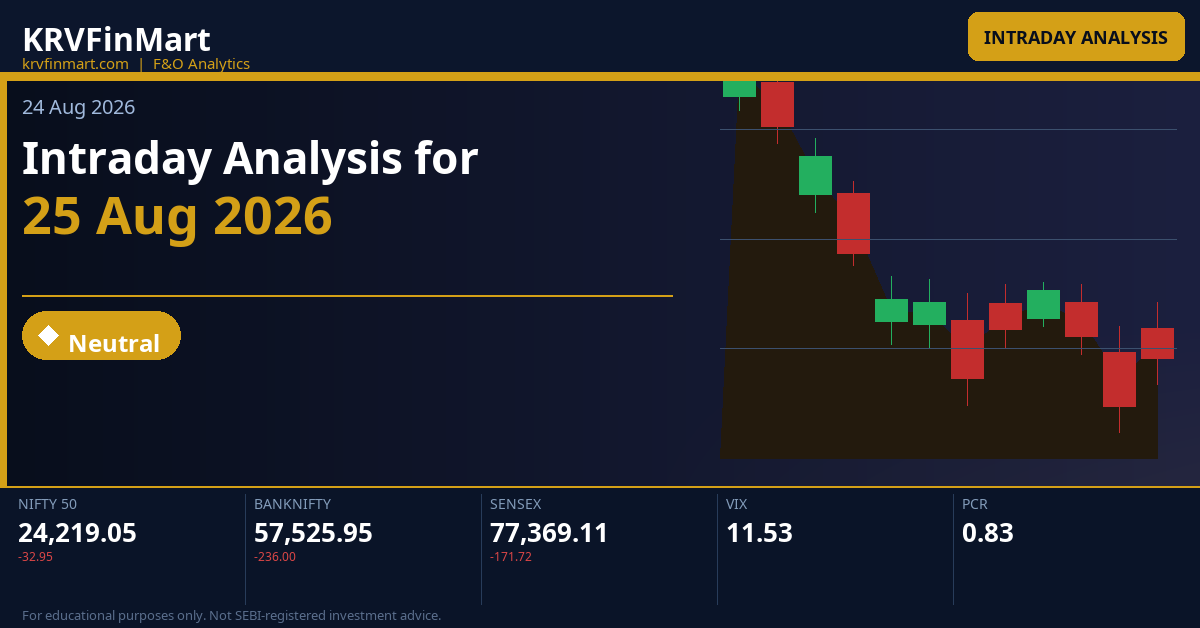
Markets closed on a mildly negative note on 24 Aug 2026 with NIFTY shedding 0.14% to 24,219.05, BANKNIFTY declining 0.41% to 57,525.95, and SENSEX losing 0.22% to close at 77,369.11, painting a picture of broad but shallow distribution. India VIX data is unavailable for today's session, which limits our ability to gauge option premium inflation or deflation — traders should treat premium decay mechanically until VIX is confirmed. All three indices are printing Descending CPR structures for 25 Aug 2026, meaning the entire CPR band sits below yesterday's price, positioning the CPR as potential overhead resistance rather than support — a structurally bearish setup that demands confirmation from price action at the open.
Key Market Signals — Intraday Setup
All three indices — NIFTY, BANKNIFTY, and SENSEX — carry Descending CPR formations for 25 Aug 2026, confirming that multi-session selling pressure is embedding itself in pivot structure; NIFTY's CPR width of just 0.03% and BANKNIFTY's 0.04% signal extreme compression that sharply elevates the probability of a clean directional trend day, making the first 15-minute candle the single most critical piece of information for intraday positioning.
Deep Technical Analysis & Levels
NIFTY
Descending — Narrow (Width 0.03%)
▼ Bearish
Market Structure Trending (up or down trend) | Straddle ATM 24200 straddle priced at 123.45 points (Call 57.25 + Put 66.2), implying a one-standard-deviation expected move of approximately ±123 points from 24200, defining a day range roughly between 24077 and 24323 — note the put premium (66.2) exceeds the call premium (57.25), reflecting a mild bearish skew in options positioning heading into 25 Aug. | Max Pain Max Pain at 24,200 for both the weekly (25-Aug-2026) and monthly (25-Aug-2026) expiries — since both expire on the same day, option sellers have concentrated maximum pain at 24,200, creating gravitational pull toward this strike and suggesting that any significant deviation above 24,300 or below 24,100 will face structural resistance from the options market's pinning mechanics. |
Tomorrow's Complete Level Map
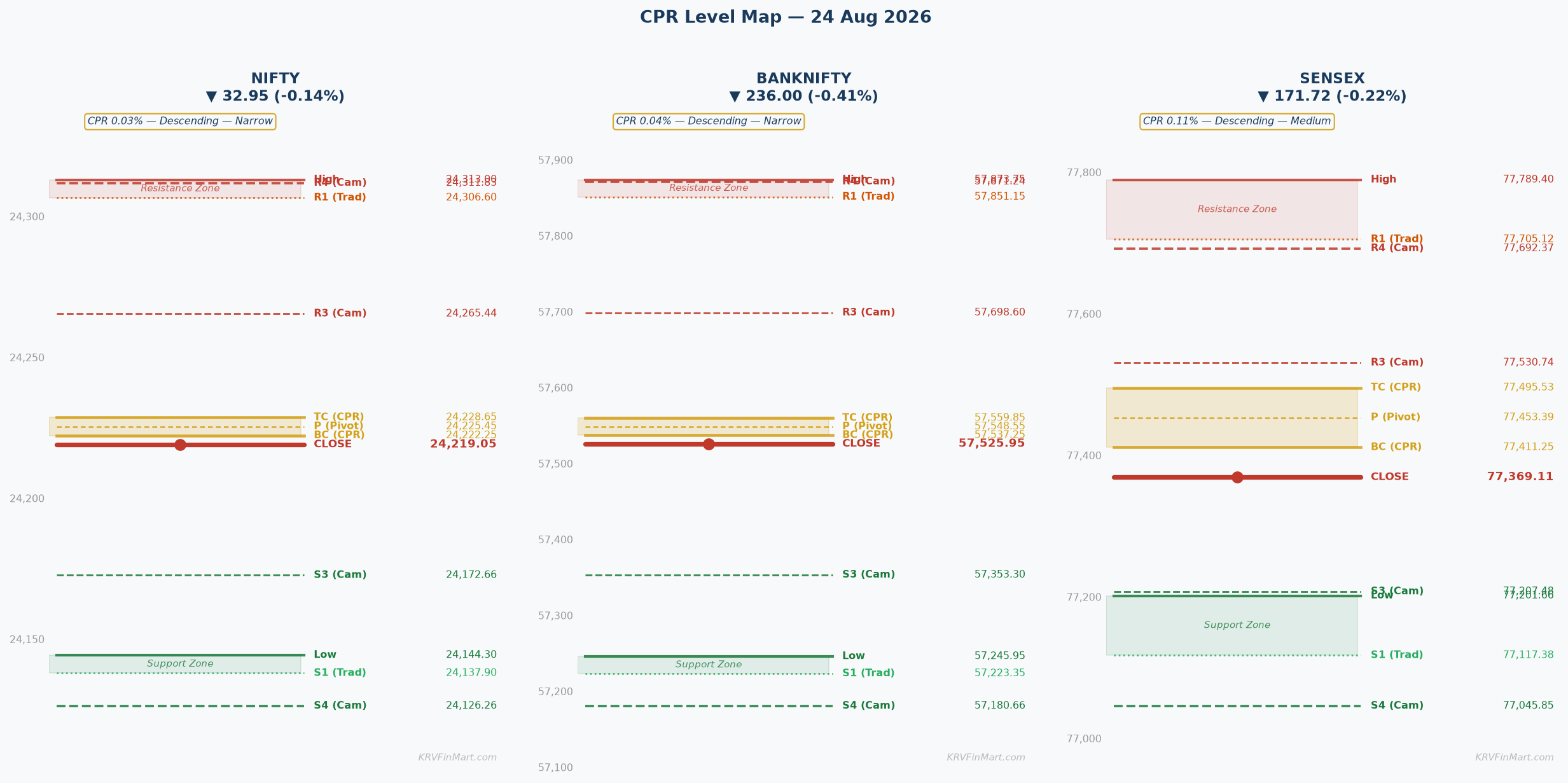
OI-R: 24,300 R3: 24,475.30 H6: 24,388.27 H5: 24,366.01 R2: 24,394.15 H4 ▶: 24,311.83 R1: 24,306.60 PDH: 24,313 H3 ↩: 24,265.44
TC: 24,228.65 P: 24,225.45 BC: 24,222.25
L3 ↩: 24,172.66 PDL: 24,144.30 S1: 24,137.90 L4 ▶: 24,126.26 S2: 24,056.75 L5: 24,072.06 L6: 24,049.83 S3: 23,969.20 OI-S: 24,000
↩ = Camarilla reversal point | ▶ = Camarilla breakout/breakdown trigger | OI-R/OI-S = Options wall (CE/PE max OI)
▲ Higher Open (Gap Up) — Open > Prev Close
▲ Bullish
Open lands: For a Descending CPR, a gap-up open places price above TC (24,228.65) — the entire CPR band (BC 24,222.25 to TC 24,228.65) lies below the opening print, meaning the CPR immediately transforms from a resistance zone into a potential support floor below the open.
CPR role: Launch pad / Support floor — CPR band (BC 24,222.25 to TC 24,228.65) acts as immediate support below price; a pullback into this zone is a long opportunity, while a breakdown below BC 24,222.25 negates the bull case.
Minor Gap (0.05–0.25%) — Structure Dominant
A minor gap-up of 0.05–0.25% places NIFTY opening in the range of roughly 24,231 to 24,279 — above TC 24,228.65 but well below H3 24,265.44 — which is a very limited gap for the Descending Narrow CPR structure to work with. The CPR structure is Descending, meaning it has a bearish lean, but a gap-up above TC 24,228.65 temporarily flips the band into a support role, creating a structural conflict: gap energy is bullish but the multi-session CPR trend is bearish, making this a low-conviction setup without additional confirmation. The first target on the upside is Camarilla H3 at 24,265.44, which is the mean-reversion stall zone — traders should take partial profits at H3 24,265.44 on the first push, with a secondary eye on OI resistance at 24,300 (CE max OI wall) and R1 at 24,306.60, both of which cluster together to form a heavy resistance band within the straddle's upper boundary.
Significant Gap (0.25–0.5%) — Balanced
A significant gap-up of 0.25–0.50% opens NIFTY approximately between 24,280 and 24,340 — at or just above H3 24,265.44, inside the critical resistance cluster formed by OI-R 24,300, R1 24,306.60, H4 24,311.83, and PDH 24,313. Opening directly into this four-level resistance cluster dramatically increases gap-fill risk, as CE writers defending the 24,300 strike will aggressively sell into any attempted rally, creating a ceiling effect that is difficult to overcome on expiry day. If NIFTY opens in this zone and fails to sustain above H4 24,311.83 within the first 15 minutes, the high-probability trade is a gap-fill back toward TC 24,228.65 and then BC 24,222.25 — the straddle's 123.45-point range means the round-trip back to 24,200 max pain is entirely within expected move parameters.
Large Gap (>0.5%) — Gap Direction Dominant
A large gap-up exceeding 0.50% would open NIFTY above approximately 24,340, pushing price beyond PDH 24,313, above OI resistance at 24,300, and approaching H5 24,366.01 — a rare scenario for an expiry day with a Narrow Descending CPR. At such heights, the gap-fill probability is high because the straddle's maximum expected move of 123.45 points from 24,200 places the upper ceiling at roughly 24,323, and any open above this level is statistically outside the day's priced move, attracting aggressive mean-reversion selling from option market makers. The abort level for any long entered at a large gap-up is a 15-minute candle failure below H4 24,311.83, with the downside target rapidly shifting to OI-R 24,300 and then TC 24,228.65 on gap-fill; however, if sustained above H5 24,366.01 on heavy volume, H6 24,388.27 and R2 24,394.15 become realistic secondary targets.
|
▲ Upside Path → OI-R From above TC 24,228.65, the upside path is TC 24,228.65 → H3 24,265.44 (Camarilla mean-reversion first stall; take partial profits here) → OI-R 24,300 / R1 24,306.60 / H4 24,311.83 (triple resistance cluster; primary ceiling and primary partial exit zone) → H5 24,366.01 (only if H4 is decisively taken on volume) → H6 24,388.27 / R2 24,394.15 (maximum bull extension; intraday target only if straddle is blown). Genuine upside momentum is confirmed by a 15-minute close above H3 24,265.44 on expanding volume, as this breaks the Camarilla mean-reversion zone and opens the channel toward the OI wall at 24,300 where CE writers will systematically defend. |
▼ Downside Path → OI-S On failure of the gap-up — specifically a 15-minute close back below TC 24,228.65 — the CPR band (BC 24,222.25 to TC 24,228.65) becomes overhead resistance and the Descending structure's bearish bias fully reasserts, with the immediate downside target being L3 24,172.66 (Camarilla mean-reversion bear stall). Below L3 24,172.66, the path accelerates toward S1 24,137.90 and L4 24,126.26 (Camarilla breakdown trigger), and a sustained close below L4 opens the channel toward L5 24,072.06, L6 24,049.83, and ultimately the OI-S floor at 24,000 where max PE writing is concentrated. |
| 🔴 OI-R: OI resistance at 24,300 (CE max OI) is the single most important level for the gap-up scenario — this is where the highest concentration of call writers has sold options, meaning they will actively sell NIFTY futures or buy puts to hedge their delta as price approaches 24,300, creating a self-reinforcing ceiling that is extremely difficult to breach on an expiry day when gamma is at its peak. In a gap-up scenario, 24,300 functions as the primary profit-booking ceiling for longs — traders should sell calls or book long futures profits at this level rather than chasing above it, as CE writing flow at 24,300 is the dominant overhead supply source for the entire session. | 🟢 OI-S: OI support at 24,000 (PE max OI) is the primary downside floor in the gap-up scenario — it is essentially irrelevant as a near-term target when price opens above 24,219, but it defines the maximum bearish extent for the day and the level at which PE writers would aggressively cover shorts (buying back puts) if price somehow collapsed to this level. The 24,000 strike's PE open interest acts as a distant but important abort-risk marker — if intraday price action on a gap-up day fails catastrophically and tests 24,000, PE writers covering at that level would create a mechanical bounce, making it a potential intraday low-risk long opportunity rather than a breakdown level. |
⚡ Key Trigger: The key trigger for the higher-open scenario is the first 15-minute candle close — per the Narrow CPR confirmation rule — specifically whether price holds above TC 24,228.65 with the CPR band acting as support; a confirmed 15-minute close above TC 24,228.65 with above-average volume signals that the gap-up is genuine and not a fade setup, with the next target being H3 24,265.44 and then the critical OI resistance wall at 24,300. If the first 15-minute candle instead closes back below TC 24,228.65, the gap-up has failed structurally and the Descending CPR's bearish nature reasserts, making the CPR band an overhead resistance and flipping the directional bias to short toward L3 24,172.66 and S1 24,137.90.
▼ Lower Open (Gap Down) — Open < Prev Close
▼ Bearish
Open lands: For a Descending CPR, a gap-down open places price below BC 24,222.25 — below the entire CPR band — meaning the CPR band (BC 24,222.25 to TC 24,228.65) immediately becomes overhead resistance, fully confirming the Descending CPR's bearish structural message and creating a trap-door setup where the burden of proof lies entirely with the bulls to reclaim BC.
CPR role: Overhead resistance / Trap door — CPR band (BC 24,222.25 to TC 24,228.65) sits above the open and acts as a ceiling; bulls must reclaim BC 24,222.25 within the first 30 minutes to neutralize the bear setup, otherwise the Descending Narrow CPR trend-day structure triggers a sustained downside move.
Minor Gap (0.05–0.25%) — Structure Dominant
A minor gap-down of 0.05–0.25% opens NIFTY in the range of roughly 24,158 to 24,207 — below BC 24,222.25 but near PDL 24,144.30 and the L3 Camarilla mean-reversion zone at 24,172.66, placing price in a historically high gap-fill zone since minor gaps within a day's prior range tend to recover within the first 30–60 minutes. However, the Descending Narrow CPR structure introduces a bearish lean — the CPR (BC 24,222.25 to TC 24,228.65) becomes overhead resistance and a minor gap below it means bulls must fight uphill against both the gap-down momentum and the CPR overhead ceiling, with the 15-minute rule indicating that a first candle close back above BC 24,222.25 is needed to reverse the bear signal. If BC 24,222.25 is not reclaimed within the first 15 minutes, bears target L3 24,172.66 initially, then S1 24,137.90 and L4 24,126.26 as the Narrow CPR trend-day structure accelerates directional selling toward OI-S 24,000.
Significant Gap (0.25–0.5%) — Balanced
A significant gap-down of 0.25–0.50% opens NIFTY approximately between 24,158 and 24,158 — directly into the L3 Camarilla zone at 24,172.66 or below it, breaching the prior day low area and opening below PDL 24,144.30 in more severe cases, which eliminates gap-fill probability and confirms a structural breakdown. At this gap size, the Descending Narrow CPR acts as a full overhead resistance zone (BC 24,222.25 to TC 24,228.65), and the 30-minute reclaim rule applies: if NIFTY cannot close a 30-minute candle above BC 24,222.25, the failure-and-resume pattern activates, targeting L4 24,126.26, then L5 24,072.06, and ultimately OI-S 24,000 where PE concentration is highest. PUT writers defending the 24,000 strike will begin monetising rapidly as price approaches L5 24,072.06, and stop-loss triggers from intraday longs below L3 24,172.66 will accelerate the downside momentum toward the OI-S floor.
Large Gap (>0.5%) — Gap Direction Dominant
A large gap-down exceeding 0.50% opens NIFTY below approximately 24,097 — near or below L5 24,072.06 — which is an extreme scenario on expiry day that would likely be driven by a major macro event or global risk-off, dramatically expanding option premiums and invalidating the 123.45-point straddle as a range reference. In this scenario, the panic dynamic initially drives prices toward L6 24,049.83 and S3 23,969.20, but the PE concentration at OI-S 24,000 will trigger aggressive put writer covering (buying back short puts) that creates a mechanical bounce from the 24,000 zone, making this a high-risk but high-reward mean-reversion long for scalpers with strict risk management. Recovery levels to watch are L4 24,126.26 (first recovery milestone), L3 24,172.66 (Camarilla mean-reversion zone), and BC 24,222.25 (CPR recovery signal) — only a close above BC within the same 30-minute window would suggest the sell-off is complete; until then, the trend-day structure keeps the bear case dominant.
|
▲ Upside Path → OI-R The recovery path from a gap-down open runs: reclaim BC 24,222.25 → P 24,225.45 → TC 24,228.65 (CPR band fully recovered, directional bias flips neutral-to-bullish) → H3 24,265.44 (Camarilla first target; partial profit zone) → OI-R 24,300 / R1 24,306.60 (overhead resistance wall; exit remaining longs here). A genuine recovery is only confirmed when NIFTY closes a full 15-minute candle above TC 24,228.65 on above-average volume — anything below this level despite intrabar pokes above should be treated as a dead-cat bounce and not a reversal. |
▼ Downside Path → OI-S The bear trend-day path from a gap-down open descends: open below BC 24,222.25 → L3 24,172.66 (Camarilla mean-reversion stall; retail longs attempt a stand here, partial cover for shorts) → PDL 24,144.30 / S1 24,137.90 / L4 24,126.26 (Camarilla breakdown trigger; stop-losses from overnight longs cluster here, accelerating the move) → L5 24,072.06 → L6 24,049.83 → OI-S 24,000 (PE max OI floor; mechanical bounce zone on expiry). Retail long stop-losses concentrated below L3 24,172.66 and L4 24,126.26 are the key accelerant for this downside path — once triggered, algorithmic momentum selling typically takes price straight to the OI-S 24,000 level within 60–90 minutes of market open. |
| 🔴 OI-R: OI resistance at 24,300 (CE max OI) functions as the distant overhead ceiling in a gap-down scenario — CE writers are deeply in-the-money on their short calls and will aggressively defend any recovery attempt toward 24,300, making it essentially unreachable on a confirmed bear trend day unless a very large recovery occurs. From the short-seller's perspective, 24,300 defines the maximum upside risk for the session — short positions initiated below BC 24,222.25 can be held confidently as long as price stays below OI-R 24,300, which on a Descending Narrow CPR trend day is a very comfortable buffer. | 🟢 OI-S: OI support at 24,000 (PE max OI) is the primary destination and put-monetisation zone in the gap-down scenario — this is where the highest concentration of PE writers has sold puts, meaning they must buy back puts (covering short puts) or buy NIFTY futures as price approaches 24,000, creating a mechanical demand zone that typically produces a sharp intraday bounce. Reaching 24,000 on expiry day with the max pain also at 24,200 creates an extreme overshot scenario — at 24,000, PE writers will cover aggressively, making it a defined-risk long scalp opportunity with a stop below L6 24,049.83 and a target back toward L5 24,072.06 and L4 24,126.26. |
⚡ Key Trigger: The key trigger for the lower-open scenario is the 30-minute reclaim attempt at BC 24,222.25 — per the Narrow CPR confirmation rule, a first 15-minute candle close above BC 24,222.25 signals potential gap-fill and bull reclaim, shifting the bias back toward neutral and targeting TC 24,228.65, P 24,225.45, and ultimately H3 24,265.44. Failure to close any 15-minute candle above BC 24,222.25 within the first half-hour confirms the bear trend-day pattern, with BC 24,222.25 then functioning as the short entry reference and L3 24,172.66 as the immediate downside target, followed by L4 24,126.26 and S1 24,137.90 as structured bear targets.
◆ Near Flat Open — Open ≈ Prev Close (±0.05%)
◆ Neutral
Open lands: A ±0.05% flat open places NIFTY between approximately 24,207 and 24,231 — precisely straddling the Descending CPR band (BC 24,222.25 to TC 24,228.65), making the open essentially inside the CPR band itself on a Descending structure; per Descending CPR rules, a flat open lands near TC (24,228.65), creating a perfect decision zone where the first directional break determines the entire day.
CPR role: Decision zone / Compression band — with NIFTY opening at or near TC 24,228.65 on a Descending Narrow CPR, the band (BC 24,222.25 to TC 24,228.65) is simultaneously overhead resistance (from the Descending bias) and the first line of support; the 0.03% width means price will resolve direction within the first 15 minutes, making this the highest-probability trend-day setup of the three scenarios.
Near Flat (±0.05%)
A flat open on a Descending Narrow CPR (width 0.03%) is the single most information-rich scenario for 25 Aug 2026 — the first 15-minute candle IS the trade, and NIFTY traders must resist the urge to pre-position before this candle closes, as the CPR compression will release energy explosively in one direction once the band is broken. The CPR band spans only 6.40 points from BC 24,222.25 to TC 24,228.65, meaning price will either break above TC 24,228.65 (bullish signal targeting H3 24,265.44 and OI-R 24,300) or break below BC 24,222.25 (bearish signal targeting L3 24,172.66 and OI-S 24,000) — the narrowness of this band makes false breakouts rare because the energy is highly concentrated. A CPR width of 0.03% is empirically one of the strongest predictors of a high-momentum trend day, meaning once direction is established in the first 15 minutes, the move is likely to persist for the majority of the session without significant retests — this is NOT a day to fade the first breakout, especially with both weekly and monthly max pain at 24,200 creating additional pinning-vs-explosive dynamics. The bull trigger is a 15-minute candle close above TC 24,228.65 (confirmed above the entire CPR band on a Descending structure = multi-session trend change signal) targeting H3 24,265.44 first, then OI-R 24,300; the bear trigger is a 15-minute candle close below BC 24,222.25 (confirming Descending CPR's bearish structure) targeting L3 24,172.66 first, then S1 24,137.90 and OI-S 24,000 on maximum extension.
|
▲ Upside Path → OI-R From TC 24,228.65, the bull trend-day path runs: TC 24,228.65 (break and hold = entry signal) → H3 24,265.44 (Camarilla mean-reversion first target; per Narrow CPR rules, take first partial here) → OI-R 24,300 / R1 24,306.60 / H4 24,311.83 (triple resistance cluster at PDH 24,313; this is the primary target and exit zone for the day) → H5 24,366.01 (only achievable if OI-R 24,300 is breached on very high volume, extremely unlikely on expiry day with CE writers defending). Volume expansion on the TC break is essential — a low-volume breakout above TC 24,228.65 should be treated as a potential bull trap and position sized smaller until H3 24,265.44 is confirmed. |
▼ Downside Path → OI-S From BC 24,222.25, the bear trend-day path runs: BC 24,222.25 (break and hold below = entry signal) → L3 24,172.66 (Camarilla mean-reversion bear zone; first partial cover for short positions) → S1 24,137.90 / L4 24,126.26 (Camarilla breakdown trigger and Traditional S1 cluster; stop-losses from overnight longs flush through here) → L5 24,072.06 → L6 24,049.83 → OI-S 24,000 (PE max OI wall; maximum bear target and mechanical bounce zone). The bear path is statistically more likely on a Descending Narrow CPR flat open given the multi-session trend direction, making short-below-BC 24,222.25 the structurally preferred trade with L3 24,172.66 as the first profit zone and OI-S 24,000 as the maximum extension. |
| 🔴 OI-R: OI resistance at 24,300 (CE max OI) in the flat-open scenario is the primary ceiling and the point at which the maximum concentration of CE writing creates systematic selling pressure — even in a bull breakout above TC 24,228.65, traders should treat 24,300 as the definitive exit zone for long trades, as CE writers at this strike will sell aggressively into any approach, and on expiry day, gamma at 24,300 is near-infinite, making it a mathematically reinforced ceiling. The OI-R 24,300 also aligns almost perfectly with R1 24,306.60 and H4 24,311.83 and PDH 24,313, creating a four-level confluence resistance band that virtually guarantees a reaction — book profits at first touch of 24,300 and do not hold longs through this cluster. | 🟢 OI-S: OI support at 24,000 (PE max OI) in the flat-open scenario serves as the maximum bearish extension and the PE monetisation floor — PE writers who sold 24,000 puts will need to buy back aggressively if price approaches this level, creating a mechanical demand zone that defines the day's maximum downside. Max pain at 24,200 combined with OI-S at 24,000 means the structural gravity of the session pulls toward 24,200, but a strong bear trend day ignited by a flat open breaking below BC 24,222.25 can override max pain gravity and push toward OI-S 24,000 in extreme conditions — in this case, reaching 24,000 before 2:00 PM would signal a put-buyer's expiry day rally from that level. |
⚡ Key Trigger: The exact triggers are: **Bull** — first 15-minute candle close above TC 24,228.65 with expanding volume, immediately targeting H3 24,265.44 as the first partial profit level and OI-R 24,300 as the primary target; **Bear** — first 15-minute candle close below BC 24,222.25 on any volume, immediately targeting L3 24,172.66 as the first level and S1 24,137.90 / L4 24,126.26 as the primary bear targets. These specific levels (TC 24,228.65 and BC 24,222.25) are the structural fulcrum because on expiry day, the Descending Narrow CPR alignment means market makers and institutional participants have positioned their delta-hedging flows exactly around these values — a break in either direction triggers cascading order flow that self-reinforces the move, making the first 15 minutes the highest-edge trade window of the entire session.
BANKNIFTY
Descending — Narrow (Width 0.04%)
▼ Bearish
Market Structure Trending (up or down trend) | Straddle ATM 57500 straddle priced at 380.9 points (Call 134.0 + Put 246.9), implying a one-standard-deviation expected move of approximately ±381 points from 57500, defining a day range roughly between 57119 and 57881 — critically, the put premium (246.9) is nearly double the call premium (134.0), reflecting a pronounced bearish skew in BANKNIFTY options positioning and signaling that option buyers are paying a significant premium to hedge or speculate on downside, which aligns with the Descending CPR bearish structure. | Max Pain Max Pain at 57,500 for the monthly expiry (25-Aug-2026) — this is the strike at which option sellers face minimum aggregate loss, creating gravitational pull toward 57,500 for the entire monthly expiry session; with BANKNIFTY closing at 57,525.95 just 25.95 points above max pain, the market is already near the ideal pinning level, suggesting option market makers will attempt to keep price within ±100 points of 57,500 through systematic delta hedging unless a decisive directional catalyst emerges. |
Tomorrow's Complete Level Map
OI-R: 58,000 R3: 58,478.95 H6: 58,156.82 H5: 58,072.88 R2: 58,176.35 H4 ▶: 57,871.24 R1: 57,851.15 PDH: 57,873.75 H3 ↩: 57,698.60
TC: 57,559.85 P: 57,548.55 BC: 57,537.25
L3 ↩: 57,353.30 PDL: 57,245.95 S1: 57,223.35 L4 ▶: 57,180.66 S2: 56,920.75 L5: 56,979.02 L6: 56,895.08 S3: 56,595.55 OI-S: 57,000
↩ = Camarilla reversal point | ▶ = Camarilla breakout/breakdown trigger | OI-R/OI-S = Options wall (CE/PE max OI)
▲ Higher Open (Gap Up) — Open > Prev Close
▲ Bullish
Open lands: For a Descending CPR, a gap-up open places BANKNIFTY above TC 57,559.85 — the entire CPR band (BC 57,537.25 to TC 57,559.85) drops below the opening print, converting the CPR from an overhead resistance zone into an immediate support floor beneath the gap-up open, creating a temporary bullish overlay on the underlying Descending bearish structure.
CPR role: Support floor / Launch pad — CPR band (BC 57,537.25 to TC 57,559.85) acts as immediate support below the gap-up open; any pullback into this 22.60-point band is a long opportunity on the Narrow structure, while a breakdown below BC 57,537.25 confirms the gap-up failed and the Descending CPR's bearish bias resumes.
Minor Gap (0.05–0.25%) — Structure Dominant
A minor gap-up of 0.05–0.25% on BANKNIFTY opens price between approximately 57,555 and 57,670 — above TC 57,559.85 but within the zone between TC and H3 57,698.60, placing price in the Descending CPR's converted support area where the band provides a floor but the next resistance at H3 57,698.60 is only ~140 points away. The Descending CPR structure creates a structural conflict: a minor gap-up above TC 57,559.85 triggers the launch-pad reading, but the overall multi-session Descending direction means this bullishness is against the grain and carries low sustained momentum probability, especially with the heavily bearish put skew (put premium 246.9 vs call premium 134.0) confirming options participants are positioned defensively. The first 15-minute candle per the Narrow CPR rule must close above TC 57,559.85 to validate the gap-up as genuine — if confirmed, the target is H3 57,698.60 for first partial profits, with OI-R 58,000 serving as the primary ceiling given the concentrated CE writing at that strike.
Significant Gap (0.25–0.5%) — Balanced
A significant gap-up of 0.25–0.50% on BANKNIFTY opens between approximately 57,670 and 57,814 — above H3 57,698.60 (Camarilla mean-reversion zone) but below R1 57,851.15 and H4 57,871.24, placing the opening in the upper mid-range of the straddle's expected move envelope. At this gap size, BANKNIFTY opens inside a zone where the Camarilla mean-reversion pressure at H3 57,698.60 lies below and the PDH 57,873.75 / H4 57,871.24 / R1 57,851.15 cluster acts as immediate overhead resistance, creating a squeeze zone with high gap-fill risk back toward the CPR band at TC 57,559.85. Delta-hedging flow from CE writers at 58,000 will cap any further upside, and the put skew (246.9 vs 134.0) suggests that the overall expiry day flow remains bearish — a 15-minute close below H3 57,698.60 following a significant gap-up signals gap-fill toward TC 57,559.85 and BC 57,537.25.
Large Gap (>0.5%) — Gap Direction Dominant
A large gap-up exceeding 0.50% opens BANKNIFTY above approximately 57,814, potentially at or above PDH 57,873.75 / R1 57,851.15 / H4 57,871.24 — directly into the triple resistance cluster that also aligns with OI-R 58,000 less than 200 points away, making gap-fill the dominant probability on expiry day. At such heights, the straddle's 380.9-point range from 57,500 places the upper bound at approximately 57,881, meaning a large gap-up above 57,814 is technically at or beyond the priced expected move, triggering systematic option market-maker selling and delta-neutral hedging that creates a ceiling effect near 58,000. The abort level for any momentum long in a large gap-up is a 15-minute close back below PDH 57,873.75 / H4 57,871.24, with the rapid downside path targeting H3 57,698.60, then TC 57,559.85, and ultimately OI-S 57,000 if the gap-fill becomes a full bearish reversal day.
|
▲ Upside Path → OI-R From above TC 57,559.85, the BANKNIFTY upside path follows: TC 57,559.85 (launch pad support) → H3 57,698.60 (Camarilla mean-reversion first stall; take first partial profits here per Narrow CPR rule) → R1 57,851.15 / H4 57,871.24 / PDH 57,873.75 (triple resistance cluster; take second partial here) → OI-R 58,000 (CE max OI primary ceiling; exit remaining longs — CE writers defend this level aggressively on expiry day, and gamma at 58,000 is near-maximum). Beyond OI-R 58,000, H5 58,072.88 and H6 58,156.82 are extreme extension targets only accessible if 58,000 is decisively breached on exceptional volume. |
▼ Downside Path → OI-S On gap-up failure (15-minute close below TC 57,559.85), the Descending CPR bearish structure takes over: TC 57,559.85 becomes resistance → BC 57,537.25 (full CPR band lost; bear confirmation) → L3 57,353.30 (Camarilla mean-reversion bear zone; first partial cover) → PDL 57,245.95 / S1 57,223.35 / L4 57,180.66 (triple bear support cluster; stop-losses from intraday longs accelerate the move through this zone) → OI-S 57,000 (PE max OI floor; mechanical bounce zone and maximum daily bear target). BANKNIFTY's heavier beta (compared to NIFTY) means the downside path can cover L3 to OI-S 57,000 (353 points) within 60–90 minutes of a confirmed bear signal. |
| 🔴 OI-R: OI resistance at 58,000 (CE max OI) is the supreme ceiling for BANKNIFTY on this expiry day — CE writers at 58,000 have the largest open interest concentration and will systematically sell BANKNIFTY futures and buy puts as price approaches this level, creating a self-reinforcing cap that is exceptionally difficult to breach intraday. In a gap-up scenario, 58,000 functions as the maximum profit-booking zone for any long position — traders should exit all long exposure at first touch of 58,000 and not chase above it, as the CE writing flow creates a guaranteed reactive ceiling that will whipsaw undisciplined positions. | 🟢 OI-S: OI support at 57,000 (PE max OI) is the primary downside floor and PE monetisation zone — in a gap-up scenario that subsequently fails, this level defines the maximum bearish extent for the day and the point at which PE writers will cover short puts aggressively, creating a mechanical bounce that can produce a sharp intraday reversal of 200–300 points. The proximity of max pain at 57,500 to OI-S at 57,000 (only 500 points away) means that a gap-up failure day could see price oscillate between OI-S 57,000 and max pain 57,500 in a whipsaw expiry pattern, making risk management at L4 57,180.66 the critical discipline point for short positions. |
⚡ Key Trigger: Per the Narrow CPR confirmation rule for BANKNIFTY, the first 15-minute candle close determines direction — a close above TC 57,559.85 confirms the gap-up is sustained and targets H3 57,698.60 as the first partial profit level, then OI-R 58,000 as the primary ceiling and exit zone for the day. If the first 15-minute candle closes back below TC 57,559.85, the Descending CPR's bearish nature fully reasserts, converting the CPR band (BC 57,537.25 to TC 57,559.85) into overhead resistance and pointing the directional trade toward L3 57,353.30 and OI-S 57,000.
▼ Lower Open (Gap Down) — Open < Prev Close
▼ Bearish
Open lands: For a Descending CPR, a gap-down open places BANKNIFTY below BC 57,537.25 — below the entire CPR band — confirming the Descending structure's bearish bias with full force; the CPR band (BC 57,537.25 to TC 57,559.85) becomes immediate overhead resistance, and the open directly below BC creates the classic Descending CPR trap-door setup with max pain at 57,500 just 25 points above prev close, creating a scenario where gap-down bulls are fighting both CPR structure and max pain gravity.
CPR role: Overhead resistance / Trap door — CPR band (BC 57,537.25 to TC 57,559.85) sits above a gap-down open and acts as a ceiling; the Descending Narrow CPR structure means bears hold structural advantage below BC 57,537.25, and bulls must demonstrate conviction by reclaiming BC within the first 15 minutes or the bear trend-day pattern activates.
Minor Gap (0.05–0.25%) — Structure Dominant
A minor gap-down of 0.05–0.25% on BANKNIFTY opens between approximately 57,382 and 57,497 — below BC 57,537.25 but still above L3 57,353.30, placing the open in the vulnerable zone between the CPR floor (now overhead at BC 57,537.25) and the Camarilla mean-reversion bear zone at L3 57,353.30. Minor gaps below BC 57,537.25 on a Descending Narrow CPR are classic gap-fill-or-trend setups: if price closes a 15-minute candle back above BC 57,537.25 within the first 15 minutes, gap-fill toward TC 57,559.85 and then H3 57,698.60 is likely; if BC 57,537.25 is not reclaimed, the Narrow CPR trend-day pattern takes over and bears target L3 57,353.30 as the first stop, followed by OI-S 57,000. The put premium skew (246.9 vs call 134.0) confirms the options market is already prepared for downside — PUT holders benefit from any failure to reclaim BC 57,537.25.
Significant Gap (0.25–0.5%) — Balanced
A significant gap-down of 0.25–0.50% on BANKNIFTY opens between approximately 57,238 and 57,382 — at or below L3 57,353.30 and near PDL 57,245.95, placing the open in the lower Camarilla zone where mean-reversion bears have already been validated and the path toward OI-S 57,000 is structurally open. At this gap magnitude, the 30-minute reclaim rule governs: BANKNIFTY must close a 30-minute candle above BC 57,537.25 to neutralize the bear setup — an extremely high bar given the open is 285+ points below this level, making the failure-and-resume pattern the high-probability outcome targeting L4 57,180.66, S1 57,223.35 (very close together forming a bear cluster), and then L5 56,979.02 approaching OI-S 57,000. PUT writers at 57,000 begin systematic delta-neutral buying as BANKNIFTY approaches their strike, creating a mechanical bounce at 57,000 that short-sellers should be aware of as a potential profit-booking level.
Large Gap (>0.5%) — Gap Direction Dominant
A large gap-down exceeding 0.50% on BANKNIFTY opens below approximately 57,238 — potentially at or below PDL 57,245.95 and S1 57,223.35 and L4 57,180.66, breaching multiple support levels simultaneously and triggering panic stop-loss cascades from intraday longs, option delta hedges, and portfolio protection trades. In this extreme scenario, the straddle's 380.9-point range from 57,500 places the lower boundary at approximately 57,119, meaning a large gap-down below 57,238 is at or outside the priced expected move and will dramatically expand put premiums as option markets reprice for additional risk. The mechanical bounce from OI-S 57,000 (PE max OI) is the primary recovery anchor — as BANKNIFTY approaches 57,000, PE writers covering short puts create systematic demand, making 57,000 the first scalp long level with a tight stop below L5 56,979.02 and a target back toward L3 57,353.30.
|
▲ Upside Path → OI-R Recovery path from gap-down: reclaim BC 57,537.25 (first 15-minute close above = bull trigger) → P 57,548.55 → TC 57,559.85 (full CPR recovered; bias shifts bullish) → H3 57,698.60 (Camarilla first target; partial profit) → OI-R 58,000 (ceiling; exit full position here). A genuine recovery from gap-down is confirmed only when BANKNIFTY holds above TC 57,559.85 for two consecutive 15-minute candles — single-bar pokes above TC without hold are false recoveries and should be used to add to short positions rather than exit. |
▼ Downside Path → OI-S Bear trend-day path from gap-down: open below BC 57,537.25 → L3 57,353.30 (Camarilla mean-reversion stall; first partial cover for short positions; intraday longs attempt recovery here) → PDL 57,245.95 / S1 57,223.35 / L4 57,180.66 (triple bear cluster; concentrated stop-losses below PDL accelerate the downside through this zone, creating rapid momentum toward L5) → L5 56,979.02 / L6 56,895.08 → OI-S 57,000 (PE max OI mechanical bounce zone; book short profits and watch for reversal). BANKNIFTY's characteristic 2–3x intraday range versus NIFTY means this entire L3-to-OI-S path of 353 points can execute within a single 60-minute window on a strong expiry trend day. |
| 🔴 OI-R: OI resistance at 58,000 (CE max OI) is functionally irrelevant as a near-term target in a gap-down scenario — it sits more than 470 points above the CPR band and is beyond the straddle's expected daily range, but it defines the maximum upside risk for any short position entered below BC 57,537.25, giving shorts a very comfortable 462-point buffer before facing meaningful CE-related headwinds. Bears can use OI-R 58,000 as their maximum stop-loss reference for position sizing purposes — a day that gaps down on a Descending Narrow CPR and then rips 462 points to OI-R 58,000 is a complete structural invalidation and should be treated as a trend reversal day. | 🟢 OI-S: OI support at 57,000 (PE max OI) is the primary target and profit-booking zone for BANKNIFTY short positions in the gap-down scenario — PE writers at 57,000 face maximum pain as price approaches this level and will buy back puts (covering short puts) and buy BANKNIFTY futures to manage delta, creating a mechanical demand bounce at 57,000 that is the ideal short-cover level. The combination of max pain at 57,500 (only 500 points above OI-S 57,000) and the put premium skew (246.9 vs call 134.0) means that reaching 57,000 on expiry day represents a dramatic overshot below max pain — in this scenario, a sharp V-shaped recovery of 200–300 points from 57,000 back toward 57,200–57,300 is the statistically probable expiry-day ending pattern. |
⚡ Key Trigger: Per the Narrow CPR rule, the key trigger for BANKNIFTY's gap-down scenario is the first 15-minute candle reclaim of BC 57,537.25 — a close above BC within the first 15 minutes signals gap-fill potential and shifts bias to neutral, targeting TC 57,559.85, P 57,548.55, and then H3 57,698.60. Failure to close any candle above BC 57,537.25 within the first 30 minutes confirms the Descending Narrow CPR trend-day bear pattern, with BC 57,537.25 remaining overhead resistance and L3 57,353.30 the immediate target, progressing toward S1 57,223.35 / L4 57,180.66 cluster and ultimately OI-S 57,000.
◆ Near Flat Open — Open ≈ Prev Close (±0.05%)
◆ Neutral
Open lands: A ±0.05% flat open places BANKNIFTY between approximately 57,497 and 57,555 — directly inside the Descending CPR band (BC 57,537.25 to TC 57,559.85), or marginally below BC 57,537.25 given the Descending CPR rule that a flat open lands near TC; either way, price opens at the TC (57,559.85) or just inside the band, creating maximum decision-zone tension on expiry day.
CPR role: Decision zone / Maximum compression — BANKNIFTY opening at or near TC 57,559.85 on a Descending Narrow CPR (0.04% width) with max pain at 57,500 just 59.85 points below TC creates an explosive compression setup; the CPR band (BC 57,537.25 to TC 57,559.85) is simultaneously the decision gate and the battleground for the entire expiry session.
Near Flat (±0.05%)
A flat open on BANKNIFTY's Descending Narrow CPR (0.04% width) on expiry day is the most high-conviction trend-day setup available — the compression energy stored in a 22.60-point CPR band combined with expiry day gamma will release directionally within the first 15-minute candle, and BANKNIFTY's natural high-beta volatility means the resulting move will be fast and sustained once initiated. The CPR band spans from BC 57,537.25 to TC 57,559.85, and a flat open near TC 57,559.85 means price is at the topmost edge of the Descending CPR's converted position — above TC is immediately bullish (band becomes support), below BC is immediately bearish (band becomes resistance), and the 22.60-point band is too narrow for price to oscillate within meaningfully on expiry day. The 0.04% CPR width combined with max pain at 57,500 (59.85 points below TC) creates a unique gravity dynamic: if bulls cannot break above TC 57,559.85 and sustain it, the max pain gravity will pull BANKNIFTY downward toward 57,500 and then the Descending CPR structure will drag it further toward L3 57,353.30 and OI-S 57,000, making the bear trigger potentially more explosive than the bull trigger. The exact triggers are: bull confirmation = first 15-minute candle close above TC 57,559.85 on above-average volume, targeting H3 57,698.60 → R1 57,851.15 / H4 57,871.24 → OI-R 58,000; bear confirmation = first 15-minute candle close below BC 57,537.25, targeting L3 57,353.30 → L4 57,180.66 / S1 57,223.35 → OI-S 57,000.
|
▲ Upside Path → OI-R From TC 57,559.85 (bull confirmation), the BANKNIFTY upside trend path: TC 57,559.85 (break above = entry; CPR band becomes support floor) → H3 57,698.60 (Camarilla first target; partial profit per Narrow rule — 139 points from TC, achievable in first 30–45 minutes) → R1 57,851.15 / H4 57,871.24 / PDH 57,873.75 (triple resistance cluster; second partial — 314 points from TC) → OI-R 58,000 (CE max OI ceiling; exit all long positions — 440 points from TC, achievable by 1:00 PM on a trend day). Volume must expand at each level breach to confirm genuine trend momentum — a stalling candle at H3 57,698.60 without volume expansion should prompt trailing the stop to TC 57,559.85. |
▼ Downside Path → OI-S From BC 57,537.25 (bear confirmation), the BANKNIFTY downside trend path: BC 57,537.25 (break below = entry; CPR band becomes resistance) → L3 57,353.30 (Camarilla mean-reversion bear zone; first partial cover — 184 points from BC) → S1 57,223.35 / L4 57,180.66 (Traditional S1 and Camarilla breakdown trigger cluster; second partial — 358 points from BC; stop-losses from overnight longs cascade through here) → L5 56,979.02 → OI-S 57,000 (PE max OI mechanical bounce; exit shorts and watch for reversal — 538 points from BC, achievable by 2:00 PM on a strong expiry trend day). The bear path has greater statistical probability given the Descending CPR structure, bearish put skew, and max pain gravity below TC. |
| 🔴 OI-R: OI resistance at 58,000 (CE max OI) in the flat-open scenario is the primary target ceiling for any bull breakout above TC 57,559.85 — CE writers at 58,000 have positioned the largest open interest concentration at this strike, and approaching 58,000 on expiry day activates maximum gamma-driven selling pressure that creates a near-impenetrable ceiling without an extraordinary catalyst. Traders initiating longs above TC 57,559.85 should book full profits at OI-R 58,000 (440-point profit potential from TC) without exception — holding above 58,000 on expiry day with CE writers fully hedged is a low-probability, high-risk proposition that statistically ends in a sharp reversal. | 🟢 OI-S: OI support at 57,000 (PE max OI) in the flat-open scenario is the maximum bear target and the expiry day's ultimate gravitational attractor on the downside — if the bear trend day activates below BC 57,537.25, the entire session's selling pressure from retail stop-losses, institutional delta hedges, and momentum algorithms will converge at OI-S 57,000, where PE writers will systematically cover, creating the day's strongest mechanical demand zone. At 57,000, PE writers' covering flow typically produces a 150–250 point bounce within 30 minutes on expiry day — traders holding short positions should book aggressively at OI-S 57,000 and not attempt to hold through the mechanical bounce, as the risk-reward deteriorates sharply below this level. |
⚡ Key Trigger: **Bull trigger**: first 15-minute candle close above TC 57,559.85 on above-average volume — this converts the Descending CPR band from overhead resistance to a support floor and targets H3 57,698.60 as the first partial profit level (per Narrow CPR rule), then OI-R 58,000 as the primary exit. **Bear trigger**: first 15-minute candle close below BC 57,537.25 — this confirms the Descending CPR's multi-session bearish structure and targets L3 57,353.30 within 30 minutes, with OI-S 57,000 as the maximum daily extension; TC 57,559.85 and BC 57,537.25 are the structural fulcrum because BANKNIFTY's expiry day gamma at max pain 57,500 creates binary delta flows that amplify any directional break from this narrow band exponentially.
SENSEX
Descending — Medium (Width 0.11%)
▼ Bearish
Market Structure Balanced or transitional | Straddle ATM 77400 straddle priced at 678.8 points (Call 354.9 + Put 323.9), implying a one-standard-deviation expected move of approximately ±679 points from 77400, defining a day range roughly between 76721 and 78079 — the call premium (354.9) marginally exceeds the put premium (323.9), reflecting a near-neutral but very slightly bullish skew in SENSEX options, which creates a mild internal conflict with the Descending CPR bearish structure and suggests the options market is more balanced than in BANKNIFTY. | Max Pain Max Pain at 77,500 for both the weekly (27-Aug-2026) and monthly (27-Aug-2026) expiries — note that SENSEX expiry is on 27 Aug 2026, not today (25 Aug 2026), which means max pain gravity is a forward-looking constraint rather than an expiry-day pinning mechanism; today's session will not experience the intense gamma-driven pinning of NIFTY and BANKNIFTY, and price may move more freely within the straddle range, making the Medium CPR width's 30-minute confirmation rule especially important for position management. |
Tomorrow's Complete Level Map
OI-R: 77,500 R3: 78,292.86 H6: 77,958.12 H5: 77,881.15 R2: 78,041.13 H4 ▶: 77,692.37 R1: 77,705.12 PDH: 77,789.40 H3 ↩: 77,530.74
TC: 77,495.53 P: 77,453.39 BC: 77,411.25
L3 ↩: 77,207.48 PDL: 77,201.66 S1: 77,117.38 L4 ▶: 77,045.85 S2: 76,865.65 L5: 76,857.07 L6: 76,780.10 S3: 76,529.64 OI-S: 75,500
↩ = Camarilla reversal point | ▶ = Camarilla breakout/breakdown trigger | OI-R/OI-S = Options wall (CE/PE max OI)
▲ Higher Open (Gap Up) — Open > Prev Close
↕ Conflicted
Open lands: For a Descending CPR, a gap-up open places SENSEX above TC 77,495.53 — the entire CPR band (BC 77,411.25 to TC 77,495.53) drops below the opening price, converting the CPR from an overhead resistance structure into an immediate support floor below the gap-up open; with OI-R coincidentally at 77,500 (just 4.47 points above TC), a gap-up above TC immediately places price at or above the CE max OI resistance wall.
CPR role: Launch pad / Support floor with immediate OI resistance — the CPR band (BC 77,411.25 to TC 77,495.53) becomes support below a gap-up open; however, OI-R 77,500 sits essentially at TC 77,495.53, creating a uniquely compressed scenario where the CPR launch pad and the OI resistance wall are at the same level — a gap-up above this cluster simultaneously triggers the bull signal AND places price at the primary resistance ceiling.
Minor Gap (0.05–0.25%) — Structure Dominant
A minor gap-up of 0.05–0.25% on SENSEX opens between approximately 77,408 and 77,562 — this range is critically important because it spans across OI-R 77,500, TC 77,495.53, and BC 77,411.25, meaning a minor gap-up could open either inside the CPR band, at OI-R, or just above TC depending on the exact opening level. If SENSEX opens between BC 77,411.25 and TC 77,495.53, price is still inside the CPR band on a Descending structure — a medium structure requires a 30-minute close above TC 77,495.53 to confirm the bull bias; if it opens above TC 77,495.53 but below 77,500 OI-R, the CPR band becomes support but OI-R 77,500 is the immediate ceiling just 4.47 points above TC. The first target upon clearing OI-R 77,500 decisively is H3 77,530.74 (Camarilla first stall; partial profit per Medium CPR rule after first 30-minute confirmation), then H4 77,692.37 and R1 77,705.12 (second target cluster), with a 30-minute hold above OI-R 77,500 being the critical confirmation for genuine bullish momentum.
Significant Gap (0.25–0.5%) — Balanced
A significant gap-up of 0.25–0.50% on SENSEX opens between approximately 77,562 and 77,755 — above TC 77,495.53, above OI-R 77,500, and approaching the H3 77,530.74 to H4 77,692.37 Camarilla zone, placing the open well above the CPR band and into Camarilla mean-reversion territory. At this gap size, the gap-fill risk back toward OI-R 77,500 and then TC 77,495.53 is meaningful, as the 0.11% Medium CPR requires a 30-minute close to confirm the breakout is real — until that confirmation, any open in the 77,562–77,755 range should be treated as potentially unstable with gap-fill risk of 62–355 points. If the 30-minute close confirms above TC 77,495.53 and OI-R 77,500, the targets are H3 77,530.74 (first partial) → H4 77,692.37 / R1 77,705.12 (second partial at 30-minute second close) → H5 77,881.15 / PDH 77,789.40 (extended target) on a confirmed bull trend day.
Large Gap (>0.5%) — Gap Direction Dominant
A large gap-up exceeding 0.50% on SENSEX opens above approximately 77,755 — well above TC 77,495.53, OI-R 77,500, H3 77,530.74, and approaching H4 77,692.37 or higher, placing price in an overextended zone that exceeds the Medium CPR's typical confirmation-required setup and demands extreme caution before entering long positions. At this opening level, SENSEX is testing H4 77,692.37 (Camarilla breakout trigger) and approaching R1 77,705.12 — two 30-minute closes are required per the Medium CPR rule before a trend position is justified, and the gap-fill risk back to TC 77,495.53 (a potential 250+ point move) is the primary risk for unconfirmed longs. Because SENSEX expiry is not today (27 Aug 2026), the gamma pinning effect is absent, and large gap-ups can mean-revert more freely — straddle monetisation (selling the strangle on a large gap) is the professional trade, targeting the eventual return to OI-R 77,500 and TC 77,495.53.
|
▲ Upside Path → OI-R From a confirmed 30-minute close above TC 77,495.53 / OI-R 77,500: TC 77,495.53 / OI-R 77,500 (cleared and held = launch) → H3 77,530.74 (Camarilla first stall; take first partial per Medium CPR rule after 30-minute confirmation) → H4 77,692.37 / R1 77,705.12 (Camarilla breakout trigger and Traditional first target cluster; take second partial at second 30-minute close) → H5 77,881.15 / PDH 77,789.40 (extended targets if volume supports) → H6 77,958.12 / R2 78,041.13 (maximum bull extension; intraday target only on exceptional volume days). Volume confirmation is critical for each level breach — Medium CPR structure requires retests, and fading moves at each Camarilla level without volume are expected behavior. |
▼ Downside Path → OI-S On failure to hold TC 77,495.53 / OI-R 77,500 on the 30-minute candle: gap-fill begins toward P 77,453.39 → BC 77,411.25 (CPR support floor; critical decision — hold here confirms bull structure, break confirms bear) → L3 77,207.48 (Camarilla mean-reversion bear zone; first partial cover for shorts) → PDL 77,201.66 / S1 77,117.38 (very close together; Traditional S1 and prior day low cluster) → L4 77,045.85 → OI-S 75,500 (PE max OI floor; 1,869 points away — maximum bear extension over multiple days, not intraday target). For today's session, L3 77,207.48 and S1 77,117.38 are the realistic downside targets on a gap-up failure. |
| 🔴 OI-R: OI resistance at 77,500 (CE max OI) has an extraordinary structural significance for SENSEX on 25 Aug 2026 — it sits at essentially the same level as TC 77,495.53 (just 4.47 points above), meaning the CPR band's topside and the CE writers' maximum resistance wall are the same price point, creating double-layered resistance that is virtually impossible to casually breach without exceptional volume and institutional buy-flow. The CE writing at 77,500 — combined with the Descending CPR positioning — means that CE writers and CPR bears are both positioned at 77,500 as the defense level, and a confirmed 30-minute close above this level would represent a genuine capitulation of the combined resistance, making any such breakout a high-conviction trend signal rather than a routine move. | 🟢 OI-S: OI support at 75,500 (PE max OI) is extremely distant from current price (approximately 1,869 points below close) and is functionally irrelevant as an intraday target in a gap-up scenario — it defines the maximum multi-day bearish extension and the level at which PE writers have positioned large open interest. For today's session, OI-S 75,500 serves as a reminder that the options market's structural support is far below current levels, meaning SENSEX has no near-term PE-writing floor except at 75,500, and any significant sell-off has open air below L3 77,207.48 and S1 77,117.38 before meaningful PE support is encountered. |
⚡ Key Trigger: The key trigger for SENSEX's gap-up scenario is a 30-minute close above TC 77,495.53 AND OI-R 77,500 — given the exceptional coincidence of TC (77,495.53) and OI-R (77,500) at essentially the same level, clearing both on a confirmed 30-minute candle is the strongest possible bull confirmation signal, targeting H3 77,530.74 for first partial profits and H4 77,692.37 / R1 77,705.12 for the primary target. If after a gap-up, SENSEX fails to maintain a 30-minute close above OI-R 77,500, the unique confluence of Descending CPR overhead and CE writing at 77,500 creates a double-resistance rejection that targets gap-fill toward P 77,453.39, BC 77,411.25, and then L3 77,207.48 — making the 30-minute candle at OI-R 77,500 the day's single most decisive data point for direction.
▼ Lower Open (Gap Down) — Open < Prev Close
▼ Bearish
Open lands: For a Descending CPR, a gap-down open places SENSEX below BC 77,411.25 — below the entire CPR band — fully confirming the Descending structure's bearish bias; the CPR band (BC 77,411.25 to TC 77,495.53) becomes immediate overhead resistance, and since OI-R 77,500 is at essentially the same level as TC 77,495.53, the gap-down creates a scenario where bulls face both CPR overhead resistance AND OI resistance at the same price (77,495–77,500).
CPR role: Overhead resistance / Double trap door — BC 77,411.25 and OI-R 77,500 / TC 77,495.53 form a layered resistance ceiling above a gap-down open; the Descending Medium CPR requires a 30-minute close above BC 77,411.25 for any bull reclaim attempt, and the additional OI-R 77,500 ceiling makes recovery attempts significantly more difficult than in NIFTY's gap-down scenario.
Minor Gap (0.05–0.25%) — Structure Dominant
A minor gap-down of 0.05–0.25% on SENSEX opens between approximately 77,176 and 77,330 — below BC 77,411.25, near L3 77,207.48, and within the PDL zone (77,201.66), placing the open directly at the Camarilla mean-reversion bear level where institutional mean-reversion longs will attempt to buy the gap. Minor gaps near L3 77,207.48 on a Descending Medium CPR create a gap-fill probability scenario: if SENSEX opens above L3 77,207.48, there is a reasonable probability of a gap-fill attempt toward BC 77,411.25, but this requires overcoming both the CPR band resistance and OI-R 77,500 / TC 77,495.53 above — two confirmation barriers for bulls. Per the Medium CPR 30-minute rule, a first 30-minute close above BC 77,411.25 would confirm recovery and target TC 77,495.53, P 77,453.39, and then OI-R 77,500; failure at BC 77,411.25 confirms the bear trend and targets L3 77,207.48, PDL 77,201.66, S1 77,117.38, and L4 77,045.85.
Significant Gap (0.25–0.5%) — Balanced
A significant gap-down of 0.25–0.50% on SENSEX opens between approximately 76,983 and 77,176 — below L3 77,207.48 and approaching L4 77,045.85, well below BC 77,411.25, making the 30-minute reclaim of BC at 77,411.25 mathematically improbable (requiring a 235–428 point recovery in 30 minutes). At this gap size, the failure-and-resume pattern is the dominant setup: SENSEX will likely attempt a brief dead-cat bounce from L3 77,207.48 or L4 77,045.85, then resume lower toward S1 77,117.38, L4 77,045.85, and S2 76,865.65 / L5 76,857.07 (very close together, forming a key cluster) — the Medium CPR's 30-minute confirmation rule means traders should wait for a 30-minute candle to stall at a Camarilla level before establishing short positions to avoid catching a violent gap-fill bounce. Since SENSEX expiry is on 27 Aug (not today), there is no same-day max pain pinning to limit downside, and the move toward S2 76,865.65 / L5 76,857.07 is fully within the straddle's 678.8-point expected range.
Large Gap (>0.5%) — Gap Direction Dominant
A large gap-down exceeding 0.50% on SENSEX opens below approximately 76,983 — at or below L4 77,045.85, near S1 77,117.38 (which at this gap size lies above the open), and potentially approaching the S2 76,865.65 / L5 76,857.07 cluster — a severe macro-driven sell-off scenario that places SENSEX well outside the short-term pivot structure. At such an open, panic dynamics dominate for the first 30–60 minutes — the straddle's 678.8-point expected range from 77,400 places the maximum downside at approximately 76,721, and a large gap-down exceeding 0.50% (open below 76,983) is already within this expected range, meaning option premiums may not spike dramatically and the gap may recover gradually. The primary recovery reference is L3 77,207.48 and PDL 77,201.66 (very close) — a 30-minute hold above L3 77,207.48 following a large gap-down signals stabilization and potential short-cover rally toward BC 77,411.25; continuation below L4 77,045.85 targets S2 76,865.65 / L5 76,857.07 and eventually L6 76,780.10.
|
▲ Upside Path → OI-R Gap-down recovery path for SENSEX: reclaim BC 77,411.25 (30-minute close above = first bull confirmation) → P 77,453.39 → TC 77,495.53 / OI-R 77,500 (dual resistance ceiling; 30-minute second close above this level = strong bull confirmation and primary partial profit) → H3 77,530.74 (Camarilla first target; take partial here per Medium rule) → H4 77,692.37 / R1 77,705.12 (maximum recovery target; exit remaining recovery position here). Two 30-minute closes above TC 77,495.53 / OI-R 77,500 are needed per Wide-adjacent Medium CPR rules to confirm this recovery is genuine and not a bull trap — patience is essential. |
▼ Downside Path → OI-S Bear trend-day path from gap-down below BC 77,411.25: BC 77,411.25 acts as overhead resistance → L3 77,207.48 (Camarilla mean-reversion bear zone; intraday longs attempt stand here; take first short partial at this level) → PDL 77,201.66 / S1 77,117.38 (Traditional S1 and PDL cluster within 90 points; stop-losses from yesterday's lows cascade here) → L4 77,045.85 (Camarilla breakdown trigger; second partial cover for shorts) → S2 76,865.65 / L5 76,857.07 (near-identical levels forming the day's maximum realistic downside target — 546 points from BC, within straddle range) → L6 76,780.10. Retests of each level are expected given the Medium CPR structure — unlike the Narrow CPR trend days in NIFTY and BANKNIFTY, SENSEX may exhibit 2–3 stall-and-continue patterns within the bear path. |
| 🔴 OI-R: OI resistance at 77,500 (CE max OI, essentially identical to TC 77,495.53) functions as the absolute overhead ceiling in the gap-down scenario — CE writers at 77,500 combined with the Descending CPR overhead creates a double-layer defense that makes any recovery beyond TC 77,495.53 require two separate 30-minute close confirmations, effectively protecting short positions from a rapid recovery and giving bears ample time to add or trail positions. The coincidence of OI-R 77,500 and TC 77,495.53 makes this level the definitive bear vs bull marker for the day — above it means the Descending CPR has been defeated and bulls have overcome the CE writing wall; below it means the combined structural pressure keeps SENSEX in sell-mode. | 🟢 OI-S: OI support at 75,500 (PE max OI) is 1,869 points below the close and is a multi-week bearish target rather than an intraday one — it plays no meaningful role in today's gap-down scenario as an immediate target, but it establishes that there is virtually no PE-writing floor between current levels (~77,200–77,400 opening range) and 75,500, giving SENSEX's bearish momentum a very long runway if the structural breakdown continues across multiple sessions. Today's relevant intraday bear targets cap at S2 76,865.65 / L5 76,857.07 — OI-S 75,500 should be monitored as a weekly structural target, not today's session target. |
⚡ Key Trigger: For SENSEX's gap-down scenario, the Medium CPR 30-minute rule governs: the first 30-minute candle determines whether recovery (close above BC 77,411.25) or bear continuation (fail to close above BC 77,411.25) is the active scenario, and a second 30-minute close above BC 77,411.25 is required for a confirmed recovery trade targeting TC 77,495.53 / OI-R 77,500. The bear confirmation trigger is simply the failure of any 30-minute candle to close above BC 77,411.25 — at that point, BC 77,411.25 and TC 77,495.53 / OI-R 77,500 form a layered resistance ceiling, and the directional trade is short targeting L3 77,207.48 → S1 77,117.38 → L4 77,045.85 → S2 76,865.65 / L5 76,857.07 in sequence.
◆ Near Flat Open — Open ≈ Prev Close (±0.05%)
◆ Neutral
Open lands: A ±0.05% flat open places SENSEX between approximately 77,330 and 77,408 — just below BC 77,411.25 or at the very bottom edge of the CPR band; per Descending CPR rules, a flat open lands near TC 77,495.53, but at ±0.05% from prev close 77,369.11, the actual opening range (77,330–77,408) falls below BC 77,411.25, meaning price opens below the entire Descending CPR band even on a flat open, creating a subtle bear bias from the very first tick.
CPR role: Decision zone / Subtle bear lean — SENSEX opening below BC 77,411.25 on a flat open means the Descending CPR band is entirely above price, creating overhead resistance from BC 77,411.25 through TC 77,495.53 and into OI-R 77,500; unlike NIFTY's flat open where price was precisely at TC, SENSEX's flat open sits below BC, giving the bear side a structural head-start that requires active bull effort to overcome.
Near Flat (±0.05%)
A flat open on SENSEX's Descending Medium CPR (0.11% width) is a nuanced setup because, unlike NIFTY's and BANKNIFTY's Narrow CPRs, the Medium CPR width means two-sided trading is expected within the band before a directional resolution — traders should NOT act on the first 15-minute candle alone and must wait for a full 30-minute close to confirm direction. The CPR band spans BC 77,411.25 to TC 77,495.53 (84.28 points wide), and a flat open just below BC 77,411.25 means price is technically outside the Descending CPR band on the downside — the bears have a structural advantage even before the first candle, as the entire CPR band acts as resistance above the opening print. However, SENSEX's 'Balanced or transitional' market structure (vs NIFTY's and BANKNIFTY's 'Trending') introduces counter-trend risk — the market is explicitly in a transition phase, meaning false breakouts in both directions are more likely, and the Medium CPR's expectation of retests within the session reduces the edge of first-candle directional trades. The confirmed bull trigger is two 30-minute closes above TC 77,495.53 AND OI-R 77,500 (their virtual coincidence makes this a single compound threshold), targeting H3 77,530.74 and then H4 77,692.37 / R1 77,705.12; the bear trigger is a 30-minute close below BC 77,411.25 that holds on a retest of BC from below, confirming overhead resistance and targeting L3 77,207.48, S1 77,117.38, and L4 77,045.85.
|
▲ Upside Path → OI-R From confirmed close above TC 77,495.53 / OI-R 77,500 (two 30-minute closes required): TC 77,495.53 / OI-R 77,500 (held as support after second 30-minute confirmation) → H3 77,530.74 (Camarilla first stall; take first partial profit here — 35 points above TC; Medium CPR means expect a retest of OI-R 77,500 before continuation) → H4 77,692.37 / R1 77,705.12 (Camarilla breakout trigger and Traditional R1 cluster; take second partial at second 30-minute close — 197–210 points above TC) → H5 77,881.15 / PDH 77,789.40 (extended targets; do not trail beyond OI-R 77,500 per Medium CPR Width rule unless on very high volume) → H6 77,958.12 / R2 78,041.13 (maximum bull targets; only for high-volume trend days with multi-30-minute confirmation). The Balanced market structure and Medium CPR width mean retests of OI-R 77,500 from above during the session are normal — maintain longs on retest-hold, exit on retest-fail. |
▼ Downside Path → OI-S From confirmed 30-minute close below BC 77,411.25 (held as resistance on retest): BC 77,411.25 (overhead resistance after bear confirmation) → L3 77,207.48 (Camarilla mean-reversion bear zone; first partial cover — 204 points below BC; expect a bounce-and-stall here given Balanced market structure) → PDL 77,201.66 / S1 77,117.38 (near-simultaneous Traditional S1 and PDL; second partial — 294–300 points below BC; concentrated stop-losses here) → L4 77,045.85 (Camarilla breakdown trigger; per Medium CPR rule, exit remaining shorts here or trail to S2 76,865.65 / L5 76,857.07 on high volume) → S2 76,865.65 / L5 76,857.07 (maximum daily bear target in the flat-open scenario). Given the Balanced market structure, expect 2–3 bounce-and-continue patterns within the downside path — SENSEX will not fall in a straight line on a non-expiry day with a Medium CPR. |
| 🔴 OI-R: OI resistance at 77,500 (CE max OI), aligned within 4.47 points of TC 77,495.53, creates the most important level on the SENSEX chart for the flat-open scenario — CE writers at 77,500 have concentrated maximum open interest here, and the CPR's TC at virtually the same level means both technical pivot sellers and options delta-hedging sellers are positioned identically, creating a double-thick resistance ceiling that demands two 30-minute close confirmations before being treated as genuinely cleared. In the flat-open scenario where price is below BC 77,411.25, OI-R 77,500 is essentially 131 points above the opening print — a meaningful gap that requires active institutional buying to bridge; CE writers will systematically sell into any approach to 77,500, and traders should treat any single-candle poke above 77,500 as a potential bull trap unless confirmed by a second 30-minute hold. | 🟢 OI-S: OI support at 75,500 (PE max OI) is a structural multi-day floor rather than a same-session target in the flat-open scenario — at 1,869 points below the close, it defines the option market's PE writing commitment level and the ultimate downside anchor for the entire August-September period. For today's intraday session, OI-S 75,500 is irrelevant as a direct target but extremely important as a context level: the absence of any meaningful PE writing floor between S2 76,865.65 / L5 76,857.07 and OI-S 75,500 means that a breakdown below S2 76,865.65 would have very little structural support until 75,500, amplifying downside momentum if the bear scenario accelerates — a crucial risk context for any trader holding overnight positions in SENSEX puts or futures shorts. |
⚡ Key Trigger: **Bull trigger**: Two consecutive 30-minute closes above TC 77,495.53 / OI-R 77,500 — the compound threshold of TC and OI-R at essentially the same price makes this a very strong confirmation gate; a single 30-minute close above is insufficient for the Medium CPR structure and could be a bull trap given the Descending CPR overhead. **Bear trigger**: First 30-minute close below BC 77,411.25 that subsequently holds BC as resistance on a retest (i.e., BC 77,411.25 becomes a ceiling when price tries to recover) — this double-confirmation bear signal per the Medium CPR rule targets L3 77,207.48 as the immediate next reference level and S1 77,117.38 as the primary daily target, with the Descending CPR structure and Balanced market structure making this a slower, retest-heavy bear move rather than the explosive trend-day seen in NIFTY/BANKNIFTY.
📊 VIX Insight: India VIX data is unavailable for today's session (24 Aug 2026 close), which is a significant analytical gap — VIX is the primary input for option premium calibration, and its absence prevents us from assessing whether the ATM straddle premiums (NIFTY 123.45 pts, BANKNIFTY 380.9 pts, SENSEX 678.8 pts) are fairly priced, elevated, or compressed relative to historical realized volatility. In the absence of VIX data, traders should treat all option trades with conservative position sizing, monitor intraday premium behavior closely as a proxy for implied volatility direction (expanding premiums = rising fear, compressing premiums = complacency), and apply the CPR structural analysis as the primary directional guide — avoiding volatility-dependent strategies like straddle buying or selling until VIX is confirmed in tomorrow's data.
Overall View:
All three indices — NIFTY, BANKNIFTY, and SENSEX — open 25 Aug 2026 with Descending CPR structures, with NIFTY (0.03%) and BANKNIFTY (0.04%) carrying near-identical Narrow CPR widths that signal a high-probability trend day governed by the first 15-minute candle, while SENSEX's Medium CPR (0.11%) implies a more deliberate, retest-heavy directional move requiring 30-minute confirmation. The structural bear lean is uniform across all indices — Descending CPR means bears have contextual advantage and the burden of proof lies with bulls at TC levels (NIFTY 24,228.65, BANKNIFTY 57,559.85, SENSEX 77,495.53) — with the added complexity that NIFTY and BANKNIFTY are on expiry day (25 Aug 2026), creating intense max-pain gravity at 24,200 and 57,500 respectively that may limit range expansion, while SENSEX (expiry 27 Aug 2026) has more freedom to explore its full 678.8-point straddle range. The highest-probability trade for 25 Aug 2026 across all three indices is a short below BC on the first 15-minute (NIFTY/BANKNIFTY) or 30-minute (SENSEX) candle close, with primary targets at OI-S levels (NIFTY 24,000, BANKNIFTY 57,000) and Camarilla L3-L4 clusters for SENSEX — while remaining alert to mechanical OI-support bounces at these floors that can produce sharp intraday reversals.
All three indices — NIFTY, BANKNIFTY, and SENSEX — open 25 Aug 2026 with Descending CPR structures, with NIFTY (0.03%) and BANKNIFTY (0.04%) carrying near-identical Narrow CPR widths that signal a high-probability trend day governed by the first 15-minute candle, while SENSEX's Medium CPR (0.11%) implies a more deliberate, retest-heavy directional move requiring 30-minute confirmation. The structural bear lean is uniform across all indices — Descending CPR means bears have contextual advantage and the burden of proof lies with bulls at TC levels (NIFTY 24,228.65, BANKNIFTY 57,559.85, SENSEX 77,495.53) — with the added complexity that NIFTY and BANKNIFTY are on expiry day (25 Aug 2026), creating intense max-pain gravity at 24,200 and 57,500 respectively that may limit range expansion, while SENSEX (expiry 27 Aug 2026) has more freedom to explore its full 678.8-point straddle range. The highest-probability trade for 25 Aug 2026 across all three indices is a short below BC on the first 15-minute (NIFTY/BANKNIFTY) or 30-minute (SENSEX) candle close, with primary targets at OI-S levels (NIFTY 24,000, BANKNIFTY 57,000) and Camarilla L3-L4 clusters for SENSEX — while remaining alert to mechanical OI-support bounces at these floors that can produce sharp intraday reversals.
Disclaimer: KRVFinMart provides educational and informational content relating to financial markets. Articles, research, examples, charts, strategies and tools are provided for educational purposes and should not be interpreted as personalised investment advice or a guarantee of financial performance. Markets involve risk, including possible loss of capital. Past performance does not guarantee future results. KRVFinMart is not a SEBI Registered Investment Adviser or Research Analyst.