
Index Research
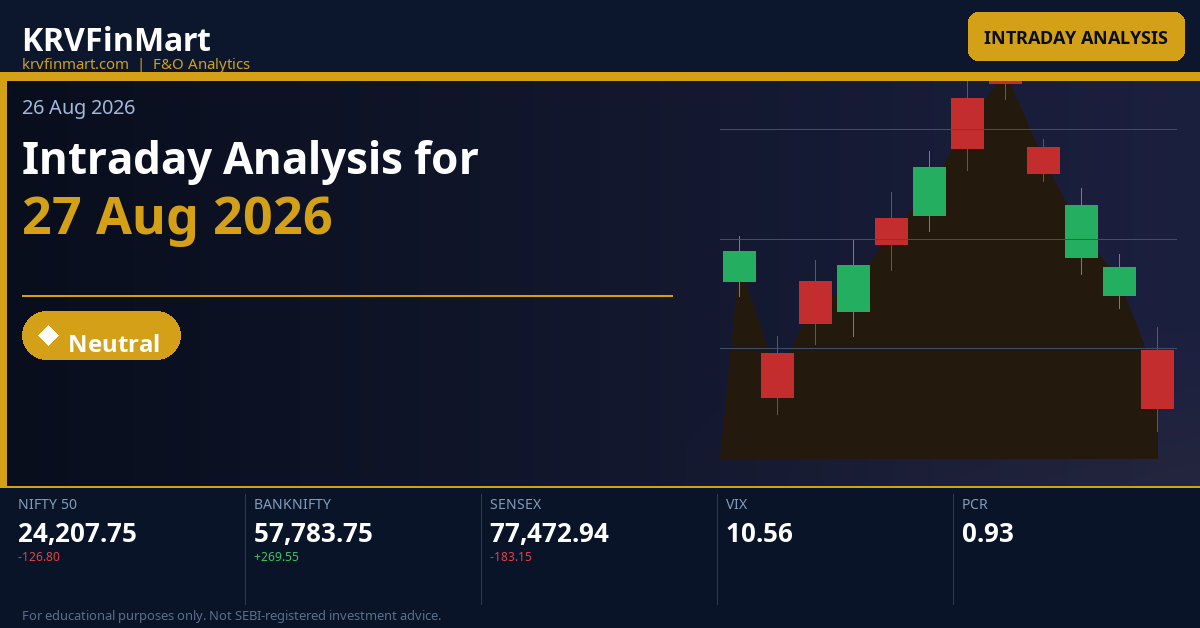
Intraday Analysis for 27 Aug 2026
KRVFinMart26 August 202647 min
Educational/Derived AnalysisSource: KRVFinMart Research Desk (End-of-Day)As of 26 Aug 2026, 05:12 PM IST
Intraday Analysis for 27 Aug 2026
Markets closed on a mixed note on 26 Aug 2026, with NIFTY shedding 0.52% to close at 24,207.75, SENSEX declining 0.24% to 77,472.94, while BANKNIFTY bucked the trend with a modest gain of 0.47% to settle at 57,783.75. India VIX data is unavailable for this session, which limits precise premium-pricing context; however, the prevailing straddle values — NIFTY weekly at 239.8 points and BANKNIFTY monthly at 1,508.1 points — suggest the options market is pricing in moderate intraday volatility, consistent with a range-bound to mildly directional environment. Traders should treat the CPR structure as the primary directional guide for 27 Aug, with OI walls at NIFTY 24,500 CE and 24,200 PE acting as the definitive session boundaries.
Key Market Signals — Intraday Setup
All three indices closed below or at their respective daily CPR bands, with NIFTY and SENSEX in confirmed sideways-to-bearish structures and BANKNIFTY showing relative strength via an Ascending Narrow CPR — this divergence between banking and broader markets is the single most important cross-index signal heading into 27 Aug 2026. The NIFTY weekly OI max pain at 24,300 sits 92 points above the close, creating a gravitational pull upward, while BANKNIFTY monthly max pain at 57,800 aligns almost perfectly with its current CPR pivot of 57,797.22, signalling strong pin risk and range-bound action in banking names unless a decisive catalyst emerges.
Deep Technical Analysis & Levels
NIFTY
Inside — Wide (Width: 0.23%)
◆ Neutral
Market Structure Sideways or range-bound | Straddle ATM 24,200 weekly straddle = 181.85 (Call) + 57.95 (Put) = **239.8 points**. This implies the options market expects NIFTY to stay within a range of roughly 23,960 to 24,440 for the week, capping the daily expected move at approximately ±120 points from ATM on an intraday basis. Given the close at 24,207.75, the straddle bounds closely coincide with the OI support at 24,200 and the weekly CPR band, reinforcing the view that any breakout must clear 24,440+ convincingly to attract follow-through buyers. | Max Pain NIFTY Weekly (01-Sep-2026) Max Pain = **24,300**. The current close of 24,207.75 sits 92.25 points below max pain, creating a gravitational pull toward 24,300 over the remaining sessions of the expiry week. Option sellers benefit most if NIFTY gravitates back toward 24,300 by Thursday, meaning intraday bounces toward the CPR band (BC 24,236.23 – TC 24,293.17) are structurally supported by the max pain dynamic. Traders should note that NIFTY Month max pain at 24,500 represents the broader longer-term pin zone. |
Tomorrow's Complete Level Map
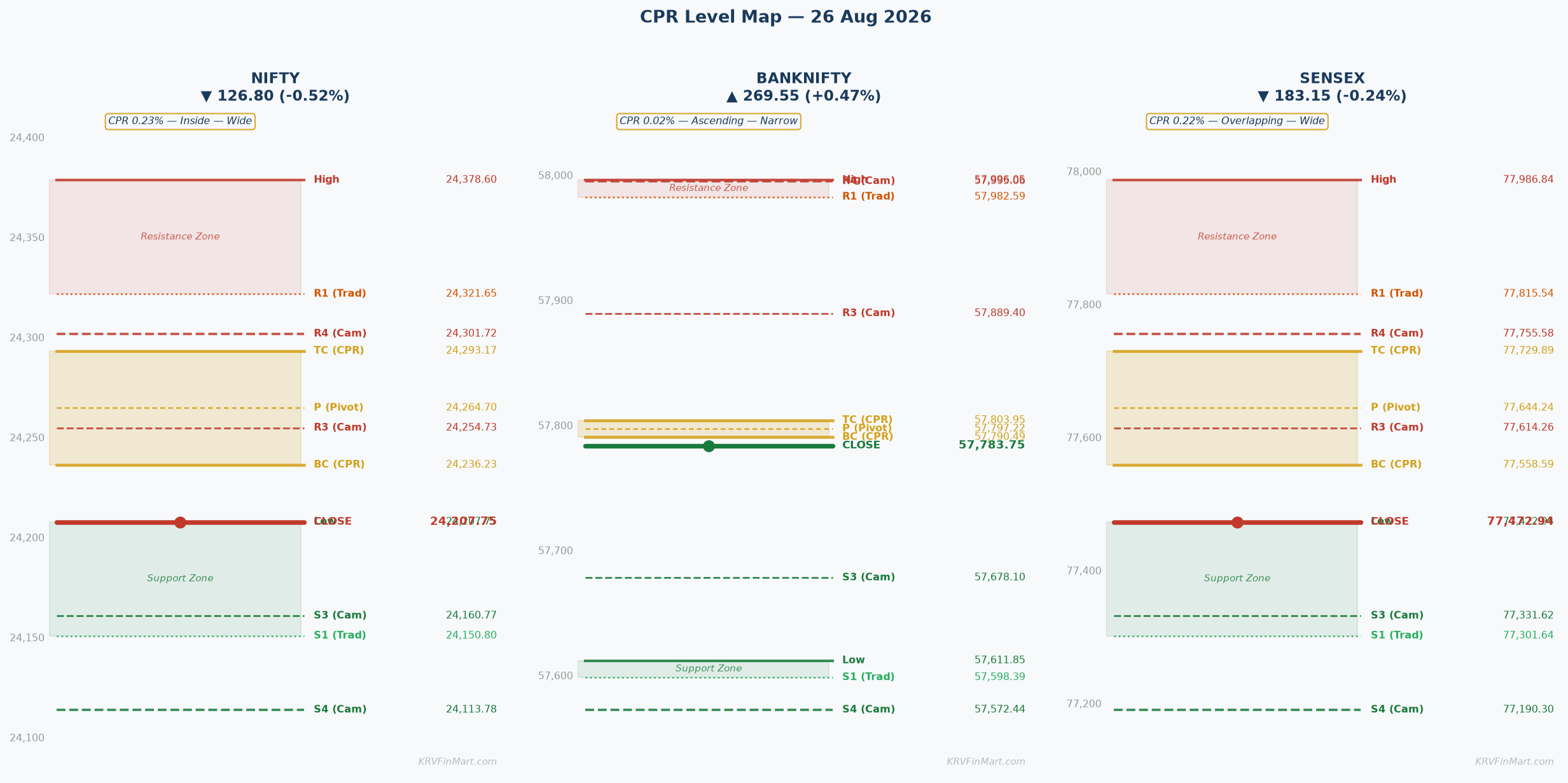
OI-R: 24,500 R3: 24,492.50 H6: 24,378.60 H5: 24,356.60 R2: 24,435.55 H4 ▶: 24,301.72 R1: 24,321.65 PDH: 24,378.60 H3 ↩: 24,254.73
TC: 24,293.17 P: 24,264.70 BC: 24,236.23
L3 ↩: 24,160.77 PDL: 24,207.75 S1: 24,150.80 L4 ▶: 24,113.78 S2: 24,093.85 L5: 24,058.90 L6: 24,036.90 S3: 23,979.95 OI-S: 24,200
↩ = Camarilla reversal point | ▶ = Camarilla breakout/breakdown trigger | OI-R/OI-S = Options wall (CE/PE max OI)
▲ Higher Open (Gap Up) — Open > Prev Close
▲ Bullish
Open lands: For an Inside CPR with Wide width (0.23%), a gap-up open above prev close of 24,207.75 places price above BC (24,236.23) and potentially inside or above TC (24,293.17). A minor gap up (~0.1-0.2%) opens between BC 24,236.23 and TC 24,293.17 (inside the CPR band). A significant gap up (~0.25-0.5%) opens near or above TC 24,293.17. A large gap up (>0.5%) opens above TC 24,293.17 — this is the classic 'double compression release up' scenario where Inside CPR energy and gap momentum combine for a high-probability trend day upward.
CPR role: Launch pad and support zone — in a gap-up Inside CPR scenario, the BC (24,236.23) to TC (24,293.17) band flips to act as the base support. Price is expected to use the CPR as a springboard, with the band providing first-pullback support before a continuation toward Camarilla H3 (24,254.73), H4 (24,301.72), R1 (24,321.65), and ultimately the OI resistance wall at 24,500.
Minor Gap (0.05–0.25%) — Structure Dominant
A minor gap up of 0.05–0.25% would place NIFTY opening between approximately 24,219 and 24,268, landing inside the CPR band between BC 24,236.23 and P 24,264.70. The Inside Wide CPR structure adds a bullish lean to this minor gap since the compression energy is now releasing upward, but the Wide width (0.23%) demands two consecutive 30-minute candle closes above TC 24,293.17 before any long trade is confirmed — a single candle is insufficient for this width. On confirmation above TC 24,293.17, the first target is H4 24,301.72 followed by R1 24,321.65, with CPR band (BC–TC) acting as the trailing stop zone for any initiated longs.
Significant Gap (0.25–0.5%) — Balanced
A significant gap up of 0.25–0.5% would open NIFTY in the range of 24,268–24,329, placing price at or above TC 24,293.17 and potentially near H4 24,301.72 or R1 24,321.65. This is the classic double-compression release where both the Inside CPR energy and the gap momentum align, but the Wide CPR rule requires two 30-minute closes above the opening zone before adding aggressive longs — gap-fill risk back toward TC 24,293.17 or BC 24,236.23 remains elevated in the first hour. Delta-hedging flows from CE writers at the 24,500 OI resistance wall will begin acting as a ceiling as NIFTY approaches H5 24,356.60 and PDH 24,378.60, making the R2 24,435.55 to OI-R 24,500 zone the ultimate target for a sustained significant gap-up session.
Large Gap (>0.5%) — Gap Direction Dominant
A large gap up of more than 0.5% would place NIFTY above 24,329, potentially opening near H5 24,356.60, PDH 24,378.60, or even pushing toward R2 24,435.55 — this is a dominant gap scenario where Inside CPR compression energy survives and reinforces the upward move. The critical exception rule for Inside CPR applies: even with a large gap, the compression energy remains valid and a trend day to the upside becomes the primary scenario, with OI-R at 24,500 as the natural ceiling where CE writers defend aggressively. Gap-fill risk back to TC 24,293.17 is the abort scenario — if price reverses below TC on two 30-minute closes, the straddle's 239.8-point width suggests the move could extend to L3 24,160.77 on the downside in a false breakout reversal.
|
▲ Upside Path → OI-R Confirmed above TC 24,293.17: first target H4 24,301.72 (Camarilla breakout trigger), then R1 24,321.65 (Traditional first partial profit — book 40% here), then H5 24,356.60 and PDH 24,378.60 cluster, and finally the primary OI ceiling at 24,500 where CE writers are most active. Genuine momentum is confirmed by above-average volume on each 30-minute close above these Camarilla levels, and any dip-and-hold at H3 24,254.73 on a pullback would constitute a high-probability breakout-retest long entry before the next leg. |
▼ Downside Path → OI-S Failure to sustain above TC 24,293.17 on two 30-minute closes reverses the structure: price falls back through P 24,264.70, then tests BC 24,236.23, and a close below BC shifts control to bears targeting L3 24,160.77 as the first Camarilla mean-reversion target. Loss of L3 24,160.77 opens the path to L4 24,113.78 and S2 24,093.85, with OI-S at 24,200 acting as a critical decision zone — if 24,200 PE support holds on retests, the gap-fill becomes a buying opportunity rather than a breakdown. |
| 🔴 OI-R: OI Resistance at **24,500 (CE max OI)** acts as the session ceiling and primary fade zone in a gap-up scenario — CE writers who have sold the 24,500 calls are heavily committed to defending this strike through gamma-driven delta selling as NIFTY approaches. The 24,500 CE wall means that even in the most bullish gap-up session, risk-reward for fresh longs above R3 24,492.50 deteriorates sharply, and traders should book profits aggressively between R2 24,435.55 and OI-R 24,500 rather than holding for extension above this wall. | 🟢 OI-S: OI Support at **24,200 (PE max OI)** is the abort level for gap-up longs — it coincides almost perfectly with PDL 24,207.75 and represents the PE writing base where put sellers have positioned for NIFTY to stay above 24,200. In a gap-up scenario, 24,200 is largely irrelevant as a direct target, but it remains the hard abort level — a print below 24,200 invalidates the bullish gap thesis entirely and suggests the market is rejecting higher prices with PE writers beginning to unwind their positions. |
⚡ Key Trigger: The key trigger for the gap-up scenario is **two consecutive 30-minute candle closes above TC 24,293.17** — this is the mandatory Wide CPR confirmation rule that validates the bullish breakout from the Inside compression. TC 24,293.17 is the structural fulcrum because it represents the top of the compressed CPR band; a sustained close above it signals that the market has accepted higher prices and that the Inside CPR energy is directionally releasing upward, while failure to hold above TC on two closes signals a bull trap and inverts the bias toward L3 24,160.77.
▼ Lower Open (Gap Down) — Open < Prev Close
▼ Bearish
Open lands: For an Inside CPR with Wide width, a gap-down open below prev close 24,207.75 places price below BC (24,236.23) — this is the 'double compression release down' scenario. A minor gap down (~0.05-0.25%) opens between 24,147 and 24,196, near or just above OI-S at 24,200. A significant gap down (~0.25-0.5%) opens between 24,087 and 24,147, between S2 24,093.85 and L3 24,160.77. A large gap down (>0.5%) opens below 24,087, approaching S2 24,093.85 or deeper toward L4 24,113.78.
CPR role: Overhead resistance — the entire CPR band (BC 24,236.23 to TC 24,293.17) becomes a resistance zone in a gap-down scenario. Price must fight through this band to recover, and the Wide CPR width means any recovery attempt requires two 30-minute closes back above BC 24,236.23 to suggest a genuine reversal rather than a dead-cat bounce.
Minor Gap (0.05–0.25%) — Structure Dominant
A minor gap down of 0.05–0.25% places NIFTY opening between approximately 24,147 and 24,196, landing just below PDL 24,207.75 and hovering near the critical OI support at 24,200 PE. The Inside Wide CPR structure means this is a double-compression release downward, adding bearish energy to the gap, but the OI-S at 24,200 is an immediate and powerful support confluence that may create a sharp opening bounce. BC 24,236.23 becomes the immediate overhead resistance for any recovery attempt — the Wide CPR rule requires two 30-minute closes back above BC before any long position is considered, making this a watch-and-wait zone in the first 30 minutes.
Significant Gap (0.25–0.5%) — Balanced
A significant gap down of 0.25–0.5% opens NIFTY between 24,087 and 24,147, below both OI-S 24,200 and S1 24,150.80, pushing into the Camarilla L3 24,160.77 and L4 24,113.78 zone. This breakdown below the 24,200 PE OI support is structurally bearish as it signals PE writers are losing control — a 30-minute candle close below L3 24,160.77 confirms the failure-and-resume pattern with L4 24,113.78 and S2 24,093.85 as the next targets. Recovery above BC 24,236.23 within the first 30 minutes would signal a bull trap reversal, but given the significant gap magnitude, the primary trade is a pullback short if BC fails to reclaim on two 30-minute closes.
Large Gap (>0.5%) — Gap Direction Dominant
A large gap down of more than 0.5% opens NIFTY below 24,087, breaching both S2 24,093.85 and approaching L4 24,113.78 — this is a panic-driven open where retail stop-losses below 24,200 and 24,150 are triggered simultaneously, creating a cascade. Despite the Inside CPR compression energy (which technically survives large gaps), the magnitude of a large gap down combined with a breakdown of the 24,200 OI support shifts the session bias to strongly bearish, with L5 24,058.90 and L6 24,036.90 becoming the intraday targets for the bear case. Straddle monetisation (selling premium) becomes attractive if NIFTY stabilises near L4 24,113.78 with contracting 5-minute candles, signalling exhaustion — but the recovery trade requires two 30-minute closes above S2 24,093.85 before any long is warranted.
|
▲ Upside Path → OI-R Recovery path: BC 24,236.23 → P 24,264.70 → TC 24,293.17 → H3 24,254.73 (note H3 sits inside the CPR band, so it acts as an internal check) → R1 24,321.65 → OI-R 24,500. Each level requires a sustained close to confirm, and a reversal above TC 24,293.17 on two 30-minute candles would shift the day back to neutral-to-bullish, suggesting the gap-down was a bear trap engineered by large players defending the 24,200 PE OI base. |
▼ Downside Path → OI-S Bear continuation: L3 24,160.77 → L4 24,113.78 → S2 24,093.85 → L5 24,058.90 → L6 24,036.90 → S3 23,979.95 → OI-S 24,200 (already breached, so 24,200 becomes resistance on the way back). Retail stop-losses accumulated between PDL 24,207.75 and S1 24,150.80 accelerate the move once L3 24,160.77 breaks, and the Camarilla L4 24,113.78 breakdown level is the key trigger for the next accelerated leg toward S2 24,093.85. |
| 🔴 OI-R: OI Resistance at **24,500 CE** is a distant ceiling in a gap-down scenario but serves as the maximum recovery target — CE writers defend this level aggressively and any rally is likely to find increasing selling pressure well before reaching it. The gamma mechanics of the 24,500 CE writing means as NIFTY falls, CE delta hedging reduces, removing a layer of natural buying support above 24,300, which actually makes the downside path easier to sustain. | 🟢 OI-S: OI Support at **24,200 PE** is the PRIMARY bear target in a gap-down scenario — a break below 24,200 triggers PE writer panic and cascading stop-losses. If NIFTY sustains below 24,200 for two 30-minute candles, PE writers begin hedging their short put positions by selling futures, creating a self-reinforcing downward spiral toward L3 24,160.77 and L4 24,113.78 as the next technical waypoints. |
⚡ Key Trigger: **Failure to reclaim BC 24,236.23 within the first two 30-minute candles** confirms the bearish double-compression release and validates the gap-down as a genuine directional move rather than a gap-fill setup. The bull recovery trigger is two 30-minute closes back above BC 24,236.23, which would signal PE base support at 24,200 is holding and the market is returning to CPR territory — this is the ONLY scenario where a counter-trend long is justified intraday.
◆ Near Flat Open — Open ≈ Prev Close (±0.05%)
◆ Neutral
Open lands: A flat open of ±0.05% places NIFTY between 24,195.65 and 24,219.85, which is below BC 24,236.23 — meaning NIFTY opens OUTSIDE and BELOW the CPR band in a flat scenario. This is technically an Inside CPR below-BC flat open, which means the market is opening in a compressed state just beneath the CPR's base, and the first directional move INTO or AWAY from the CPR band determines the entire day's structure.
CPR role: Decision zone and compression band — the BC (24,236.23) to TC (24,293.17) band acts as the key overhead decision zone. A flat open below BC means the CPR is above the open, and the first 30-minute candle's interaction with BC 24,236.23 is the session's most important data point. Two 30-minute closes above BC confirm CPR acceptance (bullish); failure to touch BC within the first hour confirms CPR rejection (bearish).
Near Flat (±0.05%)
A flat open in an Inside Wide CPR scenario is among the highest-information setups of the trading week — the market is opening in a state of maximum energy compression, just below BC 24,236.23, and the first decisive 30-minute candle direction will define the entire session's trajectory. BC 24,236.23 is the critical bull trigger: two 30-minute closes above this level confirm that the market is accepting the CPR band as support and the Inside compression is releasing upward toward TC 24,293.17, H4 24,301.72, and R1 24,321.65. The Wide CPR width of 0.23% means traders must not act on the first candle alone — two confirmed 30-minute closes are mandatory before entering directional positions, as Wide CPRs are prone to false breakouts and whipsaws in the first 30-45 minutes of trade. The dual trigger system is clear: **Bull trigger = two 30-minute closes above BC 24,236.23** targeting TC 24,293.17, then H4 24,301.72, R1 24,321.65, and OI-R 24,500; **Bear trigger = two 30-minute closes below PDL 24,207.75 and OI-S 24,200** targeting L3 24,160.77, L4 24,113.78, and S2 24,093.85.
|
▲ Upside Path → OI-R BC 24,236.23 (entry trigger on two 30-min closes above) → H3 24,254.73 (first Camarilla check, partial profit of 30%) → TC 24,293.17 (CPR band fully accepted, second partial of 30%) → H4 24,301.72 (Camarilla breakout trigger, trail stop to TC) → R1 24,321.65 (Traditional first target, book another partial) → H5 24,356.60 → PDH 24,378.60 → OI-R 24,500 (do not hold above R2 24,435.55 — CE writing wall begins here). |
▼ Downside Path → OI-S PDL 24,207.75 / OI-S 24,200 (bear trigger zone) → L3 24,160.77 (Camarilla mean-reversion first target, book 40%) → S1 24,150.80 → L4 24,113.78 (Camarilla breakdown trigger, trail stop to L3) → S2 24,093.85 → L5 24,058.90 → L6 24,036.90 → S3 23,979.95. The acceleration from L3 to L4 is driven by retail stop-losses and PE buying pressure from OI-S breakdown. |
| 🔴 OI-R: OI Resistance at **24,500 (CE max OI)** in a flat-open scenario is the session's ultimate ceiling — CE writers have positioned significant gamma at this strike, and even in the most bullish flat-to-up session, NIFTY is unlikely to sustain above 24,500 without a significant catalyst. Traders should use the 24,435–24,500 zone (R2 to OI-R) as the final profit-booking zone and not initiate fresh longs above R2 24,435.55. | 🟢 OI-S: OI Support at **24,200 (PE max OI)** in a flat-open scenario is the most important structural level of the session — PE writers have built a substantial base here, and the flat open just above 24,200 means the entire session revolves around whether this PE wall holds or cracks. A hold of 24,200 on any downward probe favours option sellers and the max-pain gravitational pull toward 24,300; a sustained break below 24,200 triggers PE writer delta hedging and accelerates the move to L3 24,160.77. |
⚡ Key Trigger: **Bull trigger: Two consecutive 30-minute candle closes above BC 24,236.23** signals CPR acceptance and Inside compression release upward — this level is the structural fulcrum because BC represents the bottom of the compressed energy band, and a confirmed hold above it means buyers are in control of the consolidation zone. **Bear trigger: Two consecutive 30-minute candle closes below OI-S 24,200 and PDL 24,207.75** confirms the double-compression release downward and invalidates any recovery attempt, with L3 24,160.77 as the immediate target.
BANKNIFTY
Ascending — Narrow (Width: 0.02%)
▲ Bullish
Market Structure Trending (up or down trend) | Straddle ATM 57,800 monthly straddle = 960.0 (Call) + 548.1 (Put) = **1,508.1 points**. This implies the options market expects BANKNIFTY to remain within a monthly range of approximately 56,292 to 59,308 from the ATM level, suggesting significant room for intraday swings. The 1,508-point straddle on the monthly contract places the daily implied move at roughly 300–400 points on an intraday basis, and given BANKNIFTY's close at 57,783.75 almost perfectly aligning with both the monthly straddle ATM (57,800) and the max pain at 57,800, this is a strong pin-risk session where premium decay favours option sellers. | Max Pain BANKNIFTY Monthly (29-Sep-2026) Max Pain = **57,800**. The close at 57,783.75 is just 16.25 points below max pain — this near-perfect alignment between the close, the CPR Pivot (57,797.22), and max pain (57,800) is a highly unusual and high-information signal. It strongly suggests that the market is in a max-pain gravitational equilibrium and that option sellers (both CE and PE writers) have strong incentive to keep BANKNIFTY pinned near 57,800 during the session. Directional breakouts above R1 57,982.59 or below S1 57,598.39 will signal genuine commitment beyond the pin zone. |
Tomorrow's Complete Level Map
OI-R: 58,000 R3: 58,366.79 H6: 58,169.10 H5: 58,118.47 R2: 58,181.42 H4 ▶: 57,995.06 R1: 57,982.59 PDH: 57,996.05 H3 ↩: 57,889.40
TC: 57,803.95 P: 57,797.22 BC: 57,790.49
L3 ↩: 57,678.10 PDL: 57,611.85 S1: 57,598.39 L4 ▶: 57,572.44 S2: 57,413.02 L5: 57,449.03 L6: 57,398.40 S3: 57,214.19 OI-S: 57,500
↩ = Camarilla reversal point | ▶ = Camarilla breakout/breakdown trigger | OI-R/OI-S = Options wall (CE/PE max OI)
▲ Higher Open (Gap Up) — Open > Prev Close
▲ Bullish
Open lands: For an Ascending Narrow CPR, the entire CPR band (BC 57,790.49 – TC 57,803.95) sits above the prev close context (since BC > prev_TC in the ascending definition). A gap-up open above prev close 57,783.75 places NIFTY inside the CPR band (between BC and TC) or above TC 57,803.95. Even a minor gap up of 0.05–0.1% places BANKNIFTY at or above TC 57,803.95, given the razor-thin CPR width of just 0.02% (13.46 points). A significant or large gap up opens well above TC 57,803.95, directly into H3 57,889.40 or higher.
CPR role: Launch pad and immediate support — the Ascending Narrow CPR (BC 57,790.49 – TC 57,803.95) acts as a springboard in a gap-up scenario. The 13.46-point band is so compressed that it is functionally a single level; price opening above TC 57,803.95 means the CPR is entirely below the open, acting as strong immediate support for any first-bar pullback. The Narrow width also means the Narrow confirmation rule applies: first 15-minute candle direction and close sets the trade.
Minor Gap (0.05–0.25%) — Structure Dominant
A minor gap up of 0.05–0.25% places BANKNIFTY opening between 57,812 and 57,928, which is above TC 57,803.95 and within the Camarilla H3 zone (57,889.40). The Ascending Narrow CPR structure strongly amplifies this minor gap — Narrow CPRs have the highest probability of trending days, and the ascending nature of the CPR (entire band above prior context) confirms multi-session upward momentum. The first 15-minute candle close above TC 57,803.95 (Narrow confirmation rule) is all that is needed to initiate a long, with the first target being H3 57,889.40 followed by H4 57,995.06 and OI-R 58,000.
Significant Gap (0.25–0.5%) — Balanced
A significant gap up of 0.25–0.5% opens BANKNIFTY between 57,928 and 58,072, placing price above H3 57,889.40 and near or above H4 57,995.06 and OI-R 58,000 — this is an aggressive gap directly into the primary CE resistance wall. Gap-fill risk is elevated here as BANKNIFTY is opening into the H4 57,995.06 / PDH 57,996.05 / OI-R 58,000 triple resistance cluster; delta-hedging by CE writers at 58,000 will create immediate selling pressure. The first 15-minute candle action at this zone is critical — a close above OI-R 58,000 with volume signals genuine breakout toward H5 58,118.47 and R2 58,181.42, while rejection creates a gap-fill trade back toward TC 57,803.95 and H3 57,889.40.
Large Gap (>0.5%) — Gap Direction Dominant
A large gap up of more than 0.5% opens BANKNIFTY above 58,072, pushing above OI-R 58,000 and H5 58,118.47, potentially near H6 58,169.10 or R2 58,181.42. This is a highly unusual open given the current max-pain pinning dynamic at 57,800, suggesting a significant macro catalyst has driven the gap. At this level, gap-fill risk is the dominant trade — the 1,508-point monthly straddle implies the market is not pricing a sustained move of this magnitude intraday, and the probability of a retracement toward OI-R 58,000 and H4 57,995.06 is high. Abort level for the gap-fill trade is a sustained 15-minute close above H6 58,169.10, which would signal genuine breakout momentum.
|
▲ Upside Path → OI-R TC 57,803.95 (bull trigger, first 15-min close above) → H3 57,889.40 (first partial profit, 30–40%) → H4 57,995.06 / PDH 57,996.05 / OI-R 58,000 (triple resistance cluster — trail stop to H3, book another 30–40% here) → H5 58,118.47 → H6 58,169.10 → R2 58,181.42 (final target — do NOT hold above OI-R 58,000 without clear CE wall break). Volume must expand on each break of Camarilla levels to confirm genuine institutional participation in the trending move. |
▼ Downside Path → OI-S Failure at TC 57,803.95: P 57,797.22 → BC 57,790.49 → L3 57,678.10 (first Camarilla mean-reversion target, book 40%) → PDL 57,611.85 → S1 57,598.39 → L4 57,572.44 → OI-S 57,500. Loss of L3 57,678.10 triggers retail stop-losses from the gap-up longs, accelerating the move toward L4 57,572.44 and OI-S 57,500 where PE writers will defend the 57,500 strike aggressively. |
| 🔴 OI-R: OI Resistance at **58,000 (CE max OI)** is the supreme ceiling for this session in a gap-up scenario — given that BANKNIFTY monthly max pain is at 57,800, the 58,000 CE OI wall represents the outer boundary of where option sellers are comfortable with BANKNIFTY trading. CE writers at 58,000 will engage in aggressive delta selling as BANKNIFTY approaches this level, creating a powerful invisible ceiling that coincides almost exactly with PDH 57,996.05 and H4 57,995.06, making this a triple-confluence resistance zone. | 🟢 OI-S: OI Support at **57,500 (PE max OI)** is functionally irrelevant as a direct target in most gap-up scenarios (it is 283 points below the expected opening range) but serves as the hard abort level for any long position — a session that reverses from a gap-up to break below 57,500 PE OI support signals a catastrophic failure of the bullish thesis and triggers the monthly straddle's downside range. PE writers at 57,500 provide structural support and are likely to add to positions on any sharp intraday dip toward this level. |
⚡ Key Trigger: **First 15-minute candle close above TC 57,803.95** is the Narrow CPR confirmation trigger for the gap-up bull scenario — the razor-thin CPR (0.02% width) means the entire directional decision is compressed into this single 13.46-point band, and a first-candle close above TC with above-average volume is all that is needed to confirm the ascending trend day continuation. Failure of the first 15-minute candle to sustain above TC 57,803.95 signals a bull trap and initiates the gap-fill scenario back toward BC 57,790.49, P 57,797.22, and L3 57,678.10.
▼ Lower Open (Gap Down) — Open < Prev Close
▼ Bearish
Open lands: For an Ascending Narrow CPR, a gap-down open below prev close 57,783.75 places BANKNIFTY BELOW BC 57,790.49 — meaning price opens below the entire ascending CPR band. This is a bearish signal in an ascending CPR structure: the market is rejecting the bullish CPR and opening below the entire band. A minor gap down (0.05–0.25%) opens between 57,639 and 57,755, in the L3 57,678.10 to BC 57,790.49 zone. A significant gap down (0.25–0.5%) opens between 57,495 and 57,639, near OI-S 57,500. A large gap down (>0.5%) opens below 57,495, breaching OI-S 57,500.
CPR role: Overhead resistance — the entire Ascending Narrow CPR band (BC 57,790.49 – TC 57,803.95) flips to act as overhead resistance in a gap-down scenario. Price must climb back through this 13.46-point band to recover bullish control, and the first 15-minute candle's interaction with BC 57,790.49 is the critical test.
Minor Gap (0.05–0.25%) — Structure Dominant
A minor gap down of 0.05–0.25% opens BANKNIFTY between 57,639 and 57,755, below BC 57,790.49 but above PDL 57,611.85 and near the Camarilla L3 57,678.10. The Ascending CPR structure is now in conflict with the gap direction — the ascending bias says buyers are in multi-session control, but the gap down below BC challenges that thesis. The first 15-minute candle close is definitive: a 15-minute close back above BC 57,790.49 signals a false gap-down and the ascending trend resumes toward TC 57,803.95, H3 57,889.40, and OI-R 58,000; while a 15-minute close below L3 57,678.10 confirms trend reversal and initiates the bearish path toward L4 57,572.44 and OI-S 57,500.
Significant Gap (0.25–0.5%) — Balanced
A significant gap down of 0.25–0.5% opens BANKNIFTY between 57,495 and 57,639, at or below OI-S 57,500 and near L4 57,572.44 — this is a severe test of the PE writing base at 57,500. A 15-minute close below OI-S 57,500 and L4 57,572.44 confirms the ascending CPR reversal pattern and signals that PE writers at 57,500 are beginning to lose control, with L5 57,449.03 and L6 57,398.40 as the next targets. The 30-minute reclaim rule above BC 57,790.49 is the only counter-trend trigger — given the gap magnitude, this would require a rapid 300+ point recovery in 30 minutes, making the bear scenario the primary trade.
Large Gap (>0.5%) — Gap Direction Dominant
A large gap down of more than 0.5% opens BANKNIFTY below 57,495, breaching OI-S 57,500 and L4 57,572.44 simultaneously — this is a catastrophic breakdown of the ascending bullish structure that overrides the CPR trend bias. The monthly straddle of 1,508 points suggests the options market is pricing a wide enough range to accommodate this move, but a large gap down into L5 57,449.03 and L6 57,398.40 territory triggers cascading PE writer stop-losses and may accelerate the session toward S2 57,413.02 and S3 57,214.19. The recovery trade requires two 15-minute closes back above L4 57,572.44 and subsequent reclaim of OI-S 57,500 — without these levels recovering, the bear thesis dominates the full session.
|
▲ Upside Path → OI-R Recovery path: BC 57,790.49 (15-min close above = bull trigger) → TC 57,803.95 → H3 57,889.40 (first partial profit 30–40%) → H4 57,995.06 / OI-R 58,000 (major resistance cluster, trail stop to H3) → H5 58,118.47. The ascending CPR structure means any recovery that reclaims BC within the first hour has a high probability of reaching H3 57,889.40 minimum, as multi-session trend momentum supports the upside. |
▼ Downside Path → OI-S Bear continuation: L3 57,678.10 (confirmed 15-min close below = bear trigger) → PDL 57,611.85 → S1 57,598.39 → L4 57,572.44 → OI-S 57,500 → L5 57,449.03 → L6 57,398.40 → S2 57,413.02 → S3 57,214.19. The 57,500 OI support level is the most critical: if PE writers panic-cover below 57,500, the move extends rapidly to L6 57,398.40 and S2 57,413.02. |
| 🔴 OI-R: OI Resistance at **58,000 (CE max OI)** becomes a distant overhead ceiling in a gap-down scenario — CE writers are largely protected as BANKNIFTY moves away from their strike, and reduced delta-hedging from CE positions actually removes a source of buying support, making the recovery more difficult. The 58,000 CE wall serves as a reminder of the gap's magnitude: if BANKNIFTY is below 57,500, it is 500 points from OI-R, and any recovery rally will face incremental selling from CE writers rebalancing as price rises. | 🟢 OI-S: OI Support at **57,500 (PE max OI)** is the PRIMARY target and critical decision zone in a gap-down scenario — PE writers at 57,500 are defending this strike with short futures hedges as BANKNIFTY approaches, creating natural buying support. A hold of 57,500 on the first test triggers a sharp recovery bounce (PUT monetisation trade), but a second test of 57,500 with increasing volume typically leads to a breakdown below L5 57,449.03 as PE writers abandon their positions. |
⚡ Key Trigger: **First 15-minute candle close back above BC 57,790.49** is the bull recovery trigger — in the Narrow CPR confirmation rule, a single 15-minute candle reclaiming BC in a gap-down scenario is sufficient to signal the ascending trend continuation and justify a long position targeting TC 57,803.95 and H3 57,889.40. **Sustained 15-minute close below L3 57,678.10** is the bear confirmation — loss of this Camarilla mean-reversion level with above-average volume signals genuine trend reversal and initiates the path toward L4 57,572.44 and OI-S 57,500.
◆ Near Flat Open — Open ≈ Prev Close (±0.05%)
◆ Neutral
Open lands: A flat open of ±0.05% places BANKNIFTY between 57,755 and 57,812. Given BC 57,790.49 and TC 57,803.95, a flat open places price either just below BC (57,755–57,790), inside the CPR band (57,790–57,803), or just above TC (57,803–57,812). The Ascending Narrow CPR means a flat open near prev close 57,783.75 lands at or just below BC 57,790.49 — the ascending CPR is acting as immediate overhead, and the first 15-minute candle defines whether BC is support or resistance.
CPR role: Decision zone and compression apex — the Ascending Narrow CPR in a flat open creates the highest-probability trending day setup of all three indices. The 0.02% width (13.46 points) means the entire CPR is a near-single-point level, and any directional commitment above TC 57,803.95 or below BC 57,790.49 on the first 15-minute candle immediately establishes the session trend with very high follow-through probability.
Near Flat (±0.05%)
A flat open in an Ascending Narrow CPR is the single highest-probability trending day setup available — Narrow CPRs (0.02% width = 13.46 points) have extremely high trend-day probability because the compressed energy band releases directionally with minimal friction, and the ascending structure confirms multi-session buying momentum is the dominant force. BC 57,790.49 is the bear/bull dividing line: a first 15-minute candle close above BC 57,790.49 with the open near this level confirms the ascending bias is holding and launches the trend day upward toward TC 57,803.95, H3 57,889.40, H4 57,995.06, and OI-R 58,000. The Narrow CPR width means BANKNIFTY should not spend more than one or two 15-minute candles oscillating within the BC–TC band before making a decisive directional commitment — prolonged oscillation inside the 13-point band is itself a warning signal that a counter-trend move (below BC) may be developing. Both triggers are clear: **Bull trigger = first 15-minute close above TC 57,803.95** targeting H3 57,889.40, H4 57,995.06, OI-R 58,000; **Bear trigger = first 15-minute close below BC 57,790.49 and L3 57,678.10** targeting OI-S 57,500, L4 57,572.44, L5 57,449.03.
|
▲ Upside Path → OI-R TC 57,803.95 (15-min bull trigger) → H3 57,889.40 (first Camarilla target, book 30–40% and trail stop to TC) → H4 57,995.06 / PDH 57,996.05 / OI-R 58,000 (triple resistance, book another 30–40%, trail to H3) → H5 58,118.47 → H6 58,169.10 (final extension target if OI-R 58,000 decisively breaks with volume). The confluence of H4 57,995.06, PDH 57,996.05, and OI-R 58,000 within 4 points of each other makes this the most important resistance cluster for this session. |
▼ Downside Path → OI-S BC 57,790.49 (bear trigger below) → L3 57,678.10 (Camarilla first target, 30–40% partial) → PDL 57,611.85 → S1 57,598.39 → L4 57,572.44 (Camarilla breakdown level, trail stop to L3, book another partial) → OI-S 57,500 → L5 57,449.03 → L6 57,398.40. The Narrow CPR trending day probability means once the bear trigger fires, the move from BC to L3 (112 points) often completes within 30–45 minutes, making scalp shorts highly effective. |
| 🔴 OI-R: OI Resistance at **58,000 (CE max OI)** in a flat-open Ascending Narrow scenario is the ultimate trending-day target — it sits just 216 points above the CPR (approximately the daily implied move), making it a realistic session target if the bull trigger fires cleanly. CE writers at 58,000 will defend the level through delta selling, and the coincidence of H4 57,995.06 and PDH 57,996.05 at this level makes it an extraordinarily high-conviction resistance cluster where all long positions should be closed. | 🟢 OI-S: OI Support at **57,500 (PE max OI)** in a flat-open scenario is the bear trending-day target — it sits 290 points below the CPR, a meaningful intraday move that is achievable only if the Ascending Narrow trending day fires in the bearish direction. PE writers at 57,500 provide natural buying support but will be overwhelmed if the Ascending CPR reversal is confirmed with volume — traders should use 57,500 as the final target for bear trending day profits and not hold short positions below L5 57,449.03 without fresh downside catalysts. |
⚡ Key Trigger: **Bull trigger: First 15-minute candle close above TC 57,803.95** with above-average volume confirms the Ascending Narrow CPR trending day to the upside — this single confirmation point (Narrow rule) is all that is required given the 0.02% width, and once TC is cleared on a first candle basis, the trend is expected to develop throughout the session with pullbacks to H3 57,889.40 offering high-risk-reward long entries. **Bear trigger: First 15-minute candle close below BC 57,790.49 followed by a second candle close below L3 57,678.10** confirms the ascending CPR reversal and initiates the bearish path — two levels must break sequentially to confirm genuine reversal given the ascending multi-session trend.
SENSEX
Overlapping — Wide (Width: 0.22%)
◆ Neutral
Market Structure Sideways or range-bound | Straddle ATM 77,500 weekly and monthly straddle = 239.9 (Call) + 115.15 (Put) = **355.05 points**. This implies the options market expects SENSEX to remain within roughly 77,145 to 77,855 for the weekly expiry, a relatively contained range that spans approximately 355 points from the ATM strike. Given SENSEX closed at 77,472.94 — just 27 points below ATM 77,500 — the straddle premium is being priced at a narrow band consistent with the Wide Overlapping CPR's range-bound structure. Note that both weekly and monthly expiry fall on 27 Aug 2026, making this a dual-expiry day with heightened gamma and pin risk near 77,500. | Max Pain SENSEX Weekly (27-Aug-2026) and Monthly (27-Aug-2026) Max Pain = **77,700**. Critically, BOTH the weekly and monthly expiry share the same date of 27 Aug 2026, meaning 27 Aug is a dual-expiry event for SENSEX — this dramatically increases pin-risk dynamics as both weekly and monthly option sellers have maximum incentive to keep SENSEX near 77,700. The close at 77,472.94 is 227 points below max pain, creating a powerful gravitational pull upward toward 77,700 and the CPR band (BC 77,558.59 – TC 77,729.89) for expiry day pinning. This is the most important structural observation for SENSEX on 27 Aug 2026. |
Tomorrow's Complete Level Map
OI-R: 78,000 R3: 78,329.44 H6: 77,986.84 H5: 77,920.64 R2: 78,158.14 H4 ▶: 77,755.58 R1: 77,815.54 PDH: 77,986.84 H3 ↩: 77,614.26
TC: 77,729.89 P: 77,644.24 BC: 77,558.59
L3 ↩: 77,331.62 PDL: 77,472.94 S1: 77,301.64 L4 ▶: 77,190.30 S2: 77,130.34 L5: 77,025.24 L6: 76,959.04 S3: 76,787.74 OI-S: 77,000
↩ = Camarilla reversal point | ▶ = Camarilla breakout/breakdown trigger | OI-R/OI-S = Options wall (CE/PE max OI)
▲ Higher Open (Gap Up) — Open > Prev Close
▲ Bullish
Open lands: For an Overlapping Wide CPR, the BC (77,558.59) sits above the prev close of 77,472.94, meaning a flat-to-minor gap up already places SENSEX near or inside the lower CPR band. An Overlapping Wide CPR has prev_close (77,472.94) below BC (77,558.59) — a gap up of 0.05-0.11% opens price at BC; a gap up of 0.11-0.33% opens inside the band (BC–TC); a significant-to-large gap up (>0.33%) opens above TC 77,729.89. Given the dual-expiry max pain at 77,700 and the TC at 77,729.89, a significant gap up directly challenges the TC and max-pain zone.
CPR role: Decision zone and launch pad — in a gap-up Overlapping Wide scenario, the CPR band (BC 77,558.59 – TC 77,729.89) acts as both a potential launch pad (if price holds above BC) and a resistance zone (if the Wide CPR acts as an absorption band). The dual-expiry max pain at 77,700 sits inside the CPR band, creating pin-risk that works against large directional moves on expiry day.
Minor Gap (0.05–0.25%) — Structure Dominant
A minor gap up of 0.05–0.25% places SENSEX opening between approximately 77,512 and 77,665, landing inside the Overlapping Wide CPR band between BC 77,558.59 and approaching P 77,644.24 or H3 77,614.26. The Overlapping CPR structure combined with Wide width (0.22%) means two 30-minute candle closes above TC 77,729.89 are required before confirming any bullish breakout — the Wide CPR is notorious for false breakouts within the first 30–45 minutes on expiry days. Given the dual-expiry max pain at 77,700 and the H3 level at 77,614.26 sitting just above the BC, the first 30 minutes of a minor gap-up will likely see congestion between H3 77,614.26 and TC 77,729.89 before a directional decision emerges.
Significant Gap (0.25–0.5%) — Balanced
A significant gap up of 0.25–0.5% opens SENSEX between approximately 77,665 and 77,859, at or above TC 77,729.89 and near max pain 77,700 — this is the ideal expiry-day scenario for option sellers who benefit from a pin near 77,700 to 77,730. The dual-expiry max pain dynamics mean that a significant gap-up opening near TC 77,729.89 is likely to face strong mean-reversion selling from option sellers defending their positions, with H4 77,755.58 acting as the first meaningful resistance after TC. Two 30-minute closes above TC 77,729.89 confirm the bullish breakout toward R1 77,815.54 and H4 77,755.58, with OI-R 78,000 as the session ceiling.
Large Gap (>0.5%) — Gap Direction Dominant
A large gap up of more than 0.5% opens SENSEX above 77,859, potentially near or above R1 77,815.54, H5 77,920.64, or even PDH 77,986.84 / H6 77,986.84 — in a dual-expiry environment, this large gap is extremely unusual and suggests a macro catalyst overwhelming the pin-risk dynamics. Given the straddle value of only 355 points, a large gap up would be severely stressing the straddle sellers — CE writers at OI-R 78,000 would face acute gamma risk and begin delta buying to hedge, potentially accelerating the move. The abort level for any long above PDH 77,986.84 is a two 30-minute close reversal below H5 77,920.64.
|
▲ Upside Path → OI-R BC 77,558.59 (entry base on gap-up hold) → H3 77,614.26 (first Camarilla partial, 30%) → TC 77,729.89 (CPR breakout trigger, two 30-min closes) → H4 77,755.58 (Camarilla breakout level, trail stop to TC) → R1 77,815.54 (Traditional first target, book another 30–40%) → H5 77,920.64 → H6 77,986.84 / PDH 77,986.84 → OI-R 78,000 (final target — do not hold longs above R1 77,815.54 without two 30-min confirms given Wide CPR rule). |
▼ Downside Path → OI-S Failure above TC 77,729.89: P 77,644.24 → BC 77,558.59 → L3 77,331.62 (first Camarilla mean-reversion, book 40%) → S1 77,301.64 → L4 77,190.30 → S2 77,130.34 → L5 77,025.24 → OI-S 77,000. Loss of BC 77,558.59 in a gap-up scenario signals a significant bull trap and the Wide CPR's absorption function is working against longs — the move from BC to L3 77,331.62 accelerates sharply as gap-up longs stop out below the CPR base. |
| 🔴 OI-R: OI Resistance at **78,000 (CE max OI)** is the supreme session ceiling in a gap-up scenario — given that SENSEX has dual-expiry on 27 Aug, CE writers at 78,000 are defending aggressively with both weekly and monthly gamma working simultaneously, creating an unusually powerful resistance wall. The coincidence of PDH 77,986.84, H6 77,986.84, and OI-R 78,000 within 14 points makes the 77,987–78,000 zone the most powerful resistance in the SENSEX universe for this session — traders must book all longs by R1 77,815.54 unless a confirmed close above PDH 77,986.84 occurs. | 🟢 OI-S: OI Support at **77,000 (PE max OI, both weekly and monthly)** is largely irrelevant as a direct intraday target in most gap-up scenarios (it is 472 points below open) but serves as the ultimate abort zone — on a dual-expiry day, PE writers at 77,000 have maximum incentive to defend this level, and a move toward 77,000 would trigger simultaneous weekly and monthly PE writer panic covering, creating a sharp snapback. Use 77,000 as the final bear target only in a large-gap-down scenario, not in gap-up contexts. |
⚡ Key Trigger: **Two consecutive 30-minute candle closes above TC 77,729.89** — this is the mandatory Wide CPR confirmation rule for SENSEX's Overlapping Wide CPR. TC 77,729.89 is the structural fulcrum of this session because it coincides with the top of the CPR band and is just 29 points above the dual-expiry max pain of 77,700, meaning a confirmed close above TC validates both the technical breakout and the expiry pin overshoot. A single close above TC without follow-through is a classic Wide CPR trap on expiry day.
▼ Lower Open (Gap Down) — Open < Prev Close
▼ Bearish
Open lands: A gap-down open below prev close 77,472.94 in an Overlapping Wide CPR places SENSEX below BC 77,558.59 — already below the entire CPR band since the prev close itself is below BC in this Overlapping structure. A minor gap down (0.05–0.25%) opens between 77,279 and 77,434, in the L3 77,331.62 to PDL 77,472.94 zone. A significant gap down (0.25–0.5%) opens between 77,086 and 77,279, near OI-S 77,000 and L5 77,025.24. A large gap down (>0.5%) opens below 77,086, breaching OI-S 77,000.
CPR role: Overhead resistance — the entire CPR band (BC 77,558.59 – TC 77,729.89) acts as a 171-point wide overhead resistance block in a gap-down scenario. The Wide CPR makes recovery particularly difficult as price must traverse this wide band with two 30-minute confirmed closes to signal genuine recovery. On a dual-expiry day, option sellers at max pain 77,700 (inside the CPR) also resist recovery by selling calls into any bounce.
Minor Gap (0.05–0.25%) — Structure Dominant
A minor gap down of 0.05–0.25% opens SENSEX between approximately 77,279 and 77,434, below PDL 77,472.94 and approaching L3 77,331.62. The Overlapping Wide CPR confirms that the entire CPR band (BC 77,558.59 – TC 77,729.89) is now overhead resistance, and a minor gap down keeps price in a tenuous zone between L3 77,331.62 and PDL 77,472.94. BC 77,558.59 is the key recovery level — two 30-minute closes above BC within the first hour are necessary to confirm gap-fill recovery, and given the Wide CPR and dual-expiry dynamics, the probability of such a recovery is below average unless a strong positive catalyst emerges. Target on the bear side: L3 77,331.62 → S1 77,301.64 → L4 77,190.30.
Significant Gap (0.25–0.5%) — Balanced
A significant gap down of 0.25–0.5% opens SENSEX between 77,086 and 77,279, testing or breaking OI-S 77,000 and L5 77,025.24 — this is a severe dual-expiry stress event where PE writers at the weekly and monthly 77,000 strike face simultaneous gamma risk. A 30-minute close below OI-S 77,000 and L5 77,025.24 confirms the failure-and-resume bear pattern with L6 76,959.04 and S3 76,787.74 as the next targets. The recovery trade requires two 30-minute closes back above BC 77,558.59 — an 500-point recovery from the opening range, which is implausible without a major catalyst reversal.
Large Gap (>0.5%) — Gap Direction Dominant
A large gap down of more than 0.5% opens SENSEX below 77,086, breaching OI-S 77,000, L5 77,025.24, and L6 76,959.04 — this is a panic-driven dual-expiry event that overwhelms all structural support. The 355-point weekly straddle is entirely consumed by such a gap, and straddle buyers (PE holders) begin monetising aggressively while CE writers face minimal losses. Targets on the extended bear move are S3 76,787.74 and S4 76,445.14, and recovery requires a macro reversal catalyst — the straddle monetisation trade (sell both CE and PE after initial volatility burst) becomes the primary strategy once 5-minute candle volatility contracts below L5 77,025.24.
|
▲ Upside Path → OI-R Recovery path: PDL 77,472.94 → BC 77,558.59 (two 30-min closes above = bull trigger) → H3 77,614.26 → P 77,644.24 → TC 77,729.89 → H4 77,755.58 → R1 77,815.54 → OI-R 78,000. Given the dual-expiry max pain at 77,700 sitting inside the CPR, a recovery to the TC zone 77,729.89 represents the primary recovery target for option sellers, and any sustained move above TC would signal a full gap-fill and expiry-day pin above max pain. |
▼ Downside Path → OI-S Bear continuation: L3 77,331.62 (15-min close below = bear trigger) → S1 77,301.64 → L4 77,190.30 (Camarilla breakdown level, trail stop to L3) → S2 77,130.34 → L5 77,025.24 → OI-S 77,000 (dual PE wall, both weekly and monthly) → L6 76,959.04 → S3 76,787.74. The dual-expiry PE writing at 77,000 makes this the most critical support level — if it breaks with volume, the next meaningful support is L6 76,959.04 and then S3 76,787.74. |
| 🔴 OI-R: OI Resistance at **78,000 (CE max OI, both weekly and monthly)** becomes a distant and heavily defended ceiling in a gap-down scenario — CE writers at 78,000 are in maximum profit territory and will aggressively sell any recovery rally above TC 77,729.89, knowing their weekly AND monthly positions benefit from SENSEX staying below 78,000. The dual-expiry CE writing at 78,000 means this level is the most powerful overhead resistance in the SENSEX history for this specific session, and any recovery bounce is likely to find CE-writing-related selling well before 78,000. | 🟢 OI-S: OI Support at **77,000 (PE max OI, both weekly and monthly)** is the most critical level of the entire SENSEX session in a gap-down scenario — on a dual-expiry day, PE writers at 77,000 are simultaneously defending both their weekly and monthly positions, creating extraordinary natural buying pressure. A first test of 77,000 should produce a sharp snapback bounce (scalp long at L5 77,025.24), but a second test of 77,000 on high volume signals PE writer capitulation and opens the path to L6 76,959.04 and the deep bear scenario. |
⚡ Key Trigger: **Two consecutive 30-minute candle closes above BC 77,558.59** is the bull recovery trigger — this is the mandatory Wide CPR rule, and the Wide Overlapping CPR means recovery below BC must be treated as bearish until proven otherwise with two confirmed closes above BC. **15-minute close below L3 77,331.62** is the bear acceleration trigger — loss of L3 with above-average volume confirms the Wide CPR absorption failure and opens the path to L4 77,190.30 and OI-S 77,000. On a dual-expiry day, the bear acceleration from L3 is often sharper than normal due to simultaneous weekly and monthly PE unwinding.
◆ Near Flat Open — Open ≈ Prev Close (±0.05%)
◆ Neutral
Open lands: A flat open of ±0.05% places SENSEX between 77,434 and 77,512, which is below BC 77,558.59 — the prev close at 77,472.94 is below the Overlapping Wide CPR band. A flat open in this Overlapping Wide context means SENSEX opens below the entire CPR band, with BC 77,558.59 acting as immediate overhead resistance and the dual-expiry max pain at 77,700 sitting inside the band as a gravitational attractor.
CPR role: Decision zone with dual-expiry pin dynamics — the Overlapping Wide CPR (BC 77,558.59 – TC 77,729.89) combined with dual-expiry max pain at 77,700 creates the most powerful pin-risk setup of the three indices. The CPR band's width of 171 points perfectly encompasses the max pain zone, and on a flat open day, the market's gravitational pull is strongly toward BC → P → TC → max pain 77,700 as expiry approaches. This is a mean-reversion-to-max-pain session structure.
Near Flat (±0.05%)
A flat open in an Overlapping Wide CPR on a dual-expiry day is a unique and highly specific setup — the market opens below the CPR band (below BC 77,558.59) but with maximum gravitational pull toward the dual-expiry max pain at 77,700, which sits inside the CPR band between P 77,644.24 and TC 77,729.89. This creates a natural upward bias (max pain pull) conflicting with a technical bearish structure (below CPR), making this a high-information decision point: if BC 77,558.59 is reclaimed on two 30-minute closes, the expiry-day max pain dynamic dominates and SENSEX is pulled toward 77,700 and TC 77,729.89. The Wide CPR width of 0.22% mandates two 30-minute closes at every level transition — Wide CPRs on expiry days are the most prone to false breakouts as market makers actively manage the pin, creating whipsaw moves around BC and TC levels. The dual triggers: **Bull trigger = two 30-minute closes above BC 77,558.59** with max pain pull toward TC 77,729.89, H4 77,755.58, and R1 77,815.54; **Bear trigger = two 30-minute closes below PDL 77,472.94 and L3 77,331.62** targeting OI-S 77,000 (dual PE wall). Given the dual-expiry, the bull trigger scenario has a higher prior probability due to max pain at 77,700 sitting 227 points above the close — but traders must wait for confirmed two 30-minute closes before acting.
|
▲ Upside Path → OI-R PDL 77,472.94 → BC 77,558.59 (two 30-min closes = bull trigger, entry) → H3 77,614.26 (first Camarilla partial, book 30%) → P 77,644.24 → max pain 77,700 (expiry pin zone, book another 20%) → TC 77,729.89 (CPR top, trail stop to BC, book partial) → H4 77,755.58 → R1 77,815.54 (Traditional first target — do not hold above TC without two confirmed 30-min closes given Wide CPR rule and expiry-day pin) → OI-R 78,000 (final target if expiry move is extreme). |
▼ Downside Path → OI-S PDL 77,472.94 → L3 77,331.62 (bear trigger confirmed on two 30-min closes, book 40%) → S1 77,301.64 → L4 77,190.30 (Camarilla breakdown level, trail stop to L3) → S2 77,130.34 → L5 77,025.24 → OI-S 77,000 (dual PE wall — book aggressively near 77,000 as dual-expiry PE writers provide massive support for a bounce) → L6 76,959.04 → S3 76,787.74 (only on extreme bear scenario with PE writer capitulation). |
| 🔴 OI-R: OI Resistance at **78,000 (CE max OI, both weekly and monthly expiry on 27 Aug)** in a flat-open dual-expiry session is the absolute upper boundary for the session — CE writers with positions in BOTH the weekly (expiring today) and monthly (expiring today) contracts are simultaneously maximally committed to keeping SENSEX below 78,000. This creates a uniquely powerful ceiling effect where any move above R1 77,815.54 encounters compounding selling from two separate expiry series, making the 77,815–78,000 zone the most dangerous zone for fresh long positions. | 🟢 OI-S: OI Support at **77,000 (PE max OI, both weekly and monthly expiry on 27 Aug)** is the most important intraday support level for SENSEX on this dual-expiry session — PE writers defending 77,000 puts across both the weekly and monthly series create a combined natural buying wall that is approximately twice as powerful as a single-series PE base. A test of 77,000 intraday should be treated as a high-probability bounce zone for scalp longs targeting BC 77,558.59, while a sustained two 30-minute close below 77,000 signals dual-expiry PE catastrophe and a session-defining breakdown. |
⚡ Key Trigger: **Bull trigger: Two consecutive 30-minute candle closes above BC 77,558.59** confirms the expiry-day max pain gravitational pull is dominant and the Overlapping Wide CPR is being accepted as support, with TC 77,729.89 and max pain 77,700 as the primary intraday targets. **Bear trigger: Two consecutive 30-minute candle closes below PDL 77,472.94 followed by a close below L3 77,331.62** confirms the CPR rejection and initiates the OI-S 77,000 dual PE wall test — the two-step confirmation (PDL breach then L3 breach) is required because the dual-expiry pin dynamic makes single-level breakdowns unreliable on expiry day.
📊 VIX Insight: India VIX data is unavailable for 26 Aug 2026, which limits the precision of premium-pricing and volatility-regime assessments for 27 Aug. In the absence of VIX data, traders should use the straddle values as the primary volatility proxy: NIFTY weekly straddle at 239.8 points implies approximately ±120 points of daily expected move, BANKNIFTY monthly straddle at 1,508.1 points implies ±300–400 points intraday, and SENSEX dual-expiry straddle at 355 points implies ±177 points — all three suggest a moderate, contained volatility environment consistent with the Wide and Narrow CPR structures observed. Traders should treat any move exceeding the straddle bounds as a high-conviction directional signal and adjust position sizing accordingly until VIX data is restored.
Overall View:
The 27 Aug 2026 session presents a highly differentiated cross-index picture: NIFTY is in a compressed Inside Wide CPR below the OI support at 24,200, requiring a definitive break of BC 24,236.23 to confirm bullish intent or a sustained close below OI-S 24,200 to confirm bear continuation; BANKNIFTY is the structural standout with its Ascending Narrow CPR perfectly aligned at max pain 57,800, creating the highest-probability trending day setup if the first 15-minute candle commits directionally above TC 57,803.95 or below BC 57,790.49. The defining event of the session is SENSEX's dual-expiry (both weekly and monthly expire on 27 Aug 2026), creating maximum pin-risk near max pain 77,700 inside the CPR band (77,558.59–77,729.89) — the gravitational pull from both expiry series toward 77,700 makes SENSEX the most range-bound of the three indices unless a macro catalyst overrides the pin dynamics, while BANKNIFTY's relative strength and NIFTY's compression create the conditions for a potential divergence trade if the opening candles confirm opposing directional signals.
The 27 Aug 2026 session presents a highly differentiated cross-index picture: NIFTY is in a compressed Inside Wide CPR below the OI support at 24,200, requiring a definitive break of BC 24,236.23 to confirm bullish intent or a sustained close below OI-S 24,200 to confirm bear continuation; BANKNIFTY is the structural standout with its Ascending Narrow CPR perfectly aligned at max pain 57,800, creating the highest-probability trending day setup if the first 15-minute candle commits directionally above TC 57,803.95 or below BC 57,790.49. The defining event of the session is SENSEX's dual-expiry (both weekly and monthly expire on 27 Aug 2026), creating maximum pin-risk near max pain 77,700 inside the CPR band (77,558.59–77,729.89) — the gravitational pull from both expiry series toward 77,700 makes SENSEX the most range-bound of the three indices unless a macro catalyst overrides the pin dynamics, while BANKNIFTY's relative strength and NIFTY's compression create the conditions for a potential divergence trade if the opening candles confirm opposing directional signals.
Disclaimer: KRVFinMart provides educational and informational content relating to financial markets. Articles, research, examples, charts, strategies and tools are provided for educational purposes and should not be interpreted as personalised investment advice or a guarantee of financial performance. Markets involve risk, including possible loss of capital. Past performance does not guarantee future results. KRVFinMart is not a SEBI Registered Investment Adviser or Research Analyst.