
Market Participants Analysis dated 25.08.2026
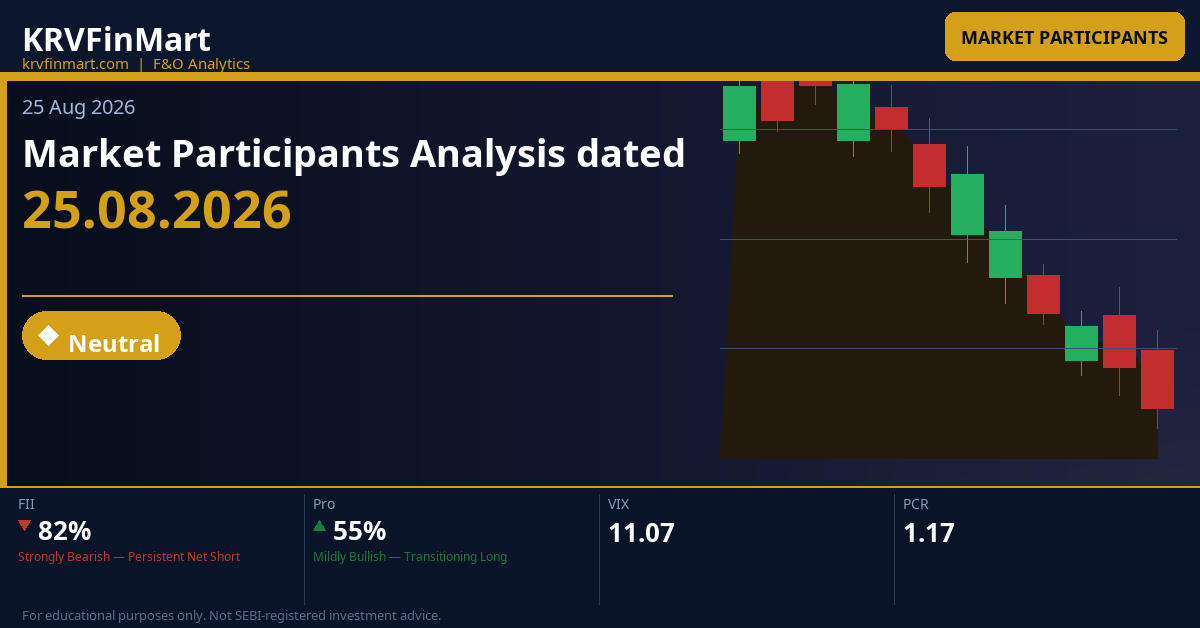
KRVFinMart — Daily Market Outlook
Key Market Signals — Data: 25 Aug 2026
NIFTY 50 24,334.55 ▲ +115.50 (+0.48%) | BANK NIFTY 57,514.20 ▼ -11.75 (-0.02%) | SENSEX 77,656.09 ▲ +286.98 (+0.37%) |
OVERALL PCR 1.17 ▲ +0.34 (+40.72%) PCR surged from 0.83 to 1.17 — put OI now exceeds call OI, signalling a shift toward protective hedging and mild bullish underpinning. | INDIA VIX 11.07 ▼ -0.46 (-3.90%) VIX at 11.07 and falling into the low-fear zone — options are cheap, complacency rising, but also signals a low-panic, range-stable market. | TOTAL OI CHANGE 32,397,188 ▼ -19,677,618 (-37.79%) Massive OI erosion of 37.79% signals a large-scale expiry-driven or event-triggered position unwinding across all participants. |
FUTURES OI 623,784 ▼ -97,388 (-13.50%) Futures OI contracted by 13.50%, driven predominantly by FII short-covering and multi-participant long unwinding — directional conviction reduced. | CALL OI CHANGE 5,129,115 ▼ -7,430,386 (-59.16%) Call OI collapsed 59.16% — both writers and buyers exited aggressively, consistent with post-expiry cleanup or gamma reset near resistance. | PUT OI CHANGE 5,994,557 ▼ -4,436,592 (-42.53%) Put OI fell 42.53% but held above Call OI — net PCR remains above 1.0, meaning put-side conviction is relatively stickier despite the mass unwind. |
Participant-wise Key Points
FII Reducing Bearish Exposure — Systematic Short Covering with Persistent Net Short
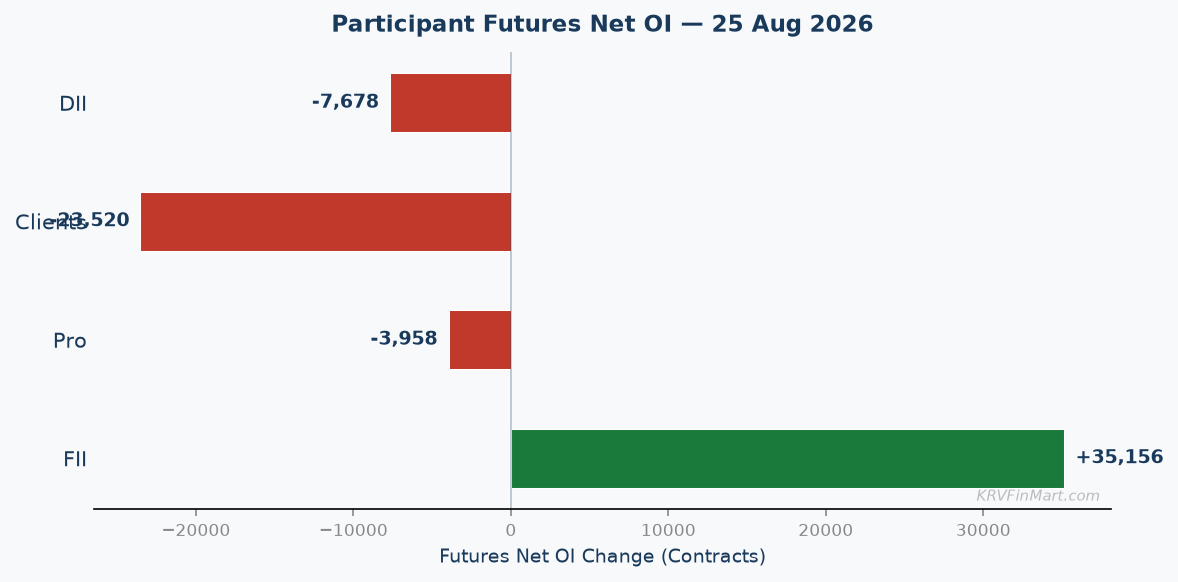
- Futures net improved from -219,383 to -184,227 (net change +35,156 contracts), marking a meaningful reduction in the net short position. The Long side fell from 27,079 to 23,857 contracts (chg -3,222, -11.90%, tagged Long Unwinding - High Vol), while the Short side fell far more sharply from 246,462 to 208,084 contracts (chg -38,378, -15.57%, tagged Short Covering - High Vol). Both tags carry the High Vol designation, which means both the long reduction and the short reduction were deliberate, high-conviction acts — not passive carry or thin-volume noise. The gross short-to-long ratio currently stands at 8.72:1 (208,084 shorts vs 23,857 longs), which is extraordinary — this is categorically not a hedge but an outright directional bear position of deep conviction. Despite the short-covering improving the net by 35,156 contracts, FIIs remain overwhelmingly net short, and the fact that they only covered shorts during a muted NIFTY session (+0.48%) suggests they are trimming rather than capitulating.
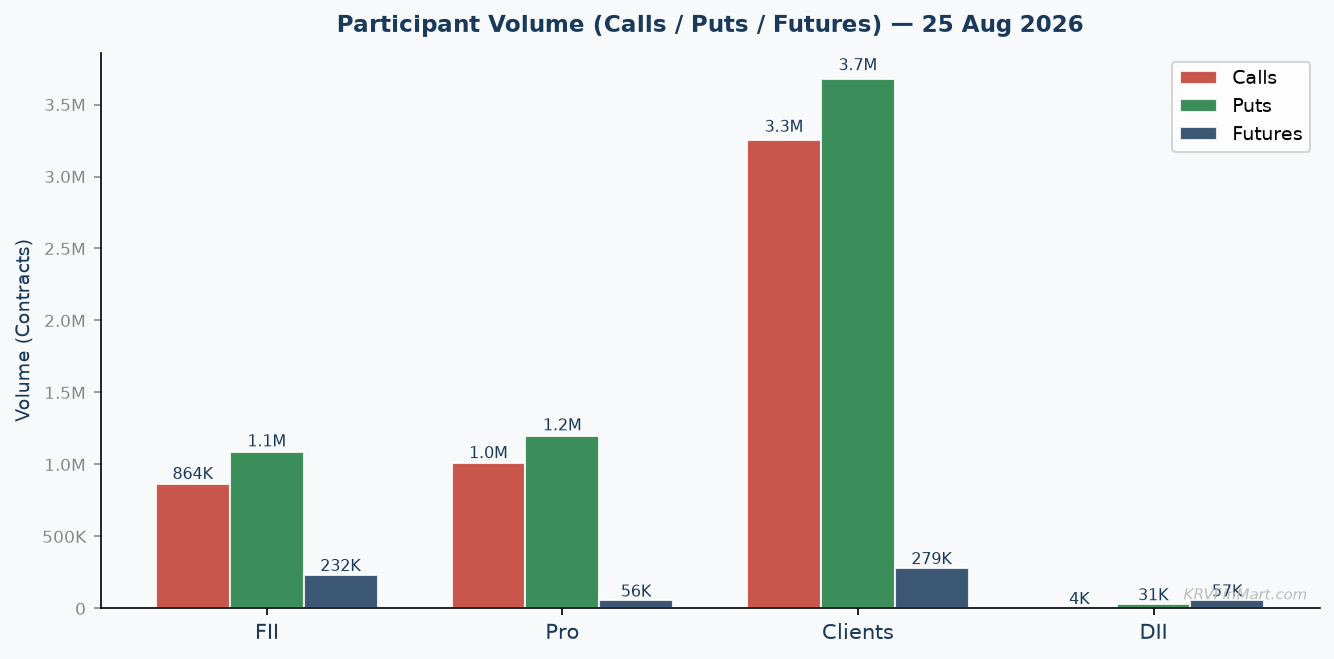
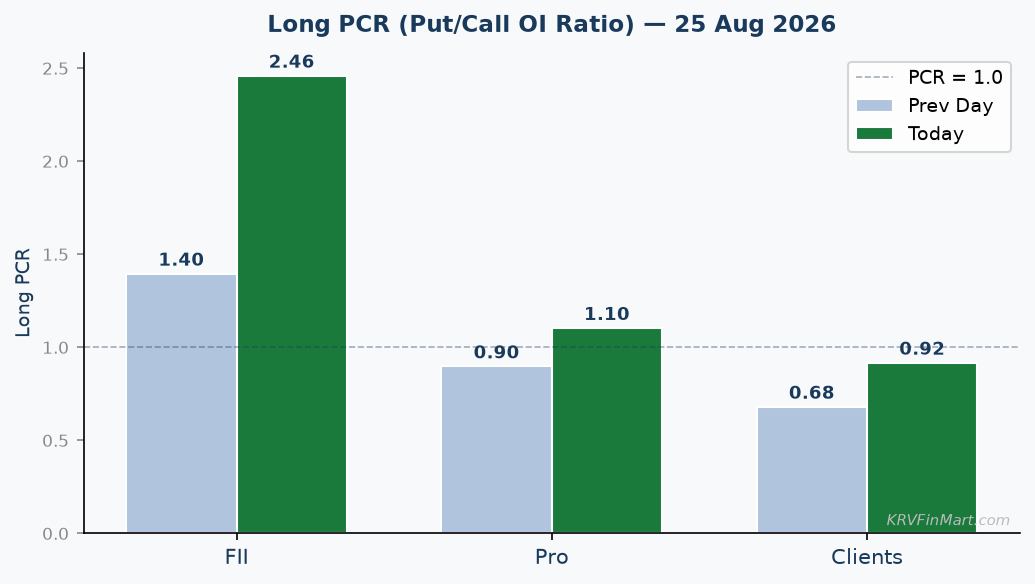
- Long PCR rose sharply from 1.40 to 2.46 (+76.21%) and Short PCR declined from 0.56 to 0.51 (-10.06%). A Long PCR of 2.46 is structurally extreme — FIIs now hold 2.46 times as many put longs as call longs, which is a deeply defensive posture that signals either protection of a large equity portfolio or an aggressive directional bearish options bet. This Long PCR surge of 76.21% in a single session is remarkable; while some of it reflects the collapse in overall Call OI (denominator fell faster than put longs), the absolute level of 2.46 confirms FIIs are leaning put-heavy with intentionality. The Short PCR falling from 0.56 to 0.51 means FIIs are writing slightly more calls than puts on their short side — a range-cap strategy consistent with a view that upside is limited, reinforcing their net short futures book. These two PCR readings together — extreme long put bias combined with a call-heavy short writing book — are internally consistent and paint a coherent bearish picture.
- Call OI net stands at -198,430 (Long 333,003 [Long Unwinding - High Vol] vs Short 531,433 [Short Covering - High Vol]). Put OI net stands at +549,436 (Long 819,216 [Long Unwinding - High Vol] vs Short 269,780 [Short Covering - High Vol]). The net short call position of -198,430 combined with the net long put position of +549,436 creates a textbook synthetic short or protective collar — FIIs are capping upside through call shorts while expressing downside conviction through put longs. The High Vol tags on all four legs confirm these are deliberate, actively managed positions — not stale residuals from prior sessions. Notably, FII put longs (819,216) dwarf their call longs (333,003) by a factor of 2.46, which is precisely what the Long PCR of 2.46 reflects — the architecture is internally consistent and unambiguous in its directional message.
- Synthesis — FII Systematic Bear with Partial Short-Cover: FIIs present the clearest and most consistent bearish narrative in today's data. A futures net of -184,227 (even after covering -38,378 shorts), a Long PCR of 2.46, net short calls of -198,430, and net long puts of +549,436 all converge on a single conclusion: FIIs believe NIFTY's upside is structurally capped and downside risk remains. The short-covering today should not be misread as a bullish flip — the gross short of 208,084 against a gross long of only 23,857 (8.72:1 ratio) remains one of the most extreme bearish futures postures in the market. The High Vol tags on both the long unwinding and short covering legs indicate this was deliberate session management, likely driven by expiry-cycle housekeeping or delta-neutral rebalancing after options mass-unwinding — not a thesis reversal. Compared to the previous session net of -219,383, the improvement of 35,156 contracts is notable but the overall architecture — synthetic short via options, dominant futures short — has not changed direction. FIIs appear to be positioned for a scenario where NIFTY fails to sustain above the 24,350 CE resistance zone and reverts toward 24,300 PE support.
- Forward: The critical trigger to watch is whether FII futures net improves further toward -160,000 (a continued meaningful reduction in gross shorts) in tomorrow's data — if short covering accelerates and futures net crosses above -170,000, it would signal the start of a genuine thesis reversal by FIIs and could provide the fuel for a sharp upward move beyond 24,350 CE resistance. Conversely, if FII futures net stabilises or deteriorates back toward -190,000 or worse tomorrow, it confirms they used today's muted session only to trim positions tactically and remain structurally short — in that case, 24,300 PE support becomes the key downside anchor to watch for. Monitor whether their Long PCR drops below 2.00 tomorrow; any move back toward 1.40 would indicate put-long monetisation and a genuine softening of bearish conviction.
DII Reducing Bullish Exposure — Long Unwinding Across Futures and Options with Flat Short Book
- Futures net fell from +25,020 to +17,342 (net change -7,678 contracts), as DIIs unwound long positions while keeping their short book completely unchanged. The Long side dropped from 44,784 to 37,106 contracts (chg -7,678, -17.14%, tagged Long Unwinding - Low Vol), while the Short side held flat at 19,764 contracts (chg 0, +0.00%, tagged Short Flat - Avg Vol). The Low Vol tag on the long unwinding is critical — it signals that DIIs reduced their futures longs with below-average volume conviction, meaning this was a thin, hesitant reduction rather than a bold tactical exit. The Short Flat with Avg Vol on their short side confirms they made no adjustment to their modest hedging book. The gross long-to-short ratio is 1.88:1 (37,106 longs vs 19,764 shorts), meaning DIIs remain net long futures but with diminishing enthusiasm — they are slowly bleeding longs rather than aggressively managing a directional view.
- DII PCR data is not separately reported in the standard participant breakdown for options (DII options positions are included under their index options longs and shorts but no explicit Long PCR or Short PCR ratio is published for DIIs in today's data). However, we can infer sentiment directionally: their Call OI Long fell from 8,246 to 4,201 (chg -4,045, -49.05%) and their Put OI Long fell from 63,572 to 30,503 (chg -33,069, -52.02%), while their Call OI Short grew from 237 to 266 (chg +29, +12.24%) and Put OI Short doubled from 20 to 40 (chg +20, +100.00%). The implied long put-to-call ratio from their options longs would be approximately 7.26:1 (30,503 put longs vs 4,201 call longs), indicating DIIs maintain a substantially defensive hedging posture on the options long side even after unwinding. The directional signal from both the futures and options together is a measured reduction in bullish exposure.
- Call OI net stands at +3,935 (Long 4,201 [Long Unwinding - Low Vol] vs Short 266 [Short Buildup - High Vol]). Put OI net stands at +30,463 (Long 30,503 [Long Unwinding - Low Vol] vs Short 40 [Short Buildup - High Vol]). DIIs remain net long on both calls and puts — an unusual but explainable posture for institutional asset managers who use options as portfolio hedges rather than directional trades. The Low Vol tag on their long unwinding across both calls and puts confirms this is not an aggressive exit but a gradual, below-average-volume reduction — likely driven by expiry-cycle cleanup or systematic rebalancing. The tiny Short Buildup on both calls (266 contracts) and puts (40 contracts) tagged High Vol is statistically insignificant in absolute size but notable as a new directional addition — it suggests DIIs may be beginning a small income-writing programme as volatility compresses with VIX at 11.07.
- Synthesis — DII Passive Long Reduction with Residual Bull Posture: DIIs are reducing exposure across all legs — futures longs, call longs, and put longs — but doing so with low-volume conviction, which suggests this is expiry housekeeping or passive rebalancing rather than a bearish directional call. Their futures net of +17,342 still represents a net long position, and their put long book of 30,503 contracts provides meaningful downside protection for their equity holdings — consistent with the behaviour of long-only mutual funds and insurance companies that dominate DII F&O activity. In sharp contrast to FIIs (who carry a gross futures short of 208,084), DIIs hold a gross futures long of 37,106 — these two participant classes are clearly on opposite sides of the futures market. The High Vol Short Buildup in calls (29 contracts added) and puts (20 contracts added) is negligible in size but signals the first small move toward writing options for premium income in a low-VIX environment. DIIs are not directionally aggressive today; they are simply a large, slow-moving long book that is shrinking at the margin.
- Forward: Watch whether DII futures net holds above +15,000 in tomorrow's data — a drop below this threshold would indicate accelerating long unwinding and could reduce one of the key structural long buffers that has been supporting NIFTY near 24,300 PE support. If DII futures net instead stabilises or rises back above +20,000, it confirms the reduction today was purely mechanical and their bullish structural posture remains intact. The key risk is a scenario where DII put-long monetisation (put OI falling further from the current 30,503) coincides with FII futures net worsening — in that combination, 24,300 PE support loses two layers of structural backing simultaneously and the downside opens more cleanly.
Pro Transitioning Neutral to Mildly Bullish — Call Net Flipped Long, Put Net Sharply Reduced
- Futures net fell from +13,207 to +9,249 (net change -3,958 contracts) as Pros reduced both their long and short futures books substantially. The Long side fell from 51,987 to 32,516 contracts (chg -19,471, -37.45%, tagged Long Unwinding - High Vol), while the Short side fell from 38,780 to 23,267 contracts (chg -15,513, -40.00%, tagged Short Covering - High Vol). Both tags carry High Vol designations, confirming this was deliberate, high-conviction position management on both sides. The gross long-to-short ratio is 1.40:1 (32,516 longs vs 23,267 shorts), a modest net long posture. The symmetrical nature of the reduction — longs down 37.45% and shorts down 40.00% — suggests Pros were actively collapsing gross exposure, likely in response to the overall OI collapse across the market (-37.79%), while maintaining a marginal net long tilt. The net decline of only -3,958 despite massive gross reductions on both sides shows the relative neutrality of Pro futures exposure at this point.
- Long PCR rose from 0.90 to 1.10 (+22.95%) and Short PCR surged from 0.73 to 1.29 (+78.07%). The Long PCR crossing above 1.00 for the first time (from 0.90 to 1.10) is a structurally significant shift — Pros now hold 10% more put longs than call longs, crossing from a mild call-long bias to a mild put-long bias in their hedging book. The Short PCR surging from 0.73 to 1.29 is the dominant signal: Pros are now writing 29% more puts than calls on their short side, which is a clear shift toward a range-bullish or put-selling income strategy. A Short PCR of 1.29 typically signals that Pros expect the downside to be limited and are comfortable selling put premium — consistent with VIX at 11.07 making options cheap to write. These two PCR moves together — Long PCR just above 1.00 and Short PCR strongly above 1.00 — indicate Pros are evolving toward a range or mild bullish view, with put writing as the primary options strategy for tomorrow.
- Call OI net flipped to +99,801 (Long 553,934 [Long Unwinding - High Vol] vs Short 454,133 [Short Covering - High Vol]). Put OI net collapsed from +198,480 to +24,124 (Long 611,629 [Long Unwinding - High Vol] vs Short 587,505 [Short Covering - High Vol]). The Call OI net flipping from -35,340 to +99,801 is the most dramatic options-side development in today's Pro data — Pros went from net short calls to net long calls in a single session, a directional architecture flip. Meanwhile the Put OI net contracted sharply from +198,480 to only +24,124, meaning Pros aggressively liquidated net put length as well. The combination of net long calls (+99,801) and a dramatically reduced net long puts (+24,124) suggests Pros are shifting toward a mild directional long in options — net long calls is the dominant signal here, pointing to an expectation of upward movement or at least a stabilisation near current NIFTY levels. This architecture is a significant departure from the previous session's more balanced put-heavy posture.
- Synthesis — Pro Transitioning from Neutral to Mildly Bullish: The Pro block has undergone the most significant architectural shift of any participant today. In the previous session they held a modestly net long futures position, net short calls, and a substantial net long put book — a hedged, defensive posture. Today, they retain the small net long futures (+9,249), have flipped their call position to net long (+99,801), and have dramatically compressed their put long book to near-neutral (+24,124). This restructuring — net long calls, near-neutral puts, mildly long futures, and a Short PCR surging to 1.29 — is the signature of a participant who is removing downside protection and adding upside participation. The High Vol tags on all four legs (call longs, call shorts, put longs, put shorts) confirm this is deliberate, high-conviction repositioning — not passive expiry runoff. The sharp rise in Short PCR to 1.29 (put writing on the short side) combined with the net long call position suggests Pros may be running a bull call spread or a net long call with put premium income overlay — a strategy that profits if NIFTY holds or rises above current levels. This stands in clear contrast to FII behaviour (who remain deeply net short futures) and creates a significant institutional divergence between these two sophisticated participant groups.
- Forward: The key trigger to watch for Pros is whether their Call OI net (+99,801 today) builds further above +100,000 in tomorrow's data — if it expands, it signals Pros are adding upside exposure with genuine conviction and NIFTY could test the 24,350 CE resistance with more institutional backing. If the Call OI net retreats back below +50,000, it would indicate today's flip was a one-session repositioning around expiry and Pros are reverting to their prior neutral stance. Also watch their Short PCR — if it sustains or rises above 1.29, put writing is becoming a structural strategy in a low-VIX environment, which would act as a support floor near 24,300.
Client Reducing Bullish Bias — Long Unwinding in Options, Short Buildup in Futures
- Futures net fell from +181,156 to +157,636 (net change -23,520 contracts), representing the largest absolute futures net deterioration of any participant today. The Long side fell from 236,736 to 218,413 contracts (chg -18,323, -7.74%, tagged Long Unwinding - High Vol), while the Short side simultaneously increased from 55,580 to 60,777 contracts (chg +5,197, +9.35%, tagged Short Buildup - High Vol). Both tags are High Vol, meaning both the long reduction and the new short addition were deliberate, high-conviction moves — this is not thin-volume noise but an intentional dual-sided bearish adjustment. The gross long-to-short ratio is now 3.59:1 (218,413 longs vs 60,777 shorts), down from the previous session's 4.26:1 — Clients remain substantially net long futures but are clearly reducing that long bias while simultaneously building shorts. This is a notably bearish intraday behaviour from a participant group that is traditionally the contra-indicator: when Clients add shorts, it often signals retail capitulation or lagging trend-following into a downward bias.
- Long PCR rose from 0.68 to 0.92 (+34.77%) and Short PCR surged from 0.94 to 1.36 (+44.68%). The Long PCR moving from 0.68 to 0.92 means Clients are rapidly shifting their options long book toward put-heavy — they now hold put longs that are 92% the size of their call longs, nearly at parity, up from just 68% previously. This signals a growing defensive or bearish tilt in how retail Clients are positioning their option purchases. The Short PCR surging to 1.36 is even more telling — Clients are writing 36% more puts than calls on their short side, which typically reflects retail put-selling (premium income) as VIX compresses to 11.07 and options look cheap. However, a Short PCR of 1.36 for Clients is often a contrary signal — retail put-sellers near critical support (24,300) are exposed to sharp downside if the support breaks. Together, these PCR moves show Clients are hedging long equity via put buying while simultaneously collecting premium through put selling — a split, somewhat self-contradictory posture.
- Call OI net declined sharply to +94,693 (Long 1,673,419 [Long Unwinding - High Vol] vs Short 1,578,726 [Short Covering - High Vol]). Put OI net improved from -843,989 to -604,022 (Long 1,535,931 [Long Unwinding - High Vol] vs Short 2,139,953 [Short Covering - High Vol]). The Call OI net of +94,693 means Clients still hold more call longs than call shorts — but this figure has fallen sharply from +227,012 in the previous session, indicating Clients are unwinding their net call-long positions aggressively. The Put OI net of -604,022 means Clients hold significantly more put shorts than put longs — they are net short puts, which is a premium-income posture that profits from stability or upside but is dangerous if downside accelerates. The combination of net long calls and net short puts on an overall basis is a synthetic long posture in options — directionally bullish, but with the risks of put writing concentrated at the downside. This options architecture is consistent with Clients being long equity/futures and supplementing income through put writing in a low-VIX environment.
- Synthesis — Client Reducing Bullish Conviction While Maintaining Synthetic Long Architecture: Clients are the largest participant group by absolute options OI, and today's data shows a broad de-risking: futures longs unwound by 18,323 contracts, new futures shorts added of 5,197 contracts, call longs reduced by 2,456,438 contracts (59.48%), and put longs reduced by 1,276,661 contracts (45.39%). Yet despite this broad unwind, their net futures position of +157,636 remains the most bullish of all four participant groups, and their options architecture (net long calls, net short puts) remains structurally bullish. This creates an interesting bifurcation: the direction of change is bearish (reducing longs, adding shorts), but the level of positioning remains bullish. FII vs Client divergence is sharp — FIIs carry a futures net of -184,227 (deeply short) while Clients carry +157,636 (substantially long) — these two groups are directly opposing each other in the futures market, and historically, FII positioning has tended to be more directionally accurate. The High Vol tags across all four of Clients' options legs confirm this was not a passive expiry unwind but active, deliberate repositioning — suggesting Clients are anticipating near-term volatility or directional risk, even if they haven't fully exited their bullish base.
- Forward: The critical level to monitor for Clients is whether their futures net +157,636 holds or continues to erode — a drop toward +130,000 in tomorrow's data would signal accelerating long liquidation and remove a key structural support for NIFTY above 24,300 PE support. Additionally, watch their Put OI net: the current -604,022 net short put position creates a gamma risk near 24,300 — if NIFTY threatens to break below 24,300, Client put shorts could force sharp delta-hedging and accelerate the downside move. Conversely, if Client futures net stabilises above +150,000 and their call long book rebuilds, it would confirm the unwind today was expiry-related and the underlying bullish retail thesis remains intact for the next series.
Bull vs Bear Strength by Participant
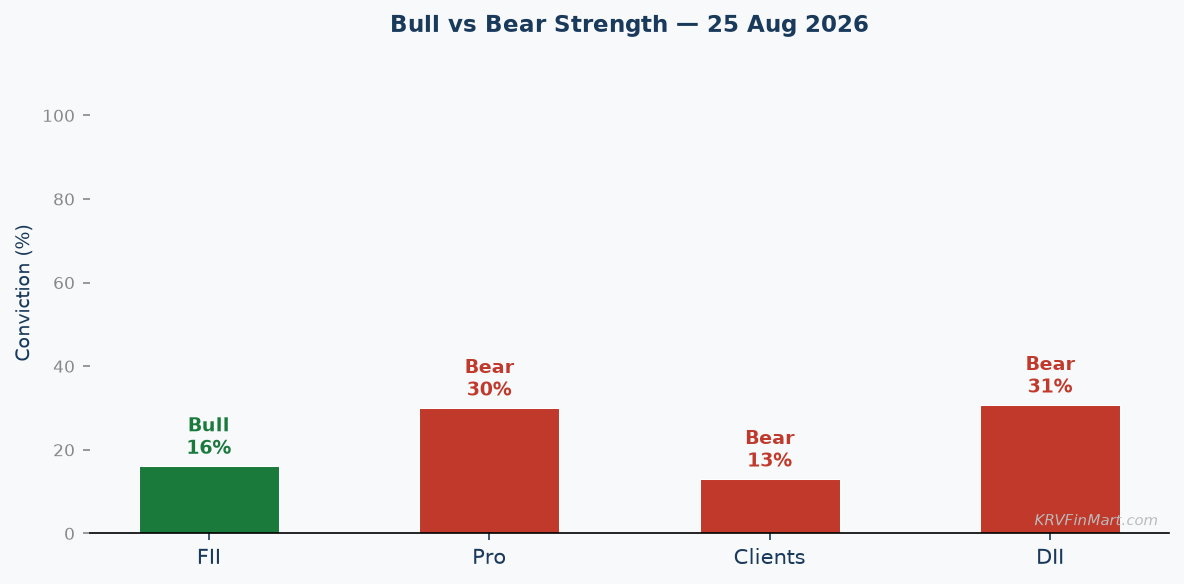
FII Strongly Bearish — Persistent Net Short 82% ▼▼ | Client Residually Bullish — Reducing Fast 58% ▲ | Pro Mildly Bullish — Transitioning Long 55% ▲ | DII Mildly Bearish — Long Reduction 60% ▼ |
Conclusion — Market Outlook for Tomorrow (26 Aug 2026)
The collective positioning picture for 25 Aug 2026 is one of a market undergoing a large-scale expiry-driven or event-triggered OI reset, with directional divergences sharpening rather than converging. FIIs remain the dominant bearish force with a futures net of -184,227 and an 8.72:1 gross short-to-long ratio, even after covering -38,378 shorts today — their synthetic short architecture (net short calls -198,430, net long puts +549,436) remains fully intact and is the most internally consistent directional signal in today's data. DIIs are reducing their net long futures book (now +17,342) with low-volume conviction, suggesting passive rebalancing rather than a directional call, but their reduction removes structural support at the margin. Pros have undergone the most significant architectural shift — flipping their call position to net long (+99,801) and compressing their put net to near-zero (+24,124), with a Short PCR surging to 1.29 — signalling a transitioning mild bullish view. Clients remain the largest net long futures participant (+157,636) but are actively de-risking, with both long unwinding and short building occurring simultaneously at High Vol conviction. The FII vs Client divergence (-184,227 vs +157,636 in futures net) is the defining institutional tension of this session.
The overall PCR surging from 0.83 to 1.17 (+40.72%) in a single session is bullish on its surface — put OI now exceeds call OI, which historically provides a floor for the market. However, this PCR surge occurred in the context of a 37.79% total OI collapse, meaning it reflects asymmetric unwinding (call OI fell 59.16% vs put OI falling only 42.53%) rather than fresh put buying — so the PCR signal here is more about call destruction than bullish put accumulation. India VIX at 11.07 (-3.90%) falling into the low-fear zone reduces the urgency of protective hedging and supports range-bound conditions, but also creates a risk of complacency — if a catalyst emerges, the low-VIX environment can produce sharp, fast moves. The 24,300 PE support (max put OI strike) and 24,350 CE resistance (max call OI strike) form an extremely tight 50-point range for NIFTY — the market is essentially pinned between these levels until a participant (most likely FIIs covering en masse or Clients fully capitulating) provides the directional breakout fuel.
The bull thesis requires FII futures net to improve materially toward -160,000 or better (meaningful short covering), Pro call longs to expand beyond +100,000, and the overall PCR to hold above 1.10 — together these would signal institutional convergence around a bullish view and could propel NIFTY above 24,350 CE resistance. The bear thesis is triggered if FII futures net deteriorates back toward -200,000 (resuming short buildup), Client futures net drops below +130,000 (retail capitulation), and the PCR reverses below 1.00 — in that scenario, 24,300 PE support would be tested with multiple participants removing protection simultaneously. The VIX is the wild card: a spike above 12.50 would change the entire calculus by repricing options sharply and potentially triggering FII short-add acceleration.
Scenario 1 — Bull case:
If FII futures net improves toward -160,000 (implying continued large-scale short covering beyond today's -38,378 covered), the overall PCR sustains above 1.15, and VIX compresses further toward 10.50, NIFTY could build momentum to challenge and break above the 24,350 CE resistance (max call OI strike). Pro's net long call position of +99,801 expanding further would confirm institutional support for the upside move. In this scenario, the FII vs Client divergence begins to resolve with FIIs reducing their 8.72:1 short ratio toward 6:1 or better, releasing trapped short fuel into an upward squeeze.
Scenario 2 — Bear case:
If FII futures net worsens back toward -200,000 (short buildup resuming), Clients' futures net drops below +130,000 (retail long liquidation accelerating), and the overall PCR retreats below 1.00 as put longs are monetised, NIFTY is at risk of breaking below the 24,300 PE support (max put OI strike). Client's net short put position of -604,022 creates a concentrated gamma risk near 24,300 — a sustained breach there could force delta-hedging selling that amplifies the downside move sharply. A VIX spike above 12.50 in this scenario would confirm fear re-entering the market and would validate the FII synthetic short architecture (net long puts +549,436) paying off.
Key Resistance NIFTY 24,350 (CE max OI strike — Weekly and Monthly) / BANKNIFTY 57,600 (CE max OI strike — Monthly) / SENSEX 78,000 (CE max OI strike — Weekly and Monthly). FIIs are net short calls (-198,430) at this zone, acting as a structural supply wall. Pro's net long calls (+99,801) provide the only institutional push against this resistance — but FII short call dominance significantly outweighs Pro's long call book, making 24,350 a high-conviction resistance unless FIIs actively cover their short call book. | Key Support NIFTY 24,300 (PE max OI strike — Weekly and Monthly) / BANKNIFTY 57,500 (PE max OI strike — Monthly) / SENSEX 77,500 (PE max OI strike — Weekly and Monthly). FIIs hold net long puts of +549,436 contracts anchoring this level as their profit zone on a breakdown. DIIs hold residual put longs of 30,503 providing additional support. However, Clients carry a net short put position of -604,022, creating a gamma trap exactly at this level — a break below 24,300 could trigger forced delta-selling by Client put writers and accelerate any downside move sharply. | Trigger to Watch Overall PCR crossing and holding above 1.20 tomorrow (from today's 1.17) would confirm genuine protective put accumulation rather than just call destruction — this would signal institutional hedging demand rising and provide stronger support to the 24,300 PE level. Conversely, PCR falling below 1.00 would confirm put monetisation is dominating and the support architecture is weakening. Additionally watch FII futures net: any move beyond -170,000 (improvement) or -200,000 (deterioration) would confirm the next directional leg. |