
Index Research
Intraday Analysis for 26 Aug 2026
KRVFinMart25 August 202653 min
Educational/Derived AnalysisSource: KRVFinMart Research Desk (End-of-Day)As of 25 Aug 2026, 04:18 PM IST
Intraday Analysis for 26 Aug 2026
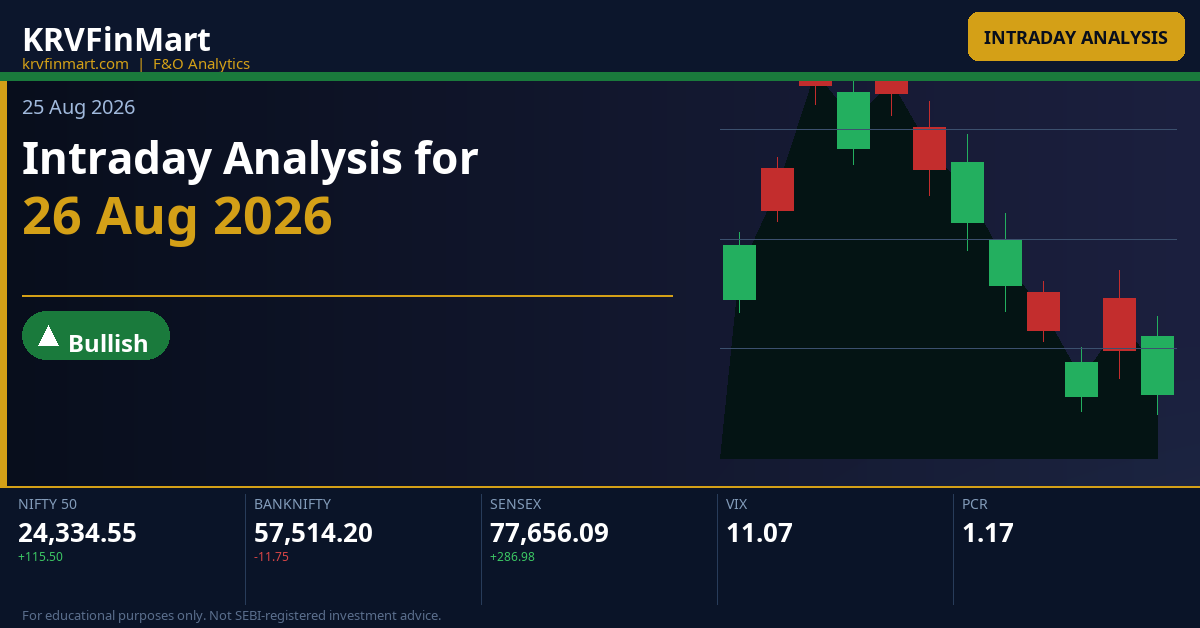
Markets closed on 25 Aug 2026 with NIFTY gaining +0.48% to 24,334.55, SENSEX adding +0.37% to 77,656.09, while BANKNIFTY was nearly flat at 57,514.20 (−0.02%), reflecting a bifurcated session where broader indices recovered but banking remained range-bound. India VIX data is unavailable for this session, which limits precise volatility-regime assessment; however, the extremely thin NIFTY straddle premium of just 15.4 points (ATM 24,350) implies the options market is pricing virtually zero expected move for the expiry-day session, strongly suggesting market makers and option writers expect consolidation near current levels with no meaningful directional breakout anticipated. The SENSEX straddle at 518.85 points from ATM 77,700 is relatively more expansive, reflecting Sensex's wider price range and more open-ended intraday potential, while BANKNIFTY's straddle of 14.25 points at ATM 57,500 similarly implies theta crush near expiry with max pain gravitating prices toward 57,500.
Key Market Signals — Intraday Setup
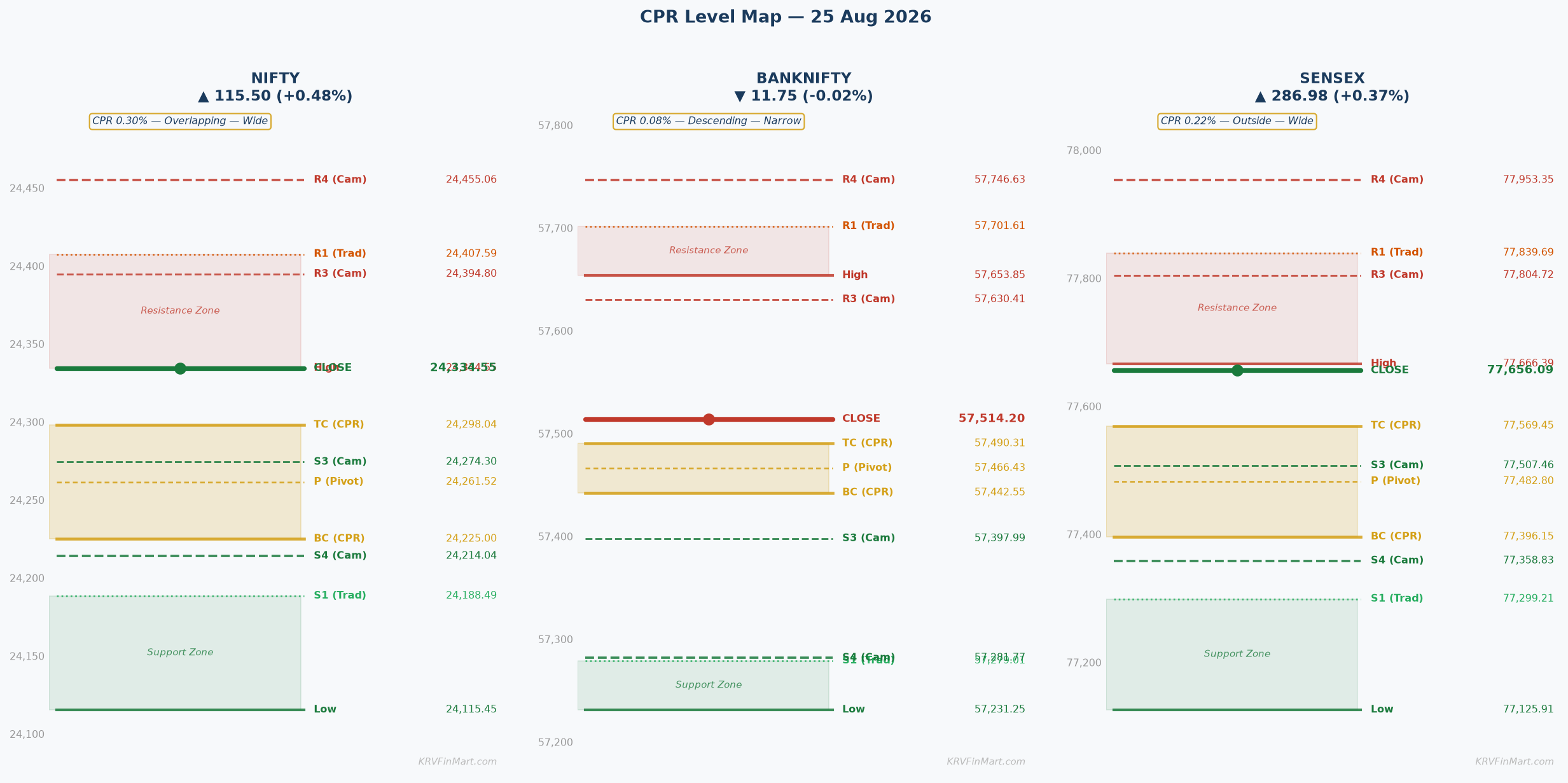
All three indices are trading above their respective daily CPR midpoints (Pivot levels: NIFTY 24,261.52, BANKNIFTY 57,466.43, SENSEX 77,482.80) after yesterday's close, but BANKNIFTY's Descending — Narrow CPR signals the banking index is in a trending regime with downside structural bias, while NIFTY and SENSEX face Wide CPR bands that favour intraday range-bound behaviour and fade strategies rather than trend-following. The combination of near-expiry straddles at near-zero premium for NIFTY/BANKNIFTY and max pain at 24,300 / 57,500 suggests strong gravitational pull toward these strikes, making aggressive directional bets risky without confirmed momentum triggers.
Deep Technical Analysis & Levels
NIFTY
Overlapping — Wide (0.30%)
◆ Neutral
Market Structure Sideways or range-bound | Straddle ATM 24,350 | Call LTP 0.05 + Put LTP 15.35 = **15.40 pts total premium** — the market is pricing virtually zero upside move and only ~15 pts downside cushion, implying option writers expect NIFTY to expire near 24,350 with almost no volatility. This is consistent with an expiry-day theta-crush environment where premium has nearly fully decayed. | Max Pain Max Pain at **24,300** — option sellers face minimum loss if NIFTY expires at 24,300, creating a gravitational pull of approximately 34 points below yesterday's close of 24,334.55. This implies that unless fresh buying or news-driven momentum emerges, the path of least resistance for option writers is to defend 24,300 as the expiry pin zone throughout the session. |
Tomorrow's Complete Level Map
OI-R: 24,350 R3: 24,626.69 H6: 24,555.64 H5: 24,525.44 R2: 24,480.62 H4 ▶: 24,455.06 R1: 24,407.59 PDH: 24,334.55 H3 ↩: 24,394.80
TC: 24,298.04 P: 24,261.52 BC: 24,225.00
L3 ↩: 24,274.30 PDL: 24,115.45 S1: 24,188.49 L4 ▶: 24,214.04 S2: 24,042.42 L5: 24,143.66 L6: 24,113.46 S3: 23,969.39 OI-S: 24,300
↩ = Camarilla reversal point | ▶ = Camarilla breakout/breakdown trigger | OI-R/OI-S = Options wall (CE/PE max OI)
▲ Higher Open (Gap Up) — Open > Prev Close
▲ Bullish
Open lands: With yesterday's close at 24,334.55 forming the PDH and today's TC at 24,298.04, a gap-up open would place price **above the entire CPR band** (BC 24,225 to TC 24,298.04) and immediately above the OI resistance wall at 24,350. Since the Overlapping Wide CPR's TC (24,298.04) is already below yesterday's close, any gap-up pushes price into the zone between PDH 24,334.55 and OI-R 24,350, which is a heavily contested CE writing zone.
CPR role: In a gap-up scenario the entire CPR band (BC 24,225 to TC 24,298.04) acts as a **support base / launch pad** below the open — price is above all CPR levels, meaning the band provides a floor for potential pullbacks rather than overhead resistance. However, the Wide CPR width of 0.30% means this support is distributed across a 73-point band, so individual levels within it (P 24,261.52, BC 24,225) retain distinct significance on any intraday dip.
Minor Gap (0.05–0.25%) — Structure Dominant
A minor gap-up of 0.05–0.25% would open NIFTY in the range of approximately **24,346 to 24,395**, placing price fractionally above OI resistance at 24,350 but below Camarilla H3 at 24,394.80. Given the Overlapping Wide CPR structure where price is already above TC 24,298.04, the CPR band transitions immediately into support below, adding a mild bullish lean — but the Wide width (0.30%) means this is not a high-conviction trending signal. The structure favours a fade-and-fade session: the first target on the upside is Camarilla H3 at 24,394.80, but the OI resistance wall at 24,350 (CE max OI strike) will act as the first and most important ceiling to overcome, requiring two consecutive 30-minute closes above 24,350 before treating 24,394.80 as a viable target per the Wide CPR confirmation rule.
Significant Gap (0.25–0.5%) — Balanced
A significant gap-up of 0.25–0.5% would open NIFTY near **24,395–24,456**, directly at or above Camarilla H3 (24,394.80) and approaching H4 (24,455.06). Opening into H3 territory on a Wide CPR day is a classic mean-reversion setup — the probability of a gap-fill back toward 24,350 (OI-R) and then TC 24,298.04 is elevated, as CE writers at 24,350 and 24,400 will aggressively sell into the gap strength. The first actionable scenario is a fade short from H3 (24,394.80) targeting the Traditional R1 at 24,407.59 as the maximum reasonable upside before fading back toward P 24,261.52; delta-hedging flows from large CE positions near 24,350–24,400 will create consistent selling pressure against any sustained move above H3.
Large Gap (>0.5%) — Gap Direction Dominant
A large gap-up exceeding 0.5% (above 24,456) would open above Camarilla H4 at 24,455.06, entering H4–H5 territory (24,455.06–24,525.44) which is the Camarilla breakout zone. At this level, the open would be approximately 50–100 points above Traditional R1 (24,407.59), creating extreme gap-fill risk in a Wide CPR environment — the Wide confirmation rule requires two 30-minute closes at the elevated level before treating it as sustainable. Given the near-zero straddle premium (15.4 points), such a large gap would be entirely outside the implied range and likely triggered by a major external catalyst; without sustained global cues, the probability of a gap-fill back toward 24,407.59 and then 24,350 (OI-R) within the first hour is very high, making the abort level for any long trade a two-candle close back below H4 (24,455.06).
|
▲ Upside Path → OI-R Confirmed two-30-min-close above 24,350 opens the upside path: **24,350 → H3 24,394.80 → R1 24,407.59 → H4 24,455.06**, with partial profit recommended at R1 24,407.59 per the Wide CPR rule (first Traditional target = first partial exit). The H4 level at 24,455.06 acts as the secondary Camarilla breakout target and coincides with R2 territory (24,480.62 nearby), so genuine momentum beyond H4 would require extraordinary volume and would not be the base case on a Wide CPR day. |
▼ Downside Path → OI-S Failure to hold OI-R 24,350 in a gap-up scenario triggers the failure path: **24,350 fails → TC 24,298.04 → P 24,261.52 → BC 24,225 → OI-S 24,300 → L3 24,274.30**. The loss of TC (24,298.04) is particularly important because it transforms the entire CPR band from support into resistance — price below TC re-enters the Wide CPR battleground, increasing the probability of a drift toward max pain at 24,300 and ultimately OI-S (PE max OI at 24,300), which acts as the gravitational floor in a theta-crush expiry session. |
| 🔴 OI-R: OI-R at **24,350** (CE max OI strike) in a gap-up scenario acts as the primary ceiling and fade zone — the largest concentration of call open interest means option writers have maximum incentive to defend this level, selling into any rally to cap upside and collect theta on expiry day. CE writing at 24,350 creates a negative-gamma dynamic where, as price approaches this strike, dealers are forced to sell futures to hedge delta, mechanically suppressing price and increasing the effectiveness of this level as a resistance wall. | 🟢 OI-S: OI-S at **24,300** (PE max OI strike) in a gap-up scenario is largely irrelevant as a downside target initially — it sits 34 points below the open and represents the max pain expiry pin rather than an active breakdown level. However, if the gap-up fails and price retreats through TC (24,298.04), OI-S at 24,300 becomes the critical floor: PE writers defend this strike aggressively by selling put premium and buying futures, creating a natural support cushion that makes 24,300 the most likely expiry pin zone for the day. |
⚡ Key Trigger: The key upside trigger is **two consecutive 30-minute candle closes above OI-R 24,350** — this is the structural fulcrum because 24,350 is simultaneously the CE max OI strike (where the largest options supply sits) and the nearest resistance above yesterday's PDH (24,334.55). A sustained hold above 24,350 with above-average volume confirms that CE writers are being squeezed and forced to cover, which mechanically drives prices toward H3 (24,394.80) and R1 (24,407.59); conversely, failure to hold 24,350 on any gap-up open confirms the CE wall is intact and pulls price back toward TC 24,298.04 and then P 24,261.52.
▼ Lower Open (Gap Down) — Open < Prev Close
▼ Bearish
Open lands: A gap-down open would place NIFTY below yesterday's close (24,334.55 = PDH) and potentially inside or below the Wide CPR band (TC 24,298.04 to BC 24,225.00). Since the Overlapping Wide CPR partially overlaps with yesterday's range, a minor gap-down (below 24,334) lands inside the upper CPR zone between TC 24,298.04 and OI-S 24,300, while a significant or large gap-down breaches the entire CPR band below BC 24,225, changing the structural character from neutral to bearish.
CPR role: In a gap-down scenario the CPR band (BC 24,225 to TC 24,298.04) acts as **overhead resistance / battleground** — price opens below (or at the lower edge of) the band, and bulls must reclaim TC 24,298.04 to restore neutral bias, while bears need to maintain price below BC 24,225 to confirm a structural breakdown. The Wide CPR (0.30% = 73 points wide) means that even partial re-entry into the band is not sufficient confirmation — the Wide rule requires two 30-minute closes above TC 24,298.04 for bullish reclaim.
Minor Gap (0.05–0.25%) — Structure Dominant
A minor gap-down of 0.05–0.25% opens NIFTY in the range of **24,275–24,334**, placing price just inside the CPR band between TC (24,298.04) and OI-S (24,300) — note the remarkable convergence of these two levels, meaning a minor gap-down lands directly on max pain and the PE OI wall simultaneously. Minor gaps inside a Wide CPR range typically fill within 30–60 minutes, and the PE wall at 24,300 acts as an immediate cushion that option writers will defend by selling puts and supporting price. The first upside resistance on any recovery is TC 24,298.04 (extremely close to 24,300), and if price recovers above TC within the first 30-minute bar, the bullish recovery scenario targets P 24,261.52 from below as a base and then back toward OI-R 24,350; failure at TC and BC (24,225) confirms the bearish path toward L3 24,274.30 and S1 24,188.49.
Significant Gap (0.25–0.5%) — Balanced
A significant gap-down of 0.25–0.5% would open NIFTY near **24,214–24,275**, placing price between L4 (24,214.04) and L3 (24,274.30) — both Camarilla downside reference levels. This opening zone is below the entire CPR band (BC 24,225 as nearest overhead resistance), meaning the CPR transforms into a complete overhead resistance structure; the 30-minute reclaim rule applies — bulls need a 30-minute close above BC 24,225 to neutralise the gap, and above TC 24,298.04 to fully recover. The bearish path on failure to reclaim BC 24,225 targets L4 (24,214.04) as the first Camarilla breakdown level, then S1 (24,188.49) as the Traditional downside target, and finally OI-S (24,300) becomes irrelevant as a support (already broken) with L5 (24,143.66) emerging as the next bear target — PUT writer flows become hesitant at this point as PE OI at 24,300 loses its gamma defence.
Large Gap (>0.5%) — Gap Direction Dominant
A large gap-down exceeding 0.5% (below 24,214) would open at or below L4 (24,214.04) and S1 (24,188.49), representing a full breach of the daily CPR structure with panic-selling characteristics. In this scenario, the VIX (unavailable today) would presumably be spiking, and the straddle premium of 15.4 points (near-expiry) would be entirely irrelevant as realized volatility exceeds implied range by multiples. Recovery levels to watch are BC (24,225) for initial stabilisation and then TC (24,298.04) for a proper recovery — but the primary downside targets are L5 (24,143.66) converging with PDL (24,115.45) and L6 (24,113.46), creating a tight technical cluster that serves as the maximum downside zone in a panic-gap scenario before straddle monetisation by premium sellers kicks in.
|
▲ Upside Path → OI-R The recovery path in a gap-down scenario runs: **BC 24,225 reclaim → P 24,261.52 → TC 24,298.04 → OI-S 24,300 (now acting as resistance-to-cross) → OI-R 24,350**. Each level must be confirmed with a 30-minute close per the Wide CPR rule — a recovery that stalls at P (24,261.52) without closing above TC (24,298.04) should be treated as a dead-cat bounce with fresh shorts warranted near TC. |
▼ Downside Path → OI-S The confirmed downside path on Wide CPR gap-down runs: **L3 24,274.30 → L4 24,214.04 → S1 24,188.49 → L5 24,143.66 → PDL 24,115.45 / L6 24,113.46 → OI-S 24,300 (failed) → S2 24,042.42**. Retail stop-losses below L3 (24,274.30) create automatic selling pressure that accelerates the move to L4 (24,214.04), where options gamma from deep ITM calls begins to cause dealer-hedging selling, compounding the downside momentum toward S1 (24,188.49). |
| 🔴 OI-R: OI-R at **24,350** in a gap-down scenario acts as a distant overhead ceiling defended by CE writers — it is largely irrelevant for the opening phase but becomes the ultimate bull case target only if price fully recovers through the CPR band. Short sellers who sold CE at 24,350 will actively sell any futures rally approaching this level, making it the maximum realistic upside even on a strong recovery day. | 🟢 OI-S: OI-S at **24,300** (PE max OI) is the primary gravitational anchor and max pain level in a gap-down — PE writers at this strike are aggressively defending by selling puts into weakness and bidding futures near 24,300, creating a natural cushion that should limit downside on minor and significant gap-downs. If price breaches OI-S (24,300) with sustained selling, it signals that PE writing has capitulated and deeper targets (L5 24,143.66, PDL 24,115.45) become the next meaningful support levels, with S2 (24,042.42) as the extreme bear case. |
⚡ Key Trigger: The key trigger on a gap-down open is **failure to reclaim BC 24,225 within the first 30-minute candle** — if the opening 30-minute bar closes below BC 24,225, it confirms that the Wide CPR's entire band has become overhead resistance and the day is structurally bearish, activating the downside path toward L3 (24,274.30 from above) and then L4 (24,214.04). Conversely, a 30-minute close above BC 24,225 shifts the bias to neutral-recovery, and a subsequent close above TC 24,298.04 (per Wide CPR two-close rule) restores the bullish intraday structure and targets OI-R 24,350.
◆ Near Flat Open — Open ≈ Prev Close (±0.05%)
◆ Neutral
Open lands: A flat open of ±0.05% places NIFTY in the range of **24,322–24,347**, which is above the entire CPR band (TC 24,298.04 is the top of the band) and directly adjacent to the OI resistance at 24,350. This is a critically important structural position: price opens above the Wide CPR but below OI-R, meaning bulls have the structural advantage of CPR as support below, but CE writers at 24,350 provide immediate upside friction within just 15–25 points of the open.
CPR role: In a flat-open scenario the CPR band (BC 24,225 to TC 24,298.04) acts as a **decision zone / support base** below — price is above the entire CPR, so the band below acts as a layered support floor rather than a battleground. However, the Wide CPR (0.30%) means this support spans 73 points, and the practical implications are: TC (24,298.04) is the first significant support on any dip, while BC (24,225) is the deeper support that must hold for the bullish structure to remain intact throughout the day.
Near Flat (±0.05%)
A flat open near 24,334 in an Overlapping Wide CPR day is a high-information setup where the first 15-minute candle's relationship to OI-R (24,350) and max pain (24,300) defines the entire session's character — traders should not commit directionally until the first 15-min bar closes, as the Wide CPR confirmation rule actually requires two 30-minute closes for any directional trade from extreme levels. Specifically, TC at 24,298.04 is the first downside trigger: a 30-minute close below this level pulls price into the Wide CPR battleground, with P (24,261.52) as the midpoint reference and BC (24,225) as the lower band — each acting as successively deeper support levels in a potential intraday mean-reversion. The OI resistance at 24,350 (only ~15 points above a flat open of 24,334) acts as the immediate ceiling: a two-30-minute-close above 24,350 is the bull trigger, while CE writers will actively sell rallies up to this level, creating a ceiling that is very tight relative to the Wide CPR width. The dual scenario is clear: **bull trigger = two 30-min closes above OI-R 24,350** targeting H3 24,394.80 and R1 24,407.59 with partials; **bear trigger = 30-min close below TC 24,298.04** followed by drift toward max pain 24,300 and then BC 24,225, with Wide CPR range-fade strategy applicable throughout — do NOT trail positions beyond the first Traditional target (R1 24,407.59 upside / S1 24,188.49 downside) per Wide CPR rules.
|
▲ Upside Path → OI-R Confirmed bull path from flat open: **TC 24,298.04 (support confirmed) → OI-R 24,350 (two-30-min-close trigger) → H3 24,394.80 (first Camarilla target, partial profits) → R1 24,407.59 (first Traditional target, Wide CPR rule = maximum trail point)**. Do not chase beyond R1 (24,407.59) on a Wide CPR day without extraordinary volume, as H4 (24,455.06) and H5 (24,525.44) are extended Camarilla targets inappropriate for Wide-CPR fade-day strategies. |
▼ Downside Path → OI-S Confirmed bear path from flat open: **TC 24,298.04 (30-min close below triggers) → P 24,261.52 (midpoint gravity) → BC 24,225 (lower band, two-30-min-close below = breakdown) → L3 24,274.30 (wait — L3 is at 24,274.30, above BC — note this means L3 is within the CPR band, so the sequence actually is BC 24,225 → L4 24,214.04 → S1 24,188.49 → OI-S 24,300 (max pain floor)**. The max pain gravity at 24,300 and PE OI floor there should limit the downside to a range between 24,225 and 24,300 on a typical flat-open Wide CPR expiry day. |
| 🔴 OI-R: OI-R at **24,350** in a flat-open Wide CPR scenario is the defining ceiling of the session — the CE max OI concentration here means option sellers have maximum delta-hedging incentive to keep price at or below this strike through expiry, actively selling futures rallies near 24,350 and writing fresh CE at this strike on any approach. In a flat-open scenario where price is only 15 points below OI-R, this creates an extremely tight range ceiling that severely limits the upside trade opportunity unless a significant catalyst triggers a breakout with two confirmed 30-minute closes above this level. | 🟢 OI-S: OI-S at **24,300** (PE max OI, coinciding with max pain) in a flat-open scenario acts as the primary gravitational floor and expiry-pin anchor — PE writers at this strike are deeply committed to keeping price near or above 24,300 through expiry, and any intraday dip toward 24,300 will see active put-selling and futures-buying by these participants. The near-zero call premium (0.05 for ATM call) confirms that upside above 24,350 is nearly fully priced out by the market, while the put premium of 15.35 at 24,350 suggests the options market believes a small downside toward 24,300–24,335 is the most likely expiry outcome. |
⚡ Key Trigger: The key upside trigger is **two consecutive 30-minute closes above OI-R 24,350** on above-average volume — this level represents the combined weight of the CE max OI wall and the PDH (24,334.55 from yesterday), making it the structural fulcrum where CE gamma is most concentrated and a sustained breach forces dealer re-hedging that drives price to H3 (24,394.80). The key downside trigger is a **single 30-minute close below TC 24,298.04** — this re-enters price into the Wide CPR battleground and signals that the bullish bias above CPR has failed, shifting the gravitation toward max pain 24,300 and then BC 24,225, where a second 30-minute close below BC would confirm a full intraday bearish breakdown.
BANKNIFTY
Descending — Narrow (0.08%)
▼ Bearish
Market Structure Trending (up or down trend) | Straddle ATM 57,500 | Call LTP 14.20 + Put LTP 0.05 = **14.25 pts total premium** — with virtually all the residual straddle value in the call (14.20) and nearly zero put premium (0.05), the options market is pricing an asymmetric setup where the primary risk is a move ABOVE 57,500 rather than below, implying the market expects price to stay at or above 57,500 through expiry. This is consistent with max pain at 57,500 acting as the expiry floor with CE writers defending any move higher. | Max Pain Max Pain at **57,500** — option sellers face minimum cumulative loss at exactly 57,500, creating a powerful gravitational force that should keep BANKNIFTY oscillating around this strike through the expiry session on 26 Aug 2026. The proximity of yesterday's close (57,514.20) to max pain (57,500) confirms that the market is essentially already pinned near this zone, and the 14.25 pt straddle confirms minimal expected deviation. |
Tomorrow's Complete Level Map
OI-R: 57,600 R3: 58,124.21 H6: 57,938.89 H5: 57,882.37 R2: 57,889.03 H4 ▶: 57,746.63 R1: 57,701.61 PDH: 57,653.85 H3 ↩: 57,630.41
TC: 57,490.31 P: 57,466.43 BC: 57,442.55
L3 ↩: 57,397.99 PDL: 57,231.25 S1: 57,279.01 L4 ▶: 57,281.77 S2: 57,043.83 L5: 57,146.03 L6: 57,089.51 S3: 56,856.41 OI-S: 57,500
↩ = Camarilla reversal point | ▶ = Camarilla breakout/breakdown trigger | OI-R/OI-S = Options wall (CE/PE max OI)
▲ Higher Open (Gap Up) — Open > Prev Close
↕ Conflicted
Open lands: For a Descending Narrow CPR where TC (57,490.31) < prev_BC (previous session's BC), a gap-up open above yesterday's close (57,514.20) places price **above the entire descending CPR band** (BC 57,442.55 to TC 57,490.31) and above OI-S (57,500). Per the Descending CPR rule, a gap-up opening above TC means price is above the entire structure where bearish CPR was expected to cap — this represents a counter-trend technical signal that must be confirmed carefully before treating as a bullish trend day.
CPR role: In a gap-up on a Descending Narrow CPR, the entire CPR band (BC 57,442.55 to TC 57,490.31) acts as **immediate support below the open** — the band that was expected to be overhead resistance in a flat or gap-down scenario now becomes a support floor that bulls must defend. However, the OI resistance at 57,600 (CE max OI) sits only ~86 points above a flat gap-up, and PDH at 57,653.85 adds another layer of resistance just above, making the upside path very narrow before encountering meaningful CE-writer supply.
Minor Gap (0.05–0.25%) — Structure Dominant
A minor gap-up of 0.05–0.25% opens BANKNIFTY in the range of **57,543–57,658**, placing price above the entire Descending Narrow CPR band (TC 57,490.31) and directly approaching OI resistance at 57,600 and PDH at 57,653.85. Given the Descending CPR structure, this gap-up is a counter-trend move — the Narrow width (0.08%) means the first 15-minute candle direction is critical, and opening above TC in a descending structure is a false breakout risk where price tends to revert back inside the CPR within the first 30 minutes. The first 15-minute confirmation rule applies (Narrow CPR): a close above H3 (57,630.41) with OI-R at 57,600 already breached confirms genuine counter-trend buying momentum targeting PDH 57,653.85 and H4 57,746.63; failure at OI-R 57,600 confirms the descending structure is intact and triggers a reversal toward TC (57,490.31), P (57,466.43), and max pain (57,500).
Significant Gap (0.25–0.5%) — Balanced
A significant gap-up of 0.25–0.5% opens BANKNIFTY near **57,657–57,801**, placing price above PDH (57,653.85) and above OI resistance (57,600), approaching Camarilla H4 (57,746.63). This is a full counter-trend breakout in a Descending Narrow CPR environment — opening above PDH (57,653.85) with a significant gap means CE writers at 57,600 are already in pain, and delta-hedging buying from these positions can mechanically push price toward H4 (57,746.63) and R1 (57,701.61). However, the Narrow CPR confirmation rule (first 15-minute candle) must be respected: a 15-min close above H4 (57,746.63) on above-average volume confirms the counter-trend day with target R1 (57,701.61) as the first partial, and H5 (57,882.37) as the secondary target coinciding with R2 (57,889.03).
Large Gap (>0.5%) — Gap Direction Dominant
A large gap-up exceeding 0.5% (above 57,802) would open above H4 (57,746.63) and approach H5 (57,882.37) territory, representing a massive counter-trend surge against the Descending Narrow CPR framework. In a Narrow CPR environment, large gaps still trigger the first 15-minute candle rule (exception: Inside CPR compression energy, which does not apply here), but the gap size dominates the CPR structure — the probability of a gap-fill back to PDH (57,653.85) and OI-R (57,600) is elevated if the opening 15-minute candle shows weak volume. The abort level for any long in this scenario is a 15-minute close back below H4 (57,746.63), below which price would likely fall rapidly toward H3 (57,630.41) and OI-R (57,600) as profit-booking overwhelms the gap momentum.
|
▲ Upside Path → OI-R Confirmed upside path after 15-min close above OI-R 57,600: **OI-R 57,600 → H3 57,630.41 → PDH 57,653.85 → H4 57,746.63 (Camarilla breakout level, partial profits) → R1 57,701.61 (first Traditional target)**. Note that R1 (57,701.61) is between H3 and H4 in this setup, making it a logical first partial exit for trailing positions as per the Narrow CPR rule (partial at first Traditional target, trail to Camarilla zone). |
▼ Downside Path → OI-S Failure path in a gap-up scenario: **OI-R 57,600 fails → TC 57,490.31 → OI-S/max pain 57,500 (near-identical, acts as dual floor) → P 57,466.43 → BC 57,442.55 → L3 57,397.99 → S1 57,279.01 / L4 57,281.77**. The convergence of S1 (57,279.01) and L4 (57,281.77) at virtually the same level creates a powerful support cluster on the downside, making this the primary bear target zone if the gap-up fails completely. |
| 🔴 OI-R: OI-R at **57,600** in a gap-up scenario is the primary ceiling and the most critical level of the day — CE writers here have the largest single position defending upside, and their gamma-hedging activity (selling futures on rallies near 57,600) mechanically caps price at this strike. In a gap-up, price approaching 57,600 from below triggers an escalating CE-writer defence, and only a high-conviction volume-driven breakout (15-min close above) can overcome this wall and convert it from resistance to support. | 🟢 OI-S: OI-S at **57,500** (PE max OI) in a gap-up scenario is the primary floor beneath the open — with yesterday's close at 57,514 already near max pain (57,500), a gap-up merely increases the distance from OI-S and reduces its immediate relevance. However, on any gap-up failure where price reverses toward the CPR, OI-S at 57,500 re-emerges as the critical support that PE writers defend by buying futures and selling puts, making it the gravitational pin that should prevent closes significantly below 57,500 on expiry day. |
⚡ Key Trigger: The key trigger for a gap-up in a Descending Narrow CPR is the **first 15-minute candle close above OI-R 57,600** — this level is the CE max OI wall where the largest short-call positions sit, and a sustained break above 57,600 with a confirmed 15-min close forces dealer delta-hedging buying that mechanically drives price toward H3 (57,630.41), PDH (57,653.85), and H4 (57,746.63). Failure at OI-R 57,600 — defined as a 15-minute close below this level after an initial gap-up above — is the most powerful bear signal available on this day, confirming that CE writers successfully defended the wall and the Descending CPR's downside bias resumes, targeting TC (57,490.31) and then OI-S (57,500).
▼ Lower Open (Gap Down) — Open < Prev Close
▼ Bearish
Open lands: Per the Descending CPR rule, a gap-down open on a Descending Narrow CPR places BANKNIFTY **inside or below the CPR band** (BC 57,442.55 to TC 57,490.31). A minor gap-down opens inside the band between BC and TC; a significant gap-down opens below BC (57,442.55) but above L3 (57,397.99); a large gap-down opens below L3 (57,397.99) and near S1 (57,279.01) / L4 (57,281.77) cluster.
CPR role: In a gap-down on a Descending CPR, the CPR band acts as **overhead resistance** — the entire band (BC 57,442.55 to TC 57,490.31) is above the open, confirming the descending structure's bearish bias is in play. Bulls must reclaim TC (57,490.31) with a 15-minute close (Narrow CPR rule) to neutralise the gap; until then, the CPR band is a ceiling, and OI-S (57,500) directly above adds an additional layer of resistance from PE writer gamma activity.
Minor Gap (0.05–0.25%) — Structure Dominant
A minor gap-down of 0.05–0.25% opens BANKNIFTY in the range of **57,400–57,514**, placing price inside the CPR band between BC (57,442.55) and TC (57,490.31), or just fractionally below BC. Given the Descending Narrow CPR structure, opening inside the band on a gap-down is exactly the expected scenario per the framework (flat/minor gap-down = inside CPR or below BC in a descending setup), and the Narrow width (0.08%) means a high-probability trending day where the 15-minute candle direction is definitive. The first 15-minute close below BC (57,442.55) confirms the bearish trend, targeting L3 (57,397.99) immediately, then S1 (57,279.01) / L4 (57,281.77) cluster as the primary bear zone; however, a 15-minute close above TC (57,490.31) — reclaiming both the CPR and OI-S (57,500) above — would neutralise the gap and shift bias back toward OI-R (57,600).
Significant Gap (0.25–0.5%) — Balanced
A significant gap-down of 0.25–0.5% opens BANKNIFTY near **57,370–57,371**, placing price below BC (57,442.55) and approaching L3 (57,397.99). This confirms the Descending CPR bearish scenario: price has gapped below the entire CPR band, making BC (57,442.55) overhead resistance and the 30-minute reclaim rule the bull trigger — a 15-minute close above BC (57,442.55) neutralises the gap with OI-S (57,500) as the next reclaim target, while failure-and-resume below L3 (57,397.99) confirms the trend continuation targeting S1 (57,279.01) and L4 (57,281.77) with PE put-writer positions at 57,500 losing their value defence. The context of PDL at 57,231.25 provides the ultimate near-term downside reference where PUT writers begin to hedge aggressively and price support emerges from expiry-day mechanics.
Large Gap (>0.5%) — Gap Direction Dominant
A large gap-down exceeding 0.5% (below 57,225) would open BANKNIFTY near or below PDL (57,231.25), breaching L5 (57,146.03) territory and creating a panic-sell dynamic on an expiry day. In a Narrow CPR Descending environment, this would be the maximum bearish expression of the trend signal — the straddle premium of 14.25 points is entirely overwhelmed, and VIX (unavailable) would be assumed to be spiking significantly. Recovery levels in order are: PDL 57,231.25 (gap-fill reference), L4 57,281.77 / S1 57,279.01 (primary recovery cluster), and then BC 57,442.55 (full CPR reclaim) — the straddle-monetisation window for PUT sellers opens near L5 (57,146.03) and L6 (57,089.51) where deep-ITM put writers and call buyers exit creating a natural bounce.
|
▲ Upside Path → OI-R Recovery path in gap-down: **L3 57,397.99 (bounce level) → BC 57,442.55 (first 15-min reclaim trigger) → P 57,466.43 (pivot midpoint) → TC 57,490.31 (full CPR reclaim) → OI-S 57,500 (max pain / PE wall) → OI-R 57,600 (ultimate upside resistance)**. Each step must be confirmed with a 15-minute candle close, and the narrow CPR (0.08%) means the distance between BC and TC is only ~48 points — a strong recovery candle can traverse the entire band in one bar. |
▼ Downside Path → OI-S Confirmed downside path in gap-down: **BC 57,442.55 (overhead resistance confirmed) → L3 57,397.99 (Camarilla mean-reversion, first bear target partial) → L4 57,281.77 / S1 57,279.01 (critical Camarilla-Traditional convergence zone, primary bear target, partial profits here) → L5 57,146.03 → PDL 57,231.25 → L6 57,089.51 → S2 57,043.83 → OI-S 57,500 (irrelevant now) → S3 56,856.41**. The remarkable convergence of L4 (57,281.77) and S1 (57,279.01) — just 2.76 points apart — creates the most powerful support cluster on the downside and is the highest-conviction bear target level of the day. |
| 🔴 OI-R: OI-R at **57,600** in a gap-down scenario becomes a distant overhead ceiling that is relevant only in a full recovery scenario — CE writers at 57,600 are in a comfortable position with their short calls massively profitable, and they will defend any approach to 57,600 aggressively by selling futures. In a bearish gap-down day, OI-R at 57,600 is essentially the absolute ceiling for any recovery rally and defines the maximum upside risk for the short-side trade. | 🟢 OI-S: OI-S at **57,500** (PE max OI) in a gap-down scenario becomes **overhead resistance rather than support** — if price gaps below 57,500, PE writers at this strike are underwater and their gamma-hedging switches from buying futures (support) to selling futures (adding to pressure) as the strike moves further into the money. This dynamic means that 57,500 acts as a ceiling on any gap-down recovery attempt, and only a confirmed 15-minute close above 57,500 restores its role as support, making this level the decisive battle line between recovery and continued bear trend. |
⚡ Key Trigger: The key trigger in a gap-down scenario is the **first 15-minute candle close — bear confirmed if below L3 (57,397.99); bull recovery triggered if close above BC (57,442.55)** — the Narrow CPR rule (first 15-min candle sets direction) is most powerful in Descending setups where the trend is already established and the gap validates the structure. A 15-minute close below L3 (57,397.99) activates the downside cascade with S1 (57,279.01) / L4 (57,281.77) as the immediate target pair, while a 15-minute close above BC (57,442.55) followed by a close above TC (57,490.31) restores the range-recovery scenario with OI-S (57,500) and then OI-R (57,600) as the recovery targets.
◆ Near Flat Open — Open ≈ Prev Close (±0.05%)
◆ Neutral
Open lands: A flat open of ±0.05% places BANKNIFTY in the range of **57,485–57,543**, which is directly at or fractionally above TC (57,490.31) and at OI-S/max pain (57,500). Per the Descending CPR rule (flat = near TC, CPR = resistance below), a flat open at 57,514 would be marginally above TC (57,490.31) — but given yesterday's close IS today's PDH (57,514.20 ≈ prev close), the flat open effectively tests TC as support from above, which is a critical structural test for the Descending Narrow CPR framework.
CPR role: In a flat-open Descending Narrow CPR scenario the band (BC 57,442.55 to TC 57,490.31) acts as a **decision zone / compression band** — price opens just 24 points above TC (57,490.31) and just 14 points above OI-S (57,500), creating maximum ambiguity. The Narrow width (0.08% = ~48 points) means the trending day probability is extremely high: the first 15-minute candle direction will determine whether TC becomes support (bullish) or the entire band becomes resistance (bearish), with OI-S (57,500) acting as the critical pivot between these two outcomes.
Near Flat (±0.05%)
A flat open near 57,514 in a Descending Narrow CPR is one of the highest-information setups available: per the Descending CPR framework, the CPR band sits below the open (TC at 57,490.31), making the band a potential support structure — but the Descending character means this is a last-chance support before the bearish trend resumes, and the Narrow width (0.08%) creates a near-certain trending day where the 15-minute candle IS the trade signal with no room for ambiguity. The key structural observation is that OI-S (57,500) and max pain (57,500) are just 14 points below the flat-open level, meaning the market is already pinned precisely at the maximum-gravity expiry zone — this makes the flat-open scenario particularly prone to a pin action where price oscillates between 57,490 (TC) and 57,600 (OI-R) for most of the session before gravitating to 57,500 at expiry. The bull trigger is a **15-minute close above OI-R 57,600** — a level that is 86 points above the flat open, requiring a strong directional move driven by either FII buying or news catalyst; this would signal that CE writers at 57,600 are squeezed and the Descending CPR has been overridden by demand, targeting H3 (57,630.41), PDH (57,653.85), and H4 (57,746.63) in sequence. The bear trigger is a **15-minute close below TC 57,490.31** — only 24 points below the flat open — which would confirm the Descending CPR's downside thesis and activate the L3 (57,397.99) → S1/L4 (57,279.01–57,281.77) bear path; the proximity of TC to the open makes this the more likely trigger given the Descending CPR's structural bias and the Narrow width's trending tendency.
|
▲ Upside Path → OI-R Bull scenario from flat open: **TC 57,490.31 (support holds on first 15-min test) → OI-S 57,500 (max pain, brief pause) → OI-R 57,600 (15-min close above = confirmed bull trigger) → H3 57,630.41 (first Camarilla target, partial profits per Narrow rule) → PDH 57,653.85 (previous session high resistance) → H4 57,746.63 (Camarilla breakout trigger) → R1 57,701.61 (Traditional first target, trail stop)**. The Narrow CPR rule specifies partial at first Traditional target (R1 57,701.61) and trail to Camarilla zone (H4 57,746.63), then exit near OI-R which is already cleared in this scenario. |
▼ Downside Path → OI-S Bear scenario from flat open: **TC 57,490.31 (15-min close below triggers) → P 57,466.43 (pivot midpoint, brief pause) → BC 57,442.55 (full CPR band breakdown) → L3 57,397.99 (Camarilla mean-reversion zone, partial profits per Narrow rule) → L4 57,281.77 / S1 57,279.01 (critical convergence zone, primary bear target, exit positions) → PDL 57,231.25 (previous day low, absolute bear support)**. The Narrow CPR rule confirms: partial profit at first Traditional target S1 (57,279.01), trail stop to Camarilla L4 (57,281.77), and OI-S (57,500) now acts as overhead resistance rather than support once breached on the downside. |
| 🔴 OI-R: OI-R at **57,600** (CE max OI strike) in a flat-open Descending Narrow CPR scenario is the supreme ceiling and the ONLY bull trigger level — CE writers with maximum open interest at this strike will sell every rally below 57,600, keeping price pinned between TC (57,490.31) and OI-R (57,600) unless a genuine squeeze occurs. The 86-point distance from the flat open to OI-R means it is achievable in a trend day (which Narrow CPR strongly implies) but requires sustained directional momentum that contradicts the Descending CPR's inherent bias, making a successful break above 57,600 a high-reward but lower-probability outcome. | 🟢 OI-S: OI-S at **57,500** (PE max OI, max pain) in a flat-open scenario is the gravitational centre of the entire expiry day — PE writers at this strike hold the largest put positions and will defend 57,500 aggressively by selling puts and buying futures whenever price approaches from above, creating a natural support cushion at 57,500. However, in a Narrow Descending CPR environment where the structural bias is bearish, a sustained break below 57,490 (TC) would quickly drag OI-S at 57,500 into the overhead-resistance zone rather than floor, transforming the character of this level from a bull anchor to a bear confirmation trigger. |
⚡ Key Trigger: The primary bear trigger for a flat open is a **first 15-minute candle close below TC 57,490.31** — this is just 24 points below the open and represents the structural line where the Descending CPR's resistance role begins; a close below TC signals that the Descending trend is resuming with high conviction, targeting L3 (57,397.99) as the first Camarilla mean-reversion target with partial profits, then S1 (57,279.01) / L4 (57,281.77) as the primary zone per the Narrow CPR rule (partial at first Traditional target, trail to Camarilla). The bull trigger is a **15-minute close above OI-R 57,600** — a full 86 points above the open, representing a counter-trend Descending CPR breakout where CE gamma forces dealers to buy futures, driving price toward PDH (57,653.85) and H4 (57,746.63); without this confirmed breakout, all upside moves toward 57,600 should be treated as fade-short opportunities consistent with the Descending CPR structure.
SENSEX
Outside — Wide (0.22%)
◆ Neutral
Market Structure Sideways or range-bound | Straddle ATM 77,700 | Call LTP 368.85 + Put LTP 150.00 = **518.85 pts total premium** — this is by far the most expansive straddle of the three indices, pricing a meaningful expected move of ±518.85 points from ATM 77,700 and implying a range of approximately **77,181 to 78,219** for the session. This is consistent with SENSEX's wider absolute price range and the Outside Wide CPR's implied energy expansion phase, suggesting intraday moves of 300–500+ points are within the options market's expectations. | Max Pain Max Pain at **77,600** — with yesterday's close at 77,656.09 just 56 points above max pain, option sellers have maximum incentive to pin SENSEX near 77,600 through the session expiry. The 518.85 pt straddle implies the market expects SENSEX to potentially move to 78,219 on the upside or 77,181 on the downside from ATM 77,700, making max pain at 77,600 a strong gravitational mid-session reference before any directional breakout. |
Tomorrow's Complete Level Map
OI-R: 78,000 R3: 78,380.17 H6: 78,200.29 H5: 78,126.95 R2: 78,023.28 H4 ▶: 77,953.35 R1: 77,839.69 PDH: 77,666.39 H3 ↩: 77,804.72
TC: 77,569.45 P: 77,482.80 BC: 77,396.15
L3 ↩: 77,507.46 PDL: 77,125.91 S1: 77,299.21 L4 ▶: 77,358.83 S2: 76,942.32 L5: 77,185.23 L6: 77,111.89 S3: 76,758.73 OI-S: 77,500
↩ = Camarilla reversal point | ▶ = Camarilla breakout/breakdown trigger | OI-R/OI-S = Options wall (CE/PE max OI)
▲ Higher Open (Gap Up) — Open > Prev Close
▲ Bullish
Open lands: For an Outside Wide CPR where today's band (BC 77,396.15 to TC 77,569.45) engulfs yesterday's range, yesterday's close (77,656.09) sits **above TC (77,569.45)** — meaning a flat or minor gap-up keeps price above TC, within the outside upper band area. A significant gap-up opens above PDH (77,666.39) approaching H3 (77,804.72), while a large gap-up opens near H3 and above OI-R territory approaching 78,000. Per the Outside CPR rule, minor/significant gaps stay inside the wide band's gravitational pull — the band is wider than yesterday's range, creating a wide-range containment zone.
CPR role: In a gap-up on Outside Wide CPR, the CPR band acts as a **distant support base / launch pad** below — since yesterday's close already sat above TC (77,569.45), a gap-up moves price further above TC, where the band provides support on pullbacks. The Outside Wide CPR's defining characteristic is that it engulfs yesterday's range (77,125.91 to 77,666.39), meaning the band contains enough width to absorb minor and significant gaps without a directional breakout — price is expected to gravitate within the 77,396.15 to 77,569.45 band during intraday corrections, with moves beyond requiring two 30-minute closes for confirmation.
Minor Gap (0.05–0.25%) — Structure Dominant
A minor gap-up of 0.05–0.25% opens SENSEX in the range of **77,695–77,850**, placing price above yesterday's close (77,656.09), above PDH (77,666.39), and approaching Camarilla H3 (77,804.72). Given the Outside Wide CPR structure, this minor gap remains within the gravitational pull of the wide band — per the Outside CPR rule, price tends to stay inside the wide containment zone, making H3 (77,804.72) the first meaningful resistance that can cause a stall or reversal. Two consecutive 30-minute closes above H3 (77,804.72) are required (Wide CPR rule) before targeting R1 (77,839.69) as the first Traditional target with partial profits, while failure at H3 triggers a fade back toward TC (77,569.45) and max pain (77,600) as the Wide CPR gravitational centre.
Significant Gap (0.25–0.5%) — Balanced
A significant gap-up of 0.25–0.5% opens SENSEX near **77,850–78,041**, placing price between Camarilla H3 (77,804.72) and R2 (78,023.28) — directly into OI resistance territory at 78,000 (CE max OI). Opening into OI-R (78,000) on a Wide CPR day creates maximum fade-short pressure from CE writers who defend this strike with the largest open call positions — the delta-hedging selling at 78,000 and above creates structural ceiling dynamics. Two 30-minute closes above R1 (77,839.69) are needed before treating R2 (78,023.28) as a sustainable target, and the gap-fill risk back toward H3 (77,804.72) and PDH (77,666.39) is elevated on any momentum failure near OI-R (78,000).
Large Gap (>0.5%) — Gap Direction Dominant
A large gap-up exceeding 0.5% (above 78,042) would open SENSEX above OI-R (78,000) and above R2 (78,023.28), entering H4 (77,953.35) — wait: H4 at 77,953.35 is below 78,042, so a large gap-up to 78,042+ would place price between R2 (78,023.28) and H5 (78,126.95). This represents a major directional breakout in a Wide Outside CPR, driven by a significant news catalyst or global rally — but the Wide CPR confirmation rule (two 30-min closes) becomes critical here before treating the move as sustainable. The straddle premium of 518.85 points implies the market already priced a range up to 78,219 from ATM 77,700, so a large gap-up to 78,042 is still within the straddle's implied range, reducing the panic-buying dynamic; the abort level for longs would be a two-bar close back below OI-R (78,000).
|
▲ Upside Path → OI-R Confirmed upside path after two 30-min closes above OI-R 78,000: **OI-R 78,000 → H5 78,126.95 → H6 78,200.29 → R3 78,380.17**. Per the Wide CPR rule, first partial profit at R1 (77,839.69) if price reaches it from below before OI-R, or at H4 (77,953.35) as the next Camarilla target beyond OI-R; do NOT trail beyond R1/H4 on a Wide CPR day unless extraordinary volume confirms trend momentum, as the Outside Wide band tends to contain moves and revert from extremes. |
▼ Downside Path → OI-S Failure path in a gap-up: **PDH 77,666.39 (first support) → TC 77,569.45 (Wide CPR top, key pullback reference) → max pain 77,600 (very close to TC, dual-gravity) → P 77,482.80 → BC 77,396.15 → L3 77,507.46 — note L3 (77,507.46) sits between BC and TC, adding a Camarilla reference within the band → L4 77,358.83 → S1 77,299.21 → OI-S 77,500 (fractionally above L3, creating dual support cluster)**. The most important observation is that OI-S (77,500) sits between L3 (77,507.46) and BC (77,396.15), creating a tightly packed support cluster (77,396–77,507) that is the primary downside destination on any gap-up failure. |
| 🔴 OI-R: OI-R at **78,000** (CE max OI strike) in a gap-up scenario is the defining ceiling of the entire SENSEX session — CE writers have built the largest call open interest here, and their gamma-hedging creates consistent futures-selling pressure as price approaches 78,000, making it the most important single level to watch in SENSEX on 26 Aug. In a significant or large gap-up scenario, the straddle premium of 518.85 points means CE writers at 78,000 are positioned for a move up to exactly this level, and a genuine breakout above 78,000 with two confirmed 30-minute closes represents an extreme scenario where the entire options structure must reprice, creating potential for an accelerated move toward H5 (78,126.95) and H6 (78,200.29). | 🟢 OI-S: OI-S at **77,500** (PE max OI) in a gap-up scenario is the gravitational floor and the put writers' maximum defence zone — with PE max OI at 77,500, put writers will aggressively buy futures near this level to prevent their positions from going deep ITM, creating a strong support cushion in the 77,500–77,507 zone (OI-S converges with L3 at 77,507.46). In a gap-up scenario, OI-S at 77,500 is approximately 155–200 points below the open, making it an extreme downside target only if the gap reverses violently — it serves primarily as the abort-zone reference where, if SENSEX reaches 77,500, the bull thesis for the day is fully invalidated. |
⚡ Key Trigger: The key trigger for any gap-up in a Wide Outside CPR SENSEX session is **two consecutive 30-minute candle closes above OI-R 78,000** — this level represents the CE max OI strike where option writers have built the largest short-call wall, and sustained closes above 78,000 force delta-hedging buying that propels price toward H4 (77,953.35) — wait, H4 (77,953.35) is below OI-R (78,000); the correct upside sequence beyond 78,000 is H5 (78,126.95) and H6 (78,200.29). A 30-minute close back below TC (77,569.45) on any gap-up would signal that the Wide CPR is pulling price back toward the band's gravitational centre and the fade-back toward max pain (77,600) and OI-S (77,500) is underway.
▼ Lower Open (Gap Down) — Open < Prev Close
▼ Bearish
Open lands: A gap-down open places SENSEX below yesterday's close (77,656.09). Per the Outside Wide CPR rule, minor/significant gaps stay inside the wide containment band (BC 77,396.15 to TC 77,569.45). A minor gap-down opens between TC (77,569.45) and BC (77,396.15); a significant gap-down opens near BC (77,396.15) or L3 (77,507.46) — note L3 (77,507.46) is inside the CPR band, above BC, creating an unusual Camarilla-inside-CPR configuration that signals a highly compressed range. A large gap-down opens below BC (77,396.15), approaching L4 (77,358.83) and S1 (77,299.21).
CPR role: In a gap-down on Outside Wide CPR, the band acts as **overhead resistance / recovery zone** — the open is inside or below the wide band, making TC (77,569.45) and then max pain (77,600) the key overhead resistance levels on any recovery attempt. The Outside CPR's wide band (173 points from BC to TC) means there is substantial internal price territory to traverse before any directional clarity emerges — Wide CPR rules require two 30-minute closes for any extreme level trade confirmation.
Minor Gap (0.05–0.25%) — Structure Dominant
A minor gap-down of 0.05–0.25% opens SENSEX in the range of **77,462–77,617**, placing price inside the Outside Wide CPR band between BC (77,396.15) and TC (77,569.45), very near L3 (77,507.46) and OI-S (77,500). The remarkable proximity of L3 (77,507.46), OI-S (77,500), and max pain (77,600) within this minor gap-down zone creates a highly convergent support cluster — PE writers at 77,500 will immediately defend the open, and the probability of a gap-fill back toward TC (77,569.45) and max pain (77,600) is elevated within the first 30 minutes. Two 30-minute closes below OI-S (77,500) / L3 (77,507.46) are required before treating the downside as a genuine breakout; a recovery close above TC (77,569.45) restores the bullish bias and targets PDH (77,666.39) and OI-R (78,000).
Significant Gap (0.25–0.5%) — Balanced
A significant gap-down of 0.25–0.5% opens SENSEX near **77,271–77,461**, placing price between L4 (77,358.83) and S1 (77,299.21) — both below the entire Outside Wide CPR band. At this level, the CPR band (BC 77,396.15 to TC 77,569.45) becomes full overhead resistance — bulls need a 30-minute close above BC (77,396.15) to begin CPR reclaim, and a two-30-minute close above TC (77,569.45) for full bullish restoration. The immediate downside is L5 (77,185.23) as the next Camarilla target if L4 (77,358.83) fails to hold, with the 518.85 pt straddle implying the lower boundary of the expected range is ~77,181 — an exact match with L5 (77,185.23), making this the maximum straddle-defined downside reference level.
Large Gap (>0.5%) — Gap Direction Dominant
A large gap-down exceeding 0.5% (below 77,269) would open SENSEX at or below S1 (77,299.21) and approaching L5 (77,185.23), representing the lower bound of the straddle's expected range (77,181) and a significant breakdown below the Outside Wide CPR structure. In this scenario, the VIX would be expected to spike significantly, and PUT holders would be aggressively monetising gains while PE writers scramble to buy futures — the panic-vs-recovery dynamic is most intense here, with the straddle's 518.85 pt premium already pricing this scenario as within the expected move, reducing extreme-panic probability. Key recovery levels: S1 (77,299.21) as immediate resistance-to-reclaim, then L4 (77,358.83), then BC (77,396.15) — a sustained recovery back above BC within 60 minutes would represent a classic gap-and-recover setup, but two 30-minute closes below L5 (77,185.23) would activate L6 (77,111.89) and S2 (76,942.32) as deeper targets.
|
▲ Upside Path → OI-R Recovery path in gap-down: **OI-S 77,500 (first PE-writer support) → L3 77,507.46 (Camarilla internal reference, closely above OI-S) → BC 77,396.15 (lower CPR edge reclaim) → P 77,482.80 → TC 77,569.45 (two-30-min-close trigger for bullish confirmation) → max pain 77,600 → PDH 77,666.39 → H3 77,804.72 → R1 77,839.69 (first Traditional target, Wide rule partial)**. The recovery path has multiple intermediate levels due to the Outside Wide CPR's large band width, providing natural staggering points for position sizing and risk management. |
▼ Downside Path → OI-S Confirmed bear path: **OI-S 77,500 (two-30-min-close below triggers) → L3 77,507.46 (cleared) → L4 77,358.83 → S1 77,299.21 (Traditional first target, partial profits per Wide rule) → L5 77,185.23 (lower straddle boundary, exit major portion) → L6 77,111.89 → PDL 77,125.91 (previous day low, final support before S2) → S2 76,942.32**. Per the Wide CPR rule, do NOT trail beyond S1 (77,299.21) as the primary profit target — L5 (77,185.23) is the maximum target zone where fading and reversal are expected. |
| 🔴 OI-R: OI-R at **78,000** in a gap-down scenario is a remote overhead ceiling with no immediate relevance — CE writers at 78,000 are deeply profitable on their short calls and face no hedging pressure, making 78,000 the absolute maximum upside even on the strongest recovery scenario. The 344-point distance from a gap-down open to OI-R makes this level relevant only in the context of establishing the absolute ceiling for the recovery trade, and short-CE writers at 78,000 have maximum incentive to ensure price does not recover to their strike before expiry. | 🟢 OI-S: OI-S at **77,500** (PE max OI) in a gap-down scenario is the first and most critical support level — PE writers at this strike hold the largest put positions and will defend 77,500 aggressively with futures buying and put-selling, creating a natural cushion that is particularly powerful in minor gap-down scenarios where price opens near 77,500. The two-30-minute-close rule below OI-S (77,500) is the most important confirmation gate for the bear trade: only after two sustained 30-minute closes below 77,500 can traders be confident that PE writer support has been overwhelmed and the structural breakdown toward L4 (77,358.83) and S1 (77,299.21) is underway. |
⚡ Key Trigger: The key trigger in a gap-down scenario is **two consecutive 30-minute closes below OI-S 77,500** — per the Wide CPR rule, this level (PE max OI, OI-S) requires two bar confirmations before treating the breakdown as genuine, and once confirmed, L4 (77,358.83) and S1 (77,299.21) are activated as the primary bear targets. The bull trigger is the mirror: **two 30-minute closes above TC 77,569.45** — reclaiming the Wide Outside CPR's upper edge from below — which would confirm that the gap-down was a false breakdown and the SENSEX is recovering toward PDH (77,666.39) and OI-R (78,000), and per the Wide CPR rule, first partial profits should be taken at R1 (77,839.69) with exits near OI-R (78,000) and no further trailing.
◆ Near Flat Open — Open ≈ Prev Close (±0.05%)
◆ Neutral
Open lands: A flat open of ±0.05% places SENSEX in the range of **77,617–77,695**, which is above TC (77,569.45) but below PDH (77,666.39 — wait: 77,656.09 ± 0.05% = 77,617–77,695, and PDH is 77,666.39 which is within this range). A flat open therefore lands at or very near PDH (77,666.39) and above TC (77,569.45), meaning price is above the Outside Wide CPR band's upper edge in the context of yesterday's close. Per the Outside CPR rule, yesterday's close inside the wide band means the flat open remains within the band's gravitational influence — the band contains yesterday's entire range and the flat open's upper band area.
CPR role: In a flat-open Outside Wide CPR scenario, the band acts as a **decision zone / compression band** below the open — TC (77,569.45) is the first meaningful support approximately 87 points below a flat open at 77,656, while the OI resistance (78,000) is 344 points above. This creates an asymmetric setup where the downside to TC/BC is meaningful but the upside to OI-R requires substantial momentum. The Wide CPR character means range-bound action is the base case, and the Outside CPR's energy-expansion nature creates the possibility of a sharp directional move — but only with two confirmed 30-minute closes at extreme levels.
Near Flat (±0.05%)
A flat open near 77,656 in an Outside Wide CPR day is a unique setup where the market opens within the wide outside band (which engulfs yesterday's full range of 77,125.91–77,666.39), and the first 30-minute candle's relationship to both TC (77,569.45) and OI-R (78,000) defines the session — the Outside CPR signals an energy expansion phase where a breakout from the previous session's range is possible, but the Wide width (0.22%) demands two 30-minute confirmations before committing to any directional trade. The key structural tension is between the bullish fact that price is above TC (77,569.45) — suggesting bulls have maintained the upper hand — and the bearish gravitational pull of max pain at 77,600 and OI-S at 77,500 below, which option writers will work to defend throughout the session. The Outside Wide CPR's most important implication is that the 77,396.15–77,569.45 band itself is a wide battleground: a flat open above TC (77,569.45) maintains bullish control with TC as first support, while any dip below TC into the band invites mean-reversion toward P (77,482.80) and BC (77,396.15). The dual triggers for the Outside Wide CPR flat-open are: **bull trigger = two 30-minute closes above H3 (77,804.72)** targeting R1 (77,839.69) as first partial profit per Wide CPR rule, then H4 (77,953.35) and OI-R (78,000) as secondary targets — maximum trail point; **bear trigger = two 30-minute closes below TC (77,569.45)** targeting max pain (77,600) as initial gravitational reference, then OI-S (77,500) / L3 (77,507.46) as the primary downside target cluster, with S1 (77,299.21) as Wide CPR first Traditional target for partial profits on the downside.
|
▲ Upside Path → OI-R Bull path from flat open: **TC 77,569.45 (support base holds) → max pain 77,600 (initial hurdle) → PDH 77,666.39 (previous day high breakout) → H3 77,804.72 (two-30-min-close trigger, first Camarilla target, partial profits) → R1 77,839.69 (first Traditional target, Wide rule partial exit) → H4 77,953.35 (secondary Camarilla target) → OI-R 78,000 (primary CE wall, maximum exit zone per Wide CPR rule)**. Note that per the Wide CPR confirmation rule, profit-taking at R1 (77,839.69) is mandatory, and the position should not be trailed beyond OI-R (78,000) under any circumstances on a Wide CPR day. |
▼ Downside Path → OI-S Bear path from flat open: **TC 77,569.45 (two-30-min-close below triggers) → P 77,482.80 (pivot midpoint, expect temporary bounce) → OI-S 77,500 / L3 77,507.46 (primary downside cluster, tightest support zone) → BC 77,396.15 (lower band full breakdown) → L4 77,358.83 → S1 77,299.21 (first Traditional target, Wide rule partial profits and maximum trail point) → L5 77,185.23 (Camarilla extreme, secondary target in strong bear day)**. Per the Outside Wide CPR rule, do NOT trail beyond S1 (77,299.21) as the maximum target in range-bound conditions, using L5 (77,185.23) only as the emergency downside reference matching the straddle's lower implied boundary. |
| 🔴 OI-R: OI-R at **78,000** (CE max OI strike) in a flat-open Outside Wide CPR scenario is the supreme ceiling and the level that defines whether the Outside CPR's energy-expansion potential becomes a genuine breakout day — CE writers with maximum exposure at 78,000 will sell every rally below this strike, and the 344-point distance from the flat open creates a challenging but achievable target only on a strong trending day supported by broad market momentum. The straddle premium of 518.85 points from ATM 77,700 implicitly defines the upper expected boundary at approximately 78,219 (77,700 + 518.85), meaning OI-R at 78,000 is within the options market's priced expected range, making CE writer defence at 78,000 a calculated risk-vs-reward decision point rather than an impenetrable wall on a high-volatility day. | 🟢 OI-S: OI-S at **77,500** (PE max OI) in a flat-open scenario is the primary floor and gravitational anchor — approximately 156 points below the flat open, this level represents where PE writers have maximum exposure and will defend most aggressively by selling puts and buying futures. The convergence of OI-S (77,500) with L3 (77,507.46) within just 7.46 points creates the most powerful intraday support cluster available in SENSEX on this day, and any dip toward the 77,500–77,507 zone should be monitored carefully for a PE-writer-driven reversal back toward max pain (77,600) and then TC (77,569.45) — making this cluster the optimal entry zone for intraday long scalps on any dip during a flat-open session. |
⚡ Key Trigger: The bull trigger is **two consecutive 30-minute candle closes above H3 77,804.72** — this Camarilla H3 level represents the mean-reversion resistance zone where the Outside Wide CPR's first genuine breakout signal is generated, and two confirmed closes above H3 (77,804.72) set up R1 (77,839.69) as the first partial profit target and H4 (77,953.35) as the trailing target before OI-R (78,000) caps the move. The bear trigger is **two consecutive 30-minute closes below TC 77,569.45** — this level is the Outside Wide CPR's upper boundary, and a sustained breach below TC re-enters price into the wide band where gravitational pull toward max pain (77,600), OI-S (77,500), and L3 (77,507.46) dominates, with the Wide CPR rule requiring patience for two bars of confirmation before committing to the short trade targeting S1 (77,299.21).
📊 VIX Insight: India VIX data is **unavailable** for 25 Aug 2026, which creates a significant gap in the volatility regime assessment for tomorrow's session. In the absence of VIX, the straddle premiums serve as the primary implied-volatility proxy: NIFTY's near-zero straddle (15.4 pts) and BANKNIFTY's near-zero straddle (14.25 pts) both signal that the options market is pricing an extreme theta-crush expiry environment with essentially no expected move — consistent with very low implied volatility near expiry. SENSEX's straddle of 518.85 pts from ATM 77,700 is the notable exception, implying a wider expected range of 77,181–78,219 and suggesting SENSEX derivatives are priced for a more meaningful session. Traders should treat the absence of VIX as a reason to remain cautious about leverage, avoid large directional bets without confirmed triggers, and prioritise option-selling strategies (straddle/strangle decay) on NIFTY and BANKNIFTY given the near-zero premium environment — while remaining alert to the possibility that a sudden VIX spike (which would be revealed in real-time opening data) could rapidly invalidate the low-volatility base case and activate the Large Gap scenarios described in this analysis.
Overall View:
The 26 Aug 2026 session opens with a clearly differentiated cross-index setup: **NIFTY** faces an Overlapping Wide CPR battleground with OI walls tightly bracketed at 24,300–24,350 and max pain at 24,300, strongly favouring expiry-pin action near the 24,300–24,334 range with minimal directional opportunity; **BANKNIFTY** presents the most actionable setup with a Descending Narrow CPR (high trending-day probability) where TC (57,490.31) is the pivotal 15-minute trigger, and the convergence of max pain, OI-S, and TC within a 24-point cluster (57,490–57,514) creates a highly sensitive first-candle setup that should resolve into a decisive trending move toward either OI-R (57,600) or the critical S1/L4 cluster (57,279–57,281); **SENSEX** offers the widest absolute range via its 518.85 pt straddle and Outside Wide CPR, with OI levels at 77,500–78,000 defining a 500-point trading corridor — the base case across all three indices favours range-bound oscillation within defined OI walls, with the highest conviction setup being a BANKNIFTY breakdown below TC (57,490.31) on a flat or gap-down open, and the most important caveat being the unavailability of VIX which could rapidly change the volatility regime if external catalysts emerge at the market open.
The 26 Aug 2026 session opens with a clearly differentiated cross-index setup: **NIFTY** faces an Overlapping Wide CPR battleground with OI walls tightly bracketed at 24,300–24,350 and max pain at 24,300, strongly favouring expiry-pin action near the 24,300–24,334 range with minimal directional opportunity; **BANKNIFTY** presents the most actionable setup with a Descending Narrow CPR (high trending-day probability) where TC (57,490.31) is the pivotal 15-minute trigger, and the convergence of max pain, OI-S, and TC within a 24-point cluster (57,490–57,514) creates a highly sensitive first-candle setup that should resolve into a decisive trending move toward either OI-R (57,600) or the critical S1/L4 cluster (57,279–57,281); **SENSEX** offers the widest absolute range via its 518.85 pt straddle and Outside Wide CPR, with OI levels at 77,500–78,000 defining a 500-point trading corridor — the base case across all three indices favours range-bound oscillation within defined OI walls, with the highest conviction setup being a BANKNIFTY breakdown below TC (57,490.31) on a flat or gap-down open, and the most important caveat being the unavailability of VIX which could rapidly change the volatility regime if external catalysts emerge at the market open.
Disclaimer: KRVFinMart provides educational and informational content relating to financial markets. Articles, research, examples, charts, strategies and tools are provided for educational purposes and should not be interpreted as personalised investment advice or a guarantee of financial performance. Markets involve risk, including possible loss of capital. Past performance does not guarantee future results. KRVFinMart is not a SEBI Registered Investment Adviser or Research Analyst.